Auto Remarketing confirmed multiple online reports from Atlanta-area media outlets that Cox Automotive is reducing its global workforce by nearly 1,000 employees, but the company said it does not “anticipate any additional large-scale reductions.”
The reports first surfaced late on Friday afternoon, and Cox Automotive corporate spokesperson Lou Laste replied to a Monday morning inquiry that the company would cut its staff by approximately 950 team members, which is about 3 percent of Cox Automotive’s total workforce.
“These changes, while difficult, will help us fuel more innovation, drive more growth and deliver the elegant, connected experience we’ve promised to our clients and the industry,” Laste said in the message. “We do not take these decisions about job impacts lightly and will remain true to our values, treating everyone with dignity, fairness and respect throughout this process.
“We are committed to moving quickly to build a stronger and more agile organization that gives us the best chance to succeed well into the future,” he continued.
As was the case in reports published by the Atlanta Journal Constitution — part of Cox Media — as well as the Atlanta Business Chronicle, Cox Automotive did not specify which segments of its businesses will endure reductions. Cox Automotive’s global presence includes:
—Alliance Inspection Management (AIM)
—AutoSt
—Autotrader
—BitAuto
—Cars Guide
—CentralDispatch
—Dealer-Auction.com
—Dealer.com
—Dealertrack
—DealShield
—HomeNet Automotive
—Incadea
—Jingzhengu
—Kelley Blue Book
—Mahindra First Choice
—Manheim
—Modix
—Motors.co.uk
—NextGear Capital
—Ready Logistics
—RMS Automotive
—vAuto
—VinSolutions
—xtime
“We have been very thoughtful and strategic in identifying the roles across all departments that need to be reduced along while making sure we have the capabilities to best serve our clients for the future,” Laste said.
“At this time, we do not anticipate any additional large-scale reductions. That said, our business and the market continue to evolve, and therefore we are never able to guarantee that a role will not change or be eliminated in the future,” he went on to say.
Each time a fender scratch is buffed out or a new set of tires is installed, KAR Auction Services chairman and chief executive officer Jim Hallett sees those reconditioning activities as wins for two of the company’s most important customer bases — dealerships and commercial consignors.
And the victories appear to be increasing, significantly boosting KAR’s recent performance as well as its outlook to compete successfully for the remainder of 2017 and as long as three years into the future.
During an exclusive, wide-ranging conversation with Auto Remarketing, Hallett described how the company’s reconditioning business is making significant strides.
That trend helped ADESA’s incremental operating profit jump by 32 percent during the second quarter.
“Being a former dealer, I’ll put my dealer hat on and tell you that the feedback from dealers has been very positive, because No. 1, there is a fluctuation in prices. Prices can change from week to week throughout the course of a month,” Hallett said. “They don’t want to get caught holding a lot of inventory in case there is a downturn in pricing that they have to take back and wholesale. They want to avoid losses.
“What they want is just in time inventory as we call it. They can drive that car right from the auction and park right in the front row, put a for sale sign on it, get it sold today and take the money and go back tomorrow and buy another one,” he continued.
“Rather than going to the auction and speculating on additional volumes, they’re more going to auctions specifically buying inventory that they need just to fill their inventory requirements. From that standpoint, it’s very attractive for dealers and efficient as well as profitable because it takes a lot of days out of their turn cycle not having to do the work themselves,” Hallett went on to say.
KAR executive vice president and chief financial officer Eric Loughmiller joined the conversation, too, reflecting back on 2011 when wholesale volume was at a low point and reconditioning services at the auction weren’t being leveraged like nowadays.
“They were taking that car directly to the lane because there was such a shortage that the dealer would pay top dollar no matter what the condition of the car, within reason,” Loughmiller said. “Today, there’s such a supply that they know there are more cars coming. They’re willing to take the time with the reason being they can create more value using the services Jim described than they’re going to touch in depreciation by taking an extra week or two.
“The truth is there is a lot of choice for the dealers. You’ve got to work hard to be the one they choose. That’s what great for our business model is we have the ability to provide those high-value services at a lower cost and faster than any other source they have because of the nature of our facilities,” Loughmiller continued.
ADESA auctions sold 830,000 vehicles during Q2, up from 750,000 in the year-ago quarter. The conversion rate also improved year-over-year, rising to 61.1 percent from 59.1 percent. Hallett touched on the possible reason.
“You’ve got a dealer standing in the lanes or buying online and they’re looking at a car. If it’s not completely retail ready and it’s going to take time to turn that car, they just turn to the right or left and look at the other lane and there is a car coming through that’s fully reconditioned. It just might be a different brand. For the most part, it’s really giving them choice,” Hallett said.
And as a result, commercial consignors are using KAR’s services so dealers trigger the hammer coming down instead of the vehicle circling back for another sale day.
“The commercial sellers recognize there’s a lot of cars in the marketplace and they recognize that for them to get the top dollar for their car, they have to do more to enhance the car,” Hallett said. “What we’re seeing is them use a lot more of our ancillary services.
“You think about the reconditioning, you think about the mechanical, you think about the paint and body work, you think about all of those ancillary services that we call end-to-end remarketing, our commercial customers are basically saying, ‘Hey, we’re going to fix whatever that car needs.’ Maybe in the past where they might not have changed the tires, they might now. Or they might not have fixed the little scratch here, or little dent here, they’re doing all of that work,” he continued.
“It’s good for our sellers. It’s good for our buyers. And it’s very good for KAR because it’s driving our revenue and margins,” Hallett went on to say.
View of KAR Remarketing Services
Auto Remarketing also asked Hallett and Loughmiller about the recently launched KAR Remarketing Services, which is designed to align the company’s AutoVIN, Dent Demon, High Tech Locksmiths and PAR North America businesses.
Hallett explained much of the action’s premise stemmed from the idea of streamlining KAR’s internal workings to improve on being an “end-to-end remarketing services provider.” He reviewed the basics of what happens throughout the wholesale market, including:
— Transportation
— Condition reports
— Reconditioning
— Putting the vehicle through the sales lane
— Getting the vehicle sold
— Post-sale inspection
— Transferring funds and titles
“One phone call, you get all of that taken care of,” Hallett said of what happens when a current or potential customer contacts KAR.
“Over the years, we’ve acquired a number of smaller companies that really complement our core businesses, which if you think of it is whole car, salvage and finance,” he continued. “They tend to be smaller in nature, but in total they’re important services our customers need in this end-to-end cycle. There’s an opportunity to grow by offering these services.
Picked to serve as president of KAR Remarketing Services was David Vignes.
“David actually was involved with the entities that were acquired. He has great knowledge of those businesses. He’s just a natural person to coordinate the efforts amongst those services,” Loughmiller said.
Salvage on the rise
Over at Insurance Auto Auctions, revenue rose 13 percent year-over-year in the second quarter as gross profit climbed to $117.2 million. IAA sold 580,000 units in Q2, representing an 11-percent volume lift year-over-year.
Hallett explained insurance companies are declaring more units as total losses in part because of the complexity of vehicles nowadays as well as the cost to have them repaired. Furthermore, IAA enjoys what Hallett deems a “strong” international buyer market.
“All of the drivers we look at with IAA are all tailwinds. They’re all in our favor right now,” Hallett said. “We don’t see this changing any time soon.”
Overall expectations
The combination of growing business opportunities along with people and technology in place to handle the work, Hallett is quite bullish about KAR’s future fortunes.
“Our outlook for the balance of the year is extremely positive. We think the market is going to be really good not only for the rest of 2017 but we think we have very clear visibility into the next three years in terms of how our businesses are going to perform,” he told Auto Remarketing.
“I know there has been a lot of conversation in the industry that I would call ‘noise’ in terms of some of our competitors making major changes to the way they’re going about managing their business,” Hallett continued. “I would say to you that we’re very focused on continuing to add the resources, continuing to add the people, and continuing to acquire the things that we need to be able to support this business because we feel the visibility that we have we feel these volumes are going to be continuing to come as far as we can see for the next three years.”
A classic car auction set for Aug. 26 at Dealers Auto Auction of Idaho will feature 60-plus cars from a personal collection of classics ranging from the years 1919 to 1982.
And the story of the man behind those cars has even more depth.
“The last 20 years he’s been buying beat-up classics and restoring them because he really enjoyed their restoration,” said Britney Egbert, business development manager Dealers Auto Auction of Idaho, during a phone interview with Auto Remarketing.
“He has them from every decade, every make and model. He’s sort of all over the place, which is pretty neat. I think there’s a car for every kind of collector in here,” she said.
The eclectic collection belonged to the late Callan Phillips, an Idaho native, Word War II veteran and farmer who found joy in repairing classic cars of all kind following retirement.
“It just became kind of a passion of his up until his death in 2013,” Phillips’ daughter Sherri Anderson said by phone. “My father was a very successful farmer. In 1994, he started dwindling down and not farming anymore.”
Phillips decided he wanted to start buying cars and fixing them up.
“His whole intent was to sell them after he fixed them up. Unfortunately, the very first car that he fixed which was a pickup truck — he fixed it up, sold it and cried,” Anderson said. “After that, he no longer wanted to sell the cars if he could help it. He started buying more and fixing them up.”
As his collection grew, Phillips had to add new buildings to his property just to house his cars.
He built a few out-buildings and had a main shop where he worked on vehicles, according to Anderson.
“Seldom did he ever send them away to have anything done to them; usually anything that was done to them was done on-site at my parents’ property,” she said.
Phillips had a full-time employee for body work who lived on-site in a mobile home, as well as a mechanic who would also come help with projects.
“Dad oversaw everything and would also work on them with them and try to get [cars] back to the original state that they once were when they were brand new, Anderson said. “He was trying his hardest to get the parts to restore these cars; it didn’t always happen and sometimes he’d just have to kind of slide by the seat of his pants to try to do whatever he could to get it as close as he could.”
It wasn’t unusual for some family members and close personal friends of Phillips to drive his cars, according to Anderson.
“One thing that was kind of neat was the grandkids got to drive these, too. Some of the grandkids and great-grandkids learned how to drive in these classic cars. So there wasn’t hardly any family member at one point in time or another who didn’t either ride or drive one of these cars or several of them,” she said.
“We’re all very familiar with them and as much as we hate to sell them, we don’t have the bandwidth to keep 65, 70 cars in out buildings.”
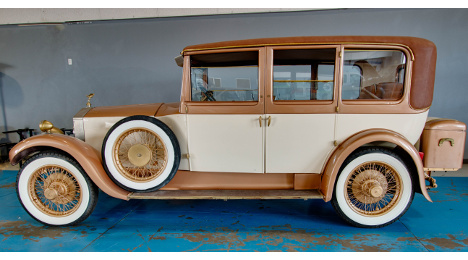
The most expensive car up for sale is a 1928 Rolls-Royce that Anderson said was not in good shape before her father restored it.
“He literally rebuilt it, even down to the upholstery and it’s now a beautiful car,” she added.
Phillips also collected a few old tractors which will be sold at a different auction.
Phillips was shot while serving in World War II and received a Purple Heart medal, Anderson said. He was born and raised on a farm in Idaho and started farming on his own after the war, she said.
“Even at the time that he was at the hospital, I remember visiting and he was still looking for parts for this car that he was working on,” said Anderson. “He was in an acute care center trying to find the parts for this particular car to fit. He wasn’t going to give up.”
At its height, Phillips’ collection reached about 80 cars, according to Anderson.
“His passion was these cars and when he’d get them fixed he’d love to show them off to people,” she added.
“It was his love and just something that he loved to do.”
Click here, for a complete list of the vehicles available for the Aug. 26 sale. Interested buyers can also find pictures of several cars on Dealers Auto Auction of Idaho's Facebook page.
As the company released its second quarter financial statement, KAR Auction Services also announced on Thursday the creation of a new operating segment — KAR Remarketing Services.
KAR Remarketing Services is designed to align the company’s AutoVIN, Dent Demon, High Tech Locksmiths and PAR North America businesses. Picked to serve as president of this new operating division is David Vignes.
“KAR’s goal is to provide a simplified, seamless experience across its end-to-end remarketing platform,” Vignes said. “The alignment of these businesses allows us to deliver the full range of inspection, recovery, reconditioning and repair services both in the lanes and on the road.
“We look forward to building on our successful foundation and expanding our integrated offerings to serve our diverse whole car, salvage and buyer and seller customers,” he continued.
Vignes previously served as KAR’s executive vice president of enterprise optimization, and has been promoted to the role of president, KAR Remarketing Services. In addition to his new responsibilities, Vignes will continue to oversee KAR’s enterprise safety efforts. Vignes also led the development of KAR’s “Safe T. Sam” program, which is available to all National Auto Auction Association (NAAA) members.
As part of this organizational alignment, Lisa Scott has been named president of PAR North America reporting to Vignes. PAR North America is a U.S. provider of vehicle transition services with coast-to-coast solutions for recovery management, skip-tracing, remarketing and title services.
“It’s an exciting time to be part of KAR, and I am thrilled to take the lead at PAR North America,” Scott said. “I worked very closely with our customers at ADESA Canada, and I’ve seen and heard their needs firsthand. I look forward to collaborating with my colleagues to develop the next generation of integrated remarketing solutions.”
Prior to this role, Scott held a variety of positions at ADESA Canada, including senior vice president of sales, marketing and operations, general manager, and, most recently, chief client officer. She has also served on several industry boards, including chair of the Canadian committee of the National Auto Auction Association (NAAA) and co-chair of the Canadian chapter of the International Automotive Remarketers Alliance (IARA).
“Lisa was a visionary leader for ADESA Canada with a strong track record of creating deep customer relationships. Her 25 years of experience, broad understanding of the marketplace, and her passion for our industry will continue to benefit our company and our customers,” Vignes said.
Scott takes the place at the top of PAR North America in place of Jerry Kroshus, who departed the company after nine years to become president and chief executive officer of Auto Approve, a refinance company that specializes in helping consumers find the best possible vehicle interest rates through its national network of credit unions, banks and finance companies.
Top-line quarterly results
In other company news this week, KAR also reported its second quarter financial results for the period that ended June 30.
The company’s total revenue jumped 9 percent year-over-year from $788.5 million to $858.0 million.
However, KAR reported a 7-percent softening in net income, landing at $57.2 million, or $0.41 per diluted share, as compared with net income of $61.8 million, or $0.44 per diluted share, in the second quarter of 2016. Management explained Q2 net income was negatively impacted by $17.3 million, net of tax ($0.13 per diluted share, net of tax) resulting from the company's refinancing activities.
Looking at figures through the first six months of the year, KAR highlighted an 11-percent gain in revenue to $1.7246 billion as net income rose 3 percent to $126.4 million, or $0.91 per diluted share.
“KAR continues to execute well on the fundamentals of our business,” KAR chairman and chief executive officer Jim Hallett said in a statement. “Our second quarter results reflect the level of performance we expect, our ability to generate cash, and the strength of our diversified business model.”
KAR also announced a cash dividend of $0.32 per share on the company’s common stock. The dividend is payable on Oct. 3 to stockholders of record as of the close of business on Sept. 20.
If there is a groundswell of momentum for Bob Wolfsen’s Auto Auction In The Round concept — which has earned a patent from the United States government — auctions could physically look much differently than they do today.
Walk into most auto auctions today and the arena where the sales happen has a familiar appearance: rectangular with long lanes that extend from one side to the other.
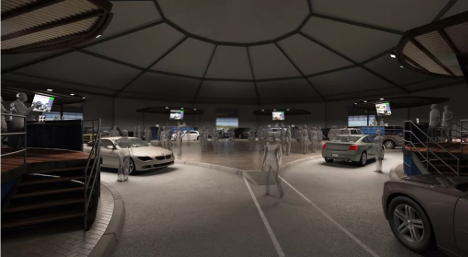
Wolfsen’s design shakes that up, making the arena — as the name would imply — round.
Each selling arena in Wolfsen’s design is a circular pod that includes anywhere from eight to 12 lanes, he said in a recent interview with Auto Remarketing.
The vehicles enter and exit behind each auction block. They come into the pod, go around to the front of the block, going 180 degrees before exiting out behind the block.
To get to the pods, attendees can walk from the office down a “tube” hallway and then select one of the pods to enter, he explained.
The patent was approved on March 23, Auto Auction In The Round is now operational and the official patent number is 9,691,100.
Inspiration for idea
Wolfsen, whose company is based Chandler, Ariz., is the transportation manager at Metro Auto Auction in Phoenix.
Asked what prompted the idea, he said: “It started when I helped put another auction together here in Phoenix — Dealers (Auto Auction of the Southwest),” he said.
Wolfsen and the team there shaped the auction blocks into a V-shape, he said, “so that the dealers could see all the cars at all the blocks from any position.
“I wish I could take credit for that but I can’t,” he said. “But it started me thinking about, ‘How do I close the V to make a circular pattern?’”
But closing the V would result in bunched-up traffic, he said: “It would be six lanes feeding into a three-lane area. So that’s when I started thinking about the circle, and coming in from the outside of the circle, around the front of the blocks, and then back out behind the block.
“And I actually laid it out over there — this was, gosh, almost 14 years ago now — in paper and drawing it out on the floor. It was an empty building. It made sense. So that started the thought process”
The design was based on what dealers had told him over the years.
“And it boils down to, ‘I missed some opportunities. I wish I had the ability to be in that other lane at a point because I really needed that car,’” Wolfsen said. “I hear this more and more. I hear it every week here. On the seller’s side, (they’re) never happy with the lanes. ‘Oh it’s too far away from the door. It’s too close to the end of the building.’
“There’s always a reason. And the third item is that, ‘I’m not happy with my numbers. I want to run in prime time and I want to run in the meat of the sale, and I want to run in 30 to 60,’ or whatever that might be,” he continued. “This addresses all those issues, where the buyer will be in a position where he can bid on any car that comes through the building.
“That’s unheard of in this industry. Where the seller can (choose to) not be concerned about lane preference, because it doesn’t matter anymore. Every car has the same exposure, availability.”
When it comes to “good numbers” to get on sale day, Wolfsen believes the new design can change that as well, based on what he expects will be a shift in the “attendance curve” typical for an auction.
Usually, Wolfsen said, dealers might arrive at the auction, get everything done within an hour or so and then leave.
He argues that the new design, by giving dealers continued exposure to inventory throughout the sale, will entice dealers to stay longer.
Wolfsen also said he believes the design will lead to a significant reduction in accidents, “because we’re taking the majority of the traffic away from them” by moving the vehicles in behind the blocks, circling in the blocks and exiting.
“They won’t have that what I affectionately refer to as ‘running across the freeway’ — cars running north to south, dealers going back and forth, east to west,” he said. “And your liability there is certainly extensive in that type of environment.”
He estimates that new system is likely to cut around 90 percent of situations where someone can be injured
What is next?
As far as what the next steps are, Wolfsen said there are three options he is considering.
One is to sell patent license agreements to other parties to build the facilities, with the stipulation that no others are built in that specific market. It would be protected territory, he said.
Another is to look for financial backers and construct the facilities himself.
Lastly, there is the option to sell the patent outright. Which he does not favor, as he wants to stay involved in the process.
Manheim vice president of industry relations Jay Cadigan is retiring at the end of the month after a 40-year career in the auto industry, the auction company announced Tuesday.
Cadigan has been with Manheim since 1993 and held the VP of industry relations position since 2012, following his time as Manheim’s market vice president for Florida and Puerto Rico; president of sales and operations for the General Motors and Avis Budget Group accounts; and Skyline Auto Exchange’s general manager (the auction is now Manheim NY Metro Skyline)
His career has also included stops at Golden Gate Auto Auction and time with US Fleet Leasing, Avis Car Leasing and Hertz.
“There’s no question Jay has been a driving force at Manheim and within the remarketing industry for some 40 years,” Janet Barnard, president of Cox Automotive Inventory Solutions, said in a news release.
“He’s been instrumental in helping Manheim maintain its leadership position and worked tirelessly to shape the industry,” she said. “We can’t thank Jay enough for all he’s done for our company, our clients and the industry.”
Cadigan was inducted into the National Auto Auction Association’s Hall of Fame in 2015 and is NAAA’s current executive vice president. He serves on its executive committee and board of directors and is a past president of both NAAA and the Eastern Auto Auction Association.
Cadigan earned Ring of Honor recognition from the National Independent Automobile Dealers Association in 2016 and was named the Remarketer of the Year in 2015 at the Conference of Automotive Remarketing.
“Jay’s dedication and commitment to advancing the automotive remarketing profession has been invaluable,” NAAA chief executive Frank Hackett said in a news release. “His leadership encouraged the development of our association members and the organization alike.”
As for his retirement plans, Cadigan has his sights set on golfing, boating, traveling and volunteering, the company said.
“One of my most rewarding career experiences has been watching Manheim and the remarketing industry’s growth and innovation over the years,” said Cadigan. “And, I’ve been fortunate to work alongside some of remarketing’s finest pros, and my years at Manheim are no exception.
“It’s been an amazing journey, and I’ll forever cherish the relationships I’ve forged over the years.”
In the latest installment of the annual
Power 300 issue of Auto Remarketing, we go behind the scenes with some of the leading companies in the used-car space and their top executives with a few Q&A features.
Next up in this series is Patrick Dudash, senior vice president of sales at XLerate Group.
The emailed Q&A is below:
Auto Remarketing: With Pennsylvania just added to your list of markets this year, how much has the recent growth impacted your business, and where might your footprint extend next?
Patrick Dudash: Our growth in both physical and digital footprint over the last three years has opened a number of markets to us, which were previously untapped. Our expanded geographic coverage obviously positions us with additional dealer groups and, in many cases, new institutional consignors. XLerate’s explosive digital growth opens even more markets for us where we do not have a traditional brick-and-mortar or a mobile sale presence.
We will continue to expand both our traditional geographic and digital footprints when the right opportunities present themselves. We will do this while continually focusing on our current core group of 10 auctions that operate 16 different sales, which includes our mobile sales in Texas, Florida and California.
AR: How is your auction adapting to an increasingly digital auction environment?
PD: Culturally, our senior management team now fully embraces the digital environment and the new, incremental opportunities a properly executed digital strategy enables for both our customers and our company. We can now “speak” both digital and brick-and-mortar to our current and potential customers and simultaneously execute well in both environments. To get to this point, we have invested heavily in market-based digital reps as well as in our own, growing digital marketplace.
In 2015, we moved Kelly McAllister from a more traditional auction role supporting our auctions digital process to director of online business development, a role designed to push digital growth at our auctions. To support this, Kelly has developed digital sales representative hiring profiles and compensation plans to assist our physical auctions in finding and hiring candidates to drive online sales volume.
AR: What do you enjoy the most about being in the remarketing industry?
PD: What I enjoy the most about being in the remarketing industry is the ever-changing landscape of consignor volume and the challenges it brings our auctions. On the institutional side, it's the opportunity to promote our auctions’ high-level touch in customer service and operational expertise when volumes are rising. While at the same time, on the dealer side, helping them find the right mix to meet their inventory needs.
We are doing this through our new XL-online Marketplace where we continue to grow consignment and sales for our dealer network, and have a dealer wish list available for us to push the inventory they need.
Additionally, we’ve recently added XLFunding (xlerategroup.com/floorplans), a dealer floor plan service available at all of our physical and mobile auctions. We see this as a key to support our buying dealers’ increased appetite for inventory.
AR: What do you see as the biggest challenge for your company, and what is its primary focus to maintain and/or grow its influence on the automotive industry?
PD: Investment capital is not an issue for XLerate. As we grow, we need to continue to recruit to-notch talent for both the “traditional” auction world as well as the digital/technology spaces — and then meld/integrate both groups of talent into one high-performing, client-centric culture.
As we see the overall economy continue to improve, we also see a correlating fall in unemployment. As we try and grow our business, it becomes more difficult to recruit, hire and retain key employees.
We continue to combat that with a safe and fun work environment, and aggressive and rewarding compensation programs. We also need to make sure that we are aligned with the right technology partners/providers who can facilitate our growth strategy is one of the most critical decisions on the near-term horizon for XLerate. This has to become our primary focus to maintain and/or grow within the automotive industry.
The record-setting streak for the Manheim Used Vehicle Value Index reached three months in a row when Cox Automotive shared the new reading on Monday.
The report indicated wholesale used-vehicle prices (on a mix-, mileage-, and seasonally adjusted basis) increased 0.75 percent month-over-month in July. This rise brought the index reading to 130.3, which was a record high for the third consecutive month and a 2.6-percent increase from a year ago.
The new high mark is more than 30 points above the index’s low point of 98.0 registered in December 2008.
On a year-over-year basis, analysts noticed prices for mid-size cars produced the largest decline in July, softening by 0.9 percent.
Each of the other five vehicle categories analysts track for the index registered price gains, with pickups leading the way at 7.8 percent and vans not far off at 5.5 percent.
Prices for CUV and SUVs along with luxury cars ticked up by nearly similar rates at 1.9 percent and 1.8 percent, respectively. Even compact cars edge slightly higher as prices for those units ticked up 0.2 percent year-over-year.
“Wholesale market values continue to show strength despite concerns that increasing off-lease maturities would result in a used vehicle supply glut and rapidly declining used-car values,” Cox Automotive chief economist Jonathan Smoke said in his commentary associated with the latest index update.
“Instead, used-vehicle sales are growing, driven by double-digit year-over-year growth in sales of vehicles less than 4 years old. Increased demand is absorbing the higher supply of newer vehicles.”
Analysts also mentioned that rental risk pricing improved as volumes dropped.
Cox Automotive determined that the average price for rental risk units sold at auction in July decreased by 2 percent year-over-year in July, which was a significant improvement over June. Rental risk prices were up 3 percent compared to June.
Average mileage for rental risk units in July (at 41,400 miles) was 2 percent below a year ago, according to analysts.
Smoke closed his commentary by emphasizing the U.S. economy “remains strong.”
According to the first estimate from the Bureau of Economic Analysis, the U.S. economy grew 2.6 percent in the second quarter.
“Consumer spending on both durable and nondurable goods drove most of the growth in the second quarter,” Smoke said. “Consumer confidence strengthened to the second-highest level in 16 years in July (only higher month was March).”
MyDealerOnline, whose software lets dealers take wholesale vehicles and places them on the dealership websites, recently announced that Ben Franklin Technology Partners of Southeastern Pennsylvania has invested in the company to bring more exposure to its multi-faceted dealership solution platform.
Executives highlighted the late seed round will make it possible for auctions on MyDealerOnline.com to get more exposure, while individuals will be able to access a wider selection of vehicle at competitive prices through trusted local dealers. The investment makes MyDealerOnline part of Ben Franklin’s portfolio of greater Philadelphia-based high-growth technology companies.
Meanwhile, MyDealerOnline is still offering an opportunity to investors to add to the current round of investment.
“We are pleased to partner with Ben Franklin and their dedication to helping early stage companies,” MyDealerOnline founder and chief executive officer Yury Kaganov said. “Their due diligence and subsequent investment continue to validate MyDealerOnline's business model and value to our marketplace.”
MyDealerOnline’s multi-faceted solution can help dealerships drive sales, increase marketing effectiveness and gain intelligent customer insights by giving them the ability to offer wholesale inventory directly to customers through their current dealership websites. The Inventory-as-a-Service platform does not require additional funds or floor-plan costs typically involved with physical inventory for a dealership. The platform also improves the acquisition process, revenue potential, and customer satisfaction rates with one solution.
For more information about the investment deal, visit this website.
In the latest installment of the annual Power 300 issue of Auto Remarketing, we go behind the scenes with some of the leading companies in the used-car space and their top executives with a few Q&A features.
Next up in this series is John Kett, chief executive officer and president of Insurance Auto Auctions. The emailed Q&A is below:
Auto Remarketing: A lot of talk this year about off-lease and wholesale volume this year. What’s the volume picture looking like on the salvage side of the business?
John Kett: Salvage industry volumes, which have grown at a double-digit rate recently, are driven by a combination of accident frequency and severity of damage. These aggressive growth volumes have been largely driven by rising miles driven, an average older vehicle on the road, increasing driver distractions and higher repair rates, which all result in insurance companies totaling more vehicles versus repairing them.
AR: Good bit of expansion this year for Insurance Auto Auctions. What is driving that need/demand for additional IAA locations?
JK: IAA has maintained a consistent and aggressive growth strategy by expanding or opening over 25 IAA facilities and increasing capacity by over 20 percent since 2016. Our strategy for expansion focuses on where it makes business sense and benefits our vehicle buyers and sellers. In addition, at the same time, we focus on expansion, we focus on the efficiency of our auction model. We know that our customers benefit greatly from innovation that makes the auction platform more efficient. Therefore, we invest heavily in technology that will support the best economic value to the buyer and seller.
AR: I understand that tech-related launches have played a big part of Insurance Auto Auctions’ strategy this year. What are some of those launches you’re particularly proud of?
JK: I’m most proud of how we lead the industry in developing technology to add tremendous value to our customers. We utilize our customers’ feedback and needs to drive the design of our products and services. Recently, we launched two products for our buyers, IAA Fast Search and IAA Enhanced Vehicle Details. Both products are examples of innovation aimed improving the shopping, bidding and buyer experience at IAA. Buyers have told us they want to be able to make fast and informed buying decisions. Both of these products enable buying customers to maximize their search time and more efficiently identify those vehicles on which they may want to bid.
AR: Looking at first-quarter results reported in May, I see that Insurance Auto Auctions’ revenue grew from $269.6 million to $297.4 million for the quarter. What is driving that kind of growth?
JK: We were very pleased with our results. IAA is a strong business and being part of the KAR Auction Services family of companies only strengthens what we deliver to the market today and beyond. Higher total loss volumes and increased vehicles offered for sale were the primary drivers of our double-digit volume growth and revenue growth in the first quarter.