As the 2016 NAAA Convention and National Remarketing Conference comes to fruition, I would like to reflect on some historical perspectives regarding industry conferences.
Over the past 25 years, our conferences proliferated in the early years — NAAA National, NAAA Zone, CARS, NRC, IARA, NIADA, NADA and many other alphabet soup designations.
Of course, the issue became too much traveling, costs and duplication of content, and the industry began to take a tougher stance on the value proposition of each event.
I remember when I was NAAA president, that when I adjusted the association's conference to end with the annual president's event on Friday instead of Saturday — to accommodate members who wanted to be home for personal and religious reasons — I was told that I had changed history and not in a good way.
Now, it completes that event on Thursday night, to allow attendees to be home by Friday to be with their families — and that, again, is a good thing.
We pushed for consolidation as a positive agenda, watching events like CAR and IARA successfully co-exist and reduce costs and pick venues that were centrally located to their attendees.
Finally, after a decade, we have CARS/IARA/NAAA in the first quarter and NRC/NAAA in the last quarter, bringing all aspects of the industry together.
Did we leave a piece out of the equation when we consolidated? I think we did when we simultaneously reduced the number of events and reduced the number of attendees.
Clearly, that decision was made by all the auctions that are members and our partners in the industry, but I think we lost a lot in the transition with regard to intra-company and interpersonal relationships.
I truly believe that at least once a year, that all auction general managers — both chain and independent — and their significant others should convene at the fall event and start developing those old relationships that we had with each other in the past.
I think the next generation of managers will be denied the class of the final event and the camaraderie driven so seamlessly in the Mike Richardson and Darryl Ceccoli days.
That might sound old school, but not everything old school is a bad thing.
Once again, just one man's opinion, and my thanks to Frank Hackett and Bill Zadeits for making this event the success we all knew it could be.
Jerry Hinton, the general manager of ADESA Portland, applauds the auction business for its willingness to adapt, no matter the challenge.
But to be fair, the incoming National Auto Auction Association president has a bit of resiliency of his own.
You see, Hinton and his wife, Dawn, have been busy with their bucket list as “empty-nesters” — and some of those checklist items require an adventurous, if not fearless, spirit.
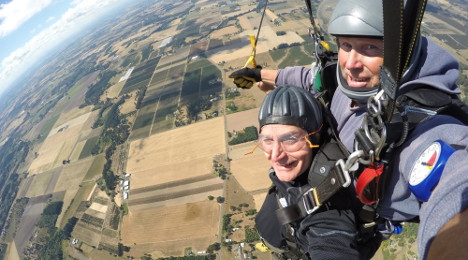
Last year, they went skydiving for the first time and climbed Mount Hood. They scuba dive regularly. As Hinton said, when you have an empty nest, “you become a teenager again.”
But perhaps the best example of fortitude Hinton shared during an October interview with Auto Remarketing began, in fact, during his last year of being a teenager.
After his freshman year at Brigham Young University, the then-19-year-old Hinton served in a mission for his church for two years in Bolivia.
He lived some 14,000 feet above sea level in the Andes Mountains among the Aymara people, speaking not only their language fluently, but also learning Spanish for his once-a-month trips into town.
Living in a mud hut, there was no access to electricity, running water or bathrooms.
It was primitive, Hinton said, but well worth it.
“It was like living in the 1800s,” he said. “You live through something like that, and you can pretty much do anything in life.
“It was very challenging, but very rewarding to be able to give back to the very poorest, most vulnerable folks in South America.”
It wasn’t long after his mission that Hinton earned his finance degree from BYU and made his way into the auction business, joining the Brasher’s organization.
He recently celebrated his 30th anniversary in the industry, and has spent his entire career with the Brasher’s group of auctions that were eventually bought by ADESA earlier this year.
Hinton recalled the conferences of his early auction days.
“Every convention I went to, there was always something looming out there that was a threat to the industry, a threat to the auctions,” he said. “And instead of the auctions just sticking their heads in the sand, the auctions embraced those issues, because inevitably, it was something that the market was asking for.”
The auction industry, Hinton said, has just grown stronger.
And that strength is something Hinton will aim to continue as he takes on the role of NAAA president.
Goals for NAAA
Hinton is no stranger to leadership beyond the walls of ADESA Portland or the auctions he worked at previously.
He just finished his first term as a city counselor in Gresham, Ore. — the state’s fourth-largest city, Hinton said — and will start his second term in January.
Meanwhile, when he’s at the helm of NAAA, Hinton said he wants to continue the safety initiatives started by 2015 president Ellie Johnson and the Auction of Year Award program for community service that 2016 president Mike Browning got started.
Regarding the importance of safety, “there’s no boundaries with that,” he said, “and we really are creating a new standard of duty relative to personal injury. And an auction who is not abiding by some of these best practices, I think, really is putting themselves in jeopardy, legally … it really is a new standard of duty.”
Along those lines, Hinton is aiming to create industry safety awards in the next year.
“That keeps safety on the radar each year,” he said, and gives targets for success metrics like days without injuries and the number of auction employees who are safety certified.
Beyond safety, Hinton wants to further continuing education efforts in the auction community to help them tackle various issues. One in particular that needs attention, Hinton says, is collections at an auction.
“There’s always that element of exposure when a dealer may go upside down or bounce a check,” he said. “How do you protect your security interest?”
Biggest challenges for auction
Asked to share the biggest challenges in the auction industry, Hinton pointed to “constantly evolving” technology, which is of great importance to the industry.
“Most of the services the auctions currently provide, and some that are still being developed, will become faster and more efficient,” he said. “There are so many pinch-points in the marketplace with auctions, but they’re becoming less and less as these technological advances continue and those pinch-points become fewer and fewer.
“However, the core of any auction’s success is the relationships it maintains with its customers,” he said. “That will never change.”
The regulatory environment can certainly be a head-scratcher, and NAAA offers its resources and its partnerships with NADA and NIADA to help dealers stay ahead of the game.
“The auctions are resilient and adaptive and have been able to navigate any regulatory changes without materially sacrificing their performance or levels of service,” he said.
Hinton knows a thing or two about the law, himself.
While working at Brasher’s Sacramento, the organization paid for him to go to law school in the evenings at the McGeorge School of Law at University of the Pacific in Sacramento, something for which Hinton expressed gratitude.
Hinton ended up finishing law school while working in Oregon. And while he never took the bar, he found that “law school’s a great business tool.”
It can help a businessperson navigate the legal process and overcome intimidation that complicated legal issues might bring, he said.
“There are questions that have legal implications on a daily basis. And again, some people can stick their head in the sand and be afraid of the legal process … and not be as aggressive as you could possibly be. But by not being intimidated by the legal system, you can be aggressive and know what your limitations are,” Hinton said. “Relative to the collection issue, it allows you to help mitigate and manage lawsuits that you may or may not have in certain states.”
Of course, the auction business is where his heart is. Asked what he enjoys most about it, Hinton said it’s the people.
“But what I really like is to be able to wear all the different hats. You get to be the manager of people. You get to be the finance guy. You get to be the marketing guy. You get to wear the legal hat. You get to wear all these different hats,” he said. “Of course, you have lots of employees and lots of resources, but you’re navigating these decisions through all these various platforms.”
And he will take it to an even broader scale this year as NAAA president.
Just another adventure to approach with resiliency.
ACV Auctions has announced that Michael Waterman is the company’s new vice president of sales.
Waterman, who began his career managing dealerships, has been part of the auto industry for more than 20 years. He most recently served in product and sales management roles with DealerSocket, Dealertrack and ADESA.
"Michael's success working with dealerships is proven," said ACV chief executive officer George Chamoun. "His background running dealerships, consulting dealers on technology and helping them enhance their wholesale operation is a very unique combination. We are very proud to have Michael lead our sales in dealerships."
Additionally, ACV Auctions said the auto industry veteran brings extensive experience in market development, hiring top sales talent and working with dealerships to strengthen their wholesale process.
"I am very excited to join ACV Auctions, an already proven better way to buy and sell wholesale vehicles," said Waterman. "My objective is to bring ACV Auctions to car dealers throughout the country, with the goal of maximizing their return on wholesale vehicles. ACV Auctions was created with these needs in mind."
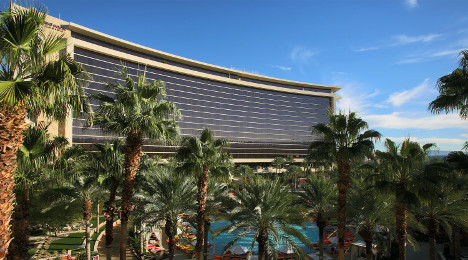
Waterman is expected to join the rest of the ACV executive team, including Chamoun and founder Joe Neiman, at Used Car Week, coming up Nov. 14-18 at Red Rock Resort, Casino and Spa in Las Vegas. Chamoun is scheduled to present during the CPO Forum on Nov. 14 on the benefits of using mobile technology to save time and money.
In September, ACV recruited Chamoun after securing $5 million in venture capital funding to scale the fast-growing company.
Depreciation slowed a bit last week for both cars and trucks.
According to Black Book’s weekly Market Insights report, overall car values (volume weighted) decreased by 0.53 percent, which was lower than the average rate of 0.75 percent seen in the previous four weeks.
Overall trucks values, also volume weighted, decreased by 0.58 percent last week, which was slightly lower than the average depreciation rate of 0.61 percent seen in the previous four weeks.
“Depreciation slowed a little last week after four weeks of steeper declines,” said Black Book’s Anil Goyal. “However, auction reports continue to show spotty demand and higher no-sales.”
A Black Book lane watcher in New Jersey reported that “the market is still good but there were lots of no-sales today.”
And one in Tennessee bemoaned an “above-normal amount of no-sales on several lanes today. Dealers reporting retail sales are still slow on their lots.”
In Pennsylvania, trucks were in highest demand, “especially the ones that were already ‘retail ready.’”
A Black Book rep in Texas reported that the auction was well-attended and prices were stable.
And in Florida, “clean condition cars are getting harder to find,” a rep lamented.
Segment-specific depreciation
Among car segments, prestige luxury cars, subcompact cars and full-size car values declined the most, by 1.03 percent, 0.76 percent and 0.75 percent, respectively. Midsize cars showed the best retention, with values dropping by 0.17 percent.
As for trucks, subcompact crossover/SUVs and subcompact luxury crossovers declined the most, dropping by 1.96 percent and 1.66 percent, respectively. Midsize crossover/SUVs showed the best retention, with values dropping by 0.14 percent.
Overall, depreciation in car segments increased last month, led by compact cars at 3.6 percent.
A retired farmer and auctioneer who is a champion for America’s Wounded Heroes raised $15,706 toward the cause during GAA Classic Cars’ recent three-day sale.
Ivan Stoltzfus is travelling across the U.S. on a 1948 John Deer Model A with the goal of raising $1 million to benefit veterans’ organizations that support physical and mental health as well as family counseling.
Stoltzfus was asked to auctioneer the sale of a small basket of items that kicked off the sale.
GAA Classic Cars wrapped up the 2016 auction year selling more than 60 percent of the 550 vehicles offered, including a 1970 Chevrolet Nova Yenko Deuce and two tribute vehicles from the 1973 film “American Graffiti.”
GAA Classic Cars’ 2017 schedule is set with sales planned for March 2-4, July 28-30 and Nov. 2-4. For more information, send an email to [email protected], call (855) 862-2257 or click here.
Click here to read more about Stoltzfus' journey.
More of the consignment at ADESA has moved toward the commercial side, and that has led to an increase in the revenue that company generates from each unit — whether that car is being sold online or in the auction lane.
That’s according to comments made by Jim Hallett, chief executive officer of parent company KAR Auction Services, during KAR’s third-quarter earnings conference call on Friday.
ADESA pulled in $441.6 million in revenue during Q3, up from $351.4 million a year earlier.
Total revenue per unit was $603, compared to $561 in the third quarter of 2015. Cars in the auction lane generated an average revenue of $758 (up from $699), with online-only revenue per unit climbing from $110 to $127.
Overall volume for ADESA was up 17 percent (6 percent excluding acquisitions). Physical volume climbed 15 percent (1 percent excluding acquisitions) and online-only volume was up 23 percent.
And while dealer consignment was up 10 percent overall, it was actually down 4 percent when acquisitions were excluded.
Dealer consignment’s share went from 52 percent in Q3 2015 to 50 percent in the most recent quarter.
“With the shift in mix to more commercial vehicles, we saw RPU increases both at the physical auctions and in our online-only venues,” Hallett said during the call. “And you may ask, ‘what's contributing to the lower dealer consignment numbers?’ I would say, there are a number of things that I would point to.”
For starters, Hallett said, lease penetration has gone up, so the number of trade-ins dealers take has likely gone down. Dealers are also seeing static retail used-car sales, he added.
“And I would also draw your attention to the comp that we had from the previous year,” Hallett said. “We had a difficult comp, where last year, the volumes were up 10 percent in the third quarter. And, as we talked about previously, we are likely seeing a high number of commercial vehicles displacing some of the dealer consignment vehicles in the lanes.”
That shift Hallett referred to appears to be happening industry wide.
In a July webinar, National Auto Auction Association chief economist Ira Silver explained that dealer consignment may decline, but it won’t be enough to counteract the impact from volume-heavy commercial consignment.
“Those cars are out there,” he said during the webinar, referring to commercial consignment. “They’ve got to come back sooner or later — and they will. And there’s enough of them out there to offset the small decline in dealer consignment that I expect.”
It started with a letter in the mid-1990s.
Now working with 50-plus auctions and various companies in the car business, TPC Management Co. celebrated its 20th anniversary this summer.
“When we opened our doors in 1996 we could not, in our wildest imagination, have conceived of all the companies and projects we would become involved in over this 20-year span,” Pierre Pons, who co-founded the company with his wife, Pauline, said in a news release.
“What began with a letter to the Independent Auto Auctions has blossomed into a dynamic enterprise with relationships to companies in various capacities in the industry. We began handling specific projects for a few auctions around the country, and eventually grew to assuming a role much like the corporate staff handles for auction chains,” he said. “Today we work with over 40 independent auctions on projects ranging from full corporate administration to business development, management recruiting and training.”
TPC’s first client was the Nichols family, which heads the BSC America group that includes the Bel Air and Tallahassee Auto Auctions, among others.
TPC has since expanded, having worked with auctions, law firms, investment firms and companies in the technology, transportation, vehicle inspection and auto finance spaces over the past two decades.
Among the industry tech providers the company has worked with are eBay Motors, Autodaq, Xcira, Auction Edge, OVE and SmartAuction.
Organizational flow
TPC’s business operations fall into three buckets: TPC Management, ServNet Auctions and Auction Academy.
“We handle general consulting and recruiting through TPC Management, and provide administrative management to ServNet Auctions,” said Pauline Pons, co-founder and vice president. “In addition, we are now about to launch our fifth class group of Auction Academy. We founded Auction Academy initially to work with the sons & daughters who represent the next generation of leadership at Independent Auctions, and we later expanded the program to provide training for the entire industry. Auction Academy has been, without question, our most fulfilling endeavor to date.”
R. Charles Nichols, the president of BSC America, said: “As Pierre and Pauline’s very first client 20 years ago, the Nichols family has a long history with TPC. They have worked with our management team utilizing all aspects of their services: TPC Consulting, ServNet and Auction Academy. We value our relationship with them and the efforts TPC has put forth on our behalf.”
Going back to Auction Academy, some of the Missouri Auto Auction's management staff have participated in the Auction Academy program. The auction’s managing partner, Kevin Brown, is the president of ServNet Auctions.
“As I’ve held various board positions with ServNet and now serve as the group’s president, I can attest first hand that Pierre and Pauline Pons, and Penny and Jiles Wanna have demonstrated tremendous leadership in fortifying the structure of ServNet as an organization and in strengthening the ServNet brand within the industry,” Brown said. “As TPC embarks on another term providing administrative management for ServNet Auctions, our group will benefit from the continuity and their expertise.
“As an auction owner I also use TPC for individual auction consulting services to keep me and my staff connected to industry decision-makers.”
Copart has opened its 14th location in California.
Copart Sun Valley is the global online auction company’s sixth location in Southern California.
“Identifying and purchasing land in such a densely populated area such as Los Angeles is a real testament to our team,” said Jay Adair, chief executive officer of Copart. “This location is our sixth location in Southern California and will allow us to better serve our customers.”
Copart Sun Valley hosts online auctions every Wednesday at noon (PST). Online auto auctions are hosted on Copart.com.
As a proud community partner, Copart offers local law enforcement, fire departments and other government agencies a safe training environment. Copart locations have been used by law enforcement agencies as a controlled environment to train K-9s to track narcotics and explosive devices. Local agencies may contact Rick Fiumetto, general manager of Copart Sun Valley, at (818) 771-9389 to learn more about conducting training at that location.
XLerate Group announced on Wednesday the opening of a detail and reconditioning center for its South Carolina location, Charleston Auto Auction.
“Our new detail and reconditioning facility brings exciting new capabilities and supports our continuing growth,” said Laura Taylor, general manager at Charleston Auto Auction. “The detail shop offers a multi-line production process and is outfitted with the most modern equipment.”
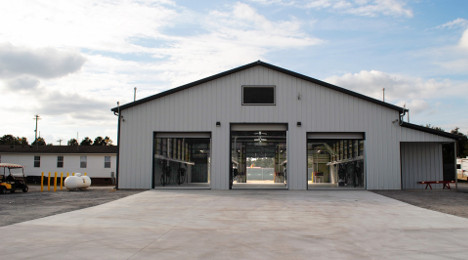
The center is made up of the detail shop that is 6,500 square feet and a 3,000-square-foot building that serves as the housing for Charleston Auto Auction and its partners' fleet and lease operations.
“With the new land and building, we have immediately increased our production capacity and added resources to support our institutional clients generally and these clients’ CPO programs specifically,” said Taylor.
Since acquiring the reconditioning center, Charleston Auto Auction has been able to significantly expand its capabilities to serve both dealer and institutional clientele, according to XLerate chief executive officer Cam Hitchcock.
“For years, Charleston has provided its dealer and institutional clients with exceptional service, despite not having a dedicated reconditioning facility,” said Hitchcock. “XLerate’s expansion of the Charleston facility demonstrates our commitment to invest in our auctions and expand our services to exceed the expectations of our clients.”
Auction Academy, a continuing education program for auto auction professionals developed by TPC Management Company, had a busy third quarter.
The Academy’s Class Group 4 completed the seventh of eight quarterly sessions with a trip to Dallas, where members were hosted by America’s Auto Auction and its chief executive officer, Ben Lange, who led the group on a tour of America’s flagship auction there.
The group also visited the headquarters of Santander/Chrysler Capital, where Brent Huisman and his team gave a review of the remarketing program for the two companies’ portfolios.
Classroom sessions during the Dallas trip also included presentations by Michael Daseke of Liquid Motors; John Poteet, Ph.D, managing partner of Louisiana’s First Choice Auto Auction who discussed his Ph.D Dissertation, Who Owns Your Customer; and Steve Jordan, chief executive officer of NIADA, who discussed the role of trade associations and the impact that independent dealers have on the industry.
The session wrapped up with a tour of Union Pacific’s automotive facility near Dallas by ShipCarsNow.
“I cannot express enough gratitude to the many industry executives who take their time to share their experience and expertise with our Academy groups all over the country,” said Pierre Pons, the chief executive officer of Auction Academy. “For instance, Ben Lange of America’s Auto Auction not only believes in the program enough to have two students in this Class Group, but also shares his own insights with the group and welcomes the class to his Dallas auction on sale day!”
The Class Group 4’s next and final meeting will be Nov. 15-18 during the NAAA/NRC conference as part of Used Car Week at the Red Rock Resort, Spa and Casino in Las Vegas. The event will mark the group’s graduation from Auction Academy.
Registration is now open for Class Group 5 of the two-year program, which will kick off its eight-session program in the spring.
New this year is Auction Academy’s One Day Seminar Series. In late September, Auction Academy held its Fleet/Lease Session in Franklin, Tenn., where 35 attendees from as many Independent Auctions around the country heard presentations and participated in discussions on various aspects of the commercial account business.
Presenting and leading the discussions were Steve Leslie of Cherokee Media Group, Mike Antich of Bobit Business Media, Jeff Roberts of OVE, Brent Ramel of Smart Auction, Joe Miller of AutoIMS, Kevin Wilson of United Auto Recovery and Memphis Auto Auction, Dan Diedrich of Auction Edge and Terry Mollica of Metrogistics.
The session began with a discussion of two case studies on compliance, led by Bob Sullivan of XLerate Auction Group and Joe Lemonds of Carolina Auto Auction.
The final Seminar Series of the year will take place Dec. 5-6 in Nashville and will feature a full-scale compliance session.
“In planning both our two-year program and the shorter focused Seminar Series, we continue to cover topics that are critical to the overall development of leaders in our industry and success of their auctions,” said Randall McCathren, chief operating officer of Auction Academy.
“The enthusiastic participation from all corners of the industry confirms that Auction Academy plays a critical role in the remarketing industry and has raised the bar for career education.”