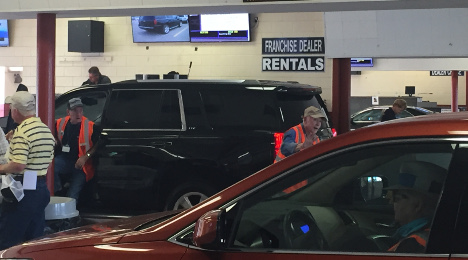
A week after making manager changes at ADESA Orlando and ADESA Los Angeles, the business unit of KAR Auction Services on Monday announced adjustments to its auction management teams at ADESA Colorado Springs and ADESA Austin, effective immediately.
The company said Steve Swanson, previously general manager at ADESA Austin, has been named general manager at ADESA Colorado Springs. Cindy Kuhn, previously general manager at ADESA Colorado Springs, has accepted a position as regional online manager for ADESA.
Swanson had been general manager at ADESA Austin since 2007. He was previously president at AutoVIN, a subsidiary of ADESA. His past experience includes serving as an auction fleet lease manager for a major auction company and as national auction manager for DaimlerChrysler Services.
“Steve has more than 25 years of experience in the remarketing industry and is well-known and well-respected by both employees and customers,” ADESA chief operating officer Paul Lips said. “His expertise in both auction management and in auction technology will be a true asset to ADESA Colorado Springs.”
Kuhn started her ADESA career in 1998 as fleet lease manager for ADESA Lansing. She also held that position at ADESA Kansas City from 2006 to 2011, when she was named general manager of ADESA Colorado Springs.
The company also announced Rich Levene, previously vice president of enterprise optimization for KAR Auction Services, has been named general manager at ADESA Austin.
Levene has more than 20 years of experience in the vehicle remarketing industry, including key management positions at CitiFinancial Auto and HSBC. During his time with KAR, he has served as assistant general manager of ADESA Golden Gate from 2001 to 2005 and as director of operations for PAR North America from 2008 to 2011.
“Rich brings a robust and versatile skill set to the general manager position,” Lips said. “His knowledge and professional experiences will bring valuable benefits to our team and our customers at ADESA Austin, and I look forward to working with him in his new role.”
West Michigan Auto Auction has earned the inaugural 2016 Midwest Auction of the Year Award from the National Auto Auction Association, which is celebrating National Auto Auction Week from Monday through Friday.
The Wayland, Mich.-based auction is one of four auctions from each of NAAA’s membership regions to win the award. Each regional chapter award winner receives $5,000, to be donated at the auction’s discretion.
The NAAA’s National Auction of the Year Award will go to one of those four regional award winners. The auction that earns the national honor will receive an additional $10,000 for its philanthropic efforts. In addition, NAAA’s On the Block magazine will feature a January 2017 cover story about the auction and its charitable efforts.
The auction will also be on the cover of the 2017 NAAA Member Directory. The National Auction of the Year winner will be announced on Nov. 17, during the Presidential Gala at the NAAA Convention/National Remarketing Conference.
NAAA Midwest Chapter President Jason Cotton said West Michigan Auto Auction’s efforts have helped so many people and have been an inspiration to many. He said he felt honored to be able to announce them as the award winner during National Auto Auction Week.
“West Michigan Auto Auction stands out for their efforts, and we are pleased they will represent the Midwest Chapter for the inaugural Midwest Auction of the Year Award,” said Cotton, Dyer Auto Auction Vice President of Business Development. “Everyone from the Midwest Chapter wishes them well.”
“We want to congratulate West Michigan Auto Auction and thank those involved at the auction who consistently give unselfishly of their time, effort, and money to so many wonderful community service organizations,” said NAAA President Mike Browning, who added that he is pleased to be president during the creation of this new award.
WMAA engages in numerous charitable and community service activities, a highlight of which was an employee who befriended a dealer client and later donated a kidney to the man.
Other efforts include raising $42,000 for the family of a Michigan auction worker who died in a car accident and each year holding a memorial ride for his family’s continued support. WMAA raised $12,000 for a dealer client whose wife contracted terminal cancer, and the amount raised was matched by the auction. Numerous vehicle repairs for financially challenged individuals in the community also have been made. Other efforts include charity golf sponsorships, food pantry collections, and raising $3,000 for a nonprofit that donates water filtration systems to countries where people don’t have access to clean water.
For the past eight years, WMAA has donated $100 for each vehicle sold in a special lane for "Rights for Kids," a service organization that provides underprivileged children with a safe environment and opportunities to develop for future success.
NAAA chief executive officer Frank Hackett said this award is designed to not only honor the efforts of NAAA members, but to boost awareness of the many worthy causes that auctions around the country support.
“I’m continually pleased to see the efforts our member auctions take to support their local community’s charities and service organizations,” Hackett said. “If we can play a small role in helping them help others, it’s a very good result.”
ADESA Winnipeg has earned the inaugural 2016 Eastern Auction of the Year Award from the National Auto Auction Association, which is celebrating National Auto Auction Week from Monday through Friday.
ADESA Winnipeg — located in Winnipeg, Manitoba — is one of four auctions from each of NAAA’s membership regions to win the award, which honors excellence in community service. Each regional chapter award winner will receive $5,000 to be donated to the charity or charities of its choice.
The NAAA’s National Auction of the Year Award will go to one of these four regional award winners. The national honoree will receive an additional $10,000 to be donated at the auction's discretion. In addition, NAAA’s On the Block magazine will feature a January 2017 cover story about the auction and its charitable efforts.
The auction will also be on the cover of the 2017 NAAA Member Directory. The National Auction of the Year winner will be announced on Nov. 17, during the Presidential Gala at the NAAA Convention/National Remarketing Conference.
NAAA Eastern Chapter president Charles Nichols said the award for ADESA Winnipeg is truly an honor, as it came by way of a vote from the auction’s peers. He said it was his pleasure to announce the award during National Auto Auction Week.
“ADESA Winnipeg displayed the kind of dedication and support to the community and its employees that make us proud to be members of this industry and this outstanding association,” said Nichols, president of the BSCAmerica Auction Group.
“We want to congratulate ADESA Winnipeg and thank those involved at the auction who consistently give unselfishly of their time, effort and money to so many wonderful community service organizations,” said NAAA president Mike Browning, who added he was pleased to be president during the creation of this award.
ADESA Winnipeg engages in myriad community service and charitable activities, on all levels. In 2011 for instance, ADESA Winnipeg’s 24th annual Golden Gavel Golf Classic and Charity Auction raised $250,000 for Variety, the Children’s Charity of Manitoba, the most money raised in a single day — worldwide — in the charity’s history. The auction also sponsors Variety’s Bids for Kids Charity Auctions, where donated vehicles are auctioned off and the proceeds help improve the lives of Manitoba’s children.
ADESA Winnipeg employees have donated their time and raised more than $3 million in the past year for such organizations as Ducks Unlimited, the Dream Factory, Juvenile Diabetes Research Foundation, the Amyotrophic Lateral Sclerosis (Lou Gehrig’s Disease) Association, the Crohn’s & Colitis Foundation of America and United Way, as well as local charitable organizations.
From January through June, the auction supported 31 charity events for causes such as a health science center, a clinic, Ronald McDonald houses, the local symphony, cancer care, the local ballet, Special Olympics, the Make-A-Wish foundation, freshwater fisheries, a veterans’ organization and a children’s hospital.
NAAA chief executive officer Frank Hackett said this award is designed to not only honor the efforts of NAAA members, but to boost awareness of the many worthy causes that auctions around the country support.
“I’m continually pleased to see the efforts our member auctions take to support their local community’s charities and service organizations,” Hackett said. “If we can play a small role in helping them help others, it’s a very good result.”
Auction sales volume has declined on a sequential basis in each of the last four months, but year-to-date it’s up 6 percent, according to NADA Used Car Guide.
The four-week period ending July 25 showed auction sales volume (of units up to 8 years old) down by more than 4 percent from the prior period, the company said in its latest Guidelines report.
However, with 2.66 million units sold, year-to-date volume is ahead by 6 percent.
The year-to-date increase in late-model volume (vehicles 3 years old or younger) is even more pronounced at 9 percent.
So far this year, there have been 1.55 million late-model units sold at auction, NADA UCG said. The biggest story in that crop of vehicles is the large pickup, whose late-model volume is up 33 percent.
Late-model compact utility volume has increased 30 percent, with midsize utility and luxury compact utility (both up 29 percent) not far behind. On the opposite end of the late-model spectrum, luxury large car volume is down 29 percent, with large car volume off 27 percent.
Volume slowing a good thing?
In its Blue Book Market Report released at the end of the second quarter, Kelley Blue Book reports a slowdown from the lease-return-spurred record auction volume in the first quarter.
And it might not be a bad thing.
KBB suggests this could “help stabilize values and prevent market oversaturation.”
Of course, the analysis says, auction volume is still ahead of recent years.
“However, we have not seen a faster-than-usual decline in values in the second quarter, contrary to expectations. In fact, the overall average decline in auction values in the second quarter of 2016 has matched the same pace as it did during the same period last year,” KBB said in the analysis. “This could indicate that manufacturers and rental companies are choosing to hold on to inventory, rather than oversaturate the market and risk a drop in vehicle values.”
GM Financial’s approach
To a degree, this saturation was addressed in a special presentation in June by GM Financial chief financial officer Chris Choate.
He emphasized that GM Financial and the parent automaker have plans in place not only to handle off-lease volume but also establish residual values that do not place undue risk on the finance company.
“GM’s actions to predict residual values include, and this has been much discussed over the last several months and quarters, the managing of fleet sales, actively managing new vehicle inventory and maintaining disciplined incentive spending. All of those have a downstream impact on residual values that GMF has to wrestle with as vehicles come off-lease,” Choate said during his prepared presentation.
“GMF has developed a robust end-of-term remarketing process,” he continued, referencing endeavors such as its private label online wholesale marketplace at GMFDealerSource.com. “It’s designed to support the GM dealer base while also maximizing resale values.
“The more vehicles that we can dispose higher up the food chain to GM dealers either at a local, regional or even national level, keeps those vehicles out of the wholesale auction markets where they will bring less value and, therefore, have a detrimental effect on residual value.”
Staff Writer Nick Zulovich contributed to this report.
Manheim has named Denis Nazarenkov to general manager of Manheim San Diego.
Nazarenkov, who has been with Manheim for a decade, most recently led people strategies for several Cox Automotive brands including DealShield, Ready Logistics, and Manheim Retail Solutions and Inspections.
“The general manager role is a natural fit for Denis because of his exceptional background as a creative and strategic leader and his accessible coaching style,” said Barry Roop, Manheim’s regional VP of the local West. “The ease with which he manages change and inspires employee engagement has Denis poised for strong results on the San Diego team.”
Nazarenkov joined Manheim in 2006 and has held various management roles within human resources. He was responsible for human resource operations and strategy for all Manheim North America locations, which includes more than 24 direct reports leading 6,000 Human Resource team members.
Nazarenkov received a bachelor’s degree in legal studies and a master’s degree in public administration from National University.
As the direct-to-consumer and peer-to-peer side of online car-buying moves into high gear, so too does the dealer segment of e-commerce.
And count Asbury Automotive Group, one of the nation’s largest and publicly traded dealer groups, among those.
Asbury has been offering 100-percent online car-buying at select stores through an e-commerce solution from San Francisco-based Drive Motors, though doing so relatively quietly.
The startup provides dealers with software that facilitates direct-to-consumer sales on the dealership’s website. With this white-label solution, the customer goes to dealer website to buy. Dealers are charged a monthly fee to use the software.
“The industry is changing, and I think it’s changing for the good. Similar to when we didn’t post car prices online 10-15 years ago, and now obviously it’s common standard … if you don’t do it, you get left behind,” Asbury director of marketing Miran Maric told Auto Remarketing earlier this month.
“When we look at it, it’s mainly about respecting the customer and the amount of information that they want and what they need,” he said.
Drive Motors was started about a year-and-a-half ago, says its chief executive officer, Aaron Krane. The online car-buying service has been available for about six months, he said.
Krane said he wanted to take the “opposite approach” to what's commonly referred to as disrupting the standard auto dealer-based car sale.
“And I decided I’m going to build a technology company that’s in Silicon Valley, but we’re going to work with the dealership,” Krane said in a phone interview this month. “We’re going to make them our primary customers. And we’re going to give them the ability to offer the solution to consumers.”
He said he has researched and watched other endeavors in this space and came to this conclusion: “If you would like to solve this problem for consumers, you must empower dealerships to do it.”
Krane added: “Because dealerships, they have a regulatory control on the market. Furthermore, they’re incredibly valuable as customer service centers and as showrooms and as, well, all of the functions they provide.”
As Krane explained it, the process appears fairly straightforward. The shopper finds the car on the dealer’s website and has the option to buy online. If he or she selects that option, there is an online check-out process that comes across from the right side of the page, keeping the customer on the dealer’s site.
That check-out process includes the option for add-ons, trade-in and the desking/finance portion. The delivery of the vehicle is up to the dealership. Dealers have the option to require in-store pickup, but Drive Motors recommends delivery.
Delivery mileage is also up to the dealership.
The service is available for both new and used vehicles.
“People will buy used cars with online checkout just as readily as new cars,” Krane said.
He declined to reveal the number of dealerships Drive Motors is working with but noted that more than 30 brands are represented and that it’s across the U.S. on “tens and tens of thousands” of vehicles.
Of course, one of those utilizing the platform is Asbury.
Maric, the Asbury marketing director, said the process for his group started six to seven months ago when he began discussing the project with Krane.
The group quietly launched it at three stores to test the platform out. Asbury wanted to gauge the impact before putting any marketing behind it
Maric said that typically, combined traffic for all of Asbury’s dealership websites is around 2 million unique visits per month, so the group picked high-volume traffic stores for the tests.
The group wanted “to see if consumers would even go down this route.”
Initial results were positive, so the group conducted some A/B testing and utilized some SEO/SEM tests.
“Our hypothesis was correct,” Maric said. “We were able to prove out that they would.” That is, go down the route of buying a car completely online.
Asbury started expanding the 100-percent online car-buying to other stores, and Maric said the group has at least one store using the Drive Motors platform in all but one of the states in which they operate.
A larger rollout is planned, he said.
Of course, it is still on a relatively small scale. In July, Asbury sold just under 75 vehicles entirely online through the Drive Motors platform.
But, Maric said, the numbers are likely much higher for folks who perhaps used the online platform for part, but not all, of the buying process (which, by the way, consumers can do).
And keep in mind, Asbury hasn't been chatty (publicly, at least) about this program, Maric said. There hasn’t been a marketing push.
As for delivery, Maric said it’s different from store to store within Asbury.
Most of Asbury’s stores in major metropolitan areas keep the mileage limit to 100, but that is flexible/negotiable at each store.
So, what is the next step in this process for Asbury?
“As the states and as the lenders — and as the OEMs — get more comfortable with signing documentations 100 percent online, I think the next relevant step that we’ve talked about with Aaron (Krane) and some of his teammates is really including docu-sign and some of the additional items in place that we might be prohibited by maybe a certain law in a state or a lender or whatever it is,” Maric said.
“That’s slowly changing now because the OEMs are now really starting to push a lot of the e-contracting, if you will,” he said. “So, you’ll start to see more of that and you’ll start to see us expand into, for the most part, all of our markets.”
If dealers aren’t already looking through the rental-risk unit run sheet at the auctions where they typically buy inventory, perhaps they should be — considering what might be crossing the block nowadays.
“It’s interesting as we note the typical rental-risk unit comprises a much more diverse mix of models, makes and colors than there used to be in the past. That’s good,” Cox Automotive chief economist Tom Webb said. “There are a lot of different options for a dealer when looking at the off-rental units. They can probably buy something that their customer wants.
“The rental fleet is much more diverse. Certainly, it’s skewed to the car side, but a lot of small crossovers because the rental car companies are doing a good job of remarketing them. You’ve got those specialty high-line rental units now, which is also a good thing,” Webb continued.
“Even with the models, the rental car companies do a much better job of contenting the vehicle like a traditional retail unit as opposed to in the past where you could say ‘that’s a rental unit’ because it’s got crank windows or something. Those days are past. There used to be a time where all those were painted white, which was not good either for residual values. It’s a much nicer spectrum of vehicles,” he went on to say.
A year ago when Auto Remarketing compiled its annual report about the off-rental market, Manheim noticed mileage for these units at an all-time high. A streak of four consecutive quarters for mileage increases left the average well above 50,000 miles, more than double the figure Manheim spotted in early 2007.
“The average mileage now is more in tune with what we’ve seen since this recovery started,” said Webb, who put the average at the midpoint of this year at about 38,500 miles. “It’s more like the 2009 through 2014 time period.
“A lot of that was caused by Hertz, primarily the second quarter of 2015, where it hit record highs. They were going through a lot of management changes and they had issues with SEC filings so they just kept their units longer,” Webb added.
Over at KAR Auction Services, executive vice president and chief economist of ADESA Analytical Services Tom Kontos isn’t seeing as much of an average mileage drop-off. Kontos indicated the average mileage for rental-risk units going down the lanes at ADESA is still near 50,000.
“That’s the data I get from our auctions. Maybe more broadly, the trend isn’t quite so high. But at least the units we’re selling at ADESA, we’re seeing pretty high mileage,” Kontos said.
Still, Kontos agreed that off-rental vehicles are a hit with dealers, especially if they can obtain highly coveted program units during closed factory sales.
“The consistency of those (program) vehicles is what it’s always been,” Kontos said. “If they’re not already in good condition, the manufacturers do what they can to recondition them. Those units are always some of the better cars available to dealers at auction.
“The demand and attractiveness of off-rental vehicles is probably better than it already was because it was already pretty good,” Kontos continued. “The rental-risk units have been attractive to franchise dealers because they’re in the younger age category — a current or 1-year-old model.
“What I would add that’s different today is the popularity of certified pre-owned vehicles, where the off-rental unit does lend itself to very well,” he went on to say.
ABC St. Louis general manager Todd Ritter concurred with Kontos’ assertion about the connection of CPO and off-rental vehicles bringing out the hammer at his auction each week.
“I think dealers have always used rentals to fill spots on their lots. With the growth of CPO, we definitely have seen an increase in demand for these vehicles,” Ritter said.
Rising off-rental supply
Both Webb and Kontos pointed out supply of off-rental units in the wholesale market is on the rise simply because rental car company fleets are growing.
“Since the recession ended, new vehicles into the rental fleets have gone up,” Kontos said. “Now it’s not been disproportionate to the growth in new-vehicle sales in general, so it’s not as if manufacturers have been favoring rental sales to the degree they might have before the recession.
“The fact of the matter is there has been growth of new vehicles into the rental fleet, and therefore you would expect growth — and there has been — in off-rental volume over the last few years at auction,” he continued.
And like Webb mentioned, the diversity of rental-risk volume has expanded. No longer are the rental lanes full of domestic, four-door sedans painted white with not many features beyond an engine and transmission.
“The actual volumes are spread across a wider array of manufacturers than there used to be in the past where it was traditionally GM, Ford and Chrysler. Actually GM, Ford and Chrysler’s share of sales into rental is now less than it’s ever been,” Webb said.
“The sales into rental are actually front-loaded into the first part of the year so we’re up about 6.7 percent year-to-date through July,” he continued.
“The interesting thing this year that has gotten a lot of press is General Motors has pulled back very dramatically from new-vehicle sales into rental this year whereas some players have increased,” Webb went on to say.
And while GM might be delivering fewer units to rental companies, what the automaker is doing in the remarketing department is disciplined, too. ABC St. Louis runs hundreds of GM units down its lanes each week.
“Our major rental account (GM) has a standard risk turn-in policy, so they have stayed fairly consistent,” Ritter said.
Like dealers, executive vice president and chief economist of ADESA Analytical Services Tom Kontos is grappling with the challenge of stop-sales, too.
According to ADESA Analytical Services’ monthly analysis of wholesale used vehicle prices by vehicle model class, wholesale used vehicle prices in July averaged $10,362 — down 2.0 percent compared to June but up 4.9 percent relative to July of last year. Kontos explained the year-over-year rise was again due to the strength of truck prices, whereas car prices fell on an annual basis. Most segments experienced seasonal month-over-month declines.
“Average wholesale values fell again seasonally in July, but they remain up on a year-over-year basis largely because of the continued price strength of trucks and continued growth of younger, lower-mileage, higher-priced off-lease supply,” Kontos said in his latest Kontos Kommentary that accompanied the latest wholesale price analysis from KAR Auction Services.
“Recalls also played a role in the overall positive price performance, so it is not clear how wholesale prices might have fared absent the supply curtailments stop-sales caused,” Kontos continued. “Nevertheless, retail used vehicle sales — especially near-record CPO sales — remain strong, providing demand-side support for wholesale values.”
ADESA indicated average wholesale prices for used vehicles remarketed by manufacturers moved higher by 0.6 percent month-over-month and 10.2 percent year-over-year. Kontos noted automakers sold almost 20 percent fewer units this year than they did last July.
“Recalls are playing a major role in this reduction, as vehicles are ‘stop-saled,’ awaiting parts and/or OKs from manufacturers for sale,” he added.
ADESA also noted prices for fleet/lease consignors softened by 2.5 percent sequentially but rose 3.1 percent annually, as these consignors sell “more younger, lower-mileage off-lease units than they did last year,” according to Kontos.
Furthermore, Kontos pointed out dealer consignors registered a 1.1-percent decrease versus June, but a 5.3-percent increase relative to July of last year.
And as he referenced earlier, Kontos recapped that July certified pre-owned sales were up 4.8 percent month-over-month and up 5.6 percent year-over-year, according to figures from Autodata Corp. that Auto Remarketing also highlighted here.
Kontos provided a video commentary as well that can be seen at the top of this page or by going here.
ADESA Wholesale Used-Vehicle Price Trends
| |
Average |
Price |
($/Unit) |
Latest |
Month Versus |
| |
July 2016 |
June 2016 |
July 2015 |
Prior Month |
Prior Year |
| |
|
|
|
|
|
| Total All Vehicles |
$10,362 |
$10,571 |
$9,876 |
-2.0% |
4.9% |
| |
|
|
|
|
|
| Total Cars |
$8,326 |
$8,562 |
$8,511 |
-2.8% |
-2.2% |
| Compact Car |
$6,325 |
$6,465 |
$6,928 |
-2.2% |
-8.7% |
| Midsize Car |
$7,520 |
$7,658 |
$7,501 |
-1.8% |
0.3% |
| Full-size Car |
$6,984 |
$7,367 |
$7,852 |
-5.2% |
-11.1% |
| Luxury Car |
$12,844 |
$13,078 |
$12,575 |
-1.8% |
2.1% |
| Sporty Car |
$13,653 |
$14,274 |
$12,852 |
-4.3% |
6.2% |
| |
|
|
|
|
|
| Total Trucks |
$12,447 |
$12,595 |
$11,414 |
-1.2% |
9.1% |
| Minivan |
$7,728 |
$7,830 |
$6,793 |
-1.3% |
13.8% |
| Full-size Van |
$12,823 |
$12,500 |
$12,611 |
2.6% |
1.7% |
| Compact SUV/CUV |
$10,725 |
$10,882 |
$10,219 |
-1.4% |
5.0% |
| Midsize SUV/CUV |
$11,054 |
$11,118 |
$9,868 |
-0.6% |
12.0% |
| Full-size SUV/CUV |
$12,828 |
$13,657 |
$11,483 |
-5.9% |
11.9% |
| Luxury SUV/CUV |
$18,449 |
$18,842 |
$17,189 |
-2.1% |
7.3% |
| Compact Pickup |
$8,727 |
$8,718 |
$7,938 |
0.1% |
9.9% |
| Full-size Pickup |
$15,855 |
$15,836 |
$14,728 |
0.1% |
7.6% |
Source: ADESA Analytical Services. June revised.
Record auction sales volumes are expected this year (9.7 million units) and next (10 million) thanks to continued gains in commercial consignment, according to National Auto Auction Association chief economist Ira Silver.
In a July webinar, Silver explained that unlike dealer consignment — a metric that more immediately reflects the new-car environment, which has slowed — commercial consignment growth is still moving higher.
It tends to follow new-vehicle sales trends from prior years — which, in this case, were stronger.
Dealer consignment may decline, Silver said, but it won’t be enough to counteract the impact from volume-heavy commercial consignment.
“Those cars are out there,” he said during the webinar, referring to commercial consignment. “They’ve got to come back sooner or later — and they will. And there’s enough of them out there to offset the small decline in dealer consignment that I expect.”
This is exemplified fairly well, appropriately enough, right in the middle of the U.S.
At Missouri Auto Auction, general manager and co-owner Kevin Brown says commercial volume is up, while dealer volume is somewhat flat in the Columbia, Mo., lanes.
Off-lease cars are coming back, he said. So are off-rental units from Avis Budget Group. Volume from commercial accounts like ARI are up.
And that’s a good thing for an auction. More cars, more opportunity for business.
But it also underscores some important reminders, said Brown, who is also president of the ServNet independent auction group.
“The big hurdle right now is just making sure you're staying up on the compliance. It’s really, really important to our commercial accounts — the compliance side of it — and we’re just one leg of that compliance,” Brown said. “So, with the CFPB dictating how the financial companies have to do everything — which I’m not saying is wrong — they rely on the auctions to make sure that’s happening, as well.
“You take a redemption, for example. Let’s say you have a repossessed vehicle. And they’re letting the auctions and the repossessors be part of that process. And we have to make sure that we do a great job for that financial institution,” he said. “ … if we’re not treating their customer with respect and handling them the way they should be handled, and there are complaints, it’s going to be a problem not only for the auction, but it’s going to be a problem for that financial institution, as well.
“So that is one hurdle that everybody needs to stay up on … You’ve just got to make sure that you’re doing everything you can to protect that financial institution and the person that is financing the car. That’s really what it’s all about,” he said.
This message of compliance has also been a consistent part of ServNet’s efforts as an organization, Brown said. He pointed to ServNet chair Patty Stanley as a “big, big advocate of compliance” who has dug deep into researching the issues to help the group’s members stay compliant.
For more on this issue, see Auto Remarketing's recent story on how auctions navigate the complex world of compliance.
It was the same story, different week for vehicle values — sort of.
“Last week, the depreciation rate on car segments accelerated to the highest level in the year, while truck segments, including pickups and SUVs, continue to show strength,” Anil Goyal, senior vice president of automotive valuation and analytics for Black Book, said in the most recent Market Insights report.
Volume weighted, overall car segment prices (model years 2008-2014) decreased by 0.62 percent last week, slightly higher than the average depreciation rate of 0.44 percent seen in the previous four weeks. For the segment as a whole, vehicle values were down an average of $71.
Midsize car, near-luxury car and prestige luxury car segments declined the most, by 0.74 percent, 0.92 percent and 0.93 percent, respectively.
Meanwhile, volume-weighted, overall truck segment values decreased by 0.29 percent last week, similar to the average depreciation rate of 0.32 percent seen in the previous four weeks. For the segment as a whole, vehicles values were down an average of $47.
Compact van and subcompact crossover segments declined the most, by 1.36 percent and 1.12 percent, respectively.
Representatives from Black Book go out into the auction lanes throughout the U.S. each week. Below are some of their most recent observations:
“The market trend at this location is slow, but full-size trucks are still in demand,” said a lane watcher in Tennessee. “Dealers state that the slow retail business is due to the heat.”
Heat did not seem to be an issue in Nevada, where a watcher noted that “buyers were aggressive today, with many dealers buying to fill slots in their inventory.”
Late-summer vacations appear to have played a role in Pennsylvania, where Black Book personnel noted: “There was a slight slowdown in retail last week due to vacations before school started back, but dealers were buying well today.”
Elsewhere in the Keystone State: “Slow sale today per several dealers.”
Meanwhile, a Black Book rep in Texas noted: “A fairly steady auction today but many no-sales.”
Finally, in Michigan, “Retail is a bit soft here, but bidding has been very active just the same.”
What happened in July
According to Black Book data, the average price of a used vehicle for model years 2011-2015 depreciated by 1.5 percent in July, slightly better than June’s 1.7 percent and similar to monthly depreciation rates seen in the past three Julys: 1.4 percent in 2015, 2.1 percent in 2014 and 1.3 percent in 2013.
Vehicles in July averaged a 12-month depreciation change of 15.4 percent, the same as June and at the lower end of the range seen prior to the recession, Black Book said. Across all segments, the average vehicle price at the end of July was $15,893, down from $18,784 a year ago.
Cars overall depreciated by 1.9 percent in July. Car prices finished the month at an average of $12,677, down from $15,487 a year ago.
Trucks, meanwhile, finished at 1.2 percent for July. Truck prices finished the month at an average of $20,121, down from $23,119 a year ago.
Luxury cars saw the highest depreciation in July at 2.5 percent, finishing the month with an average price of $22,883, down from last year’s $29,251.
In addition to luxury cars, five other segments saw an increase in depreciation by 2.0 percent or greater in July: compact luxury cars (2.3 percent), midsize cars (2.2 percent), prestige luxury cars (2.1 percent), subcompact cars (2.1 percent) and full-size cars (2.0 percent).
Full-size crossovers saw the strongest retention during July at 0.5 percent, finishing the month with an average price of $28,739, down from last year’s $31,780.
Full-size vans (0.7 percent) were the only other segment with a depreciation rate of less than 1.0 percent on the month.
“Although we saw depreciation trends last month that was consistent with typical seasonal valuation patterns this month, many segments showed slightly better retention heading into the deeper summer months,” Goyal said. “Depreciation for all segments will likely worsen as fall nears and demand for certain segments continues to dwindle.”