While wholesale prices seem to be moving at a “normal rate,” Black Book representatives in the lanes this past week noticed dealers didn’t come to auction as much as summertime heat became entrenched from coast to coast.
This week’s Black Book Market Insights report relayed the sentiment from Missouri that indicated, “Consignment and attendance were both below normal at this week’s auction.”
A similar scene unfolded in Arizona as Black Book mentioned, “Attendance was low today but the market seems steady. Also, rental cars did very well today.”
In Tennessee, the story went like this: “The market is still good here, but buyers say sales are down a little compared to previous weeks.”
Up in Washington, Black Book’s lane watcher added, “Prices were down on most units today with pickups still in fair demand.”
And with the last full week of July straight ahead, what Black Book found in Texas might be an indication of what’s going to happen as August approaches.
“The market trend was much better this week, but many are saying they expect more and more no-sales in the upcoming weeks,” the Lone Star State representative said.
Moving along to the data segment of Black Book’s latest report, editors said car and truck segments depreciated at nearly the same percentage this past week. Also, they pointed out that cars saw heavier depreciation at the same time last year, while the opposite was noticed for trucks.
“The used-vehicle values continue to depreciate at a normal rate at this time of the year, with truck segments continuing to perform better than car segments,” said Anil Goyal, Black Book’s senior vice president of automotive valuation and analytics.
Volume-weighted, Black Book indicated overall car values decreased 0.39 percent last week. For comparison, last year the overall depreciation rate was 0.43 percent.
The compact car segment checked in with the highest weekly depreciation rate at 0.69 percent. The luxury segment declined 0.52 percent, followed closely by sub-compact and mid-size segments at 0.46 percent.
On the truck side, overall volume-weighted values decreased 0.37 percent last week. A year ago, the overall truck depreciation rate came in at 0.34 percent.
Editors noted the compact luxury and full-size luxury CXU/SUV segments posted the highest weekly depreciation rates at 0.96 percent and 0.92 percent, respectively. Black Book added this movement also was the highest weekly decline this year for these segments.
Aside from surging numbers from 2016 model-year vehicles, auction sales volumes slowed in June, according to the latest Guidelines report from NADA Used Car Guide.
But year-to-date volume is still on the rise, particularly for late-model vehicles.
NADA Used Car Guide data indicates that there have been 2.29 million auction sales of vehicles up to 8 years old through six months of 2016. That beats year-ago figures by 5 percent.
There have been 1.34 million late-model vehicles (3 years old or younger) sold at auction this year, which is up 9 percent year-over-year.
Put differently, late-model vehicles represented more than 58 percent of auction sales volume in the first half.
One slice of the late-model segment — 2016 vehicles — were particularly strong in June.
This was the only segment to see an increase in auction sales volumes (up 30 percent) for the four weeks ending June 27, NADA Used Car Guide said.
However, overall auction sales volume was down 6 percent.
Year-to-date, the 2013 model-year class has seen the greatest increase (27 percent) with 509,000 cars being sold at auction. This is no surprise, NADA Used Car Guide said, with off-lease gains as high as they are.
Segment-wise, large pickups were the biggest story in the first half of the year. Their auction sales volume climbed 34 percent, more than any other segment, NADA Used Car Guide said.
Copart announced the expansion of its location in China Grove, N.C., one of three locations in the state.
“This expansion provides additional land and accommodations for more inventory,” Jay Adair, chief executive officer of Copart, said in a news release. “We are proud of our team’s dedication to providing an unmatched experience for our members as we expand this location.”
The China Grove location, at 1081 Recovery Road, hosts online auctions at 10 a.m. ET Mondays. The community is welcome to preview the inventory in person from 8 a.m. to 5 p.m. Monday through Friday. Copart's inventory includes a wide selection of cars, trucks, motorcycles, RVs, ATVs and more.
Elsewhere in North Carolina, Copart’s location at 310 Copart Road in Dunn hosts online auctions at 10 a.m. ET Tuesdays. Its Mebane location at 1879 U.S. Highway 70 hosts online auctions at 10 a.m. ET Wednesdays.
Copart highlighted that it has been a proud partner to the North Carolina community for nearly two decades. The company recently sponsored the 72nd annual Automotive Recyclers Association Convention in Charlotte, raising $8,500 for the Automotive Recyclers Association Scholarship Fund.
Copart links sellers to more than 750,000 members across the globe using its patented VB3 technology and multi-channel online platform. Members can participate in multiple auctions around the world simultaneously via mobile phone, tablet and desktop.
NADA Used Car Guide reports that its seasonally adjusted used-vehicle price index at the midyear mark was 3.7 percent below last year’s six-month average.
And the rate of depreciation is increasing: Used-vehicle prices were 12 percent lower through June relative to all of last year. In the same period last year, that figure was 9 percent lower than full-year 2014. .
According to the latest Guidelines report, subcompact car prices fell the most through June, down by an average of 19 percent. Compact car depreciation reached 15 percent; midsize and large cars were down by just over 13 percent. Trucks and utilities saw milder declines: large pickups were down less than 7 percent, while large utility and midsize pickups prices were down by 5.5 percent.
Depreciation across luxury segments ranged from 11.4 percent for luxury large utilities to just below 15 percent for luxury large cars.
The one segment that saw an improvement in depreciation relative to last year was large utility. Prices fell by 7.1 percent over the first half of 2015, but only fell 5.4 percent in the first half this year.
Mainstream car depreciation was roughly 4 percentage points higher through this June, while mainstream truck depreciation was 3 points worse. Luxury car and truck depreciation was 1.5 and 2.7 points higher, respectively.
“Used-vehicle prices are clearly, but not unexpectedly, on a downward trend,” Larry Dixon, senior manager for market intelligence for NADA Used Car Guide, said via email. “This comes following years of exceptional strength. But as the strength exhibited over the past several years was due to falling used-vehicle supply, the softness we’re currently witnessing is largely due to increasing supply.”
That rising supply, he said, is attributable to the recovery of new-vehicle sales and a massive increase in leasing since 2013. “Manufacturer incentives are also taking a toll on used-vehicle prices,” he said. “Incentive spending is as high as it’s ever been and with new-vehicle sales appearing to plateau, it’s likely it will move even higher.”
What happened in June
Wholesale prices of vehicles up to 8 years old fell by 2.4 percent in June compared to May — the steepest monthly decline thus far in 2016, but in line with expectations for the month.
As such, NADA Used Car Guide’s used-vehicle price index moved only slightly, falling by 0.2 percent to 119.9.
Looking at individual segments, prices of mainstream used cars continued their near-industry high rate of decline in June. Subcompact car prices fell by an average rate of $455 over the month, which translates to a 4.5 percent decline from May. This was the steepest loss for the segment since last September’s nearly 6 percent drop.
Losses for midsize and large cars were high but not atypical for this time of year, with depreciation for each at 3.2 percent. Compact car depreciation was in line with last June at 3 percent.
Midsize and large pickup prices were relatively unchanged for the third straight month; prices for both slipped by a combined average of 0.6 percent in June. Prices for other mainstream truck segments fell between 1 percent (large utility) and 2.2 percent (compact utility).
Luxury cars saw the steepest price drop last month, with prices declining 4.7 percent in June after falling only 0.3 percent in May. June’s figure was nearly 3 percentage points worse than the segment’s five-year average for the period. Monthly average depreciation for the four months prior to June was 1 percent.
Among other segments, luxury compact utility and luxury large utility prices fell by 2.6 percent and 3 percent, respectively. Luxury midsize car prices fell 2.3 percent, and luxury midsize utility and luxury compact car prices were down by 1.6 percent.
Forecast for July and beyond
NADA Used Car Guide predicts that prices of vehicles up to 8 years old will fall by 2.5 percent to 3 percent in July when compared to June. This is somewhat higher than the 2-percent decline averaged for the month over the past five years.
Subcompacts are expected to fall by 3 percent to 3.5 percent in July, while compact, midsize and large car prices are expected to fall by an average of 3 percent. Prices for these segments fell at similar rates last July, with the exception being subcompacts, which were down more than 4 percent last year.
Other segments are expected to fall by 2.5 percent or less.
Depreciation is expected to pick up as the market enters what is typically considered the softest part of the year. Used vehicle prices are expected to fall by about 3 percent in August and 3.5 percent in September (last year, those numbers were 2 percent and 3.4 percent, respectively).
NADA Used Car Guide’s full-year forecast now has prices of used vehicles up to 8 years old falling by an average of less than 5 percent on an index basis from last year — an improvement over the previous outlook of a 5 percent to 6 percent decline.
Dixon said this is based on relatively solid market performance over the past two months as opposed to an expected improvement in fundamentals moving forward.
“Moving forward, NADA Used Car Guide expects to see used prices continue to soften as supply and incentives move steadily higher. The positive, other factors affecting used-vehicle prices, namely job growth, consumer sentiment, overall economic activity, credit conditions, etc., remain relatively good. In short, we’re transitioning from a period dictated by extraordinary factors to one more in line with the ‘status quo,’” Dixon explained.
Auction Management Solutions announced this week that the firm recently started by industry veterans Tom Stewart and Richard Curtis has partnered with 166 Auto Auction for business development consulting.
Mike Bradley, general manager of 166 Auto Auction, explained why he aligned with AMS, which provides consulting services to the automotive industry that include independent auto auctions, service providers and vendors.
“We believe that being a partner with AMS will provide us with the exposure that will take our auction to the next level,” Bradley said. “Ace Tetlow, the auction AGM and national sales representative, has done a great job getting us to where we are today and will be working closely with AMS to continue our growth and success.”
Located in Springfield, Mo., and owned by Tom Schaefer, 166 Auto Auction has been in business since 1949, offering more than 800 units weekly. The operation offers eight lanes, full reconditioning at its mechanical and body shop, as well as a monthly specialty boat/RV sale.
AMS boasts a team that possesses more than 50 years of experience in the wholesale industry. AMS also recently landed Dealers Auto Auction Group as a client.
“The focus of AMS is to provide strategic business development services, with an emphasis on business processes and profitability that aid in the growth and success of client/partner businesses,” Stewart said.
“It is our intent to keep our clients on the forefront of the automotive industry by maintaining a comprehensive and competitive alternative,” he went on to say.
Along with some specifics as to what dealers wanted coming down the lanes, this week’s Black Book Market Insights report showed depreciation across the board for all car and truck segments.
Editors put particular emphasis on trucks and small crossovers. They indicated vehicles in these segments faced the heaviest price drops this past week with compact vans added into the mix, too.
“Weekly depreciation rates have been fairly consistent since Memorial Day with cars at a cumulative adjustment of 2.7 percent, a 35-percent higher rate of decline compared to trucks at 2.0 percent,” said Anil Goyal, Black Book’s senior vice president of automotive valuation and analytics.
Volume-weighted, editors indicated overall car values decreased 0.37 percent last week. That’s the lowest overall weekly deprecation rate in the past six weeks.
Black Book noticed full-size and midsize car segments received the highest weekly depreciation rates at 0.66 percent and 0.54 percent, respectively. In fact, the full-size segment registered its highest weekly depreciation rate this year.
Volume-weighted, editors found that overall truck values decreased 0.30 percent last week. A year ago, the decline came in at 0.17 percent.
Black Book analysis showed the sub-compact luxury crossover segment turned in the highest weekly deprecation rate at 1 percent. Three segments followed closely with 0.79 percent declines; that group included sub-compact crossovers and compact luxury crossovers as well as compact vans.
So in light of the prices movements, what are dealers seeking to fill their inventories? Black Book’s representative in Florida reported, “Buyers continuously looking for low mileage, clean history units in this location.”
Perhaps those kinds of units were what brought out the hammer quickly in Michigan as Black Book reported, “A very big auction today. Bidding was active and the sales percentages were high.”
Two recaps from Tennessee showed varied wholesale activity as one representative indicated, “Prices were strong here today with full-size pickup trucks leading the way,” while another also stationed in the Volunteer State added, “A lot of no-sales in the highline lanes today.”
Up in Pennsylvania, Black Book spotted some soft activity, too, as its representative said, “Seems to be fewer cars and more trucks and SUVs on the lanes these days.”
Finally out West, Black Book’s representative in Washington noticed, “Prices were down a little on most models today, but still a good auction.”
Don’t underestimate the power of Mickey Mouse.
David Vignes would know.
Vignes — the executive vice president of enterprise optimization at KAR Auction Services — spent more than 15 years with The Walt Disney Co.
“You look at Mickey in the park and you see people jumping on him, because if you can get a nice, pleasant character, people will have an attraction to it,” he said during a June phone interview.
As for the cartoonish Safe T. Sam character that he created, Vignes was going for this reaction: People automatically think about safety.
In essence, the goal of the auction safety program around Safe T. Sam that Vignes spearheaded was similar: Make thinking about safety a second-nature reaction.
KAR developed its safety program in 2012 and rolled it out company-wide in 2013. When the process of putting it together began, the company decided to “start from scratch.”
“It was all about going back to the basics and really focusing on how do we change the culture of the employee to be sure that they think about safety the same way that they think about getting the car to the auction or taking care of their customers or being sure that when they’re in charge of cleaning a car, they clean the car,” Vignes said.
Auction employees who do their jobs well do so “because it’s part of their DNA,” he said.
“The goal with the Safe T. Sam program was (figuring out) ‘how do we do the same thing with safety?’” Vignes said. “We want our employees to think about safety without thinking about it. That if they see something wrong, they speak up.”
In other words, it comes naturally to keep your eyes open for something like a slippery floor and take action.
And that takes training, training and more training.
“I believe that when you talk about safety, it’s all about education and training. Train your people every day, every week, every month. And when they think they have been trained, you do it again,” Vignes said.
“And what we have done here is very simple … every month, every employee of this company — you go from the last employee we hired here yesterday to Jim (Hallett), our CEO — they have a Safe T. Sam training video every month,” he said. “Last year, the year before, this year, next year, five years and 10 years. And if you can do that and get your people to think about safety on a regular basis, slowly it will become part of their DNA, and that’s when you start to be successful.”
The videos are typically eight to 20 minutes, Vignes said, and the idea is that getting into a routine of watching the video each month will get people thinking about safety.
The company has been using Safe T. Sam program videos every month for more than three years, and in October, KAR licensed the videos' use by NAAA-member auctions.
NAAA then announced this spring that it was providing its member auctions with free courses on Auction Safety Certification and Lane Safety Training, incorporating the Safe T. Sam program.
The NAAA courses are based on a two-tiered system for both full-time and part-time employees at auctions.
The Auction Safety Certification course includes 12 videos. Staff members take a quiz at the end of each one. NAAA estimates that the entire course can be completed in an hour, but participants will have a month to complete it once they start.
Meanwhile, the 20-minute Lane Safety Training course is designed for temporary agency drivers.
There are 15 independent dealer associations that belong to NAAA, chief executive officer Frank Hackett said in a May phone interview. And they can offer the NAAA safety training to their groups and become safety certified.
“We’re also looking at using our AuctionACCESS kiosk, where a dealer, when they sign in, would see six safety points that we would hope that they would recognize and acknowledge that while they’re there, buying and selling, that they’re recognizing that safety is an important part of the day for them, as well,” he said.
Hackett said Manheim, ADESA, independent auctions and associate members were represented well at the safety summit, showing that it’s not just one company, “it’s an industrywide effort.”
“When you look at the takeaways, I think what you’d find is that people recognize that the association has put together a really good program that is going to make it easier for any auction in the association to certify their employees, simply and I think also, quickly,” Hackett said, “where you have a little longer than an hour, but you can certify employees on all the areas that you’d be concerned about if you owned an auction.”
Risks at the auction
Think about it. When you have pieces of machinery weighing thousands of pounds moving by a crowd of dealers and employees, “it’s a risky area,” Vignes said.
The auction arena or its entrance and exit can be particularly risky, he said. People are close together and dealers are trying to get the last bits of info on a car, whether it’s listening to a motor or scanning the VIN.
Traditionally, the school of thought is to keep six to eight feet between the cars, Vignes said. ADESA decided in 2014 that there should be at least 20 feet between cars at its sales.
Most of the serious accidents that have happened in the auction industry, Vignes said, have occurred when a dealer or employee gets pinned between two vehicles.
Of course, a serious accident is still possible when there is 20 feet of separation, but the chances are lower, Vignes said.
“From a severity standpoint … that’s probably the type of accident that you fear the most, a car running out of control and hitting a dealer or employee,” Vignes said. “From a numbers standpoint, when I look at the auction business, the No. 1 incident probably is slip and fall.”
Slips and falls and other relatively benign accidents like a cut hand or tweaked back are the more common incidents, Vignes said; fortunately, it’s not the serious accidents that auctions deal with on a day-to-day basis.
That’s not to say those don’t happen. They certainly can.
The key is vigilance, mindfulness.
And that comes with constant education and communication.
Those two elements are what Vignes sees as integral themes throughout the whole safety discussion.
“You need to communicate constantly on a regular basis,” he said. “And you need to educate — non-stop — your employees, all your dealers about the risk and the fact that they need to be careful.”
Editor's Note: For Part I of this feature, we spoke with the management of Manheim Darlington and Missouri Auto Auction to get the boots-on-the-ground, day-to-day perspective of ensuring safety at an auction.
Trucks literally are carrying the pricing load, according to ADESA Analytical Services’ monthly analysis of wholesale used vehicle prices by vehicle model class.
ADESA’s Tom Kontos reported on Tuesday that wholesale used-vehicle prices in June averaged $10,556, which was down 1.5 percent compared to May but up 3.3 percent relative to June of last year. Kontos pointed out that car model classes again took the bigger month-over-month hit and were down on a year-over-year basis while truck prices climbed.
“Average wholesale values fell again on a month-over-month basis in June, but they remain up on a year-over-year basis largely because of the continued price strength of trucks,” Kontos said as a part of his Kontos Kommentary he distributes each month.
“A portion of the month-over-month price decline can be explained by the usual falloff in prices from May to June, typifying the transition from the strong spring/tax season to the less robust summer months,” he continued. “However, incentive activity, which has been relatively benign, may be on the rise, as manufacturers look to boost waning new vehicle sales — a pattern that bears watching.
“In the meantime, retail used vehicle sales were strong in June, which once again provided demand-side support for wholesale values receiving downward pressure from supply growth,” Kontos went on to say.
Data from the National Automobile Dealers Association showed a 5.3-percent year-over-year increase in retail used-vehicle sales by franchised dealers and a 9.1-percent increase for independent stores in June. “Both were up significantly up month-over-month,” Kontos added.
As previously reported by Auto Remarketing, Kontos also cited figures from Autodata Corp. that highlighted June certified pre-owned sales ticked up 0.8 percent month-over-month and 5.0 percent year-over-year.
That sales activity pushed average wholesale prices for used vehicles remarketed by manufacturers 5.7 percent higher month-over-month and 2.0 percent year-over-year.
Kontos noted prices for fleet/lease consignors softened 1.1 percent sequentially but edged 0.7 percent higher annually. He also mentioned dealer consignors registered a 1.1-percent price decrease versus May but a 3.6-percent increase relative to June of last year.
Kontos went into more detail about wholesale activity in Canada in the video that can be viewed at the top of this page or here.
ADESA Wholesale Used-Vehicle Price Trends
| |
Average |
Price |
($/Unit) |
Latest |
Month Versus |
| |
June 2016 |
May 2016 |
June 2015 |
Prior Month |
Prior Year |
| |
|
|
|
|
|
| Total All Vehicles |
$10,556 |
$10,718 |
$10,215 |
-1.5% |
3.3% |
| |
|
|
|
|
|
| Total Cars |
$8,556 |
$8,952 |
$9,901 |
-4.3% |
-3.8% |
| Compact Car |
$6,468 |
$6,835 |
$6,765 |
-5.4% |
-4.4% |
| Midsize Car |
$7,659 |
$8,045 |
$7,690 |
-4.8% |
-0.4% |
| Full-size Car |
$7,354 |
$7,864 |
$7,820 |
-6.5% |
-6.0% |
| Luxury Car |
$13,087 |
$13,740 |
$13,881 |
-4.7% |
-5.7% |
| Sporty Car |
$14,294 |
$14,207 |
$13,813 |
0.6% |
3.5% |
| |
|
|
|
|
|
| Total Trucks |
$12,573 |
$12,673 |
$11,675 |
-0.8% |
7.7% |
| Minivan |
$7,823 |
$7,932 |
$7,353 |
-1.4% |
6.4% |
| Full-size Van |
$12,483 |
$13,361 |
$13,022 |
-6.6% |
-4.1% |
| Compact SUV/CUV |
$10,868 |
$10,851 |
$10,414 |
0.2% |
4.4% |
| Midsize SUV/CUV |
$11,101 |
$11,484 |
$10,123 |
-3.3% |
9.7% |
| Full-size SUV/CUV |
$13,639 |
$13,502 |
$11,770 |
1.0% |
15.9% |
| Luxury SUV/CUV |
$18,850 |
$19,175 |
$18,655 |
-1.7% |
1.0% |
| Compact Pickup |
$8,699 |
$9,283 |
$8,162 |
-6.3% |
6.6% |
| Full-size Pickup |
$15,797 |
$15,857 |
$14,420 |
-0.4% |
9.6% |
Source: ADESA Analytical Services. May revised.
Insurance Auto Auctions, a business unit of KAR Auction Services, announced a 10-acre expansion of its Culpeper, Va., facility.
The now 32-acre facility highlights IAA's strategic expansion in the growing industry. The company explained the expansion in Culpeper will allow customers to select from a larger inventory of vehicles with increased convenience, while also providing more flexibility and quality service to buyers and sellers. As part of IAA’s continued commitment to better serving its customers, the Culpeper site expansion incorporates many enhanced features, including a new garage and motorcycle storage area.
“The Culpeper expansion represents an important step in our efforts to expand our operations to better serve our loyal base of buyers and sellers,” John Kett, IAA president and chief executive officer, said in a news release. “The thriving marketplace enables us to effectively extend the company’s growing footprint and influence in the industry, with more than 170 locations in North America.”
The branch, one of six in Virginia, is at 15201 Review Road in Culpeper. Auctions will begin at 9 a.m. ET on Tuesdays.
By standards here in the Carolinas, it doesn’t feel particularly hot outside at this late-May, mid-morning auction sale.
But still, the glass-door refrigerator next to the auction block at Manheim Darlington has a few handfuls of water bottles, free for the taking.
The auction offers free water and utilizes mist-spraying swamp coolers in the lanes, says general manager Danny Brawn.
It’s a safety measure to combat heat, which in these parts can be as sticky as it is stifling.
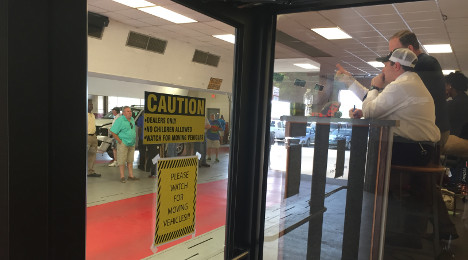
Attached to doors leading into the auction lanes are yellow caution signs with messages like “Dealers Only” and “Please watch for moving vehicles.”
Other signs at the auction offer tips for dealing with heat and emergency numbers for injuries. One reiterates the need to watch for moving cars and reminds people to keep their feet outside of the lane.
Asked if there was one specific area of which folks at Manheim Darlington needed to be particularly mindful, Brawn said: “All the moving pieces.”
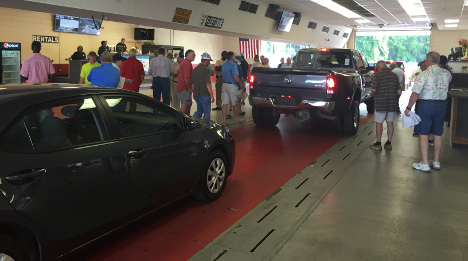
This beehive of moving pieces buzzing about an auction on sale day — including car after car pumping through the lanes, with dealers standing alongside and crossing through those same lanes — amplify the need for vigilant safety mindfulness.
That’s a big part of why the National Auto Auction Association announced this spring that it is providing its member auctions with free courses on Auction Safety Certification and Lane Safety Training, which incorporates KAR Auction Services’ “Safe T. Sam” program.
NAAA also hosted a Safety Summit in Dallas this spring, where Manheim, ADESA and independent auctions were represented well, said NAAA chief executive officer Frank Hackett.
This, Hackett said, shows that “it’s an industrywide effort.”
And the efforts to push safety are perhaps most visible, though not limited to, sale day.
For Part I of this feature on auction safety, we spoke with the management of Manheim Darlington and Missouri Auto Auction to get the boots-on-the-ground, day-to-day perspective of ensuring safety at an auction.
Part II of this feature has an industry-level focus, with insight on NAAA’s efforts from Hackett and the perspective of David Vignes, vice president of enterprise optimization at KAR Auction Services, who spearheaded the Safe T. Sam program.
Sale days
Every Friday morning before Missouri Auto Auction’s weekly sale in Columbia, Mo., there is an operations meeting that typically includes safety reminders.
When Auto Remarketing spoke with the auction’s management in early June, one of the reminders the week prior was about the heat.
It had been hotter than normal, so they reminded the operations staff about the water bottles available and staying hydrated, co-owner and director of human resources Kathleen Brown told Auto Remarketing in a phone interview along with her husband, co-owner and general manager Kevin Brown.
In the winter, those tips would change to things like how to avoid slipping on the ice.
Similarly, Manheim Darlington has a driver meeting at 8 a.m. every Thursday before its sale. If you’re not there, you don’t drive.
Missouri’s Kevin Brown, who is also president of the ServNet auction group, said sale day in the lanes can be the most at-risk safety element of an auction, simply because of the sheer numbers of people and vehicles.
“It’s not necessarily always the driver that’s distracted; it’s the actual dealer that gets distracted, especially with the technology that we have today,” he said. “Not all dealers are looking at the cars anymore; they’re looking at their technology, their cell phones and things like that. So it’s actually even more critical now, because the dealers’ heads aren’t up anymore.”
Instead, they might be scanning and reading vehicle history reports, vehicle valuations and so forth.
To get the safety message out to everyone, Kevin Brown addresses it during the opening announcements, emphasizing that dealers need to pay attention to their own actions as well as those of the drivers.
For example, if a driver appears ill, report it to the auction staff. Or if a dealer is not paying attention, “we address it,” he said.
It’s one thing to train your own employees and hold them accountable; it’s a completely different challenge to make sure non-employees at the auction on sale day are following the same protocols.
While there may be no way to completely ensure that those folks are following safety procedures, Brawn has employees out in the lanes, and lane leaders communicating with the drivers.
At Darlington, Brawn himself walks through the lanes, observing to make sure people are taking safety precautions. For instance, Brawn said if he sees a dealer in the lane and there’s a car approaching, Brawn will ask him to move.
Going back to the heat that can often be an issue this time of year, Missouri Auto Auction has the auctioneer, ringman and its two clerks on the block to be watchful as well. If they see something unusual with a driver, they are expected to contact management.
“Because they see more than anybody,” Kevin Brown said.
“And we don’t reprimand people for taking a break. If they need to, it’s encouraged, especially for heat-related stuff,” Kathleen Brown said.
The other 6 days
Being cognizant is important to auction safety — whether it’s sale day or not.
Even on things as seemingly insignificant as a pothole.
“I tell all of my team members that if you see a pothole, I need to know about it right away,” said Brawn. “We’ll go out and we’ll get QUIKRETE and we’ll fill it today.
“They have the authority to make those decisions and get things fixed, that they see that are out of place, immediately,” Brawn said.
And outside of the auction lanes, in the various shops at Manheim Darlington (recon, body, etc.), they use a “5S” philosophy: sort, set, sweep, standardize, sustain. That is meant to ensure cleanliness and organization to avoid trips and falls.
These shops have a weekly checklist they have to take care of, and they’re graded by Manheim’s safety department through a twice-a-year-audit.
‘Just try to keep it in their head’
Often, safety starts at hiring.
When an employee is hired at Missouri Auto Auction, one of the first things they go through is a safety orientation, which Kathleen Brown runs.
They watch the Smith System’s “Cycle of Safety” video on sale-day driving safety, whether they’re a driver or not.
The orientation goes through a driver safety manual, developed by the auction’s safety committee, for a driver’s functions during the week, providing a detailed and comprehensive guide covering everything from breaking down on the highway to being pulled over.
Also discussed during orientation is the auction’s safety committee, which includes representatives from every department
“And obviously, the reason we do that is so that we get feedback from every area and every department of our organization,” Kathleen Brown said.
The safety committee meets quarterly, talking about safety needs, updating the safety manual and monitoring any changes in OSHA regulations. Everyone on the committee is first-aid and CPR certified.
Training on responses to things like fire, tornado and hazard training is done up front, as well.
“Safety is our No.1 topic here at Missouri Auto Auction,” said Kevin Brown. “We reiterate to all of our employees: safety, safety, safety, and just try to keep it in their head.
“And the other thing is, we call auto auctions ‘organized chaos,’” he said. “But when you hire somebody, they don’t understand organized chaos. So, we want to make sure that when they’re hired and (at) the first sale, your head could start spinning, so we put them with somebody else to work with them for the first day, just to get them comfortable.”
And during that first sale, Kathleen Brown adds, the new employees ride along with an experienced driver to show them what they should be looking for, safety-wise. Once the new employee is comfortable, they swap places in the car.
The auction also emphasizes that no employee should drive a vehicle with which they feel uncomfortable, Kathleen said.
At Manheim Darlington and any Manheim auction, all employees have to go through the Smith System driver training each year, Brawn said.
“It’s for every employee, because you never know when you have to get into a car and move it, for any reason or another,” Brawn said. “Even title clerks, who never drive cars, if we need them to drive cars for any reason, they’ll know how to — and (know) that they have to buckle their seatbelt, and when they come into the lane, they have to put the car in park. They have to look left and right before moving … items like that, that they won’t think about otherwise if we don’t put them through the training.”
Disaster & emergency preparedness
When the devastating flooding hit South Carolina in fall 2015, water filled the back part of the lot at Manheim Darlington, Brawn said.
But the auction was able to get the cars moved off that back part of the property and the employees out of harm’s way.
That underscores the importance of Manheim Darlington’s safety training, conducting things like fire drills once a quarter and emergency evacuation practice.
Last year, part of the auction’s mechanic shop roof blew off, Brawn said. But because of their training, employees knew exactly how to respond, he said.
“Those are the reasons why,” Brawn said. “You never know what’s going to happen.”
Including accidents and injuries.
Should an accident happen, Brawn said that at Manheim Darlington, employees are required to notify a manager (if not a manager themselves). Human resources and security are brought to the scene immediately for documentation purposes.
Brawn contacts his supervisor, who contacts Manheim’s safety department to notify them of what happened.
“But the most important thing at that point is making sure that whoever is hurt is OK and doing anything that we can to make them as comfortable as they can be in the current situation. But we call 911 if it’s a situation that requires it … we have a good relationship with the sheriff and the fire chief, and we’ll call all those if necessary,” he said.
Kevin Brown, a former law enforcement officer himself, said Missouri Auto Auction also has a good relationship with the local sheriff’s department and encourages them to be a part of the auction. In fact, the department conducted its K-9 training at the auction.
“We feel that the more that they’re here,” he said, “the better we are.”