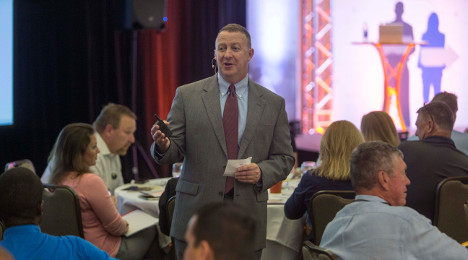
Long gone are the days where a dealership could adequately maintain its inventories by utilizing traditional methods of vehicle acquisition alone. That’s according to the folks at Autotrader, who hosted the company’s Interactive Dealer Summit in the North Carolina capital last Thursday.
One of the workshops for dealers at the event, titled “The Frond-End Fundamentals: Transforming the Art of Selling to the Science of Results” was presented by Glenn Pereira, Autotrader’s manager of industry education.
Pereira hit on what the company sees as the eight key areas that successful dealerships should focus on the front end of the vehicle sales process, from vehicle selection all the way to customer handling. One topic during the event proved particularly poignant: dealers can’t stay in a selling-only mindset.
“You can’t afford to only sell cars,” Pereira said. “You need to be in the business of buying cars, as well.”
This statement, made while discussing the vehicle acquisition process, resonated well with the dealers in attendance at the event. Pereira went on to break down the traditional and non-traditional methods of vehicle acquisition.
He explained that a good acquisition strategy involves pursuing every avenue possible. In addition to more traditional methods, like vehicle trade-ins and auction purchases, Pereira heavily emphasized the use of more non-traditional acquisition methods, such as a car-buying campaign or a “trade-in marketplace” on the dealer’s own website.
“It’s a good plan to have a buying center without the contingency of selling them a car,” Pereira said.
Autotrader says its most successful customers advertise their car-buying intentions separately and in addition to their own vehicle sales. While some dealerships have an acquisition manager on staff, some of the larger groups will even have an entire acquisition team dedicated to targeting ideal inventory.
For more information and further Autotrader advice on the acquisition process, visit its site here.
As part of our “Top 100 Used Car Dealers: Independent Edition" issue of Auto Remarketing, we asked some of the nation’s leading independent stores about the challenges they face in the pre-owned market and the strategies they use to overcome those hurdles, as well as how these dealers excel in the used-car business.
Below is what three of the Top Independent Dealers had to say.
Out West, Southwest Motors Inc., located in Pueblo, Colo., says the past three years have been the best in the dealership’s history, due in part to the store “adapting” to the shifting winds of the auto retail market.
“We have adapted to today’s automotive landscape. We have embraced the digital age, but have stayed true to our core principles. They have guided us through the past 20 years,” owners Mike and Randi Zavislan told Auto Remarketing.
The owner team also explained to succeed in the auto industry, one has to cater to their customers, yes — but they also need to stay true to their employees.
“We have the right people. The average employee has been with us for over 11 years. We put them first, and they believe in our philosophy, said Mike and Randi Zavislan.
Enterprise Car Sales, which made the Top 100 National Rankings for its Orlando, Fla., and Kansas City, Mo., stores, works to provide a large used inventory selection for its customers with a no-pressure approach when it comes to negotiation.
Mike Bystrom, corporate vice president at Enterprise Car Sales, said, “When customers visit Enterprise Car Sales, they appreciate our great selection of late-model, certified vehicles, competitive used-car prices and no-pressure sales approach. In fact, Enterprise pioneered 'no haggle' used-car pricing, and every vehicle we sell includes a 12-month/12,000-mile limited powertrain warranty.”
Moving over to highlight a Southwest dealerships, used success for Autoflex Leasing in Richardson, Texas didn’t come until the recession, when many in the industry were hurting for inventory and customers.
David Blassingame, managing partner at Autoflex Leasing, told Auto Remarketing his store only offered leases up until 2007, when the leasing market dropped off, as well as credit. In an effort to ramp up profit, the store started selling used cars and “were able to fain the lenders needed to service customers ranging from deep subprime to super prime.”
The dealership also worked to figure out where business is coming from since its primary audience had changed and advertised on a variety of radio stations in the area.
Lastly, Blassingame said the stores customer relationship management program is key.
“This has allowed us to eliminate all of our third-party lead providers except for one,” he said. “Everything else we are picking up from referrals or our radio advertising. All four of those stations we are on for a certain reason, because of the segment of business that they provide us.”
Editor's Note on Data: The Top 100 sales rankings in this report are courtesy of Cross-Sell Reports, a division of Dominion Dealer Solutions. The rankings are based on retail used-vehicle unit sales from full-year 2014. Please note that while the Cross-Sell data includes a substantial portion of the U.S., it is not meant to be representative of all 50 states.
Cross-Sell gathers the sales data via state DMV title registrations. Some stores within a multi-point group may title used-vehicle retail sales with their respective state DMV as a group, versus titling individually. It is up to the individual state to decipher such collective filings
Staff Writers Josh Hyatt, and Nick Zulovich, and editor Joe Overby contributed to this report.
What seems to be an unfortunate fact about business, in general, is that no matter how good you do your job, you can’t make everyone happy. That is especially true in customer-service oriented occupations, such as vehicle sales.
If your dealership has never received a negative review on any of the review sites online, congratulations, you are part of a very small minority. For the rest, the folks at DealerRater have assembled a few tips you can follow when you need to respond to negative reviews made online.
First and foremost, the most important thing you can do is respond. While many customers will glance over negative reviews as they research a dealership, they really pay attention to the reviews that get responses due to the fact that so many go unanswered. At the very least, responding responsibly shows you care about what your customers think.
Here are the other four recommended response tips from DealerRater:
- Acknowledge and apologize when necessary.
- Use active voice.
- Use personal pronouns.
- Be specific.
Want some more insight into these tips and more advice on the topic? Check out DealerRater’s full post on the topic here.
The increasing digitization of the auto sales industry has changed more than just the screens and mediums shoppers’ use to research their next vehicle purchase.
In the recently released Earnst & Young Future of Automotive Retail report, the company contends we are in the midst of an overall automotive retail paradigm shift.
EY broke the five pillars of the paradigm shift down like this:
- Managing trust and complexity throughout customer life cycle
- Customizing value propositions
- Creating an engaging digital experience
- Redesigning distribution networks
- Crafting an omni-channel brand management strategy
Last week, we tackled the “omni-channel strategy,” or providing a consistent consumer experience across all digital platforms — mobile sites, websites, advertising and more.
And as the car research process becomes more and more complex, with an increasing number of avenues available for shoppers to research and purchase vehicles, EY asserted dealers and manufacturers now need to spend more time managing trust and staying connected throughout the entire customer life cycle.
“We believe automakers and dealers must focus on transforming the overall customer experience and ultimately develop into a trusted organization,” the report stated. “An integrated customer experience strategy is key to building loyalty, retention, and consequently higher profit margins in sales and aftersales.”
In other words, the auto retail market needs to work toward “interjecting trust-building attributes into every customer interaction.”
To back up this assertion, EY cited telling consumer data. For example, 72 percent or consumers feel that an improved buying process would motivate them to visit dealerships more often. And from a business standpoint, 70 percent of organization believe that an increasing emphasis on customer experience is driving business growth strategies.
What does this mean for dealers? One easy way to look at it is making sure to manage the customer experience across multiple touch points.
EY breaks it down like this:
- First contact
- Vehicle research and test drive
- Vehicle financing
- Vehicle delivery
- Warranty and repair
- Replacement
All of these are critical points in the customer life-cycle that give dealers the opportunity to make contact and create loyal customers.
So, what can automakers and dealers do to improve the customer experience and remain in contact with customers from the research to replacement phase?
EY offers four suggestions. First up, the report suggest auto retail stakeholders should design a customer experience that is consistent with the brand identity and works to create trust through all customer interaction.
Next up is the call to transform processes and systems that impact sales, service, marketing and customer relationship management, in order to “enable a seamless customer experience.
EY also calls the market to manager change and realign incentive structures to focus on trust, or to “drive change management to enable employees to deliver the envisioned customer experience,” the report explained.
Lastly, to adjust to the shifting auto retail market, the EY report says dealers and automakers should focus on key trust drivers, such as authenticity, transparency and consistency.
With customers shopping online more and more, most dealers are already very familiar with the term multi-channel, as the ways shoppers search for cars online are increasing daily, as well as the devices they use.
But a new report from Ernst & Young takes it a step further. The company’s Future of Automotive Retail report contends dealers and automakers need to shift toward an “omni-channel strategy.”
Simply put, although many dealers and automakers are using a multichannel approach, allowing for shoppers to find information about them through difference sources, these sources often provide an inconsistent consumer experience.
To put this problem in perspective, consider this statistic: According to EY data, consumers spend more time for online research per-purchase of a car than for any other product.
And customers these days have the ability to absorb information and engage with companies from a variety of media and devices, and EY said this “needs to reflect in the customer experience and marketing strategies,” of both dealers and automakers.
“Customers want the freedom and flexibility to move between numerous information sources and receive a similar brand experience across all channels. Retailers need to evolve to an omni-channel strategy to deliver a seamless customer experience at every level of the customer life cycle,” the report stated.
Providing this experience is becoming increasingly important day-by-day, as EY data shows that almost half of the consumers surveyed said they would be willing to finance a purchase online, proving that completing the car-buying process completely on the Web may only be a few months or years away.
And automotive customers spend an average of 10 hours online searching for dealership and vehicle information in their car-shopping process. But they aren’t just going to be sitting at a desktop.
According to the report, 80 percent of customers will use multiple devices to research a purchase.
“For automakers, they have an opportunity, for the first time, to not only build a relationship with the customer by leveraging connected vehicles, but also to deliver a rich brand experience through seamless integration across all customer-facing channels,” said Randall Miller, global automotive and transportation sector leader at EY.
And this goes for dealers, too, as 52 percent of new and used-car customers will visit the dealer’s website in the buying process, according to EY data, showing the need for individual dealerships to streamline their online messages, as well.
Beyond the shift toward an omni-channel online environment, there is more at work here in the overall automotive retail paradigm shift.
“Digitization, regulations, evolving customer needs and new competitors necessitate a rethink of the retail model,” the report stated
EY broke the five pillars of the paradigm shift down like this:
- Managing trust and complexity throughout customer life cycle
- Customizing value propositions
- Creating an engaging digital experience
- Redesigning distribution networks
- Crafting an omni-channel brand management strategy
Stay tuned to Auto Remarketing Today as we continued to discuss these topics through the lens of the new EY report.
As part of our “Top 100 Used Car Dealers: Franchised Edition" issue of Auto Remarketing, we asked some of the nation’s leading franchised stores about the challenges they face in the pre-owned market and the strategies they use to overcome those hurdles.
Below is what four of the Top Franchised Dealers had to say.
Starting in the Midwest, Ricart Ford in in Groveport, Ohio, ranked second on the list with 7,700 used retail unit sales in 2014.
Rick Ricart — the vice president of sales and marketing at Ricart Auto Group — had this to say: “The most obvious challenge and hurdle is really the decision and re-invention of the franchise used-car business model. Many dealers try to hang on the past without properly embracing today’s consumer behavior and catering to the how and why of today’s shopper.
“The reliance of a good new-car market allows mediocrity in pre-owned where true attention to the process and philosophy could benefit the dealership much more than in the past,” Ricart added.
“All three major categories of a sales department — inventory, personnel and promotion — have to be adjusted and sometimes completely redesigned to allow for that potential growth and opportunity,” he continued. “Many independents (small and large) have taken advantage of that opportunity and no longer does having a big manufacturer sign on the property mean an advantage in selling used cars.”
Further south, Ray Sanabia of Cavender Toyota in San Antonio noticed an especially strong pre-owned market.
“The market is so strong, the only challenge anyone should have is how to get more display space for their inventory,” said Sanabia, the store’s used-car sales director.
The big challenge that Lasco Ford vice president Matt Lasco sees for the market deals with figuring out exactly where supply and demand lies. He also explained how his store, based in Fenton, Mich., may respond.
“I think one of the biggest challenges used-car dealers will face in the next 12 months is finding out where our true supply and demand is,” Lasco said. “We’ve seen an increase in lease returns hit the auction markets.
“However, there still is not been the wholesale value drop relevant to the increase in supply,” he added. “As a dealer, one of our other main focuses will be on the speed and turnover time of a quality reconditioning, which should allow us to run a leaner, quicker turning inventory.”
Interestingly enough, one of the challenges Norm Reeves Honda Superstore has faced actually stems from the new-car side. But, it’s a dynamic that the Cerritos, Calif., store has eventually be able to take advantage of.
“Some of the used-car challenges we face here at Norm Reeves Honda Cerritos is the constant incentives on the new-car inventory and heavy advertising. Being the largest Honda dealer in the country, it’s natural for our consumers to gravitate towards our new models with the best price standing behind it,” said Peter Buckley, used-car manager of Norm Reeves Honda Superstore
“We are able to take in numerous amounts of trade-ins, which become quality used cars that give us the competitive advantage with an outstanding selection of certified Hondas at all times,” he continued. “This in turn keeps offsite acquisition and costs low, along with a fast turn rate and minimal wholesale loss.
“We also have an exceptional management group who provides quality training on the features and benefits of used cars.”
Editor's Note on Data: The Top 100 sales rankings in this report are courtesy of Cross-Sell Reports, a division of Dominion Dealer Solutions. The rankings are based on retail used-vehicle unit sales from full-year 2014. Please note that while the Cross-Sell data includes a substantial portion of the U.S., it is not meant to be representative of all 50 states.
Cross-Sell gathers the sales data via state DMV title registrations. Some stores within a multi-point group may title used-vehicle retail sales with their respective state DMV as a group, versus titling individually. It is up to the individual state to decipher such collective filings
Staff Writers Josh Hyatt, Sarah Rubenoff and Nick Zulovich contributed to this report.
Phone strategy recommendations based on the company’s latest sales appointment data as well as a service drive product enhancement offered by DealerSocket all coincide with the aggressive plan to cater to dealers that chief executive officer Jonathan Ord has.
In sharing that DealerSocket is actively pursuing more acquisitions, Ord explained the various ways DealerSocket is out to back up its marketing mantra of, “We are automotive.”
During a face-to-face interview at the annual conference hosted by the National Alliance of Buy-Here, Pay-Here Dealers last month in Las Vegas, Ord said, “We can buy companies to create new product offerings, we can build the technology internally or we can partner.
“Our strategy and vision is to utilize all three of those avenues in the best way possible to transform the industry,” he continued. “You’ll see us make one to two acquisitions a quarter. You’ll see us launch new technologies every few weeks across all of our product lines. And then you’ll see us continue to partner with other great companies that can even be competitive to what we have but that really have the same vision as us.
“The most important thing for us is that the dealership is happy and there is value there,” Ord went on to say.
What DealerSocket hopes has value is what the company unveiled on Tuesday. DealerSocket announced a complete revamp of its online service Scheduler within its service dashboard.
The online service scheduler can allow dealer customers to schedule a service appointment on the store website.
“We are excited to introduce the redesign for online service scheduler,” DealerSocket chief technology officer Brad Perry said. “Our new responsive design is more intuitive which, in turn, helps dealers increase the amount of service appointments scheduled by their customers.”
New enhancements include an easy-to-use, responsive user interface, reduction of duplicates logged into the system, Facebook login integration, and more.
Also coming this summer is the ability to upload video content to explain dealership service offerings.
DealerSocket said dealerships that provide their customers with an online portal to schedule service appointments saw at least a 35-percent increase in appointments scheduled.
Along with providing an online avenue for the service drive, DealerSocket reminded dealers that they shouldn’t abandon the phone to boost their retail sales division.
The company recently analyzed 11.5 million sales records. In short, DealerSocket insisted that dealers need to put in time on the phone to drive appointments.
DealerSocket highlighted this recommendation for efficiently and effectively confirming appointments — follow up 16 to 30 minutes after receiving a lead.
“By doing so, dealers are 23 percent more likely to close a sale than those who responded within the first 15 minutes,” DealerSocket said.
DealerSocket indicated the average dealer called each prospect three times, set 23 appointments and sold fewer than seven vehicles per month.
But then the company noticed the most successful dealers made eight calls per prospect, set 49 appointments (a 113-percent increase) and sold 13 vehicles.
DealerSocket also metnioned the average dealer's calls last one minute 59 seconds each (a total of five minutes, 59 seconds per prospect).
But then added top-performing dealers calls last one minute 37 seconds each (a total of 12 minutes, 56 seconds per prospect).
“So, the difference between being an average performer and a top performer is essentially another six minutes on the phone per prospect, which result in a 117-percent increase in vehicle sales per dealer,” DealerSocket said.
NADA Regulatory Affairs has spotted a regulatory update dealers may want to pay attention to: the Federal Trade Commission announced Friday that it has updated its informal staff publication — “FTC’s Endorsement Guides: What People Are Asking” — to help answer questions regarding the legal principles involved with disclosing material connections between advertisers and endorsers.
The fundamentals, as listed on the FTC website, include:
1. Endorsements must be truthful and not misleading.
2. If there’s a connection between an endorser and the marketer of the product that would affect how people evaluate the endorsement, disclose it clearly and conspicuously.
3. If the advertiser doesn’t have proof that an endorser’s experience represents what consumers will achieve by using the product, clearly and conspicuously disclose the generally expected results in those circumstances.
According to NADA Regulatory Affairs, the updated guidance could affect dealer marketing efforts. The frequently asked question section covers trending questions the commission has been receiving recently, including, “Is there special wording I have to use to make the disclosure?” as well as more emphasis on social media inquiries, such as, “What about a platform like Twitter? How can I make a disclosure when my message is limited to 140 characters?”
To see the full version of the FTC guide, click here.
In other news, the National Automobile Dealers Association is hosting its 2015 Dealership Workforce Study with an extended participation deadline ending June 30.
NADA and ATD member participants in the study will receive certain perks for participating in the study, including a complimentary dealership-specific basic report, a complimentary comprehensive industry report, an enhanced report with franchise-specific market date (for a nominal upgrade fee) as well as an enhanced report/search tool bundle (as well for a discounted upgrade fee).
For more information on what is included with participation with the study and the benefits, visit the NADA Workforce Study website.
Last week, Auto Remarketing recapped a DealerRater and J.D. Power study — the 2015 PowerRater Consumer Pulse — that breaks down the respective percentages of new-car shoppers that want the salesperson to be a negotiator, educator and facilitator.
But what about used-car shoppers?
DealerRater shared those numbers with us on Tuesday. And they’re not all that different from the new-car crowd.
Respondents were asked whether being a negotiator, educator or facilitator is the most important role a salesperson plays.
On the used-car side, 44 percent want a negotiator, 37 percent prefer an educator and 19 percent are looking for a facilitator.
On the new-car side, 46 percent said negotiator, 42 percent said educator and 12 percent said facilitator, according to the report.
The 2015 PowerRater Consumer Pulse was put together by J.D. Power and DealerRater. A more detailed look at their findings can be found here.
Consider all the information and power the new-car shopper has at their fingertips (or within the reach of a thumb swipe): volumes of vehicle research, tools to see the prices others are paying for their desired ride, car-buying advice and so much more.
However, in a “somewhat surprising” twist to findings from DealerRaler and J.D. Power, many of these shoppers still prefer the salesperson at the dealership to act as a negotiator.
That said, consumers who try their hand at negotiating may end up being less satisifed with the overall car-buying process — meaning there is an opportunity for dealers to gain some ground with these shoppers.
J.D. Power and DealerRater explore more about that below; but first, here are the overall results of the 2015 PowerRater Consumer Pulse provided by the two companies.
What Do They Want Salesperson to Be?
Respondents in this survey were asked whether being a negotiator, educator or facilitator is the most important role a salesperson plays in the new-car purchase process.
Forty-six percent said negotiator, 42 percent said educator and 12 percent said facilitator, according to the report.
“Given that people so often turn to the Internet and smartphone apps to research vehicles — and can even see what others have paid for a similarly spec’d vehicle — the results of our analysis were somewhat surprising; but it’s clear that consumers still want salespeople to be part of the overall purchase process,” said Gary Tucker, chief executive officer of DealerRater.
So, what exactly does being a “negotiator” entail?
Citing a survey this spring of more than 8,000 consumers who had posted a review on DealerRater.com shortly after buying a new car, the analysis said when a salesperson is a negotiator, his or her role is to “to assist buyers in arriving at a mutually acceptable deal.”
Included in that process is reaching a consensus on the price of both the new-car purchase and, if the shopper has one, the vehicle to be traded in.
Breakdown of Negotiator Preferences
Of course, this preference for the negotiator salesperson is not homogenous across the board.
For example, mass-market car buyers (at 47 percent) were moderately more likely to prefer a negotiator than luxury car buyers (43 percent), according to the report.
The negotiator role was preferred more often by buyers of cars from brands like Nissan and Kia (both at 53 percent). Conversely, Subaru (35 percent) and Audi (40 percent) buyers didn’t feel the same way — they were among the least likely to prefer this route.
Likewise, there are some generational differences, as well.
“Among the generations, Gen Y buyers negotiate the vehicle price 72 percent of the time, while Pre-Boomers negotiate only 61 percent of the time. Gen X negotiates 66 percent of the time and Boomers 64 percent of the time,” said Chris Sutton, vice president, U.S. automotive retail practice at J.D. Power.
J.D. Power defines Pre-Boomers as those born before 1946, with Boomers born between 1946 and 1964. Gen X goes from 1965 to 1976, with Gen Y from 1977 to 1994.
“In an increasingly digital world where everything’s at our fingertips, savvier consumers are armed with a lot more information to bring into a negotiation than was readily available in past generations,” Sutton added.
Why You May Want to Examine Negotiation Approach
The J.D. Power 2014 U.S. Sales Satisfaction Index Study said that about two-thirds of new-car buyers claim to have done some horse-trading with the dealership to sweeten the deal.
Interestingly enough, 45 percent said getting the best deal required “a moderate amount of effort.”
Granted, there can be a negative connotation around negotiating these days, but that J.D. Power SSI study mentioned a few pluses for the new-car shopper who negotiates.*
— More than half (55 percent) said they got a better price
— Almost a third (32 percent) said their trade-in value was higher
— Also, nearly a third (31 percent) said they were given another purchasing incentives (i.e. preferred interest rate, free service, additional vehicle feature)
*Note: Consumers were allowed to choose more than one response for this question in the SSI
Here’s an interesting twist, though: new-car shoppers who tried to negotiate for a better deal reported a lower satisfaction with the overall buying experience (793 out of 1,000) versus those who chose not to (844).
What does that mean for dealers?
“Dealers would do well to examine their approach to customer negotiations to close this satisfaction gap to avoid misconceptions and frustrations with in-store interactions, as well preserve loyalty and advocacy for the product being sold, person selling the product, the place where the consumer buys the product and its overall price,” said Tucker.
“Employee review pages are a great example of how we've seen dealers achieve this,” he added. “By making connections and establishing trust with the salesperson before going into the store, anxiety is lessened and the overall sales process goes faster and smoother.”