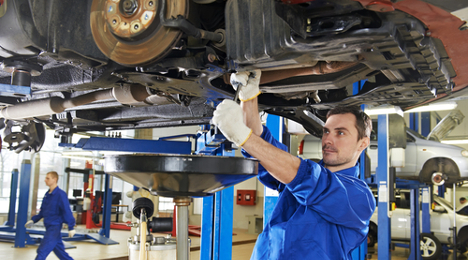
The service and fixed operations industry is a $310 billion business. The problem is, only a little more than a quarter of that goes to franchised dealerships, says Netsertive’s Tim O’Rourke, citing outside research.
“The franchised dealers are getting 27 percent of that ($310 billion total), according to their own internal data. They are getting about $85 million,” O’Rourke, Netsertive’s sales director of auto, told Auto Remarketing at the NADA Convention & Expo in January. “The rest of that is flowing to the third-party service providers … or those who are doing it themselves.”
“So, there is a tremendous opportunity there, and the battle is being fought online,” he continued. “People have said overwhelmingly they search online when they are trying to figure out where they are going to get their service performed, and the franchised dealers just aren’t there.”
But based on the outside research shared by Netsertive, perhaps they should be. On dealer websites, 97 percent of material is sales-based; just 2 percent to 3 percent is for service, O’Rourke said.
Which is somewhat odd, considering how profitable the service side can be: despite comprising less than a quarter of sales, more than half (54 percent) of dealer profits come from the service side.
“It could really be a game changer for the dealers, if they could change their marketing practices, which we are encouraging them to do,” O’Rourke said. “They need to get in the game, and they need to be working with the right partners and have a good solid strategy and allocate the right amount of budget.”
Of course, there are many things dealers can be doing online to push their service department. At the top of that list, says O’Rourke, is utilizing search. In fact, he said, 70 percent of parts/service purchasers used search at some point.
“Much farther down the line is social. It’s still important, but you want to cover that first base. What we are doing with dealers today is they are just not present at all. So, to go and tell a dealer we will help them with their social, we would be skipping some of the more important areas,” O’Rourke said. “Search is first, but having said that, down the road, and not that far down the road, we certainly anticipate adding that, especially Facebook.
“We are a Google premier partner, but we also work with Bing and Yahoo and Facebook. And it’s all very customer-centric. Based on the dealer’s strategy, we want to drive the best performance we can for each campaign, and whatever tools we need to use to do that, we’ll use,” he continued.
The ‘Zero-Mile Defection’
Another missed opportunity is the customer in your own front yard: those who buy a vehicle from you.
There are a couple reasons why a customer who purchased a car from a given dealership may not return to that same store for service, a phenomena often referred to as the “zero-mile defection,” says Chris Ice, the vice president of product marketing at Xtime, a provider of retention solutions for the retail auto business that is owned by Cox Automotive.
One possibility, he said, is out-of-market sales via the Internet. And that’s understandable: a customer in Charlotte, for example that found their car online and buys it from a dealership in Atlanta, probably isn’t going to drive down from North Carolina to Georgia to get their car serviced.
However, the other reason he cites is a bit more problematic.
“But the other, especially in rural areas, for example, or the Midwest, you come up through generations where you’ve got a guy (who you turn to for vehicle service),” Ice told Auto Remarketing at NADA. “You have the guy and that’s the guy you see … and if dealers aren’t actively introducing the sales customer to the service department at the time of vehicle delivery, you’ve missed that opportunity to make that customer aware that they actually do provide service, and in some cases with no cost or pre-paid maintenance, it’s included with the vehicle.
“They just don’t know. There’s not that awareness because they’re not making that hand-off from sales to service, and they’re going to the guy that they’ve always seen,” he said. “I think the challenge there will be, as the vehicle product gets more complicated, it’s going to be more difficult for ‘Bob on the corner’ to take care of the vehicle in the way it needs to be taken care of.
“So, it’s a great opportunity right now for dealers, with the vehicle product that they have, to get engaged in making that sales to service handoff, introduce that customer to the service department and establish that relationship upfront,” Ice said. “I think you’ll see that reduce that zero-mile defection.”
Editor’s Note: The outside research Netsertive cited is from Cars.com, Dealer Communications, Ward’s Auto and the National Automobile Dealers Association.
Staff Writer Sarah Rubenoff contributed to this report.Look for more fixed ops coverage in our April 1 issue.
One of the most profitable areas of the dealership — if not the most profitable — is the service department. And what is the backbone for a successful service department? The people, and that, of course, includes your technicians.
Unfortunately, there appears to be a widespread shortage. One of the most consistent comments made by executives at the largest public dealer groups for the last several quarters is the fact that many are struggling to find qualified technicians.
One of those retailers — Asbury Automotive Group — revealed its most recent plan to cull the shortage of automotive technicians at the company in mid-March. The auto group says it plans to hire between 200 and 400 technicians over the next year or two. In a conference call last fall, AutoNation executives discussed how technician hiring efforts paid off for them.
Dealer groups, essentially, are striving to answer this question: who’s going to work on all of these vehicles when they return for service? Even with steady unit sales growth, service revenue remains an integral part of dealer profitability, and you need to attract the right service personnel before you can facilitate the customers.
And that’s where it can get tricky. Ted Kraybill, the president of ESI Trends, fleshed out some details from the NADA’s recent 2014 Dealership Workforce Study Industry Report with Auto Remarketing at the last NADA Convention.
According to Kraybill — who designed the study — your dealership will need to adjust to the new predominant demographic for technicians looking for jobs: Generation Y.
“Obviously, with technicians and service advisers, you have more and more of the millennials that are coming into the service department,” Kraybill said. “Of new hires, into technician positions, over 50 percent of the new hires are millennials. Which would be, I think, expected, but it is also saying that perhaps more of the older, experienced techs are staying. They’re not jumping around as much from dealership to dealership.”
The most common and apparent method to attract talent in such an environment is to offer higher wages. According to Kraybill, technician positions saw a 2-percent increase in compensation in 2014 compared to the year before.
Those in certain parts of the country should note that this isn’t only due to competition within the automotive space — the increased need from other industries, especially in oil field services, has led to the leaching of technical talent into other sectors, according to Kraybill.
Another tactic becoming more common, which Kraybill warned about, is retention incentives.
“More and more dealerships are adding retention bonuses,” Kraybill said. “But they’re only doing it, really, for technicians, which is causing some problems.”
Kraybill said that the retention bonuses he’s seeing, which are given after the technicians stay with the company for a certain amount of time, range from small yearly bonuses to sizeable bumps in the technician’s flat-rate pay. This, however, doesn’t always go over so well with the non-technician staff he has surveyed.
“But we see comments coming back from service advisers, parts employees, and so forth,” Kraybill said, “and they say, ‘Why don’t we get retention bonuses? Why is it only the techs?’”
It also makes sense, in this situation, to look at who can actually afford to pay technicians these higher rates. According to Kraybill, 2014 saw a decline in the gap between what the largest dealer groups (with more than 40 dealerships) and what the medium dealer groups (between 10 and 40 dealerships) are paying their staff.
“What we’ve seen is that the large dealer groups were paying higher salaries than the other two categories,” Kraybill said. “But in this past year, across all positions in a dealership, salary growth was only 1.3 percent — that was down 3.4 percent the prior year. But within that 1.3 percent, most of the salary growth was at the midrange dealer groups.”
This does, however, leave out a piece of the picture — the dealer groups with less than 10 rooftops and the individual dealers, who cannot always afford to raise salaries to attract talent.
“The smaller dealer groups, the dealers that have one, two or three stores, they can’t necessarily compete with what the big guys are offering,” Kraybill said.
So what else can you do to sweeten the job offer? Fortunately for the smaller dealers, money isn’t everything to the growing demographic of technicians.
“Pay isn’t a high priority with millennials,” Kraybill said. “They come into a dealership and in an interview they’re more likely to ask questions about work schedule, time off, flexibility and training. Millennials are all about balancing job and free time because they figure that they’re going to be working for a long time.”
According to Kraybill, highlighting your ability to hone millennials’ marketable skills is key. Smaller dealers, if they make it part of its “employment brand,” can often spend more time training individuals and speed them through the ranks, in addition to their other advantages.
“They need to compete on other things, like more of a family culture, because it truly is a family business,” Kraybill said. “They need to compete, perhaps, on allowing more flexibility, more job- and personal-life balance. They can make community service and involvement in the community as part of their employment brand.”
Editor's note: Auto Remarketing editor Joe Overby contributed to this article. Look for more fixed ops coverage in our April 1 issue.
What was your first car?
Ask this question of someone and chances are, he or she will crack a smile.
Granted, whether that smile is one of nostalgia for a classic ride or humor at one’s humble beginnings — or some combination of the two — may largely depend on the car.
(Mine was well over a decade old at the time, had an arm-cranked sunroof and featured a cassette player during the height of the CD’s popularity. It was beige-ish. I loved it.)
Whatever the car may be, more than likely, the former owner is likely to express some kind of position of emotional connection to that car.
For Cox Automotive president Sandy Schwartz, that first car was a Sunbeam Alpine. He spoke of that car with fondness during a presentation at the NADA/J.D. Power Automotive Forum in New York on Tuesday, and said his wife had a similar reaction of excitement when purchasing a car recently.
“Everybody has something about cars that they love,” Schwartz said. “They don’t always love the process of getting that car, but when they get that car, there’s just so much about it that they love and they care about.”
That underscores what Schwartz and others emphasized throughout the day on Tuesday; that there’s a genuine human emotion in our reaction to a car and that car-buying is a people business built on relationships.
More and more of the process is becoming automated, but the human interaction is still an integral part, as industry leaders expressed during the forum.
Tom Doll, Subaru of America’s president and chief operating officer, recognized the fear some may have of the auto business simply becoming a “fancier” version of grocery store online check-out lines.
And granted, there already is some of that automated processes going on in the business, much of it helping create greater efficiencies and making the process easier for consumers.
“But we have to know when enough is far enough. NADA tells us that people need people. They tell us that customers are happiest when they feel that they’ve been given the time of a real person in the transaction,” Doll said during a presentation at the event.
“J.D. Power tells us that the thing customers want more than ever is a detailed explanation of the work performed,” he added. “Can a computer do that? Possibly. Would it be as satisfying? Not at all.”
And here’s the thing: even with something like the expanding automotive presence of social media, a tool that some argue dulls the face-to-face, interpersonal communication in society at large, the key themes are still all about people connecting with people and relationship-building.
That is important to remember given this statistic shared by Michelle Morris, group director for automotive and financial services at Facebook, during her presentation: people check Facebook an average of 14 times a day and log onto the site 15 hours a month.
“In this crazy mobile world, social allows you to connect to your customers wherever they are, because real people are logged into their devices,” Morris said. “But it’s the frequency of how those people are using the platform that helps build the brand message; it helps to sell the vehicles and build those brands.”
She later added: “Social sells cars, but it also helps you express your brand and it creates meaningful relationships for your customers for life.”
Many who will be buying that first car.
Brand new research to hit the market is working to debunk the assertion that factors driving dealer success and profitability remain beyond the industry’s control.
Instead, the new report — released by McKinsey & Company, in cooperation with NADA — titled, “Fast Forward: How U.S. Auto Dealers Can Drive Sustainable Economic Performance in the Digital Age,” shows that internal operating practices play a large role in differentiating highly profitable dealers from the pack.
In other words, for store owners and GMs, the keys to profitability growth potential might be more in their hands they one might think. According to the report, marketing spending and operations should be top-of-mind for dealers looking to increase profitability.
The study results were announced at the NADA/J.D. Power Automotive Forum Tuesday afternoon, and shared insight on internal operating practices from more than 800 new-car dealerships across the country, as well as analysis of more than 2,000 retailers and a car-buyer survey of more than 3,000 U.S. consumers.
Auto Remarketing discussed the results of the new study with Stefan Knupfer, director at McKinsey; Robert Mathis, partner at McKinsey; and Steven Szakaly, chief economist for the National Automobile Dealers Association, shortly before the results were revealed on Tuesday.
Let’s take a look first at shopping trends that inspired the report’s authors to pick out operations and marketing spending as the top two critical areas dealers need to focus.
Traffic & Conversion
If you have been a dealer for over a decade, there’s a good chance you may have noticed less store traffic — but that doesn’t mean you’re selling less cars.
Compared with 10 years ago, new-car buyers are spending almost triple the amount of time online doing research. Consequently, 42 percent of the dealers surveyed reported a decline in store traffic, compared with just five years ago.
That said, according to the report, 61 percent of dealers reported a rise in the conversion rate of store visitors in the last five years. In other words, shoppers are coming into the dealership with a much clearer picture of what type of vehicle they want.
Szakaly pointed out that if one takes a look at the number of models and the variances on today's vehicle models, it’s almost impossible for consumers to do their shopping only by visiting stores.
“I cannot go look at every mid-sized SUV and test drive it. That’s six weeks doing of test drives. A lot of consumers are now shopping online, doing comparisons, and they have narrowed it down to a couple of products, so they are coming into the dealerships with some idea of what they want to purchase.” he said. “They are much farther along in their purchase cycle than previously, which is why in-store conversion is now higher.”
Interestingly, 84 of the new-car dealers surveyed look at the rise of the highly informed consumer as the most significant recent shift in the industry.
The report’s authors and analysts agree, noting the trend can prove to be a great benefit for dealers.
“They start their search on the Internet; they start comparing vehicles, brands and the content of the vehicles, and they are much better informed and don’t need to visit so many dealers,” said Knupfer. “That is also why dealer traffic is going down. They are visiting less dealers, because they don’t need to see a lot of dealers to get the information they have already found online. And because they are better informed, they can make faster decisions.”
Dealers, Manufacturers and Third-Party Providers
Taking these shopping trends into account, the report pointed out that “new players,” such as third-party lead generation sites, have popped up to aid these new consumer preferences.
This trend brings another marketing arm into the mix, making it even more complicated for dealers to consider line items such as digital marketing spend.
The report stated in this confusion, sometimes manufacturer and dealer spending on media activities are not well coordinated.
The report offered two fixes for this conundrum:
- Investing in a synchronized approach to marketing return on investment
- Coordinated lead generation across all channels
For every car sold and serviced in North America, according to the report, manufacturers and dealers jointly spend an average of nearly $8,500 for marketing and sales activities over its lifecycle.
“Part of the challenge is obviously there are different parties at play that basically try to do the same thing. If you look at a new-car sales lead, from the third-party lead providers like TrueCar, and you have the OEM generating leads, and you have the dealership generating leads, and they are all feeding into the same pool to the dealer that has to convert them into actual customers,” Mathis explained, which can cause confusion as to what marketing and lead generation tools are actually working.
There is considerable frustration and ambiguity surrounding the question of what money is well spent when it comes to the lead generation process, the report contends.
“Obviously, the reason that these third-party lead providers are part of the industry is that they are offering a value proposition that wasn’t covered by the manufacturers or dealers,” Mathis said. “So the question at hand is what the dealers and manufacturers can do to fill that gap, because people are going to third parties for help.”
The report suggests a more synchronized approach to marketing return on investment for individual franchised dealers and their manufacturers.
Though there has been some confusion as to which digital marketing outlets have the best ROI, the report suggested: “With the rigorous application of advanced analytic capabiltieis, each manufacturer can create a complete picture of spending effectiveness across online and offline channels by analyzing the marketing ROI of both its own and its dealers’ consumer-facing spending.”
As a result, the report contended, manufactures and dealers can better allocate marketing spending to the best-performing channels.
“There are three different institutions (lead generators) working on this, and it’s not very efficient,” said Knupfer. “There is a lot of money that is spent, but there is more opportunity for improvement. As a consequence, we see there have been a lot of attempts at training and a more sophisticated efforts between manufacturers and dealers.”
Operational Keys To Profitability
Contrary to popular belief, the report contends that dealership business success is not driven primarily by structural factors out of the control of the dealer, but rather by tightening up internal operations.
According to the report, 60 percent of the performance gap between dealerships is determined by operating practices. And if dealers were to implement existing best practices in operations alone, the average performance of the entire auto retail industry could increase from a net profit pretax margin of 2.2 percent to more than 4 percent. According to the report, this could add about $1 million to the average dealer's bottom line.
What should be top of mind? The report’s authors focused on people management, customer retention and focus on total profit opportunity.
“As part of the research, we basically went out and observed more than 800 dealers in the U.S. and really tried to understand what the operational factors are, and we overlaid them with the financial information we were given and statistically correlated which of the factors mattered the most,” said Mathis. “And what we found among the top 10 factors, was that many of them were people management related.”
Interestingly, the single most important operational factor turned out to be tenure of the service manager, “meaning, if you are able to retain your talent in critical positions, it puts you in a much better position to increase value,” Mathis said.
He also pointed out that in terms of focusing on total profit opportunity, dealers need to focus on the entire lifecycle of a customer, meaning not only the new-car sale, but also F&I, service, aftersales, parts and more.
This strategy can help dealers not only to service the customer, but also understand how much profit is being generated from each individual shopper, said Mathis.
And if that if you have the right documentation of how you captured value for a single customer, it is much easier to see where best to put your resources and prioritize your customers.
“If you look at it in an integrated way, it is much easier to capture customer lifecycle,” he said.
Szakaly agreed, summarizing as follows: “It’s not viewing the customer as a new-car sales or a used-car sale or a service customer, but as all of that combined. When he buys a new car, there is a service opportunity. When he is in for service, there is a new-car opportunity. It’s looking at it holistically.”
In summary, by investing in operational improvements and streamlining marketing expenses, the report shows a potential way overall dealer profitability could hit the levels of today’s top quartile performing dealers in the near future.
Auto Remarketing editor Joe Overby contributed to this report.
You can buy just about anything these days with a thumb-swipe on a mobile device or a click of a mouse, and when it comes to buying cars, more and more of that is moving online, too — but not the whole process; and it appears most consumers want to keep it that way, as they see value in what a dealership salesperson brings to the table.
The Autotrader Car Buyer of the Future study, released Monday night, found that 84 percent of respondents want to purchase a car in person.
“And dealerships aren't just about the transaction,” Autotrader president Jared Rowe said in a presentation of the results in New York on Monday. “Forty-three percent of all consumers actually want to go to the dealership to learn. So, when you think about that paradigm from a retail perspective, this is where you build value in the sale.
“You don't build value in a distributive price negotiation; you build value by talking about feature benefits,” he added. “What we found is that 43 percent of all consumers want to go to the dealership. They want to learn more about those feature benefits. Now, they may want to learn about it in a slightly different way … but ultimately, this is something that they value tremendously.”
Consumers view the dealership experience as a chance to validate what they learned online, while also getting more information on specials, offers, warranty and service, the study says.
This notion that salespeople will be less important in the future is just one of three that Autotrader says its study dispels.
“Some commonly held beliefs about the future of car buying are that salespeople will be less important in the future; consumers don’t want to negotiate; and that lowest price will always win. In fact, the study shows the opposite,” the company said in the study’s news release.
The second commonly held belief on Autotrader’s list is negotiation — more specifically, that consumers just don’t want any part of it.
However, the study found that more than half (56 percent) actually would rather negotiate. What’s more, millennials and women, in particular, will take negotiation over flat rate pricing.
“This is a result of the fact that consumers do not yet trust flat rate pricing, and they feel that they have to negotiate to get a fair price,” Autotrader said.
Third on the list deals with price — in that lowest is always best. But, again, more than half (54 percent) of respondents said they would choose to purchase from the store that offered a better experience than one that offered the best price. This helps show that even though price is vital, “the dealership experience can trump lowest price,” the company said.
And consider this: more consumers were willing to drive farther to work with a salesperson they liked (73 percent) than to get the lowest price (65 percent).
Improved sales numbers are usually aided by a good reputation. And that reputation, according to a recent release from J.D. Power and DealerRater, starts in your service department.
The March 2015 PowerRater Consumer Pulse, a monthly analysis of — as the title suggests — consumer opinions, is developed jointly by J.D. Power and DealerRater, each of which lend their specific angles on the automotive industry to create a picture of how customers feel about their dealer experiences.
According to the report, “a dealer’s ability to satisfy its service customers boosts its reputation for good service, which may ultimately lead to increased vehicle sales.”
Other key findings, according to the report, are as follows:
- Highly satisfied service customers (overall satisfaction scores of 901-1,000 on a 1,000-point scale) are more likely to write a review about their experience, compared with those who are merely satisfied or indifferent (scores of 750-900), according to J.D. Power. Among the 37 percent of highly satisfied customers, 4.3 percent indicate that they posted an online review of their experience. In contrast, less than 3 percent of service customers who are either merely satisfied or indifferent posted an online review.
- Among highly satisfied customers who posted an online review of their last service experience, 91 percent of the reviews were positive; among merely satisfied or indifferent customers who posted a review, only 71 percent of the comments were positive.
- According to data collected by DealerRater, 40 percent of car buyers indicate that the service department’s reputation was significantly important in choosing the dealer they purchased from.
Chris Sutton, the vice president of U.S. automotive retail practice at J.D. Power, reflected on the findings.
“Clearly, there is a strong incentive for dealers to maximize customer satisfaction as it leads to a greater likelihood that customers will post a positive review, helping to support the reputation of the dealer’s service department,” Sutton said.
Furthermore, J.D. Power recommends five critical areas to focus on that have the “highest potential impact on customer satisfaction” in the service department.
- A service advisor who focuses on customer needs.
- Providing helpful advice to customers.
- Fixing a vehicle correctly the first time.
- Quick access (within 2 minutes) to a service adviser.
- Having the vehicle ready when you said it would be ready.
Generation Y, also referred to as millennials, are becoming more influential in the automotive space as their purchasing power increases and they become more of an integral demographic in the car-buying population.
And, clearly, their shopping and buying habits will shape the future of the retail auto business.
With that in mind, a recent post to ADESA’s Overdrive blog — titled “Marketing to Millennials: What Do They Want in a Car Dealership?” and written by ADESA director of communications Darci Valentine — recaps three solid points of advice for dealers on how to reach this crowd.
Read the full post here to learn what this generation wants in a dealership.
Dealertrack Technologies acknowledged large, high-profile retailers such as Target and Home Depot may get the headlines, but the service provider said dealerships are especially vulnerable to data security breaches thanks to the large amount of personal information they gather about customers.
During a free webinar, Dealertrack associate general counsel Randy Henrick will discuss how managers can implement best practices to safeguard their dealerships against data security breaches. Discussion points will include:
— Financial ramifications of a data security breach
— Requirements of the Safeguards Rule mandated by the Federal Trade Commission
— Best safeguards practices for dealers
The webinar will conclude with a live Q&A session.
The hour-long session is scheduled to begin at 2 p.m. on Thursday.
Dealers can complete the free registration here.
The National Auto Auction Association is hosting its “Stay in Sync with NAAA’s Arbitration Policy” webinar on Jan. 16 at 2 p.m EST.
Matt Arias, the NAAA Auction Standards Committee co-chair and director of arbitration for Manheim, will be on hand to review the changes to the NAAA Arbitration Policy, which will go into effect on March 2. At the end of the webinar, Arias will answer as many questions as possible for dealers with further inquiries.
Frank Hackett, the chief executive officer of the NAAA, will moderate the event.
Interested parties can register here.
In an effort to decipher which auto research sites are favorites among the female population, Women-Drivers.com utilized a survey technique to rank the top sites.
And it seems dealers are doing something right when it comes to their online presence, because dealership websites remain the No. 1 online research option for women, with 41.27 percent of survey respondents choosing this option on the survey.
Coming in at No. 2 was manufacturer websites.
WomenDrivers.com conducts ongoing research through its Women Satisfaction Index, and the site also asks women to complete an optional 25-question survey about their dealership experience after completing a dealer review, which includes questions about online research.
After dealer and manufacturer websites, third-party sites began showing up in the results with Kelley Blue Book leading the way, followed by Consumer Reports.
Listed below are the top sites women visited from Women-Drivers.com’s most recent 3,220 surveys.
1. Dealership (41.27 percent)
2. Manufacturer (39.75 percent)
3. KBB (39.62 percent)
4. Consumer Reports (22.23 percent)
5. AutoTrader.com (21.34 percent)
6. Edmunds.com (20.38 percent)
7. Cars.com (18.85 percent)
8. Carfax (15.29 percent)
9. Craigslist (7.64 percent)
10. JD Power (6.05 percent)
11. TrueCar.com (4.71 percent)
12. Autobytel (2.29 percent)
* Note: Total adds up to greater than 100 percent as reviewer can leave multiple responses.