Today, we focus on the road to ultimate business success. This is powered by a growing customer base, increasing loyalty and customer retention. Here are some innovative marketing ideas to increase your competitive edge by delivering more value to women customers.
1. Buy a Car in Less Than 2 Hours
Do you know it currently takes a woman an average of three hours and 20 minutes to buy a car? Most women feel “highly inconvenienced” by this, especially because time is one of women’s most prized commodities. Implement a marketing approach where buyers can seal the deal in two hours or less.
2. Test Drives On-Call
Half of the buyers at a dealership are women — but most women work. With professional females and moms on-the-go, a way to distinguish your dealership is having “test-drives-on-call.”
Bring a new vehicle to her place of business or home to test drive; this concierge service is attractive to women, as again, it is time saving.
3. Access to Technology Experts
Car buying is a costly purchase. Women buyers, especially, take a lot of time to research the dealership and learn about the vehicles before they make their final decision.
In the car itself, there are so many buttons and touch points on a dashboard. Who can remember all the things said during a test drive? Most buyers spend no more than five minutes learning about their NAV or tech packages and leave the dealership unfamiliar with these aspects of their new vehicle.
Have classes for consumers to attend, post-purchase, about the cars’ technology and perhaps some one-page cheat sheets for them. Having access via email, text, Twitter, Instagram or Facebook to your dealership’s technology expert is a must.
4. Build a Strong Brand Dealer Reputation
Women rely on car dealer reviews 50 percent more than men. It makes sense; they want to get their car-buying right! They really want to buy from well-reputed and trusted dealers.
To build strong brand reputation and attract more women buyers, dealers can get reviews from women shoppers and train their sales team to deliver the ultimate car-buying experience to every customer who walks in the store. This low cost model is a win-win.
5. Acknowledge Mistakes and Show Customers They are Valued
It is difficult for businesses to acknowledge their mistakes. When it comes to client retention, “holding up your hand” in business, is paramount. For example, when it comes to reviews — keep it real and be transparent.
Ask to have a one-on-one discussion with the consumer via telephone. Market your dealership in such a way so that all customers feel included and a valued part of the process.
Positioning your dealership in this way — and clearly communicating these services — makes clients and potential customers feel that your business is working in the clients’ best interest rather than just “selling cars and making money.”
Editor's Note: This is a contributed column from Women-Drivers.com. Anne Fleming, who heads up the site, was a 2013 Women in Remarketing honoree and is a frequent guest columnist for Auto Remarketing.
With vehicle technology advancing at a rapid pace — growing more complex with every year — the role of product specialist in dealerships is becoming more important and playing a larger role in the sales process.
This assertion was highlighted in the 28th annual J.D. Power 2014 U.S. Sales Satisfaction Index Study results, which were released Thursday.
It seems automakers are rising to the occasion — tackling technology head-on — as overall sales satisfaction improved by 13 points year-over-year to 686 in 2014 from 673 in 2013, on a 1,000-point scale.
In this high-tech environment, judging from the responses of the 29,805 buyers who participated in the study, Mercedes-Benz was found to be No. 1 in sales satisfaction among luxury brands, with a score of 761, on a 1,000-point scale. The automaker was also the most improved for premium brands from 2013, with its score rising 33 points.
And for the fifth year in a row, Mini ranked highest among mass market brands, taking home a score of 727 — a 9-point increase from 2013.
For mainstream brands, Buick improved the most, bumping up its score by 32 points from 2013, moving up to 9th place.
The study measures buyer satisfaction based on four factors (in order of importance): working out the deal (17 percent); salesperson (13 percent); delivery process (11 percent); and facility (10 percent).
Those who chose not to buy, or rejecter satisfaction, is based on five factors (in order of importance): salesperson (21 percent); fairness of price (8 percent); experience negotiating (8 percent); variety of inventory (7 percent); and facility (7 percent).
The Role of the Product Specialist
On top of ranking the automakers, the study also found that dealers are turning more and more to product specialists to ramp up the new-vehicle sales process.
These employees work to improve the sales process by demonstrating vehicle features and technological innovations and may also play a follow-up role in buyer education.
According to the study, 15 percent of customers said they worked with both a salesperson and a separate product specialist when shopping for their vehicle.
Premium buyers tend to use product specialists slightly more (19 percent).
Regardless of market segment, sales satisfaction was higher among buyers who worked directly with a product specialist as well as a salesperson — 856 versus 853, respectively, for premium; 809 versus 806, respectively, for non-premium.
"With such tech-heavy vehicles today, introducing product specialists into the sales process helps improve the delivery process and customer understanding of how to operate key features," said Chris Sutton, vice president of the automotive retail practice at J.D. Power. "Dealerships need to be mindful when dividing a customer's time between a salesperson, product specialist, and the finance and insurance representative. That's a lot of customer touch points. Adding more time to the sales process usually has a negative effect on sales satisfaction; thus, dealers need to ensure an integrated approach that respects a customer's time."
DealerRater announced the results of its mid-year update to the 2015 DealerRater Consumer Rating Index (CRI) for Auto Manufacturers.
At the head of their respective markets, Lexus ranked highest in customer experience in the luxury segment while Hyundai took the top spot in the mass market. Japanese manufacturers Honda and Subaru rounded out the top three for the mass market, while German-based Mercedes-Benz and Audi took the No. 2 and 3 spots in the luxury market.
DealerRater’s CRI is based on nearly 352,000 verified reviews gathered during a 12-month period starting in September 2013. Based on a five-point score, the rankings are based on numerical averages of all reviews that are attributed to the specific OEMs.
“Overall, CRI scores have increased since we introduced the index this past spring, which means dealers are working to improve the shopping experience for their customers,” Gary Tucker, DealerRater’s chief executive officer, said. “Our main goal in collecting consumer reviews and sharing these ratings is to help build trust between dealerships and car shoppers, so the fact that manufacturers and their dealers are listening to their customers’ feedback is very encouraging.
“Providing an exceptional buying experience is the key first step for dealers to forge long-lasting relationships with their customers.”
Below are the top five in each category of DealerRater’s current CRI. For a complete list, click here.
DealerRater’s Consumer Rating Index October 2014 (Luxury)
- Lexus, Score: 4.808/5
- Mercedes-Benz, 4.770
- Audi, 4.769
- Porsche, 4.760
- Acura, 4.750
DealerRater’s Consumer Rating Index October 2014 (Mass Market)
- Hyundai, Score: 4.762/5
- Honda, 4.744
- Subaru, 4.743
- Kia, 4.727
- Ford, 4.726
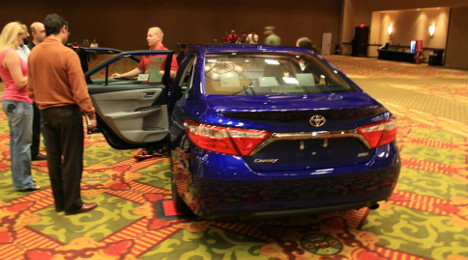
On a Thursday afternoon at a hotel in the Charlotte suburbs, a crowd of auto journalists — flanked to the left by a deep blue 2015 Toyota Camry XSE reflecting overhead ballroom lights — listened to a presentation on the Camry’s redesign by Darlene Morgan of Southeast Toyota Distributors.
Southeast Toyota was hosting a media event in Concord, N.C., to introduce the completely redesigned 2015 Camry, so Auto Remarketing made the short trip from our Cary, N.C., offices and caught up with the Southeast Toyota team.
The Deerfield, Fla.-based company — which is part of JM Family Enterprises — indicates on its website that it is the largest independent distributor of Toyota and Scion vehicles in the world, and its dealers represent about a fifth of all U.S. Toyota vehicle sales.
There are 176 stores throughout the Carolinas, Georgia, Florida and Alabama that are within the regional reach of Southeast Toyota, which is responsible for distributing new-vehicle inventory, parts and accessories to these dealerships.
Additionally, SET’s duties also include providing training to these stores, which it does at no charge, Morgan said during an interview with Auto Remarketing. And that’s where the mission for these product-launch events comes into play.
“We feel the more knowledgeable the field consultants are, understanding the product, getting hands-on the product, the better they’ll be with the customer,” said Morgan, sales training manager with SET.
“So, we do events like this when we launch new vehicles. We bring them out; we give them the opportunity to drive the competitor product and our product, right behind each other, side by side, so they can feel those differences and have those key stories (to share) with some of the customers,” she added. “We’re big on training.”
As Morgan put it, “there’s only so much you can get from taking an online test.” While technology certainly has its benefits in the training process, getting the five-senses experience with the vehicle can make for a more meaningful discussion with the customer.
By going through this hands-on training with new-vehicle launches, dealers can tell shoppers, “I felt exactly what you were talking about; here’s what you’re going to feel when we go out there,” Morgan said.
“It’s more relatable,” she added.
Having that relatability and achieving that personal-experience understanding with a customer, Morgan agreed, can be just as important as the marketing piece.
“It’s just as important,” she said, “just as the online side is important to a customer to get all their research. At the end of the day, they’re still going to want to touch that car. It’s a very small percent that probably, actually, just buys a car sight-unseen. And we feel the same way with our sales consultants. We want to give them that experience.
“So, we think it resonates and it makes a difference to give them all of those touch-points, to give them those stories,” Morgan continued. “And also, they’re networking with other sales consultants in other dealerships that are in the same territory and asking them questions.”
By doing that, dealers are getting to share stories and learning from one another about working with customers.
And that, as she put, is “priceless.”
Editor's Note: Stay tuned for the Nov. 1 digital edition of Auto Remarketing, where we include an online slideshow with more photos of the 2015 Camry.
Auto Remarketing is hosting NADA Used Car Guide for a free webinar to help dealerships smooth out what consumers consider one of most dreaded parts of the buying process.
During the free session titled, “Close More Deals, Negotiate Less,” a pair of NADA UGC experts will ask dealers how satisfied their customers are with the store’s appraisal process and how it compares to recent research.
The Deloitte 2014 Global Automotive Consumer Study indicates that consumer dissatisfaction with the appraisal process is at 79 percent. That’s up from a dissatisfaction rate of 68 percent in 2009.
In this webinar, NADA Used Car Guide experts will identify the factors that are primary concerns for consumers and the actions dealers can take to improve the appraisal process. Managers will learn how to make the process one that consumers can understand, earn their trust faster and close more deals with less back and forth.
Webinar presenters Stu Zalud and Jim Dodd will demonstrate how taking the consumer through the appraisal process from start to finish, showing them everything that goes into the store number and presenting that number in an official appraisal document will close more deals faster, without the back and forth.
The webinar is scheduled for 2 p.m. ET on Thursday.
Leveraging more than 35 years of automotive retail experience, Zalud brings a dealer-focused perspective and insight to his role as director of dealer services for NADA Used Car Guide. Zalud joined NADA in this position in April 2007 and is responsible for promoting NADA Used Car Guide’s data and services to franchised and independent dealers, presenting at various industry events, and contributing to the development of future products and services to meet changing dealer needs.
Zalud’s previous experience includes 30 years as an Oldsmobile and Pontiac dealer in Cleveland and eight years as a Cadillac dealer in Hilton Head, S.C. In addition, he served on the NADA board of directors, NADA Used Car Guide board of advisors, and as chairperson of both the Greater Cleveland and Ohio Automobile Dealers Associations. He also served a five year term as a member of Ohio’s Dealer Licensing Division of the State.
Dodd joined the NADA Used Car Guide team in 2010, bringing more than 10 years of auction experience and dealer-focused perspective to his role as the account executive for automotive dealers.
At Southern Auto Auction, Dodd held various positions in sales and marketing. As Southern’s director of marketing, Dodd focused on information technology to develop electronic delivery systems that communicate auction information and data to dealers in real time.
Dodd was instrumental in the development and marketing of the industry’s first hand held utility, CarLots-2-Go, allowing dealers to download vehicle lists to their PDA or Smartphone through a WiFi network.
Dodd served on the board of directors for the Connecticut Auto Dealers Association representing the auction industry.
Dealers can complete the registration for the free webinar by going to this website.
The folks at Swapalease.com released a blog post on their site this week regarding photo-taking mishaps to avoid when selling a vehicle online. While most of these tips are aimed at private sales, these guidelines are good to keep in mind for dealer sales, as well. The following 11 suggestions from the Cincinnati-based marketplace are situations and photo-taking practices to avoid:
- Poor photo filters: Filters might be okay to use on your Instagram for your night out on the town or a trip to an exotic locale on your vacation. But for selling transparency? The clearer, the better.
- Stretched photos: Make sure the photo accurately represents the true dimensions of the car.
- Inappropriate vehicle location: A photo of your car right next to a dumpster doesn’t exactly give the right impression, does it?
- Improper photo orientation: Your cars are designed to navigate the horizontal planes of life — make sure your photos reflect that. You’re selling a car, not a rocket ship.
- Nighttime photos: Just like you try to keep your lot as well-lit during business hours as possible, customers want the same in an advertisement for the vehicle.
- Poor photo cropping: Show the whole car — having parts of the car off-frame may suggest there are parts of it you’re trying to hide.
- Sun glare photos: Once again: the clearer, the better. If you’re having trouble finding a good angle at a certain time of day, move the car to a better location, turn it around, or take the photo at a different time.
- Inappropriate vertical shots: If you’re taking a photo in a pinch while working on a tight deadline and have to use your phone, be sure to turn it sideways so the photo is a landscape, not a portrait.
- Not having interior shots: Customers want to see the inside of the car just as much as the outside.
- Modeling shots: Many customers won’t get the right impression if the camera is focused on something other than the vehicle for sale.
- Modeling the features: Customers are smart. You don’t need someone to point out the features one-by-one in the photos. If you say it has a sunroof, they’ll notice it by the simple fact it has one in the photos. No need to go any further than that.
When dealership personnel say quickly and almost automatically that “we treat everyone the same,” what is really meant is that they greet prospects consistently and similarly with a sales process in person or digitally.
However, having the capacity and ability to treat every walk-in customer the same simply can't be accomplished. It’s the perfect ideology, the perfect philosophy that we all want to live by, but the truth of the matter is that it is not possible.
After all we are humans, not robots. We can’t be shaped and programmed to treat everyone the same. And, who would want that anyway? Certainly not your customers.
And, it’s more than semantics.
It Simply Isn’t True
Think about it. Does a physician treat all her patients the same? Does your child’s teacher treat all his students the same? Of course not. They would have a pretty bad reputation if they did. Why?
Each patient has his own well being issues and each student performs at her own learning style that is personal to them. Why would it be any different for a client or customer purchasing a car?
What brings them into this dealership, their finances, influencing factors, comfort and ability to negotiate are all personal and individual.
A dealership’s sales team undergoes the same level of training. How is it that some sales advisers are so much more engaged and sell to women with ease? Others, even seasoned “car guys,” can have a more challenging time — sure, they may “get through it,” but they don’t have the comfort and success rate.
Don’t Let Past Experiences Interfere with Sales
During sales training, it is important to advise sales professionals not to let their experiences from the past interfere with their sales engagement. But that is much easier said than done.
Folks who sell cars are just like us all; they have full and robust lives, and sometimes those experiences from the past influence the way they behave in the present. It’s largely because each and every one of us has a neurological make-up filled with fright and flight responses. Lets take a closer look.
Sales advisers interact with numerous customers every day. The good, bad and the ugly experiences, behaviors, reactions and emotions of previous situations are all stored in the human brain. When confronted with a similar situation, whether consciously or not, elicits reactions based on past recollections.
Let’s say a sales associate approaches a women shopper who resembles a one-time friend with whom the relationship soured. Instantly and unconsciously there will be a negative association formed with this customer. In most cases the sales process will not go well or be successful as the sales professional person fails to deliver customized, service.
In most cases when pressed what went wrong, the sales member feels and believes that “that customer rubbed me the wrong way.”
Customized Treatment is Critical
Today is about customization, both in offering tangible and intangible services. The same holds true in selling and approaching customers. Using the same opening line and attempting to sell customers equally may not go so well.
According to the new world definition, being “customer-focused” means going the extra mile in delivering quality experience to each customer individually according to their preferences.
This means dealerships must ensure that their team of experts on the sales floor and BDC don’t deliver cookie cutter lines, openers, or emails to customers; but rather understand each customer as well as possible the way they want to be treated.
That’s what customers are now looking for. Not, just a sales exchange. And, it’s a tall order!
Understanding the customer and offering customized treatment has become even more crucial today because the auto industry is gradually shifting from male to female-focused, leaving dealership management trying to truly understand this large and growing market segment. Its time to break away from the so-called ideal philosophy of treating everyone the same and begin deliver tailored treatment to each customer. And, who knows what that approach will be until the customer speaks, and dictates it?
Tips for Your Dealership
1. At a sales meeting, brainstorm on ideas for opening conversations and ice-breakers with women.
2. Women buy a car because they trust and respect the seller. Period. Ask questions to get a true understanding of what she is looking for and how you can be a trusted adviser. Don’t stop asking until at least five questions have been asked to each customer. Get to know her. That is relationship building and what women want.
3. Outbound emails should be personal and of value to each client. Provide her with women- and family-relevant content that will truly assist her.
4. Be supportive, attentive and interested. Above all, listen.
5. Speak in full sentences to women. Many times we hear that sales advisers say “leather or cloth”? etc. The point is there is another adult being spoken to, so don’t be in such a hurry that you stop speaking to them and instead start talking at them.
6. Don’t ask for a test drive too early without being very clear on No. 2 above.
7. Don’t jump to conclusions about any of your customers. Even with a husband and wife and asking who is going to initiate the paperwork. Keep your eyes on both of them.
Editor's Note: Anne Fleming is president and car-buying advocate of Women-Drivers.com and a guest contributor to Auto Remarketing. She was also recognized as one of AR's 2013 Women in Remarketing.
If you see a CarMax commercial on TV, chances are, you’re not going to see the price of the car advertised.
Here’s what you will see, though: the company emphasizing the positive experience a CarMax store delivers to consumers.
That’s just one example that NADA Used Car Guide’s Stu Zalud and Jim Dodd shared with Auto Remarketing in a recent conversation about how dealers can improve the experience shoppers have at their stores, particularly as it relates to a part of car-shopping all too often found to be a significant “pain point” — the appraisal process.
In a presentation titled “Close more deals, Negotiate less,” NADA Used Car Guide cites data from the Deloitte 2014 Global Automotive Consumer Study indicating that consumer dissatisfaction with the appraisal process is at 79 percent. That’s up from a dissatisfaction rate of 68 percent in 2009.
NADA Used Car Guide lists these four factors as primary concerns consumers have with the appraisal process:
- Length of time it took
- Value they received
- Lack of transparency (Explanation)
- Lack of trust
Breaking some of that data into specifics, the company included an infographic in its presentation summarizing consumer responses to this prompt: “Please rate how satisfied you were with each of the following aspects for your last used-vehicle appraisal.”
Regarding length of time, 37 percent were satisfied; 50 percent were neutral; and 13 percent were dissatisfied.
On price, 26 percent were satisfied; 33 percent were neutral; and 41 percent were dissatisfied.
Meanwhile, only 23 percent were satisfied with the explanation they received; 45 percent were neutral; and 32 percent were dissatisfied. This hammers home the point from Zalud and Dodd that customers are often unsatisfied with the appraisal because they aren’t provided enough information.
Improving consumer satisfaction with an explanation can actually help customers feel more comfortable with the values put on their car; in other words, if they can see how you got there, they’re more likely to accept the price.
Dodd illustrated that point with this example. Say, you’ve got a diamond engagement ring and you take it by the jewelers after a few years to have it appraised. If the jeweler came back simply with a piece of paper with a dollar amount written in pen, chances are you wouldn’t appreciate it.
But that’s the way car appraisals are still done, at times. The appraisal process needs to be transparent and explanatory, Dodd and Zalud said.
Or, as their presentation notes when explaining the vehicle appraisal of NADA Used Car Guide: “Consumers do not consider the condition of their vehicle when evaluating it on their own. By detailing the conditions that lead to an adjusted value, they are more willing to adjust their expectation.”
I’ve discussed the various issues that are putting gross margins under pressure. Those factors aside, there’s another barrier that dealers have to contend with — the fact that consumers come to the dealership armed with more knowledge than ever. When the amateur knows more than the professionals on your lot, it’s difficult for salespeople to develop trust and add value.
Wanted: Product Experts
The average customer conducts about five months of research before visiting a dealership. Information available on the Internet and the ubiquity of mobile devices mean consumers can access all the information they need about a car anytime, anyplace — including your showroom.
According to a Nielsen/Cars.com survey, 83 percent of consumers have a smartphone in their pockets when they walk into your dealership. That means even when they’re in your showroom, they’re able to access information not immediately available to the salesperson. That makes it nearly impossible for your salespeople to build trust and add value.
The fact is that today, consumers don’t want salespeople; they want product experts. Salespeople tend to be very knowledgeable about models in general but not necessarily about specific units. But consumers already know about makes and models. You have to talk about why the cars on your lot are preferable to the ones offered at a nearby competitor.
Why Buy This Car?
Used-car buyers, in particular, have done their research online and have already made the decision to visit your store to see a specific vehicle — for instance, a BMW 328i. Unlike new-car buyers, they didn’t come to your store because you sell the BMW 3 Series. They came because they found a particular 328i on your website and they want to know why they should buy the one on your lot today. So when your salesperson starts talking about the benefits of the 3 Series in general, the used-car buyer is thinking, “I already know this.”
That’s why it’s critical for dealerships to equip their staffs with the insights that consumers already have. Your salespeople have to be instant experts on every car on your lot. They have to be able to demonstrate why the BMW 328i on your lot is better than the one a mile down the road that’s $1,000 cheaper.
The only way to build that value and trust to reach today’s car shopper is to adapt your processes. In my next post, I’ll elaborate further on why this is necessary.
Pat Ryan Jr. is the CEO and Founder of several tech companies focused on transforming automotive retail, including FirstLook and MAX Digital. This and more of his posts can be found at getrelevantordie.com.
So far I’ve discussed two factors that are putting gross profit margins under pressure: market-based pricing and the impending increase in the supply of used cars. There’s a third element to this equation: the fact that dealers have fundamentally changed their pricing strategy without also changing their sales and marketing approach. That has led to a disconnect that we call the “double discount.”
“Double Discount” Defined
The first discount used to be taken at the desk with the “first pencil.” But now, with market-based pricing and the transparency of the Internet, the first discount is actually taken with the Internet price before the consumer even gets to the store.
Then when the consumer is negotiating the car deal, salespeople are often programmed to try to close by discounting price, leading to a double discount.
That’s because salespeople have been trained to negotiate to close the sale by discounting and consumers have been conditioned not to buy unless they negotiate a significant discount. This has put dealers in a bind. Either they double discount on price and erode their margins, or they refuse to negotiate on price and discount their closing rates.
The Need to Adapt
So what’s the solution? Increase your close rates without discounting. Or at the very least, minimize the discount offered when already priced to market. How? By adapting the way you market and sell your cars.
That’s easier said than done, of course. But the bottom line is that dealers have fundamentally changed the way they price their inventory without adapting the way they market their cars online or sell them on the lot. In the long run, that’s an unsustainable situation.
Over the next few posts, I’ll describe how dealers can avoid the double discount problem by changing their sales and marketing strategies.
This is the third installment of a three-part series on gross profit. See the first installment here. See the second installment here.
Pat Ryan Jr. is the CEO and Founder of several tech companies focused on transforming automotive retail, including FirstLook and MAX Digital. This and more of his posts can be found at getrelevantordie.com.