Consider this episode of the Auto Remarketing Podcast a preview of what’s to come during Used Car Week 2018.
Joining Nick for this edition are representatives from two presenting sponsors — Anne Holtzman of Allied Solutions and Jeremiah Wheeler of DRN — who offer a glimpse of their presentations focused on how watching insurance data can be a great way to mitigate risk in connection with repossessions and recoveries.
The full discussion can be found below.
Download and subscribe to the Auto Remarketing Podcast on iTunes or on Google Play.
You can also listen to the latest episode in the window below.
Catch the latest episodes on the Auto Remarketing Podcast homepage and on our Soundcloud page.
Please complete our audience survey; we appreciate your feedback.
It’s been about two weeks since Hurricane Florence lashed the Carolinas with rain measured in feet in some places. Now the task given to the wholesale industry — contending with flood-damaged vehicles — is gaining steam.
To accelerate catastrophe response in the Carolinas and Virginia, Insurance Auto Auctions (IAA), a business unit of KAR Auction Services, announced the expanded launch of its IAA Tow App. This enhanced technology utilizes complex data analytics and the latest mobile technology to streamline the dispatch and towing cycle of salvage vehicles.
During natural disasters and catastrophic events, IAA recovers flood-damaged and total-loss vehicles on behalf of their insurance customers, clearing roadways for recovery vehicles and expediting the claims process for policy-holders.
The company indicated the second phase of IAA Tow App has been deployed to towing and hauling contractors transporting vehicles impacted by Hurricane Florence and the resulting flooding.
“One of our primary commitments is to quickly and efficiently transport customer assets to our facilities. This is particularly important during catastrophic events when impacted vehicle volumes surge,” said John Kett, president and chief executive officer of IAA.
“By digitizing and automating a historically cumbersome, paper-driven assignment process, our towing partners can better manage their assignments and loads,” Kett continued. “And by accelerating recoveries, we can inventory, process and auction salvage vehicles faster to help our customers and the communities we support get back on their feet.”
The IAA Tow App utilizes inventory management software to automatically push tow assignments directly to IAA contracted towers with capacity on their tow trucks or haulers. When a tow truck driver accepts an assignment, the app can open the mobile device map function to provide driving instructions.
Once assigned vehicles are located, drivers can check in and quickly complete the entire transport process via the app — from location, to pick-up, to drop-off at an auction facility or holding yard.
“We’ve leveraged the best mobile technology and fueled it with home-grown engineering and data from across the KAR platform to deliver a fast, simple and intuitive resource for our partners,” said John Krupnik, senior vice president and chief technology officer at IAA.
“The app also allows us to deliver real-time tracking and recovery information to our customers so they can monitor the location and status of their assets anytime, anywhere.”
IAA has a catastrophe response team prepared year-round to respond to natural disasters. In advance of Hurricane Florence and its subsequent flooding, IAA secured nearly 1,100 acres available to store recovered vehicles, obtained commitments from over 1,300 towers and has more than 400 IAA team members ready to respond.
IAA has 16 branches in Virginia, North Carolina, South Carolina and Georgia with capacity for the anticipated vehicle volume as a result of Hurricane Florence and historic flooding. All IAA branches, including Wilmington, N.C., are open and fully operational.
Watching for flood units in the lanes
Meanwhile, AutoCheck Auctions acknowledged the sometimes flood-damaged units still make their way to the block. To help dealers and consignors, AutoCheck Auctions vice president Jamye Carpenter shared company plans in a message to Auto Remarketing.
AutoCheck Auctions is currently working on a special report called The Florence Report that will be provided at no additional cost to its auction customers.
“This report will be made available as part of our ongoing effort to provide critical data, helping to protect both auctions and their dealer customers from undisclosed problem vehicle,” Carpenter said.
“It is important to note that the Florence Report will not indicate that a car has flood damage. This report will alert you to the fact that a particular vehicle was registered in one of the flood impacted ZIP codes, prompting you to take a closer look at that vehicle for potential flood damage,” Carpenter continued.
If you find a vehicle has flood damage, Carpenter asked customers to report this information to AutoCheck Auctions by calling (800) 332-2608 or sending a message to [email protected].
Carpenter also offered these tips for spotting a flood-damaged vehicle, including
1. Check the outside body panels for waterlines.
2. Check the carpet, upholstery, and inside doors for mud, dirt, damp feeling and discoloration.
3. Check beneath the vehicle's carpet to see if the pad beneath the carpet is damp.
4. Check for dirt buildup around seat tracks.
5. Check under the dash and in the glove box for dirt or dampness.
6. Look at the owner's manual. Check to see if the paperwork was ever wet.
7. Waterlines could be visible inside the car. Look at the seats, inside doors and door jams.
8. Smell the inside of the vehicle. A musty or damp smell can be a good indicator of flood damage. Is there an over powering use of air freshener?
9. Make sure all the dash lights are working properly. Do the turn signals work?
10. Check under the vehicle for corrosion, flaking metal underneath.
11. Check inside the engine compartment for waterlines, dirt or mud.
12. Are the headlights or taillights fogging?
13. Check the air cleaner for water.
14. Check the oil to see if there's a copper or milky color which could indicate water damage inside the engine.
15. Look for water in the spare tire compartment.
16. Look inside the trunk for dampness, dirt or mud.
Retail challenges, too
On the retail side of the industry, Auto Remarketing connected with Hendrick Automotive Group on Sept. 21 to gauge how Florence impacted operations within the dealer group and how Hendrick prepared ahead of the storm’s arrival.
A Hendrick spokesperson said via email that the retailer took a proactive approach and began closing stores in towns near the Carolina coasts early in the week of Sept. 10-14.
Employee safety being the top priority, the automotive group wanted enough leeway for team members in those areas (specifically: Wilmington, N.C.; Jacksonville, N.C.; Charleston, S.C.) to evacuate, per the recommendation from authorities.
The proactive response to the storm is par for the course for the Hendrick group, which has dozens of stores in the Carolinas.
During events like these, there is constant and strategic communication and coordination between the retailer’s management in Charlotte and the teams at individual dealerships.
Ahead of such storms, stores in affected areas do what they can to secure vehicle sand facilities ahead of time, plus any nearby objects that could cause damage, the spokesperson said.
The protocol for post-storm is to abide by the steps given by local authorities as team members re-enter and assess damage.
Sharing more details on the response to Florence, Hendrick also closed dealerships further inland in the middle to later part of the Sept. 10-14 week. Some have since reopened.
Here’s a breakdown by market, according to the group:
North Carolina
Fayetteville: Closed Sept. 12. Re-opened Sept. 18.
Raleigh-Durham area: Closed 6 p.m. (ET) Sept. 12. Re-opened Sept. 17
Greensboro: Closed 2 p.m. (ET) Sept. 14. Re-opened Sept. 17.
Charlotte-Concord area: Closed 2 p.m. (ET) Sept. 14. Re-opened Sept. 17.
South Carolina
Easley: Closed 2 p.m. (ET) Sept. 14. Re-opened Sept. 17.
Fort Mill: Closed 2 p.m. (ET) Sept. 14. Re-opened Sept. 17.
As of Sept. 21, the exact damage was still to be determined, but the Hendrick spokesperson said the Wilmington and Jacksonville stores were the hardest hit, with other areas incurring minor impact.
In those highly impacted areas, flooding had made it difficult to get to those stores. The group hoped to have those operating again soon, as of Sept. 21.
Auto retail expert Cory Mosley recently launched an online strategic consulting and presentations communications coaching service to help vendors and dealers win more sales.
The resources are all available at MOSLEYB2B.com.
“Having spent almost two decades working with and advising dealers, associations, and manufacturers, I have developed a unique perspective on how to truly penetrate a market and help clients become thought leaders in their given product category,” Mosley said in a news release.
“I help accelerate the growth of vendors who are truly committed to helping our Industry remain strong and profitable, by helping them move their prospects to yes and next steps to win more deals,” he continued.
MOSLEYB2B.com is a division of Mosley Automotive, which Mosley founded in 2004. Over more than 20 years, he has established himself as a steadfast expert dedicated to helping his clients sell more, decrease expenses and increase net profit.
MOSLEYB2B offers two critical business-enhancement services, both calculated to help clients become thought leaders, scale for opportunity more quickly, and set and reach new levels of sales growth.
Working with clients’ internal teams, MOSLEYB2B can deliver on two topics; the first being strategic consulting. Details on that include:
• Competitive advantage strategy development
• Dealer and OEM market penetration strategy development
• High ROI market strategy development
• Thought leadership marketing and positioning strategies
The other subject is presentation skills coaching and content development, including:
• Coaching with Cory, a one-day program featuring skills improvement and action plan development, with on-camera role play and training
• On-site coaching for sales teams with Cory at your facility, working with your group to build persuasive and engaging presentation skills across your organization
• Content development and curation, leveraging MOSLEYB2B’s extensive experience creating powerful keynote, sales, and OEM RFP stand-up presentations
MOSLEYB2B is designed to help executive, sales and marketing professionals use story-telling skills, translate data into compelling and convicting observations and sale points, use voice tone and engagement techniques to build trust and convey conviction, and to guide audiences toward decision or action next steps.
Mosley’s credentials include working with high-profile dealer groups, Tier 1 vendors, dealer associations and multiple OEMs. He is a certified speaking professional (CSP) accredited by the National Speakers Association.
For more information, visit MOSLEYB2B.com.
New research from AAA could make the late-model vehicles in your inventory equipped with Apple CarPlay and Google’s Android Auto even more appealing to your dealership’s potential buyers, especially the purchasers who rate safety as one of the main criteria during the shopping process.
According to a research project orchestrated by the AAA Foundation for Traffic Safety, Apple CarPlay and Google’s Android Auto are less distracting to drivers when compared to built-in vehicle infotainment systems designed by automakers.
While AAA acknowledged many of today’s infotainment systems create potentially unsafe levels of distraction by allowing drivers to perform complex tasks like programming navigation or sending a text, researchers discovered CarPlay and Android Auto were 24 percent (5 seconds) faster on average than the vehicle’s native system when making a call and 31 percent (15 seconds) faster when programming navigation.
Experts said this difference is critical, as drivers who take their eyes off the road for more than two seconds double their risk of a crash. AAA is encouraged by these findings as the organization said they indicate that popular infotainment systems can be designed in a way that is less distracting.
Distracted driving is responsible for more than 390,000 injuries and 3,500 deaths every year, according to AAA
“Google and Apple are proving that it is possible to reduce the level of demand in-vehicle infotainment technology places on drivers,” said David Yang, executive director of the AAA Foundation for Traffic Safety.
“While improvements are necessary before any of the systems can be considered safe to use while driving, this research shows that smartphone-based software has the potential to offer a simpler, more familiar design that is less confusing to drivers, and therefore less demanding,” Yang continued.
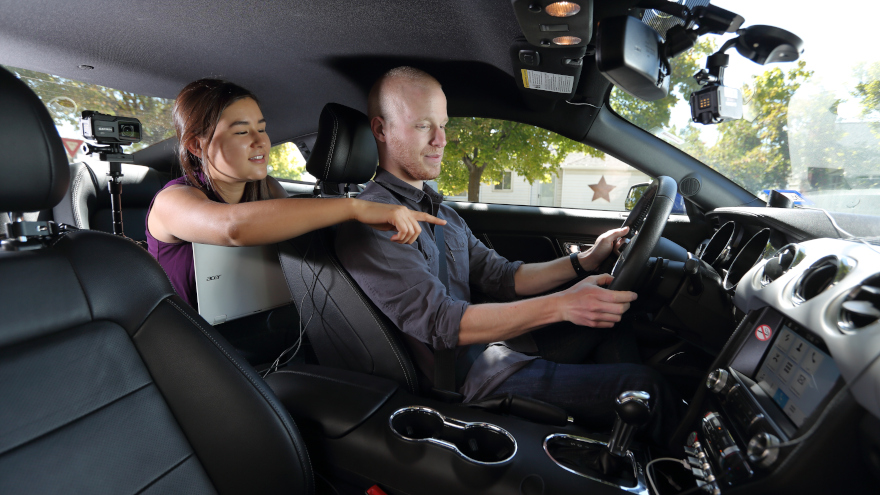
The AAA Foundation for Traffic Safety teamed with researchers from the University of Utah to evaluate five vehicles to determine the amount of visual and mental demand placed on drivers by CarPlay, Android Auto and each vehicle’s native infotainment system. The specific units involved in the study included”
• 2017 Honda Ridgeline RTL-E (HondaLink)
• 2017 Ford Mustang GT (SYNC 3)
• 2018 Chevrolet Silverado LT (MyLink)
• 2018 Kia Optima (UVO)
• 2018 Ram 1500 Laramie (Uconnect)
While CarPlay and Android Auto can still create potentially unsafe levels of distraction and should not be used to perform complex tasks when behind the wheel, researchers determined they decrease the demand placed on drivers compared to similar technologies offered by automakers.
Researchers also found that CarPlay and Android Auto did not differ significantly from one another in the level of overall demand. A rating scale was used to measure the visual (eyes-off-road) demand, cognitive (mental) demand, and the time it took drivers to complete a task using the systems. The scale ranged from low to very high levels of demand.
A low level of demand equates to listening to the radio or an audiobook, while very high demand equates to an industry standard that produces demand similar to balancing a checkbook while driving.
Both CarPlay and Android Auto generated an overall moderate level of demand while the native vehicle systems created very high levels of demand for drivers. AAA recommends that industry strive to design in-vehicle technology systems that do not exceed a low level of demand.
“Automakers are experts at building safer cars, but Google and Apple are more skilled at building safer vehicle infotainment technology,” AAA president and chief executive officer Marshall Doney said. “By leveraging their strengths, the two industries must work together to significantly improve the design, functionality and safety of these technologies.”
AAA cautions that not all vehicles are created equal when examining the overall performance of CarPlay and Android Auto.
Researchers noticed the interface design of some vehicles’ native systems resulted in additional menus and text on vehicle touchscreen displays, which increases the overall workload on drivers. Each vehicle’s system also influenced what features were locked out while the vehicle was in motion when using Android Auto and CarPlay.
For example, AAA found that some vehicles allowed drivers to access their entire contact list when calling or texting, while others limited the number of contacts shown or completely blocked access — resulting in the smartphone-based systems performing differently across various vehicle models.
AAA urged drivers not to use in-vehicle infotainment technology to perform non-driving related tasks when behind the wheel to avoid driving while distracted. Even with Apple CarPlay and Android Auto requiring less overall demand and time to complete a task, drivers still took up to 33 seconds to complete a navigation task compared to 48 seconds for native systems.
At 25 mph, researchers calculated that drivers can travel the length of three football fields during this time.
“Drivers must use common sense when it comes to technology inside the vehicle. Just because it is available, doesn’t make it safe to use,” said Jake Nelson, AAA director of traffic safety and advocacy.
“Smartphone companies and automakers must collaborate to reduce the potential for distraction that technology places on drivers. The airline industry doesn’t compete on safety, and neither should automakers. Motorists deserve better,” Nelson went on to say.
Nelson added that locking out high-demand functions such as programming navigation and text messaging can significantly reduce the level of demand created by in-vehicle infotainment technology; a step recommended by the National Highway Traffic Safety Administration.
Since the vehicle’s software influences which features are locked out, AAA emphasized that it is important that automakers and software designers work together to improve the safety of in-vehicle infotainment technology.
“AAA is sharing this new research with automakers and system designers to help advance the dialogue about ways to improve the functionality and design of new infotainment systems and the demand they place on drivers,” Doney said.
“By working together to leverage the design benefits of CarPlay and Android Auto and addressing the issues that prevent the software from effectively interacting with a vehicle’s system, automakers and smartphone companies can improve the driving experience and limit distraction on the road,” Doney went on to say.
Expanding on research released in October 2017, AAA also evaluated distraction levels caused by built-in (native) infotainment systems in 10 other 2017 and 2018 model-year vehicles. A total of 76 drivers ages 21 to 35 participated in the study of these additional vehicles.
Research found that none of the 10 vehicle infotainment systems produced low demand, while six systems generated high or very high levels of demand on drivers.
The complete report can be found here.
Your company employees can be one of your greatest assets, but a new study from Shred-it showed how your workers also can present significant risks, too.
With one-third of working adults in the U.S. admitting to potentially risky behavior at work, employee negligence poses major security concerns for U.S. businesses, according to Shred-it's State of the Industry Report, which exposes information and data security risks currently threatening U.S. enterprises and small businesses and includes survey findings from the Shred-it Security Tracker, conducted by Ipsos.
When assessing the cause of data breaches, the report found that employee negligence or accidental loss is a main cause. Nearly half of c-suite executives (47 percent) and small business owners (42 percent) reported that human error or accidental loss by an employee was the cause of a data breach.
Additionally, more than one in four c-suite executives (28 percent) and nearly one in five small business owners (17 percent) reported human error or accidental loss by an external vendor caused their organization to suffer a data breach.
“The study’s findings clearly show that seemingly small habits can pose great security risk and add up to large financial, reputational and legal risks,” Shred-it vice president Monu Kalsi said.
“For companies looking to better protect their data, smart information security begins with giving employees access to smart information security practices and training,” Kalsi continued. “Through consistent training and education, businesses of all sizes can take back ownership of information security and create a more security-minded work culture among their employees.”
The study also found that 78 percent of c-suite executives and just over one in four (28 percent) small business owners plan to train their staff on information-security procedures and policies over the next year.
Additional findings from the report available online here expose high risk areas and activities businesses should consider examining, including:
— Off-site and remote work habits are in play. When employees work remotely or off-site, businesses believe the odds of a data breach occurring are higher
— Eight-six percent of c-suite executives and 60 percent of small business owners agree that the risk of a data breach is higher when employees work off-site than when they work at the office.
— However, despite security risk concerns, just 35 percent of small business owners have a policy in place for storing or disposing of confidential information while working off-site, while 54 percent of small business owners have no policy in place at all.
— A majority of c-suite executives have an information security plan in place. These respondents reported that they train employees on keeping sensitive information out-of-sight when working in a public space (81 percent), sharing company-issued electronic devices with family or friends (60 percent), keeping company-issued devices safe from interference from children or pets at home (56 percent), using public Wi-Fi (54 percent), identifying fraudulent emails (71 percent) and providing guidance on how to report a lost or stolen electronic device (73 percent).
— Physical document security is a concern. From loosely stored confidential notes on a desk to the theft of paper documents while working off-site, U.S. employees create vulnerable paper trails.
— Most U.S. workers (65 percent) admit they take notes at work in a paper notebook. Additionally, two in five (39 percent) admit they leave these work documents or notebooks on their desk after they leave the office for the day, leaving documents with confidential information vulnerable to theft.
— Thirty-six percent of c-suites admit employees lost or had paper documents with sensitive company information stolen, compared to just 6 percent of small business owners.
— As workers continue to turn to pen and paper to take confidential business notes inside and outside the office, the good news is that 96 percent of c-suites say they have a policy for storing and disposing confidential paper documents. However, just 49 percent of small business owners report that they have a paper policy in place.
— Device use is a major consideration, too. Bad employee habits are bad news for businesses, as U.S. workers are losing computers and mobile devices and/or leaving them vulnerable to theft.
— One in four U.S. workers (26 percent) leave their computer on and unlocked when they leave work for the day.
— Around half of c-suite executives indicate that they have had employees who lost or had their company laptop/device (49 percent) or company mobile phone (43 percent) stolen. Comparatively, small business owners were much less likely to report employees had lost or had their company laptop/device (7 percent) or company mobile phone (9 percent) stolen.
— Nearly one in five c-suite executives (17 percent) and small business owners (18 percent) suffered a data breach due to an employee losing or having sensitive information stolen.
On the surface, managing the total cost of ownership for vehicle fleets seems like a fairly straightforward calculation: Buy the right vehicles at a discounted price with low depreciation rates, take good care of them, maybe recondition them a bit before sale and wholesale them off as quickly as possible.
Then, start all over again.
In reality, professionally controlling your total ownership costs better than your competition involves a greater level of thought, planning and analysis.
While the straightforward plan of buying well and selling quickly covers the basics, it will likely result in you or your clients leaving a lot of money on the table. Within each step are opportunities to minimize your total cost of ownership with strategic planning, analysis and decision-making.
If you manage, advise on, or own a large fleet of vehicles, consider these four strategies for improving your bottom line.
1. Choose the right vehicle
What do most employees who drive fleet vehicles really need? A safe, reliable car that will get them to meetings and other engagements on time.
Perhaps a utility vehicle with the base features required for the team to execute their tasks in the field. The team might appreciate driving a more popular brand or having features like Bluetooth and backup cameras, but those perks can add up quickly and may seem like a waste of money.
Even basics like automatic windows and mirrors or cruise control aren’t always necessary for entry-level staff or quick, non-strategic vehicle uses.
However, just because your current drivers don’t need the features doesn’t mean you should automatically avoid them.
While base models may on the surface look “cheaper” — and provide everything your drivers need — they can actually cost more money in the long run once you factor in the significant reduction in remarketing proceeds when it comes time to sell the vehicle.
Nearly every vehicle put through a remarketing channel will eventually end up in the hands of a consumer. What that consumer is willing to pay for that vehicle has value consequences all the way up the supply chain to the original user of the vehicle, so it’s good to keep resale in mind and consider the desires of the end consumer when buying your fleet vehicles.
When remarketing at an auction or other wholesale alternative, the buyer is typically a wholesaler or dealer that will ultimately resell to the general public, so they’ll factor in the vehicle’s features and general desirability into their purchase price.
When remarketing a vehicle directly through a retail channel, the consumer coming for a test drive will likely notice and be turned off by basic inventory that lacks features like Bluetooth, power window and locks, cruise control and others commonly demanded by consumers.
At CarLotz, we have seen base versions of vehicle models like Audi Q7s, Chevy Silverados and Nissan Frontiers — typically in high demand among consumers — take much longer to sell or sell for reduced prices because they lack features like sunroofs, power windows or backup cameras.
Similarly, if these vehicles were wholesaled through an auction or online channel, wholesale buyers may avoid these vehicles because of their reduced feature set.
Cost-minimizing tip: Look beyond your current drivers’ needs when selecting vehicles for your fleet. Determine which features and models the ultimate consumer buyer may want in the remarketing process, and consider key upgrades to your fleet to maximize your remarketing proceeds down the road.
2. Be strategic with your refresh timing
Timing is everything, even with a vehicle refresh. Let’s say you bring on a new fleet every three years and sell your old vehicles in late fall.
This timing may work well for your company’s operational needs, but you’re missing peak remarketing season — spring — which means you’re not maximizing the remarketing proceeds and, as a result, increasing your total cost of ownership. The retail market for used vehicles, which spikes in the spring due to tax refunds driving consumer purchases, generally leads to increased used-vehicle prices in the retail and the wholesale market.
To manage your timing strategically, you need to not only consider your internal schedule, but also the wider market demand for used vehicles. Shift your refresh forward or backwards just a few months, and you can take advantage of spring’s more favorable remarketing conditions. As a result, you may be able to remarket your old vehicles more quickly — and for a higher price — than just a few months before or after.
Cost-minimizing tip: Analyze your fleet refresh timing, from selecting new cars to reconditioning your existing vehicles. Then, work backward and plan your next refresh to align with spring’s peak retail remarketing season.
3. Address reconditioning
Between rushing to meetings, eating in the car and spending so much time on the road, company drivers don’t always take the best care of their vehicles. So, when you’re ready to remarket your fleet, reconditioning is key if you want to get top dollar.
While a detail and windshield replacement or light paint touchup seem like obvious reconditioning tasks, sellers should consider spending a few additional dollars to remove the larger red flags, which often lead to a significant reduction in what buyers are willing to pay.
Check-engine lights, for example, are often linked to inexpensive issues like an O2 sensor or loose gas cap but will likely result in a significant reduction in buyer interest and purchase prices. Putting four new tires of any brand, replacing worn seats or rectifying dash lights will dramatically improve each vehicle’s appeal.
Used-car dealers are willing to pay up for “front-line ready” vehicles, as they will reduce the time required for getting the vehicle sold and reduce the risk that they’ll uncover other issues in their inspection process. Oftentimes, the work required to make a vehicle front-line ready is far less than the cost of doing the work
Cost-minimizing tip: Be proactive about reconditioning. Talk to your fleet manager or your account reps working with you at your remarketing channel of choice about your remarketing goals and how they can help you prep for getting the highest return on remarketing spend from your existing fleet. Your remarketing channel rep should have your goals in mind when making reconditioning recommendations.
4. Experiment with multichannel marketing
To maximize remarketing proceeds, you need to think about the whole picture, not just the puzzle piece in front of you. Looking beyond wholesale is key in the evolving remarketing industry.
With more vehicles hitting the market and auction prices dropping in reaction, strong proceeds depend on expanding your distribution channels.
While auctions and online wholesale channels will likely always be a part of the fleet-sales process, including cutting-edge online and retail remarketers in your strategy is increasingly important. These emerging distribution channels enable you to skip the middleman and go straight to the retail buyers, which pay retail prices well above wholesale.
It’s certainly not the obvious choice for every vehicle, but for vehicles that are “front-line ready” and in high demand among consumers or those that will appear far riskier than they actually are through a wholesale channel, selling through a retail channel will maximize remarketing proceeds and minimize total cost of ownership.
Of course, selling a car at wholesale may only take a week or two, while retail may take a week or two longer than that. But, assuming an average sales price of $15,000, an additional $1,500 per vehicle that you’re likely to achieve in the retail market equates to a roughly 10-percent greater return in a couple of weeks, which annualizes to well over a 100-percent return on your investment.
Cost-minimizing tip: Evaluate your current vehicles and the available remarketing channels to determine where to list each one. By strategically selling your fleet — rather than automatically choosing wholesale — you may be able to dramatically reduce your or your clients’ total cost of ownership.
When you have a large fleet, small savings on each vehicle can add up to become meaningful differences for your company or your clients. With a few changes to your strategies and decisions, your total cost of ownership could go down for every single car in your fleet. And who doesn’t like those cost savings?
Michael Bor is co-founder and chief executive officer of CarLotz.
Machines might be handling more queries from auto finance company customers with potential results that human representatives continually strive to reach but perhaps fall a little short.
One of the experts who spoke during the International Auto Finance Network Conference hosted by White Clarke Group back in January described how this approach uses artificial intelligence to transform the way companies handle customer service calls and to improve satisfaction and build loyalty.
Benji Stone, customer success lead at Digital Genius, outlined how AI can help customer service operations, using statistical software that can ingest huge amounts of historical data.
“You can either have AI trying to replace your staff, and trying to completely take away the human work, or you can have the AI trying to augment your staff, trying to aid your staff and make them more efficient,” Stone said.
“It’s kind of like the difference between the Terminator and Iron Man. The Terminator takes over the job; Iron Man kind of augments it,” Stone continues in this video available here and at the top of this page.
Finance companies are fighting a cyber-war against criminals who carry out millions of daily attacks in a bid to steal personal data and defraud businesses of millions of dollars.
That is the stark message from data security expert Royce Curtin, managing director of global intelligence at Barclays, who warns finance companies that they must constantly evolve their defenses or risk falling victims to new scams.
Gangs target companies to steal funds or increasingly to obtain customer data, which is then used to defraud consumers.
Curtin said, “Companies suffer an average 1.5-percent share price decline after cyber-attacks are made public, with some drops of up to 15 percent. Financial services experience the biggest declines and the highest regulatory fines.”
During a speech at the Auto Captives Summit in London, he provided auto finance executives with guidance on the current threats and how to combat them.
Details of his presentation are available in this video, courtesy of leading global automotive, consumer and equipment finance software business, White Clarke Group.
“Despite the increasing sophistication of the criminals, simple measures can still combat much of the threat,” Curtin said, “You have to have strong assurance programs to protect your intellectual property and personal identifiable information. You have to build defenses in depth with the customers and clients and the supply chain and vendors that you use.”
For more on the guidance, download the White Clarke Group 2018 Global Technology Report today.
The report showcases new business models and best practice from around the world in four key categories:
• Mobile and pay-as-you-go auto finance
• Artificial customer service
• Cryptocurrency, blockchain and mobility
• Cyber wars
Download your copy of the White Clarke Group report here.
Before dealer principals and store managers brush aside the issue by stating something like, “I’m a car guy, not an accountant,” NADA Academy instructor Eric Dreisbach shared eight potential pitfalls of a financial practice many dealerships might use — work-in-process (WIP) accounting.
In a blog post setting up his foundational concerns, Dreisbach explained that officially work-in-process (WIP) labor is considered an inventory of labor purchased from technicians. He said that inventories are considered assets and carry a normal debit balance.
Then Dreisbach went into the potential quandaries, especially if the dealership has a busy service drive stacked up with customers needing repairs along with reconditioning of units that managers are eager to get on the front line.
“The problem is that repair orders are typically posted before the technicians are paid,” Dreisbach said. “For example, when a technician completes his work and the RO is closed, it usually gets posted within a day or two.
“However, the technician does not get paid until the end of the pay period, a week or two later,” he continued. “This leaves a credit balance in the WIP account for that time period. Credit balances in inventory accounts are not usually accepted by the manufacturer or by generally accepted accounting principles.”
Whether or not a dealer has competent accountants either on staff or secured through another firm, Dreisbach used a separate blog post to explain eight common reasons errors can happen within WIP accounting. Those elements included:
—Tech pay raise is recorded in the payroll settings but is not updated in the service settings. This will typically result in a growing debit in the account.
—Tech bonus pay posted to WIP but not costed on the RO. Dreisbach recommended using a separate account for tech bonus pay. A store may use a cost of sale account or another payroll expense account. He said this makes it easier to track and will keep it out of WIP. “Use caution since this may impact the service manager bonus,” he added.
—Hourly technicians may be costed out on the RO but paid out of other salaries and wages. Check your DMS settings.
—Wrong technician flagged on the RO. Tech 23 versus Tech 32 for example.
—Miss-flagged/miss-posted pink tickets. Sometimes 0.3 can look like 0.8
—Unapplied labor posted as regular flat rate pay. You may flag a tech for work not costed on a RO, snow removal for example.
—Excessive open RO’s. Repair orders should be closed in a timely manner.
—Fraud. Sometimes only found if you are looking for it.
Along with some of the suggestions already mentioned, Dreisbach also offered this broad recommendation to help dealerships.
“I suggest posting the credit from the RO directly to a payroll payable account, bypassing the WIP account,” Dreisbach said. “The payroll process will then debit payroll payable and clear out the balance. Simple, accurate, and no need for extra posting and gyrations at month end.
“But whether you see work in process as an inventory asset or a liability, you must have this account on a schedule and control it by the repair order number,” he continued. “Setting up a schedule will require a bit of reconciliation but errors and omissions will show up quickly and will help keep your books tidy.”
Dreisbach’s discussions arrived as the National Automobile Dealers Association is gearing up to host a financial management seminar.
In this week-long seminar, NADA instructors Heather Westman, Jeff Breeland and Thomas Shaughness will introduce key dealership accounting principles and how to navigate both the balance sheet and income statement at the dealership and department levels.
“You’ll learn how to interpret and analyze financial statements to identify performance improvement opportunities,” NADA said while adding that some of the other key areas to be covered include:
—Maximizing cash flow and profit
—Identifying frozen and working capital
—Evaluating inventory performance
—Calculating total absorption
—Analyzing sales and gross profit
—Controlling and minimizing expenses
The training event begins on April 23. Registration can be completed at this website.
Fraud is very much on the minds of finance companies nowadays. And for good reason, as LexisNexis Risk Solutions put a figure on how much fraud added to finance companies’ operational costs.
According to the study titled, “2017 True Cost of Fraud for Financial Services," LexisNexis Risk Solutions found that for every dollar of fraud, financial services companies incur $2.67 in costs, which includes chargebacks, fees, interest and labor, according to the LexisNexis Fraud Multiplier.
Based on a comprehensive survey of 185 risk and fraud executives in financial services companies, including retail and commercial banks, credit unions, investments, trusts and wealth management, the study evaluates how to navigate the growing risks of fraud, while strengthening customer trust and loyalty.
A key finding from the study shows that digital channels increase the cost of fraud for financial services companies, if they are not managed effectively.
Analysts determined that mid-to-large digital financial services companies, which earn a minimum of $10 million in annual revenues, 50 percent of which is through online and/or mobile channels, pay $3.04 for every dollar of fraud. This is compared to mid-to-large non-digital financial services companies with less than 50 percent of revenue from online or mobile channels, which pay $2.35 for every dollar of fraud.
Fraud costs as a percentage of revenues is also higher among mid-to-large digital financial services companies.
“As digital channels become more prevalent, particularly with consumer demand for mobile banking, fraud is a significant drain on financial services companies' revenues — more than just the value of the fraud itself,” said Paul Bjerke, vice president of fraud and identity management strategy at LexisNexis Risk Solutions.
“These companies need to track and combat fraud effectively to reduce the cost on their business and protect their customers in the new digital age,” Bjerke continued.
Other key findings from the study include:
— Identity fraud, including synthetic identity fraud, is a significant issue for financial services firms, particularly in larger banks with more than $50 million in revenue. The study showed 62 percent of fraud losses for these banks are due to identity fraud. Furthermore, three-fourths of mid-large digital firms indicate identity verification as a top online challenge; they are also more likely than other financial services companies to cite device verification and excessive manual reviews as a challenge.
— Financial services firms that track fraud costs by both channel and payment method experience lower fraud costs: $2.49 per dollar of fraud, versus $3.04 per dollar of fraud. Large digital firms are most likely to track fraud costs by both channel and payment method, while mid-sized firms with revenues of $10 million to $50 million still lag behind.
— Financial services firms that layer fraud prevention solutions to counteract both identity and transaction fraud experience fewer false-positives, manual reviews and a lower overall cost of fraud.
"As the risk of identity and transaction fraud grows, particularly among digital channels, financial services companies must implement a multi-layered approach to fraud prevention. This approach helps accelerate the good transactions, and reduces the costs associated with manual reviews, successful fraud attempts and generates fewer false-positives," said Kimberly Sutherland, senior director of fraud and identity management strategy, LexisNexis Risk Solutions.
This project is the eighth annual comprehensive research study on U.S. merchant fraud conducted by LexisNexis Risk Solutions. The methodology of the results contained in this news release targeted U.S. financial services companies with a comprehensive survey of 185 risk and fraud executives conducted during March and April 2017. Respondents represented all channels, company sizes, industry segments, and payment methods.
Analysts pointed out the overall margin of sampling error is plus/minus 7.2 percent at the 95 percent confidence level. Data reflects the U.S. population of financial services firms based on weighting to U.S. Economic Census.
For more information, visit risk.lexisnexis.com.