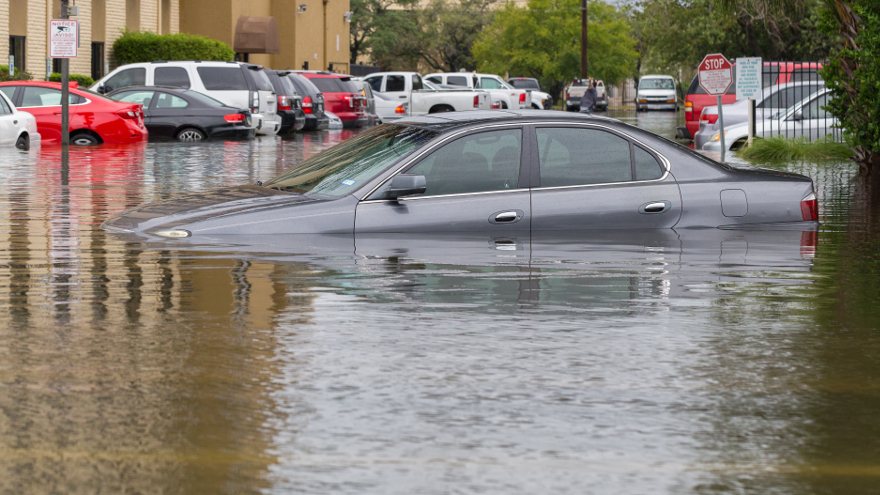
With two Category 4 hurricanes striking the United States during the past two weeks, the National Automobile Dealers Association offered 10 inspection tips for prospective buyers to spot flood-damaged vehicles.
As what’s left of Hurricane Irma cut through Georgia and Alabama on Monday, the impact left a day earlier in Florida was significant.
According to updates posted on its website, ADESA did not open its Florida facilities in Tampa, Sarasota, Orlando, Ocala and Jacksonville on Monday. ADESA Atlanta was set to close at 1 p.m. on Monday. ADESA Birmingham opened on Monday, but officials said the Alabama facility was operating with a limited staff.
While ADESA said its Orlando operation still was planning to have its dealer consignment sale on Tuesday, and its regularly scheduled consignment sale in Atlanta on Wednesday was still scheduled, the company emphasized that dealers and consignors should monitor its website for potential changes.
No matter how dealerships might be acquiring inventory in the coming weeks, NADA urged used-car managers and operators to watch for potentially damaged vehicles by taking these steps it listed on its website:
1. Check a vehicle’s title history using the National Insurance Crime Bureau’s VinCheck, the National Motor Vehicle Title Information System or a commercially available vehicle history report service, such as Experian or Carfax, etc. Reports may state whether a vehicle has been flood damaged.
2. Examine the interior and the engine compartment for evidence of water and grit from suspected submersion.
3. Check for recently shampooed carpeting.
4. Look under the carpeting for water residue or stain marks from evaporated water not related to air-conditioning pan leaks.
5. Inspect for interior rust and under the carpeting, and inspect upholstery and door panels for evidence of fading.
6. Check under the dash for dried mud and residue, and note any mold or a musty odor in the upholstery, carpet or trunk.
7. Check for rust on screws in the console and in other areas water would normally not reach unless the vehicle was submerged.
8. Look for mud or grit in alternator crevices, behind wiring harnesses and around the small recesses of starter motors, power steering pumps and relays.
9. Inspect electrical wiring for rusted components, water residue or suspicious corrosion.
10. Inspect other components for rust or flaking metal not normally found in late-model vehicles.
NAMAD gets involved in hurricane relief
In light of historic hurricane disasters in Texas and Florida, the National Association of Minority Automobile Dealershas spearheaded the NAMAD Disaster Relief Fund to assist employees and families of NAMAD members in these affected areas.
In a member-wide call to action, NAMAD has asked members to contribute $2,000 for each dealership they own to this crucial Fund.
“The response has been amazing,” NAMAD chairman Irving Matthews said in a news release. “We have already collected more than $400,000 towards our goal of raising $1 million. Even our dealerships in the affected areas have donated, despite the potential for huge financial losses.
“All of the monies raised will be distributed to NAMAD member dealer employees and their families to help them deal with the loss of income, housing and stability hurricanes Harvey and Irma have created,” Matthews continued. “Like millions of Americans coast to coast, we've made a commitment to help those in need, and help jumpstart the rebuilding process.”
NAMAD acknowledged it will take months for the most severely damaged businesses to rebuild. This, too, prolongs the crisis for affected families.
“NAMAD calls on the insurance industry to be expedient in processing claims for losses during Hurricanes Harvey and Irma,” NAMAD president Damon Lester said. “We also thank automobile manufacturers for accelerating vehicle removal and staging so damaged inventory can be replaced as quickly as possible.
“Texas and Florida represent two major markets for new vehicle sales in the U.S., and NAMAD and others are doing our part to assist those in need,” Lester said. “If all companies that support the automobile industry react and respond with immediacy and purpose, we can, more quickly, put Hurricanes Harvey and Irma in the history books.”
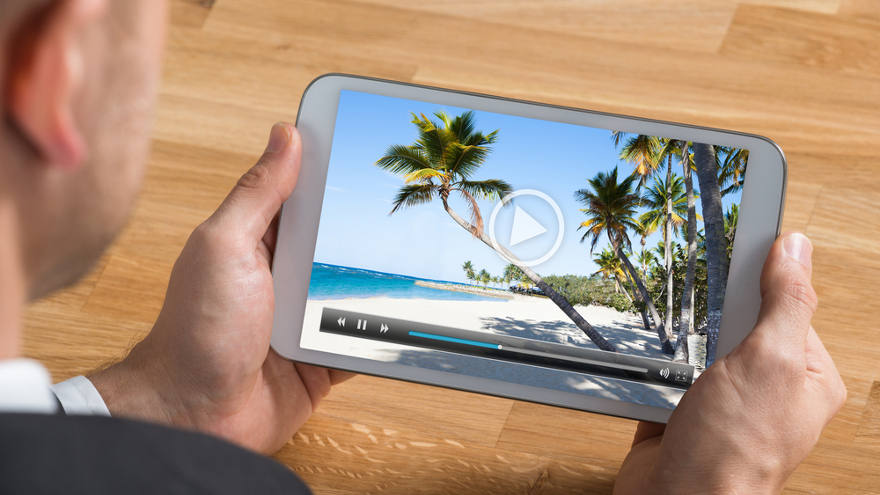
Automakers are continuing to shift more dollars from their historically massive broadcast TV buys to digital video spends.
However, for many, digital video is still a new frontier – and one that requires special considerations if marketers are to take advantage of its unique engagement opportunities and ability to drive “butts in seats” (i.e. sales).
The auto marketers who are succeeding with their video investments are doing more than just repurposing their TV spots. They’re uniquely identifying, targeting and engaging buyers based on their position within the consumer decision journey.
Let’s look at how automakers and dealer groups can use video to engage potential auto buyers throughout the customer journey.
Unique considerations
When compared with traditional TV spots, there are unique benefits and considerations for incorporating digital video into consumer engagement strategies. Digital video advertising empowers marketers to not only provide the opportunity to target people that fit the proper demographics of a vehicle, but they also have the opportunity to target specific creative based on their stage in the buyer journey.
The right platform can move them through the journey, leveraging engagement data and varied content based on their reactions to an auto brand’s message; thus, simply repackaging TV spots for digital video misses the opportunity to connect with the consumer in a meaningful way based on their level of consideration.
Since consumers view digital video on both mobile and desktop, it’s critical to think holistically about each ad and take the device and ad unit into account to achieve the best user experience. People will react very differently to brand messages delivered on mobile, desktop and tablet. It is important that marketers target a person when they are in context or are most receptive to a brand’s message.
In addition, given social media’s potential for driving purchase intent and awareness in the auto industry, marketers must also consider how to incorporate the messaging of their video advertising into their social media strategies. The more coordinated auto marketers are across channels, the more likely they are to move the consumer further along the path to purchase with each interaction.
A two-way conversation
Consumers want to be heard. They want a voice. Unlike broadcast TV, digital video has the potential to start a two-way conversation with potential customers. Remember: Digital video viewers, unlike broadcast TV viewers, are very open to interacting with their screens, especially in mobile where they are leaning into their viewing experience.
As such, marketers miss a significant opportunity if they simply allow their digital videos to end without engaging the viewer further.
By placing interactive engagement experiences at the end of videos, consumers finally get to have a voice and auto marketers have an opportunity to engage consumers in a conversation that reveals brand sentiment and product preferences.
These engagement cards enable consumers to give feedback through surveys, watching additional related videos (turning paid into earned media), open social sharing and other immersive rich media experiences.
Tips for leveraging video by campaign goal
Digital video and interactive engagement cards should be leveraged differently according to campaign goals. Let’s look at unique tactics you can incorporate for the following common campaign types.
Branding and vehicle launch: For branding and vehicle launch campaigns, marketers should target their ad campaigns to a broad audience and seek to gauge the viewer’s response to the creative. Testing multiple creative messages and analyzing the audience’s reactions to the campaigns is relatively simple via digital video and can help marketers learn more about their target buyers to refine, segment and look-a-like model audiences to drive additional purchase intenders into a customer journey with that brand and vehicle. Via interactive surveys following a video, marketers can engage viewers with a specific goal in mind. For example, they can gauge their likeliness to purchase a vehicle in the upcoming months, or gain insights into the viewer’s perception of the auto brand’s quality and luxury status.
Brand and model-level shopping: For brand and model level shopping, auto marketers can target ad campaigns to a broad audience and then encourage the viewers to watch more videos through a video explorer engagement experience post awareness video. Subsequent video content can be tailored according to the make or model that the viewer chooses or let a potential auto buyer dive more into the car by offering up videos on safety, technology or performance of a specific model.
Marketers may also choose to segment audiences by product preference, and then re-engage those audiences on the open web and in app with sequential videos that engage and educate. They should also consider simultaneously exporting the audience in real time to Facebook or their DMP for a cross channel approach.
Shopper messaging: Automakers can also leverage digital video to keep interested consumers in the moment and entice deep engagement with auto purchase decision makers. To meet shopper messaging marketing goals, it’s best to turn the ad into an app through interactive engagement experience following a video. These features could include a “build your own car” interactive tool or a financing calculator that determines monthly payments based on the viewer's input.
Parts & Service Messaging: everaging current customer data likely held in an automakers DMP enables partners to target current auto owners with incentives to bring their car into a dealer for genuine parts and service.
As vehicles get older, consumers sometimes select local auto mechanics to perform needed service. Automakers and dealers begin to lose the ability to understand long term performance of their vehicles and how to improve them. It also represents a loss of service revenue as well as a chance to sell a consumer into a new car as their current car ages out or doesn’t fit their current lifestyle. Engagement experiences at the end of the video could include digital coupons for an oil change and other needed service.
Online shoppers to dealer stores: Digital video can also enable dealer groups to drive a consumer into a dealership for a test drive through a geo-targeted campaign.
The video can promote vehicle sales incentives and also enable a viewer to identify their local dealership through an interactive engagement experience.
Through advances in tracking and attribution the dealer group can measure digital video ad effectiveness by tracking dealership visits.
Social expansion: Auto marketers can leverage digital video’s interactivity to entice happy customers to share their experiences on social media. They can create custom social audiences based on sentiment and product preferences, and then provide easy-to-use social share options. This enables auto marketers to continue to build followers and influence on social media outlets, bringing digital video’s utility full circle within the sales funnel.
Glenn Kiladis is vice president of product & strategy at ViralGains, a company in the video advertising space.
Hireology is looking to help dealerships slow the costly churn of employees being added and subtracted from their workforce.
Officials from the hiring and talent management platform are working in partnership with Cox Automotive and the National Automobile Dealers Association to host a retail automotive human capital management summit called Elevate. Intended for general managers, dealer principals and HR leaders, Hireology insisted attendees will assess competencies, identify gaps and formally develop 2018 human capital management plans during the conference, set for Sept. 19 in Chicago.
Hireology went on to highlight participants will build the strategy and tactical plan to turn their hiring and talent management processes into a source of competitive advantage. Leveraging a provided playbook to guide discussion, attendees will create a plan unique to their organization and outline steps necessary to successfully implement changes after the event.
“As the retail automotive industry enters a more challenging cycle, management teams must leverage human capital as a source of competitive advantage,” said Adam Robinson, co-founder and chief executive officer of Hireology.
“For most dealerships, the people side of their business is an under-managed operation that represents huge upside potential. Attendees will leave this event with a defined human capital game plan that can dramatically improve their competitiveness and profitability.”
New research from Cox Automotive and Hireology will be released at the event, providing critical insight into the state of dealership staffing. Through extensive research of more than 1,000 dealerships, their employees and the broader U.S. workforce, the 2017 Dealership Staffing Study provides perspective on
—Current perceptions of working in automotive
—How to drive greater applicant engagement
—Tactics to drive great buyer satisfaction via your staffing strategy
A wide array of summit speakers are on the agenda, including:
—Michael Dunlap, director of business development at Schomp Automotive
—Isabelle Helms, VP of research and market intelligence at Cox Automotive
—Chris Hoffman, regional managing partner in San Diego at Fisher & Phillips
—Chris Holzshu, executive vice president & chief human resources officer at Lithia Motors
—Jessica Kain-Barton, director of client relations and sales at Kain Automotive
—Eve Knudtsen, president at Knudtsen Chevrolet
—Eric Savage, owner of Freedom Automotive Group
—Steven Szakaly, chief economist at NADA
Elevate will be held Sept 19 at the Hilton Rosemont/Chicago O’Hare, located at 5550 N. River Road in Rosemont, Ill. Click here to register and purchase tickets. For more information, call (312) 283-3625, email [email protected] or visit hireology.com/elevate2017.
The newly released Prospect Satisfaction Index U.S. Auto Industry Benchmarking Study by Pied Piper Management Company has ranked Nissan’s Infiniti brand dealerships the highest for a second year.
Toyota’s Lexus brand ranks second, and dealerships selling Mercedes-Benz are ranked third.
Pied Piper’s process to determine its rankings includes “mystery shopping” measurement and scoring to industry sales success.
Between last July and this past June, the company measured in-dealership treatment of car-shoppers by deploying 5,289 hired anonymous “mystery shoppers” to dealerships located across the country.
“Today nine out of ten car-shoppers gather information on-line before they ever visit a dealership,” Fran O’Hagan, Pied Piper Management president and chief executive officer said in a news release. “Dealerships today have to work hard to be helpful from the first visit, because they may not have another opportunity.”
Tesla, Mitsubishi, Lincoln, Ram, Subaru and Chevrolet brands have improved the most from year to year, according to Pied Piper.
Tesla, which improved 8 points from 2016, had the most improvement of any brand, according to Pied Piper. The U.S. brands low PSI score resulted from high variability in sales process behaviors across Tesla stores, the company said.
“For example, Tesla staff on average asked how the vehicle would be used only about half the time (64%), asked about trade-ins 45% of the time, and suggested going through the numbers 56 percent of the time.” Pied Piper explained.
“About 23 percent of Tesla visits were exceptional experiences that under the PSI “letter grade” scale earned an “A,” with an average PSI score above 130. However, 32 percent of the visits earned a PSI letter grade of “D” or “F,” with an average PSI score below 75.
A total of 21 brands improved or remained the same from 2016 to 2017, while 12 brands declined. Declining brands include Jeep, Fiat, Volkswagen and BMW.
Nine brands consistently ranking at or above the industry average each year includes Infiniti, Lexus, Mercedes-Benz, Toyota, Honda, Hyundai, Audi, BMW and Kia.
Chevrolet, Land Rover, Mitsubishi, Mazda and Fiat are five brands that have scored below the industry average for each of the past five years.
For more information about the Prospect Satisfaction Index and Pied Piper’s scoring process, visit www.piedpiperpsi.com.
In the spirit of summer holidays like Independence Day, Cars.com suggests that auto dealers align their pre-holiday advertising and mobile content in time for holiday weekends.
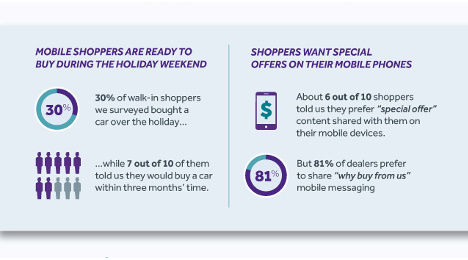
The third-party shopping site found that during holidays, car shoppers tend to buy — and they also want special offers delivered to their mobile phones.
Consider the traffic dealerships saw this Memorial Day weekend.
Over the Memorial Day weekend, 30 percent of mobile consumers Cars.com surveyed purchased a car.
Roughly 71 percent of mobile consumers said they visited a dealer to specifically shop for a vehicle, and 26 percent for service, according to a recent Memorial Day Weekend survey on Cars.com’s blog.
On a non-holiday weekend, 60 percent of consumers visit a dealer for service and 40 percent to shop.
When it comes to special offers via mobile, around six out of 10 shoppers told Cars.com that they prefer “special offer” content shared with them on their mobile devices, while 81 percent of dealers prefer to share “why buy from us” mobile messaging, Cars.com Research and Insights senior manager Amanda Kaleta-Kott explained.
Additionally, during the Memorial Day weekend, 41 percent of all store visits were walk-ins where the shopper didn’t contact the dealer prior to making a visit.
Twenty percent of those walk-in shoppers surveyed by Cars.com bought a car over the holiday and seven out of 10 said they wish to make a purchase within three months.
Helion Automotive Technologies has a new data security warning for auto dealerships because in recent weeks spear phishing hackers have been busy planting malware inside of social media posts designed to lure employees of organizations to click on the post.
Dealership employees are ideal targets for spear phishers looking to grab Personally Identifiable Information (PII) and bank account information, according to Helion.
"This is the same spear phishing scheme that hackers have been using successfully in targeted email messages for several years now," Helion president and chief executive officer Erik Nachbahr said in a news release. "The problem is that although most employees have been told and know not to click on emails from people they don't know, they don't think twice when it comes to clicking on a message or offer in their Facebook feed. They are more trusting in a social media environment."
If employees take the bait of hackers and click on infected links, malware can be downloaded onto the employee's computer compromising the entire organization's network, the information technology solutions for auto dealers said.
Helion recently conducted a phishing test at an auto dealership by sending emails to 125 employees where three employees took the bait. When prompted by the website the email drove them to, they entered both their usernames and passwords.
If the attack were in fact real, the consequences could cost a dealership thousands, Helion said.
"That test was a good sample that revealed auto dealerships are very vulnerable to this type of attack and need to do a better job at educating their employees," Nachbahr said.
Nachbahr’s tips for preventing a spear phishing attack:
- Instruct employees to never click on links in social media posts and messages from their computers or personal devices while at work
- Require employees to change their network login passwords every 90 days
- Encourage employees to keep social media profiles private and don't accept friend or connection requests from people they don't know
- If employees receive a phone call, email message or social media message from a banking institution, vendor or other entity that asks for personal information, do not give this information verbally or via email, but contact the institution directly
- Get cyber liability insurance, which covers costs associated with a data security breach and loss of data
- Regularly apply software updates to Microsoft Windows, Internet Explorer and all software applications on every PC
For the third year in a row, Donlen has been recognized by the National Association for Business Resources (NABR) as one of Chicago's Best and Brightest Companies to Work For, the company recently announced.
Dolen and other winners will be honored at a symposium and awards celebration on July 17 at the Chicago Marriott Southwest at Burr Ridge.
"Employee satisfaction and development drives our award-winning culture here at Donlen," the company’s human resources business partner Kelly Elliott said in a news release. "We promote an empowering environment that gives our employees the resources and opportunities they need to find success, grow, and contribute to the exceptional fleet experience that Donlen provides our customers.
“We are honored to be recognized by the Chicago’s Best and Brightest organization and we thank our employees for their dedication and efforts to make Donlen a desirable and productive workplace.”
NABR selected this year's winning companies using an independent research firm that evaluates each company's entry in the following categories, according to Donlen:
—Compensation, benefits and employee solutions
—Employee enrichment, engagement and retention
—Employee education and development
—Recruitment, selection and orientation
—Employee achievement and recognition
—Communication and shared vision
—Diversity and inclusion
—Work-life balance
—Community initiatives
—Strategic company performance
—Best of the Best Small Business, Medium Business and Large Business.
“Profitability and stability is essential for businesses in today’s economic climate. Companies that recognize that their employees are the key to their success achieve staying power,” said Jennifer Kluge, president and chief executive officer of MBPA, an affiliate of NABR. “Our 2017 winners create their human resource standards to ensure employee satisfaction and they set standards for every business to aspire toward. We are proud to honor this year’s winners.”
For more information about the Best and Brightest Companies to Work For organization, visit www.101bestandbrightest.com.
While quality and affordability are regarded as key decision factors when purchasing a car, America’s growing group of millennial consumers are most likely to consider brands that fit with their personal image instead, according to Cambridge Analytica, a data analytics and behavioral communications provider
“Finding brands which fit their personal image was the largest growing factor amongst millennials when compared to older respondents,” Cambridge Analytica Data Scientist Tom Richardson said via email when Auto Remarketing asked about the study’s findings.
Fitting personal image was found to be the largest differentiating factor between the youngest consumers and older car buyers, he said.
Cambridge Analytica found this and several other trends following its study which examined American car buying habits across key demographics.
About a third of millennials surveyed said fitting personal image was “extremely important,” while only a quarter of all respondents said the same, according to the study.
Last summer, Cambridge Analytica asked 3,018 respondents to consider the following set of factors: fits with personal image, affordability, high quality, driven by celebrities, brand reputation, made in the USA and environmentally friendly.
“When dealing with younger customers we might advise dealers to use a sales pitch based on matching an individual’s style and perhaps offer small personifications/bonus extras with the cars,” Richardson explained.
According to the study, Audi is the most desired brand amongst the millennials surveyed and Lexus and Honda ranked the lowest, which suggests the two brands don’t align with a millennial’s personal image.
Car owners vs. non-owners
The study also found that car ownership status rather than age is the best predictor when identifying shoppers who rate environment as important.
While environmental impact was found to be generally less important than both affordability and quality, 10 percent of respondents without a vehicle said they consider environmental factors extremely important.
Those without a car also consider affordability to be extremely important more often than quality. The group is 10 percent less likely to rate quality as extremely important and about 6.5 percent more likely to rate affordability as extremely important, according to the study.
Similarly, respondents who already own a car told Cambridge Analytica they are mostly interested in vehicles that offer higher quality than what they currently own.
Men vs. Women
High quality and affordability were the most important factors for both men and women.
But while a majority of both genders agree that the two factors are extremely important when choosing a new car, about 10 percent more women than men believe affordability, in particular, is extremely important.
Additionally, men are almost two times more likely than women to select BMW as their most desired brand, according to the study.
Other luxury brands such as Mercedes and Lexus were also found to be favorite brands for men.
Women were found to desire Japanese economy brands like Honda and Toyota most, while they significantly favor the Jeep brand more than men. Meanwhile, 7.6 percent of the women surveyed chose the American brand as their favorite compared to just 4.5 percent of men.
Interestingly, Audi was equally as popular with both genders: 7.8 percent of men chose the brand and so did 7.8 percent of women, according to the study.
Cambridge Analytica’s study was conducted online in June 2016, “when most people began talking about 2017 car models,” Richardson added.
The National Automobile Dealer Association recently highlighted a new resource for members is now available: “A Dealer Guide to the FTC Used Car Rule.” Members can secure it through NADA University Online.
Association officials explained the material provides an overview of the revised Used Car Rule from the Federal Trade Commission, including details about the revised Buyers Guide, instructions on properly completing the Buyers Guide form, and with a number of templates and other examples.
The FTC finalized amendments to the Used Car Rule last November, noting seven specific modifications.
The guide is available to NADA and ATD members only at no charge by going through this website. Members needing assistance in accessing the guide should call NADA customer service at (800) 557-6232.
Like many organizations, FICO indicated Toyota Financial Services was looking for ways to achieve better outcomes from its collections efforts.
At the same time, FICO acknowledged it was critically important for the captive to demonstrate to its customers that the company values the relationship. They sought to help customers avoid repossession or credit impacts due to delinquencies and profitably grow their lending portfolio.
Included in new a case study, FICO describes how Toyota Financial Services applied a collection optimization-based approach to keep delinquent customers in their vehicle.
The study highlights how the captive generated these five results, including:
• Used statistical modeling, forecasting, predictive modeling and optimization to rapidly simulate multiple scenarios, and then deploy an optimal strategy into production.
• Segments customers based on risk, ensuring that the collection treatments are delivered individually, one customer at a time.
• Kept more than 6,000 drivers in their vehicles, while 1,500 customers avoided reaching a stage of repossession.
• Reduced operating expense and grew its portfolio by roughly 9 percent without adding collections headcount.
• Ties future lending decisions to its collections abilities, putting more customers behind the wheel of a Toyota.
“Collection optimization isn’t just for auto lenders. It can be used by any first- or third-party looking to improve collections,” FICO said.
Go to this website to download the case study or contact the company at [email protected] or (866) 350-3426 to learn more.