This dealer made the journey from a youth rehabilitation center to become one of the best operators in the country.
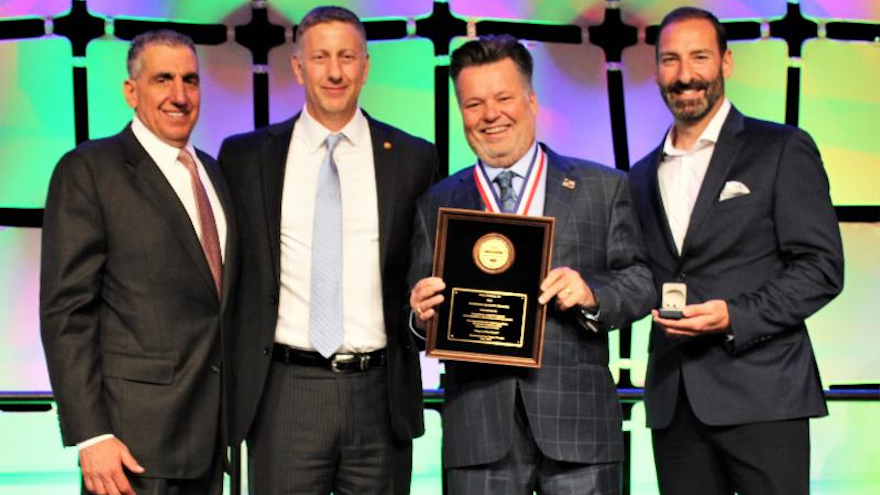
Otto Hahne, president of City of Cars in Troy, Mich., was named the 2019 National Quality Dealer of the Year by the National Independent Automobile Dealers Association to close NIADA’s 73rd annual Convention and Expo in Las Vegas.
In a ceremony webcast live last Thursday night from the Venetian Resort on NIADA.TV, Hahne was chosen from the 13 state quality dealers nominated for the highest honor awarded among NIADA’s dealer members.
The National Quality Dealer is chosen by a selection committee comprised of some of the most distinguished names in the used vehicle industry based on a variety of factors, including contributions to the automotive industry and the association, and community involvement.
This year’s committee included:
— AFC chief operating officer Joe Keadle
— NADA senior vice president and chief operating officer Mike Stanton
— Black Book Automotive vice president and North American auction director Tim West
— NIADA senior vice president and 2013 National Quality Dealer Joe McCloskey of McCloskey Motors
— NIADA Region III vice president and 2011 National Quality Dealer Scott Allen
— Elgie Bright, chairman of the Automotive Marketing Department at Northwood University.
“I am so, so humbled. I love this industry and I can’t thank everyone enough,” Hahne said in accepting the award. “I never expected to be here.”
Hahne’s remarkable journey began with a troubled childhood that eventually led to Boysville of Michigan, a youth crisis rehabilitation center run by the Brothers of the Holy Cross. That, he said, was exactly what he needed to help him get his life on the right track and build the foundation for his career.
From there he enrolled at the Michigan Career Institute and graduated at the top of his class as a master mechanic. After working as a service technician for auto dealers, he opened his own independent shop, repairing and restoring Jaguars and other exotic cars.
Soon the owners of those cars began to ask him for advice about buying other high-end vehicles, a spark that ignited his passion for buying and selling cars. Eventually, that led him to become a buyer for auto dealerships, and in 1994 he took the leap of opening his own dealership, Factory Executive Motor Cars, with $20,000 and an inventory of just three vehicles.
That dealership, which was renamed City of Cars when Hahne moved it from Pontiac, Mich., to Troy in 2011, now has two locations with a combined inventory of 250 vehicles and $28 million in sales last year.
The family business – Hahne’s wife Jerrianne and children Lauren, Leah and Evan are all involved – has grown from two employees to 17.
That success is a result of Hahne’s dedication to providing the best possible customer experience, including everything from giving his staff “carte blanche” to take care of any customer issues that come up to giving dealership visitors what Jerrianne calls “the famous Otto hug.”
“We don’t really ‘sell’ cars,” he said. “We connect our customers with the right car for them.
“We can come in each morning with a smile, leave each day able to look ourselves in the mirror — and even have a little fun in between.”
Hahne is happy to pass along that business philosophy and the operational aspects of his dealership — including his favorite quote, “Every minute a car is not online is a minute of lost opportunity” — to others.
He has served as a mentor not only to his team members — six of whom have gone on to own their own independent dealerships — but to employees of other dealerships, many of whom have been sent to Hahne by the dealerships’ owners to be trained in his methods.
Hahne said his commitment to teaching others began with coaching his children and their teams in youth sports.
“I realized my job as coach was to put my team in the best possible position to win,” he said. “That is my mission today. I’ve trained so many dealers, many of whom have sent their team members to me. I’ve trained them and helped them. I always want to be transparent and give back.”
Hahne’s mission extends to himself – he continues to constantly educate himself on the industry’s latest trends and techniques. He is an active member of an NIADA Dealer 20 Group and in 2018 he completed the course to become a Certified Master Dealer.
He also gives back to his national and state independent dealers associations, the used vehicle industry and his community.
Hahne is currently serving his second term as president of the Michigan IADA, having previously served as vice president and on every MIADA committee.
In those roles, he was instrumental in MIADA’s successful campaign to enact legislation requiring pre-licensing and continuing education for the state’s used vehicle dealers and in setting up an internship program with Northwood University. He has been involved in NIADA lobbying efforts at the federal level at the National Policy Conference in Washington D.C.
Hahne has given his money and time to community and charitable organizations including youth sports, Boy Scouts, Care House, St. Jude Children’s Hospital, the Lions Club and, of course, Boysville. He has also helped numerous individuals, donating money, vehicles and Christmas gifts to families in need. For the past 10 years, he has given each patient at Detroit’s Qualicare Nursing Home a Christmas gift bag.
NextGear Capital honors Hahne, too
In recognition of Hahne’s award, NextGear Capital and Cox Automotive will donate an emergency response vehicle to Hahne’s local American Red Cross chapter.
This will be the ninth emergency vehicle donated to the American Red Cross through Cox Automotive. Since 2015, the company has donated more than $1 million to the American Red Cross to support disaster relief. The vehicle will be transported to the winner’s dealership where it will officially be donated to its local American Red Cross chapter.
“Otto and his team live out not only what it means to be a National Quality Dealer each and every day, but practice the very values NextGear Capital and Cox Automotive operate by,” said Randy Dohse, senior vice president of operations for NextGear Capital.
“He embodies all that it means to be committed to quality, excellence, outstanding customer service and to making the community a better place for everyone. I could not be more pleased with this year’s recipient,” Dohse continued.
Each year, the American Red Cross responds to nearly 64,000 disasters around the country — from home fires and tornadoes to severe winter weather, hurricanes and floods. Members of the Disaster Responder Program invest in disaster relief readiness to ensure supplies, shelters and emergency vehicles are ready to respond when disaster strikes.
Black Book is seeing car values that bloomed during the spring market now wilting in the summer heat.
This week’s Black Book Market Insights report indicated nearly all car segments sustained a significant decline in values, signaling summer seasonality.
Conversely, editors noticed the truck space had three segments finish with an increase in value during the week.
“Depreciation in car segments has increased after the Spring season. Pickup trucks, which usually retain strength in the summer months, went up in values last week,” Black Book executive vice president of operations Anil Goyal said in the latest report.
According to volume-weighted data, Black Book determined overall car segment values decreased by 0.44% last week. That’s up from the four-week average decline of 0.32%.
Values of compact cars and prestige luxury cars dropped the most, sliding by 0.68% and 0.69%, respectively.
Again based on volume-weighted information, editors learned that overall truck segment values (including pickups, SUVs, and vans) dipped by 0.12% last week. That’s 2 basis points above the four-week average drop of 0.10%.
Among trucks, values of subcompact crossovers decreased the most, sliding by 0.72%.
Turning next to what Black Book observers spotted when watching the lanes at nearly 60 sales nationwide, a representative connected with an independent dealer in Arizona who described the competition for inventory.
“The price range that we look for our independent store is becoming more difficult to source,” the dealer said. “We look for clean vehicles in the $10,000 to $17,000 range and find ourselves competing more and more with the franchise stores as well as the independent dealers.”
In other parts of the country, active bidding by franchised and independent stores seemed to be brisk. Here is Black Book’s latest anecdotes:
—From Texas: “The auction inventory was low today, which kept the values up as bidding was brisk.”
—From Florida: “The market seemed slightly lower. The rental and lease lanes did well, but they seemed to have lowered their floors to make the deal.”
—From Illinois: “One of the buyers for a large retail chain of stores is reporting that business is good, and the prices remain elevated.”
The upcoming Automotive Intelligence Summit is designed to help dealers get a better handle on the technological challenges Equifax identified on Tuesday.
A new automotive survey from Equifax finds that dealers understand digital retail solutions, but may struggle in providing such solutions to customers. The online survey polled 135 dealers around the U.S. to get a better understanding of current trends in retail transactions, credit applications, vehicle financing, fraud and their prospects of offering online digital retailing options to customers.
Equifax learned that time at the dealership continues to remain a problem for consumers looking to complete a transaction, particularly when it comes to the F&I process.
According to dealers, 45% said it still takes between one-and-a-half and two hours, while 31% said it takes between two and two-and-a-half hours to complete a deal. While 84% of dealers said they offer appointment setting online, only 27% said they can facilitate the entire deal online.
Conversely, 87% of dealers admit that customers would prefer to complete a deal online.
Additionally, 89% of dealers acknowledged that they continue to grapple with unidentifiable information in credit applications, saying they handle one to two credit applications each day that fall into this category. Dealers also remain largely focused on collecting information stated on the credit application, such as income (89%) and employment (84%).
Less than half of dealers (42%) said they are also currently collecting alternate forms of data such as property ownership or property payment histories, additional data that can be critically helpful in identifying the appropriate financing for an individual.
“There remains a distinctive gap in what dealers are currently offering and what car shoppers want when it comes to the realities of digital retailing,” said Jenn Reid, vice president, strategy and marketing leader, automotive, at Equifax.
“Clearly, there is a lot of room for improvement in speeding up the transaction process and offering a complete online transaction solution,” Reid continued. “It is also clear that dealers continue to need reliable solutions that help speed up the process with credit qualifications and fraud prevention, which continue to impact CSI scores and online reviews, and put dealers margins at risk each month.”
Fraud continues to be a challenge as well. The survey revealed that 76% of dealers are forced to handle between one to three fraudulent transactions each month, and another 19% saying between three and five transactions each month.
“Fraud comes in many forms within an automotive transaction and remains a significant concern for many dealers, illustrating the deep need for advanced digital technologies that today offer instant verification of identity, residence, and other forms of alternative data,” Reid said.
“These sophisticated technologies can reduce the threat of fraud while also improving the overall customer experience for shoppers,” she went on to say.
During AIS 2019, a collection of dealers will be discussing these topics and more.
Next month’s Automotive Intelligence Summit will have at least three of North Carolina’s most well-known and digitally savvy dealership groups on hand for a panel on “Auto Dealerships & The Digital Revolution: What’s Next?”
The session, moderated by North Carolina Automobile Dealers Association president Bob Glaser, will include:
—Eric Flow, president of management services, Flow Automotive Companies
—Erick Kirks, marketing director, Johnson Automotive
—Chris Vester, chief operating officer, Hubert Vester Auto Group
The session will delve into the digital revolution in the auto industry and what it means for dealerships.
It will examine how dealers are evolving to address the digital retailing needs of their customers, while also focusing on how dealerships are using fintech to improve their customers experience inside and outside of the physical dealership.
The panel is set for 1:45 p.m. ET on July 24.
The event agenda will also include various other angles on the evolution of digital retail presented during the three days of the second annual AIS.
—Separating the Facts from Fiction: Andrew Tai, CEO at MotoIsight, says his goal during his keynote “is to help dealers better understand the wave of change that is already upon us, but also navigate how to take advantage of it.”
—The Future of the Automotive Experience — How Unification of Technology Drives the Right Customer Journey; Craig Sims, VP, Automotive Solutions, Equifax: This session will help attendees see how today’s digital retailing tools are helping to create unification in an effort to drive the most successful customer journey.
—DR: Your Direction Determines Your Destination: The big buzzwords in automotive right now are “digital retailing”. OEMs and dealers alike are trying to navigate this new world. Tim Cox, Co-Founder at CarNow, shares a clear road map of what is working in some of the most successful dealerships in the country.
—PeteMacInnis, Founder and CEO, eLEND Solutions, will tackle the following question: Is Digital Retailing Promising More Than It Can Deliver?
—Digital Retailing and the role of FinTech; Tarry Shebesta, CEO, truPayments: Dealers, OEMs, lenders, credit bureaus, and technology providers are all jockeying for a winning position. Place your bets, and get ready for a spirited interactive discussion from session attendees.
Complete agenda and registration details are available www.autointelsummit.com.
With wholesale prices softening as summer officially arrives this week, Black Book is noticing that dealer activity is rebounding a bit at the auction even if action at their showrooms is not at an optimum level.
This week’s Market Insights report showed that values for both cars and trucks decreased at rates much above the average editors spotted during the past four weeks.
“Car segments are in a steady depreciation pattern, in line with seasonality. SUVs and pickups (except for luxury) show strong retention,” Black Book executive vice president of operations Anil Goyal said in the latest report.
Volume-weighted, editors indicated overall car segment values decreased by 0.46% last week. That figure is more than double what Black Book computed at the four-week average (down by 0.22%).
In the car space, Black Book noticed values of subcompact cars decreased the most, dropping by 0.90%
Again volume-weighted, editors determined overall truck segment values (including pickups, SUVs and vans) softened by 0.16% a week ago. Like with cars, that truck reading more than doubled the four-week average that came in at 0.07%.
Among trucks, Black Book found that values of subcompact luxury crossovers softened the most, sliding by 1.10%.
Turning next to the anecdotes Black Book representatives collected by attending nearly 60 sales nationwide, lane watchers shared these comments, including:
— From California: “The sale was active both on the floor and through the simulcast. Prices are holding firm for the most part.”
— From South Carolina: “We had a good crowd throughout the sale which was encouraging. Small and midsize SUVs were selling well today.”
— From Michigan: “Dealers are saying that difficulty with inventory acquisition along with below average retail business is currently holding them back.”
— From Illinois: “Prices were strong across the board today. Due to low inventories, even the vehicles with hail damage brought good money.”
Roadster chief operating officer Rudi Thun sees some successful dealerships making great strides in smoothing out the friction points vehicle buyers experience.
Thun described how those stores are doing it during this Auto Remarketing Podcast with Nick that originated during CU Direct’s Drive 19 Conference in May in Las Vegas.
The full episode can be found below.
Download and subscribe to the Auto Remarketing Podcast on iTunes or on Google Play.
You can also listen to the latest episode in the window below.
Catch the latest episodes on the Auto Remarketing Podcast homepage and on our Soundcloud page.
Please complete our audience survey; we appreciate your feedback.
Black Book’s lane watcher stationed at a sale in Pennsylvania succinctly summed up the dealer and wholesale price activity contained in the firm’s latest Market Insights report.
The Keystone State representative said, “The auction is simply not as active as it was just a couple of weeks ago.”
Editors noticed wholesale prices for both cars and trucks softened at greater rates last week than they had on average during the previous four weeks.
Volume-weighted, Black Book indicated overall car segment values decreased by 0.36% last week. In comparison, editors said market values for cars had decreased by 0.22% on average during the prior four-week period.
Among cars, editors reported values of prestige luxury cars, and full-size cars decreased the most, sliding by 0.63% and 0.62%, respectively.
Again looking at volume-weighted data, Black Book found that overall truck segment values (including pickups, SUVs and vans) decreased by 0.16% last week. Truck market values ticked down by 0.07% on average during the previous four weeks.
Values of sub-compact crossovers and sub-compact luxury crossovers declined the most as editors pinpointed the drops at 0.65% and 0.67%, respectively.
“The overall depreciation rises as buyer interest wanes a little after a strong spring market. Trucks are retaining values better than cars,” Black Book executive vice president of operations Anil Goyal said.
The latest report also included observations from other parts of the country since Black Book attends nearly 60 sales each week. The other anecdotes included:
— From South Carolina: “Cars in the rental lane were getting more interest than the SUVs and trucks due to the more aggressive floor prices on those units.”
— From Michigan: “The supply challenge continues with auction inventory being down along with fewer trades coming in.”
— From Tennessee: “The number of buyers bidding is below normal. The higher price vehicles are hard to sell creating opportunities for the smaller size SUVs.”
With dealership competition as fierce as ever and consumers further recognizing the value of used vehicles, vAuto wants to be sure its tools are as sharp as possible. On Wednesday, the company expanded its proprietary suite of market data to all Stockwave users.
The expansion included the introduction of vAuto’s Live Market View and Autotrader’s Scarcity Index.
Stockwave is a vAuto solution that can help dealers effectively and efficiently find and purchase vehicles from top wholesale sources all through a single platform. Through this expansion, Stockwave users — both independent and franchised dealerships — will gain access to valuable market data from vAuto and Autotrader to help them make more confident and informed used-vehicle purchase decisions.
While rising affordability concerns are causing new-vehicle sales volume to taper, vAuto insisted the used-vehicle market continues to hold strong. In fact, vAuto acknowledged dealerships may need to be more concerned about supply than demand.
To date, wholesale market growth and supply has largely been driven by off-lease vehicles. However, Cox Automotive calculations suggest off-lease volume will peak in 2019, indicating supply moving forward could become a major headwind for the used-vehicle market rather than demand itself.
Both independent and franchised dealers are starting to take notice, with approximately 33% of all dealers saying limited inventory is holding back their dealership, according to the Cox Automotive Dealer Sentiment Index for the second quarter of 2019. That’s an increase of 4 percentage points from last quarter.
“With the number of off-lease units at a peak and fewer consumers as a whole trading in their vehicles, the data and insights dealers have at their fingertips are more important than ever to ensure they are buying and selling the right inventory at the right time for the right price,” said Patrick Janes, business development director for Stockwave at vAuto.
“As supply changes, so must dealer inventory strategies. By introducing Stockwave Market Data, both independent and franchise dealers will be better equipped with information to acquire the inventory they need and capitalize on rising demand,” Janes continued.
Previously only available to Stockwave dealers with vAuto Provision, all standalone Stockwave dealerships will now also have open access to the following four key metrics right in the platform:
1. Autotrader Scarcity Index: Gives dealers an understanding of online search demand for a car relative to the number available in a given market area.
2. vAuto rBook Market Days Supply: Lets dealers know at a glance whether a vehicle is likely to sell fast, given competing cars in the market and recent sales.
3. vAuto rBook Adjusted Market Average Price: Uses proprietary technology to indicate what a vehicle’s real market average pricing is with inventory mileage from competitors factored in.
4. vAuto rBook Market Average Odometer: Specifies the average mileage of retail vehicles in a dealer’s given market.
“Having the Scarcity Index and Market Days Supply inside Stockwave will help my team save hours of scanning through search results to find the right cars,” said Craig White, pre-owned director at Ourisman Lexus of Rockville.
“What we used to track through static spreadsheets is now all in one dashboard and available at a quick glance, enabling my team to make split-second decisions on vehicles that weren’t even on our original buy list. We are now nimbler, able to monitor multiple auctions at once and effectively growing our used-vehicle volume to meet rising demand,” White went on to say.
Auto Remarketing recently hosted Janes as a part of a free webinar to share strategies on improving inventory management. That webinar is available here.
For more information on Stockwave, visit www.vauto.com/stockwavedata.
Dealers don’t need to be reminded that the world of dealer data is changing. The volume of information generated and stored has exploded, and that information is more sensitive and more valuable than ever. It’s no longer just the dealer generating this information; “big data” companies and data brokers hold vast amounts of data, and vehicles themselves are now generating data about drivers, owners, passengers and others.
At the same time, the number of third parties with whom a dealer must share information has also increased. Take a look at this very basic representation of today’s complicated dealer data ecosystem.
The collection, storage, use and sharing of this information raises many complicated legal, regulatory and business issues for dealers, including:
How can this data be shared securely?
What information should be shared with whom and how do I know that third parties are not misusing that information?
Who has the right to control the integration, dealers or dealer vendors?
Are dealer systems cybersecure, and are they ready for integration with the vehicle?
What information can an OEM require a dealer to share?
What “telematics” and other information is your manufacturer sharing with you?
How can dealers and OEMs accomplish this sharing while meeting their ever-growing legal requirements?
At the same time, dealers must meet long-standing federal privacy obligations while understanding the implications of new laws such as the EU’s General Data Protection Regulation (GDPR), state laws like California’s Consumer Privacy Act (CCPA) and others. There are also a number of federal legislative proposals that would vastly broaden U.S. federal privacy law. None of these laws are aimed specifically at the auto industry, but they will have significant effects on dealerships.
For the dealership model to continue to thrive, we must meet these technical and legal challenges.
Dealers should know that One NADA is here for you! As chairman, I can assure you this is a top priority at NADA. For many years, we have worked closely with regulators, manufacturers, dealer vendors and others to ensure that dealers have the tools they need to comply with the law and are ready for the technical, cybersecurity, and data challenges for the future. Those efforts continue today.
You can help by prioritizing these issues at your store. Double down on compliance efforts. Talk to your manufacturer about these issues and let them know how important they are to you and your business. Work with your vendors to ensure you know and understand how your customer information is handled and shared. Remind your employees how important it is that this information is treated with the utmost care.
Simply put, the data you maintain is at the heart of your customer relationship, your reputation and the value of your business. We dealers are swimming in increasingly challenging waters, but with the help and guidance of NADA, we stand ready to exceed expectations, providing our customers with world-class products and services as well as cutting-edge technology and privacy protections.
Charlie Gilchrist is the 2019 NADA chairman and president of Gilchrist Automotive in Dallas and Fort Worth, Texas. This commentary originally appeared on NADA’s blog here.
Manheim now has its first all-digital auction location: Manheim Tucson.
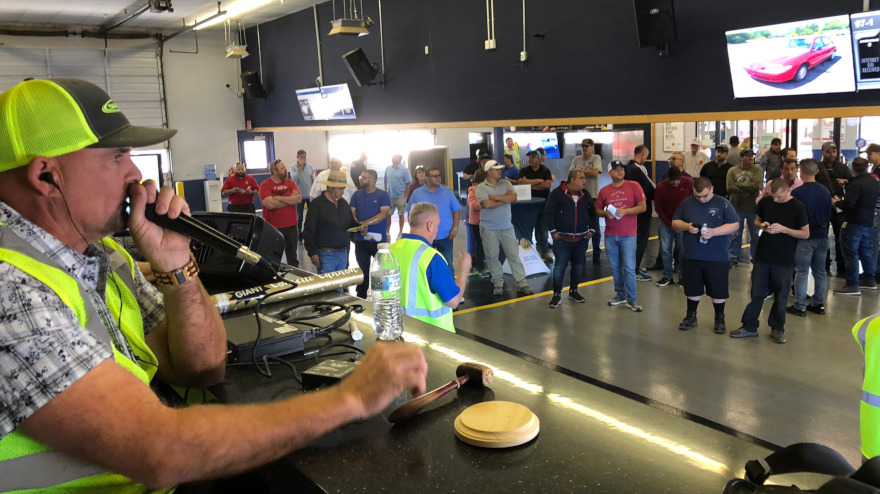
The Arizona auction is Manheim’s first to incorporate a 100% digital format, utilizing a four-lane setup where cars are parked in designated spots and sold to buyers both physically present at the facility and online.
An auctioneer has them up for sale digitally through oversized monitors that include enhanced images, barcode price scanning and condition report info.
Buyers and sellers can participate in person at the auction or online through Manheim Simulcast.
There was a ribbon-cutting late last month and the first sale had more than 300 bidders (online and in-lane combined) with a conversion rate of about 76%, Manheim said.
Though this facility is the first to go 100% digital, Manheim has rolled out more than 100 digital-only lanes at its locations throughout the country.
“Bringing the excitement of the auction to clients in a live, all-digital format is a key move in our broader digital strategy,” Manheim president Grace Huang said in a news release.
“With advanced vehicle information and imaging, we are able to deliver digital solutions that create greater confidence and efficiencies while delivering a safer auction experience for everyone,” Huang said.
Manheim Tucson will have its Digital Debut Grand Celebration on Wednesday, which will include a Total Resource Auctions sale at 9:30 a.m., the auction’s regular sale at 10 a.m., giveaways to the first 200 dealers in attendance and special sale incentives.
“Our team was so excited to be part of creating a new chapter in our company’s history,” Manheim general manager John Duplanty said in a news release. “Our main priority was to work closely with our clients, preparing them for the change and help them realize higher conversion and retention performance. This has been a big win for our buyers and sellers.”
Added Vinnie Da Cruz of Simply Sell it Now in Tempe, Ariz., “I see the benefits and efficiency of digital lanes. No emissions in the lanes, and the increased safety that comes with moving to a digital auction help prevent accidents from happening in physical lanes.
“In an industry such as the reselling of automobiles, to not accept technological growth is almost certain death,” he said.
Safety certainly continues to be a pressing topic through the entire auto auction industry.
Future of auction industry?
Looking forward, Manheim said this type of all-digital auction site may be an early peek at what the wholesale digital marketplace might look like down the road.
Wail Abushaar, dealer principal at Tucson’s Pioneer Automotive, said in the Manheim news release: “I think going with digital auctions — without driving the cars through the lanes — is a brave move the rest of the auction industry will look up to.”
Along those lines, ADESA announced this winter, as reported by Auto Remarketing correspondent Arlena Sawyers, that it had launched what it calls VirtuaLane at 20 of its North American auctions, where certain lanes at the auctions are digital only.
These efforts continue the strategy by Manheim, ADESA and the independent auctions, alike, to blend digital sale technology with brick-and-mortar sales.
At Manheim, 43 percent of sales in 2018 — and over 2 million transactions — involved a digital buyer, the company said.
“And we have seen that accelerate in recent years,” said Derek Hansen, Manheim’s vice president of off-site solutions, during a press conference at NADA Show 2019.
Similarly, at rival KAR Auction Services, which owns the ADESA auction chain, the breakdown in the wholesale mix is about 50-50 online/digital versus physical auction, chief executive Jim Hallett told Auto Remarketing at NADA.
Likewise, companies like Auction Edge and others are providing independent auctions with simulcasting capabilities and the ability to facilitate online/remote transactions.
This week’s Black Book Market Insights report showed the days’ supply of new full-size pickups currently sits at a four-year high, well above 100 days.
While editors are thinking automakers might push incentives to get those new trucks over the curb at franchised dealerships, Black Book isn’t seeing prices soften for full-size pickups moving down the lanes.
“The depreciation rates normalized last week after a strong spring market. Pickups continued to show strength in values,” Black Book executive vice president of operations Anil Goyal said in the latest report.
Volume-weighted, Black Book determined overall truck segment values (including pickups, SUVs and vans) decreased by just 0.08% last week. In comparison, truck values edged up by 0.03% on average during the previous four-week period.
As mentioned, editors noticed the values of pickups increased the most with full-size models rising 0.22% and small trucks climbing 0.47%.
Meanwhile, in the car space, Black Book’s volume-weighted data showed overall car segment values softened by 0.31% last week. That’s quite a bit more than the four-week average, which was a 0.05% dip.
Among cars, editors indicated values of prestige luxury cars decreased the most, declining by 0.67%.
Turning next to what Black Book representatives in the lanes saw at nearly 60 sales nationwide, the anecdotes reflected a mixed bag of observations. Here is the rundown:
— From Michigan: “Consignment has been low, which would normally result in high sales percentages, but lower retail demand has had an effect.”
— From Florida: “We had a good sale this week. However, some of the franchise dealers mentioned slow retail sales.”
— From South Carolina: “More no-sales, and the values seem to be slipping a bit.”
— From Massachusetts: “All but one of the commercial consignors reported good sales today.”
— From California: “The southern California market remains good with the bank/repo lanes performing the best today.”
Update on the specialty market
As they do at the beginning of each month, Black Book editors gave a report about what’s happening in the specialty markets. Here is what they said:
— Collectibles: “This has been a great year so far for collectible vehicle auctions, and the two most recent sales did not disappoint.”
— Recreational vehicles: “As we make the transition from the end of spring to the beginning of summer, interest in used RVs remains strong. Dealers are reporting good traffic on their lots and websites, and the auction companies have seen their volumes rise a significant amount.”
— Powersports: “As we near the high point of the year for the powersports market, values are up nearly across the board, but by fairly modest amounts in most segments this month.”
— Heavy duty: “Higher mileage units continue to enter the market while demand remains steady, leaving buyers with no option but to purchase less desirable units.”
— Medium duty: “Steady volume is helping keep downward pressure on the overall market as used prices continue to depreciate.”