While it likely will be some time before the decision significantly impacts your dealership’s used-vehicle industry, General Motors put a timeline on when it wants to depart from the business of manufacturing vehicles that run on gasoline or diesel fuel.
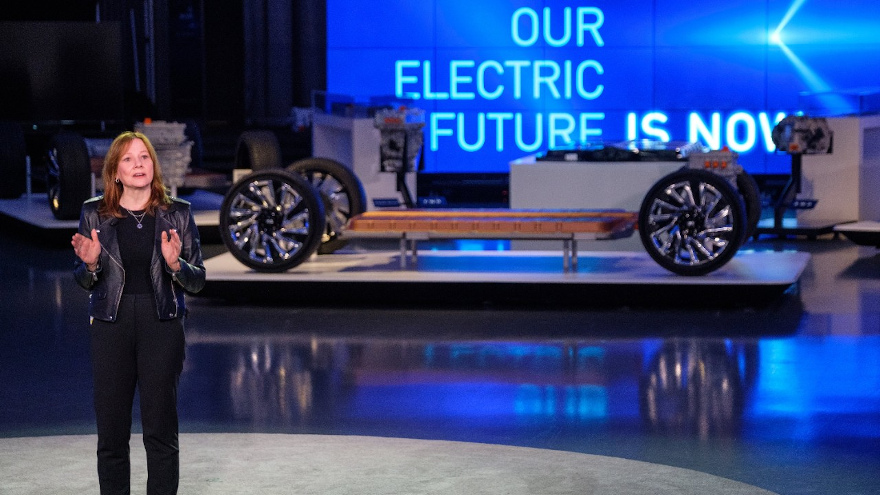
On Thursday, GM announced that it is looking to eliminate tailpipe emissions from new light-duty vehicles by 2035 along with the intention to become carbon neutral in its global products and operations by 2040.
“General Motors is joining governments and companies around the globe working to establish a safer, greener and better world,” GM chairman and chief executive officer Mary Barra said in a news release. “We encourage others to follow suit and make a significant impact on our industry and on the economy as a whole.”
With a fleet of vehicles operating on electricity, GM also acknowledged that it is critical that they be charged with electricity generated from renewable sources like wind and solar.
In the news release, the automaker noted that it has worked with utilities and developers to support investments in renewable energy found in and around communities that have GM facilities via power purchase agreements and green tariffs.
The company said it is also working with EVgo to triple the size of the nation’s largest public fast charging network by adding more than 2,700 new fast chargers by the end of 2025, a move set to help accelerate widespread electric vehicle adoption. GM said these fast chargers will be powered by 100% renewable energy.
“GM believes that the energy sector is well on its way to a decarbonized grid and that an all-electric future will be supported by renewable infrastructure and technology,” the company said.
GM highlighted that will offer 30 all-electric models globally by mid-decade and 40% of the company’s U.S. models offered will be battery electric vehicles by the end of 2025.
GM also said it is investing $27 billion in electric and autonomous vehicles in the next five years — up from the $20 billion planned before the onset of the COVID-19 pandemic.
This investment includes the continued development of GM’s Ultium battery technology, updating facilities such as Factory ZERO in Michigan and Spring Hill Manufacturing in Tennessee to build electric vehicles from globally sourced parts and investing in new sites like Ultium Cells in Ohio as well as manufacturing and STEM jobs.
The company went on to note that more than half of GM’s capital spending and product development team will be devoted to electric and electric-autonomous vehicle programs.
“And in the coming years, GM plans to offer an EV for every customer, from crossovers and SUVs to trucks and sedans,” the company said.
GM added that it worked with the Environmental Defense Fund to develop a shared vision of an all-electric future and an aspiration to eliminate tailpipe emissions from new light-duty vehicles by 2035.
“With this extraordinary step forward, GM is making it crystal clear that taking action to eliminate pollution from all new light-duty vehicles by 2035 is an essential element of any automaker’s business plan,” Environmental Defense Fund president Fred Krupp said in the news release.
“EDF and GM have had some important differences in the past, but this is a new day in America — one where serious collaboration to achieve transportation electrification, science-based climate progress and equitably shared economic opportunity can move our nation forward,” Krupp went on to say.
Electric vehicle designer and manufacturer Fisker says its first dedicated engineering and technology center, to be located in the Mission District of San Francisco, will be the focal point and development center for the company’s software and vehicle electronics.
That includes in-car and Fisker data center elements.
The company’s chairman and chief executive officer Henrik Fisker said development of the company’s first vehicle is “progressing at speed,” and the company is scaling accordingly.
“We are now establishing the facilities that can support our expansion,” Fisker said in a news release.
Fisker continued, “As a company born in California, we wanted to draw on all the diversity, creativity and technical capability this state is famous for. We’re calling the San Francisco office ‘Source Code’ — which also marks the start of a naming convention for all our facilities going forward.”
The company is planning a portfolio expansion “to a four-vehicle range” by 2025. In addition to the Ocean SUV, the lineup will include a “super-sports sedan” based on the EMotion concept, an “extreme sports crossover,” and a new lifestyle pickup truck that the company describes as “segment-changing.”
Fisker says it will deliver each vehicle through the use of durability-tested platforms, battery packs and component systems from technology suppliers and automotive firms, and Fisker will provide specific engineering input.
Fisker’s design and engineering teams are developing Fisker-specific IP and customer features that it says are consistent with the Fisker brand. The company says its creation of its Fisker Flexible – Platform Adaptive Design, or FF-PAD, development process, has allowed it to be “platform-agnostic.” Consistent with the intended start of production, projected for the fourth quarter of 2022, Fisker says it plans to make the final selection on the platform for the Ocean soon.
Fisker’s recently appointed chief technology officer, Burkhard Huhnke, said the design and development of the software and vehicle interfaces will be “an important differentiator for all our products.” The new San Francisco facility will be key to that process, Huhnke said.
Huhnke added, “Having a presence in the Bay Area gives us access to the right talent at the right time.”
Micky Bly says the auto industry is “approaching an inflection point” in the area of demand for affordable long-range electric vehicles.
Bly is head of global propulsion system engineering for FCA, and he said in a news release that steps FCA announced on Wednesday to make choosing and buying an electric vehicle easier “is just one of FCA’s efforts to improve awareness and convenience in the EV purchase experience.”
One of those steps is that the Chrysler brand website now features a direct link to purchase Mopar’s 240-volt wall charger on Amazon.com. Users can now also purchase installation services for any branded EV charger.
That, according to FCA, gives customers “a fast and convenient way to charge their vehicles at home.”
As the company launches more than 30 electrified nameplates by 2022, additional FCA consumer websites will offer those services.
“We see opportunities to make owning an EV easier, and creating a simple solution for at-home charging is among them,” Bly said.
Where and how to set up a charger in their home is among the questions for customers considering a switch to electric vehicles. FCA said its approach helps remove the guesswork from the equation.
Customers can visit Amazon.com/pacificahybrid to purchase a charger, answer questions about their home, see an installation quote, and schedule a licensed electrician to complete the installation of their EV charger.
In identifying a long-term strategy for transitioning to EVs, FCA says the Ram 1500 and Jeep Wrangler with eTorque, along with the recently announced Fiat 500 and Panda mild hybrid systems, are examples of technology adaptation on high-volume vehicles.
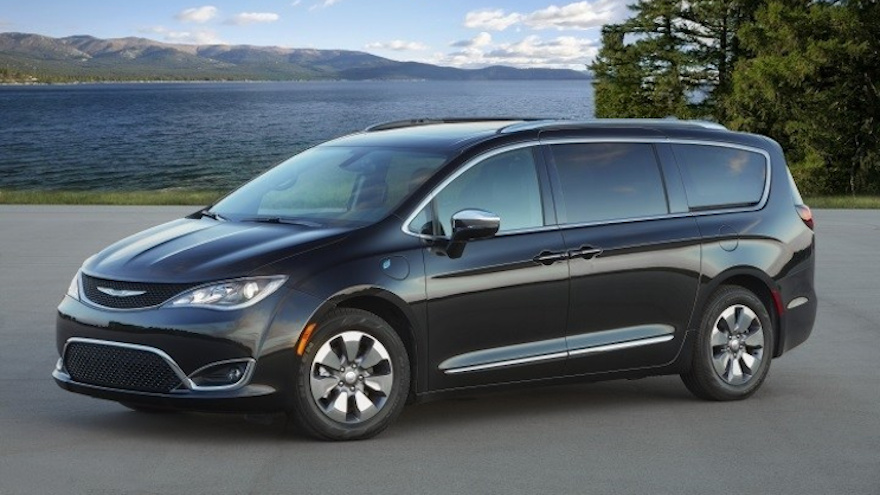
In addition, the automaker describes the Chrysler Pacifica PHEV as “America’s first and only hybrid minivan,” stating that its natural drive cycle as a local-use family vehicle shows a pure electric range of 32 miles. After that, it continues to “operate as a fuel-sipping hybrid.”
FCA’s global lineup in the 2020 calendar year will include seven new high-voltage EVs.
Those include several electrified Jeep vehicles, a second-generation Fiat 500 BEV, Fiat Ducato BEV and the first hybrid from Maserati.
But in the discussion on FCA’s EVs, vehicles are only part of the equation. The company notes that EV customers must also be able to charge their vehicles conveniently and affordably.
With that in mind, FCA signed agreements in Europe with energy sector companies Enel X and ENGIE. Those agreements will support corporate production and distribution of PHEV and BEV vehicles.
Also through those agreements, dealers can offer charging products and services to retail and business customers.
FCA also mentioned its partnership with Italy electricity provider Terna in which FCA will study EVs’ interaction with the distribution network.
An experimental two-way charging infrastructure built within the Mirafiori district will provide energy from cars to the grid when electrical demand is high. It will return to vehicle charging when the demand is low.
Many Americans are concerned about global warming and vehicle emissions, according to market research company Ipsos.
But only 30% surveyed in a recent Ipsos study said they would buy an eco-friendly vehicle.
Ipsos set out to find out, Why is there a disconnect between environmental beliefs and automobile selection?
According to the study, which is titled “Ipsos Global Mobility Navigator Syndicated Study,” The answers are overall cost, range and charging location stations.
On that first barrier regarding cost, Ipsos vice president of mobility Todd Markusic said it is the primary barrier, regardless of the type of vehicle in question.
And it is the most important factor when drivers are purchasing/leasing a new vehicle, he said.
“This poses a huge hurdle for BEV (battery electric vehicle) manufacturers, since the cost of batteries remains high and are then rolled into the asking price,” Markusic said in a news release.
He continued, “Our study revealed consumers are only willing to pay up to an extra 10% more for a BEV over a similar gas/diesel version of the vehicle. However, we see once that price point exceeds 20%, consideration in the BEV option drops considerably.”
These new findings are from the second module of the Ipsos Global Mobility Navigator Syndicated Study in which 20,000 consumers worldwide shared their opinions on alternative engines and what it would take to get them to consider one.
Ipsos said the module helps answer the question, Why aren’t environmental concerns necessarily translating into BEV sales?
Regarding the second main hurdle, the range barrier, Ipsos said it appears to be based on a misconception that causes “range anxiety.”
But Ipsos said the average American actually drives around 170 miles during his or her normal workweek. Many current BEVs offer 200 miles per full charge, so an owner would only need to charge once a week to meet his or her driving needs, Ipsos said. That is similar to filling up gas once a week, the company said.
“The misconception of ‘range anxiety’ has many believing they couldn’t drive to the store without having to charge their BEV, with 45% incorrectly thinking they would need to charge their vehicle once a day or more,” Ipsos wrote.
Regarding that last major barrier for BEVs, location of charging stations, Ipsos said most consumers would seek ways to recharge their BEV at home rather than charging stations. Ipsos noted that current fast charging options can recharge a BEV to 80% within 40 minutes.
And a 30-minute option is “on the market horizon,” Ipsos wrote.
Additional key findings from Ipsos’ study:
— “Type of Engine” is not a primary purchase attribute that opens the door to consideration of an electric motor.
— Consideration of alternative engines has risen nearly every year since 2011.
— Thirty-seven percent of those seriously considering a BEV believe the external design should be different than the gas version of the vehicle.
— According to the average new car buyer, it will be at least 4.6 years before a BEV is available that meets their budget and vehicle needs.
Exposure is extremely important to help the BEV industry clear these hurdles, Markusic said.
“The U.S. exhibited some of the lowest familiarity with BEVs, with only 10% indicating they know them ‘very well.’ Meanwhile, most consumers simply have not been exposed to a BEV, with less than 10% having any type of significant interaction with one, which includes driving, looking or riding in one,” Markusic said.
He continued, “Many of the existing barriers could be resolved with messaged marketing and consumer education to resolve misconceptions.”
Ipsos said more than 50 new electric models could be released over the next few years. Because of that, the auto industry should have a more in-depth understanding of its consumers, the company said.
Ipsos added, “For that, they will need even greater insights as to what it would take to break barriers and put consumers into the driver’s seat of a BEV.”
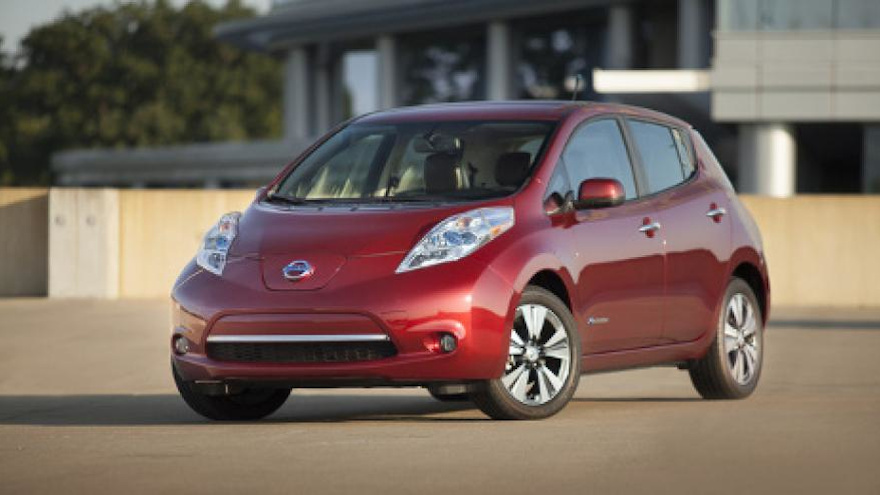
The Tesla Model S may be the original electric luxury car. But the Nissan Leaf “was the first electric car to target the masses.” That's according to Autotrader.
“Think of it as the modern Ford Model T of electric cars,” the third-party listings brand said in a news release about the Leaf.
Autotrader recognized both of those vehicles as being among “The 15 Best Cars of the Decade.”
The Toyota Prius, Acura NSX, Mazda Miata, Toyota RAV4, Genesis, Kia Telluride, Ford Mustang, Ford F-150 Raptor, Porsche Macan, Chrysler Pacifica, Jeep Gladiator, Volvo XC90 and Dodge Hellcat are the additional vehicles to make Autotrader’s list.
Autotrader noted that as the 2010s have come to an end, the company felt now is a good time to review the cars that it says had the most impact over the past 10 years. The vehicles on the list stand out in various ways, Autotrader says.
“Some pushed boundaries with electric powertrains, mind-melting performance, and ultramodern designs, while others kept it simple, sticking to the basics and improving upon formulas that have worked now for decades,” Autotrader wrote.
The company continued, “A few even created entirely new segments.”
Discussing the Toyota Prius, Autotrader writes that the vehicle faced new competition as the hybrid-electric segment was growing quickly. Therefore, it needed to make improvements, Autotrader said.
“The third-generation Prius was more aerodynamic than the previous model and included a bigger engine and rear disc brakes,” Autotrader wrote.
About the Acura NSX, Autotrader wrote that when Acura finally released the second-generation NSX for the 2017 model year, it did so “with a price tag that is hardly as relevant to everyday buyers as the other vehicles on this list.” Autotrader notes the NSX's “impeccable handling from its sophisticated AWD system.”
Regarding the Mazda Miata, after the vehicle debuted in the 1990 model year, Autotrader said Mazda has “stuck to the same general winning formula throughout the years.” The fourth-generation Miata now features “a much more refined and polished package,” Autotrader writes.
“No other vehicle will put a smile on your face quite like the Miata,” Autotrader writes.
Autotrader praises the Toyota RAV4's "spacious cabin, good cargo volume, efficiency and reliability."
A sampling of Autotrader comments regarding additional vehicles on the list: The Genesis is a “full-fledged luxury nameplate” and “deserves a spot on the shopping list of any luxury buyer.” Autotrader describes the Kia Telluride as “featuring an extremely attractive, chiseled, boxy design that undoubtedly appeals to moms and dads who grew up with SUVs in the 1980s and 1990s.”
And the sixth-generation Ford Mustang, released in the 2015 model year, turns the Mustang “from a snarling muscle car to a fun, lightweight autocross champ,” Autotrader writes.
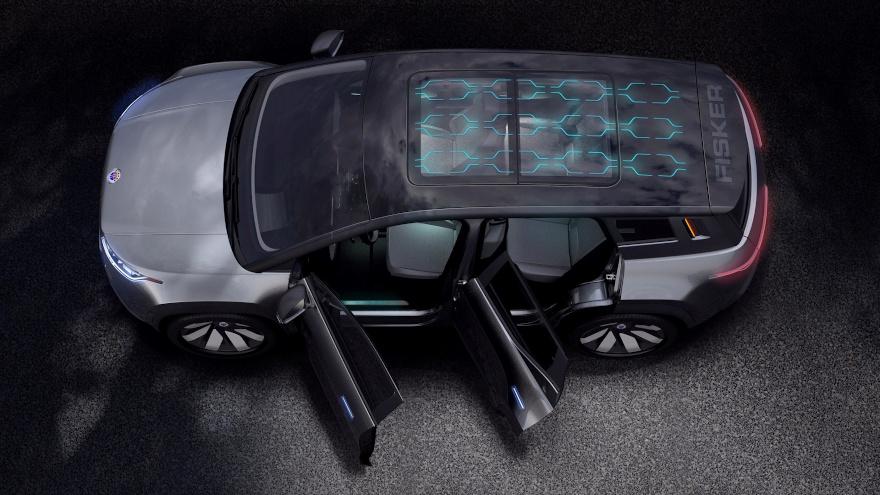
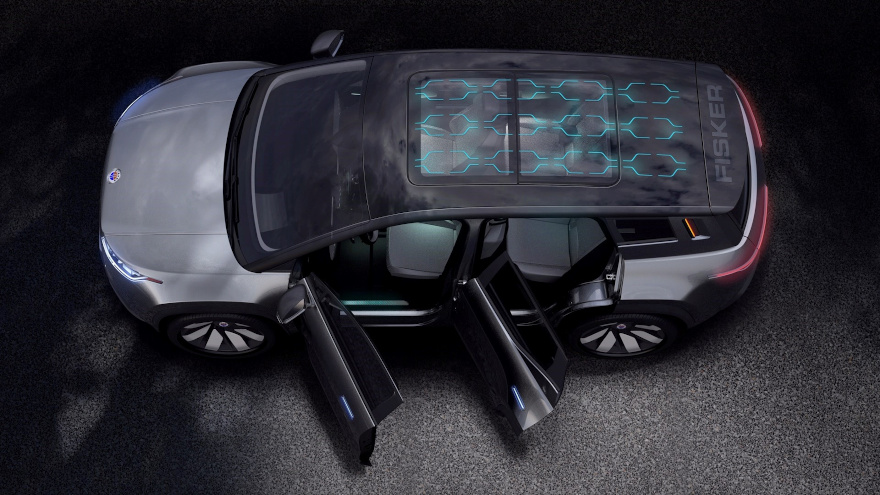
Electric vehicle designer and manufacturer Fisker is describing its upcoming all-electric luxury SUV as “the world’s most sustainable vehicle,” with features such as recycled materials and a full-length solar roof.
Now, the vehicle has a name: Fisker Ocean.
Fisker will unveil the vehicle on Jan. 4, 2020 during a private event that will be live streamed online.
Auto designer Henrik Fisker, who is chairman and chief executive officer of Fisker Inc., said that in designing the vehicle, he “wanted to combine maximum usability with an unprecedented driving experience.”
“For the past two years, we have been working quietly on an emotionally appealing and affordable luxury electric vehicle that will serve as a flagship for driving positive global change — from the most sustainable materials possible across the supply chain to practicality that will change the perception of what an EV can be,” Fisker said in a news release.
He continued, “The Fisker Ocean features dramatic sculpture — with a wide stance and a luxurious SUV silhouette.”
The company said those interested in leasing the vehicle can reserve it through a mobile app-based flexible lease model. Reservations open Nov. 27, and the company will reveal pricing information on that date.
It is targeted to begin production at the end of 2021, and the company projects the first high-volume deliveries to take place in 2022.
Fisker says that those who lease the vehicle at that time will experience what it describes as “better design for the future of green mobility.”
The Fisker Ocean is 4,640 mm in length, which the company says is “designed for optimal space and usability.”
The focus on design efficiency includes a fixed hood that the company says “avoids costly sealing and latches” and saves weight.
The company said the room under the hood helps house new-age electronics and the air conditioning unit. That, according to Fisker, results in more interior space.
Fisker also emphasized that it is skipping the standard automotive process of making a show car. Instead, the company says it will reveal a fully running production-intent prototype, and it will sit on the actual, completely engineered platform on Jan. 4.
In producing what it describes as “the world’s most sustainable vehicle — from the inside-out,” Fisker said customers will have the opportunity to contribute to a more sustainable future. Additional Fisker Ocean features include:
— Fully recycled carpeting made from regenerated nylon. That is made from abandoned fishing net waste pulled from the oceans and aquaculture.
— Vegan interior consists of 100% polycarbonate polyurethane surfaces and 100% reinforced rayon backing.
— Repurposing rubber waste: The discarded rubber waste is generated during tire manufacturing rather than being dumped in landfills.
— All-electric SUV range: The all-electric SUV will come standard with an extended range. The target is approximately 250 to 300 miles, depending on driving conditions. That range is enabled by an approximately 80 kWh lithium-ion battery pack.
““The interior is spacious and extremely modern, bringing a luxury feel and timelessness that has never been seen in a vehicle before,” Fisker said.
He continued, “The future of mobility is about enjoying an electric vehicle without hassle, long-term commitment and the prohibitive high cost of ownership. Driving the Fisker Ocean will be easy: through a flexible lease via a mobile app. And we take care of all the service and maintenance. Simply put, we’re introducing the future of hassle-free, fun and easy e-mobility.”
Many TV viewers know him as “Jaime” on the HBO series, “Game of Thrones.”
But many of those fans might not know that Nikolaj Coster-Waldau travels the world as the United Nations Development Programme Goodwill Ambassador for climate change and other social issues.
Now, Coster-Waldau is teaming up with electric vehicle and advanced mobility products company Fisker to bring sustainable, affordable and premium mobility to market.
He will serve as a partner and sustainability adviser to Fisker chairman and chief executive officer Henrik Fisker in working toward a future with advanced, affordable, electric mobility serving as a model for the future of transportation.
Fisker and Coster-Waldau first connected on Twitter, discussing their passion for sustainability. The two are working toward helping Fisker Inc. fulfill as many of the United Nations’ sustainability goals as possible.
Fisker Inc. is working toward completion of its “affordable, all electric production-intent” SUV prototype. The company will unveil the all-electric SUV at the end of this year, and it will feature a range of approximately 275 to 300 miles.
The vehicle will also use recycled plastic from ocean debris, vegan leather, and a solar roof in its top-model spec.
Also, the vehicle will recycle waste generated during tire manufacturing. The vehicle will recycle that waste — which typically goes to landfills – for various interior applications.
Fisker Inc. says its long-term goal is the creation of a consumer platform that brings desirable, affordable and sustainable mobility to the mass market.
The company wants to enable a wider consumer base to drive its premium electric vehicles. To do that, Fisker is working on what it describes as a “revolutionary direct-to-consumer smart platform,” which it says might not include sales of its vehicles.
Fisker Inc. says it will announce details of its affordable, direct-to-consumer e-mobility platform later this year. That, according to the company, will break new barriers of entry to affordable, clean mobility “without onerous long-term contracts or expensive upkeep.”
“I am very excited to have Nikolaj participate in Fisker’s mission of binging the world’s most sustainable, affordable and desirable electric vehicles to mass market,” Fisker said in a news release. “I am looking forward to working with him on learning about and achieving U.N.’s sustainability goals”
“Mass vehicle electrification around the world will make an immense impact on the fight to combat climate change,” said Coster-Waldau, who has also partnered with Google in implementing its street-view tool to raise awareness and show the impacts of climate change in Greenland. He has also traveled to Maldives to report the effects of global warming.
Coster-Waldau continued, “And although we’ve progressed, there’s still a long way to go. Henrik Fisker’s vision to help spark wider adoption of electric vehicles is unique, combining the most sustainable materials and manufacturing with his globally renowned design touch to bring emotionally appealing vehicles to the mass market. I’m delighted to embark on a journey to deliver more beautiful vehicles for a more beautiful world.”
More electric vehicles are available today than ever before, said Chase Disher, an analyst at Autolist.
“But that hasn’t done much to change consumers’ perceptions of them,” Disher said in a news release. “The misconceptions that electrics faced at the beginning of this decade are still a major impediment to their success right now.”
According to the latest Autolist.com survey, overall range, price compared to a similar gas vehicle, and lack of charging infrastructure in their area are the three biggest reasons people would not buy an EV.
The study results showed some similarities to the latest phase of a Cox Automotive study titled, “Evolution of Mobility: The Path to Vehicle Adoption.” That study showed that although consumers believe EVs are coming, that hasn’t increased their interest in buying one. The study also said cost and battery were the biggest consumer and dealer barriers to EV adoption, public charging infrastructure is an extremely important factor in increasing EV proliferation, and that lack of inventory levels, perceived profits, and OEM support are reasons that dealers’ sense of urgency to sell EVs is low.
The Autolist study also showed some encouraging signs. Autolist says consumers' expectations of EVs “are starting to align with reality.”
One of those promising signs: Survey participants showed realistic expectations regarding the range of a mainstream, non-luxury EV. In response to a question on the minimum range they would accept if they were buying a $35,000 EV, the most popular answer was “between 250 and 300 miles.”
Autolist said that range is fairly close to that of several EVs currently on the market. Before incentives, the Kia Soul Electric, Chevrolet Bolt and Hyundai Kona EV all start at around $37,000. They offer 238 miles, 243 miles and 258 miles of EV range, respectively, Autolist said.
Another of the survey’s bright spots for EVs: 69% of shoppers supported tax rebates, incentives and other perks at the local, state and federal levels to encourage people to buy and use electric vehicles. Sixteen percent did not support those perks, and 15% were not sure.
And another good sign for EVs: The survey asked participants how their household would use an EV if they bought one today. Fifty-five percent said it would be their primary vehicle. Twenty-four percent answered that the EV would be a secondary vehicle, 10% said it would be a third or extra vehicle and 11% were unsure.
“That so many people would use an EV as their household’s main vehicle rather than just an errand-runner or gadabout is a good sign for the future of EVs,” Disher said. “It shows that people are taking the idea of an electric vehicle seriously even if they don't own one yet.”
Consumers have reasonable expectations for the battery range on “affordable” EVs, Autolist said. However, when asked about luxury EVs, their assumptions were much different.
What minimum range would car shoppers accept if they spent $70,000 on an electric vehicle? The most popular answer was “More than 500 miles,” and that was by a large margin. Sixty-one percent said the vehicle would need more than 400 miles of range.
Autolist said no mass-market EV currently offers more than 400 miles of range, and one is not expected for several years. Autolist notes that with an EPA-estimated range of 370 miles, Tesla’s Model S Long-Range is the longest-range EV currently on the market.
Autolist also discovered widespread confusion about Tesla’s Supercharging network from the survey. Autolist says industry analysts and rival automakers consider that feature be a key Tesla brand asset.
Seventy-four percent of car shoppers were unsure when Autolist asked them whether they thought any EV could charge on Tesla’s network. By the way, they can’t, Autolist said. Fourteen percent said “no” and 12% said “yes.”
A Cox Automotive conference call discussing the latest phase of its study titled, “Evolution of Mobility: The Path to Electric Vehicle Adoption,” highlighted results from a Cox Automotive survey of consumers and dealers. One of those findings: Consumers believe EVs are coming, but that hasn’t increased their interest in buying one. The session discussed additional trends such as the finding that Tesla leads the pack in EV brand awareness.
But the discussion also turned toward used EVs, as Cox Automotive manager of economic and industry insights Zo Rahim said that as the market intensifies its look at the rise of electric vehicles, his company is also focusing on used electric vehicles.
Rahim said increasing used EV sales means increasing used EV supply.
“So far, the used EV market has been relatively non-existent, but it’s [ripe] for change,” Rahim said. “To examine EVs in the remarketing space, we’re studying both supply and pricing trends to learn about how these vehicles behave in the wholesale and used markets.” He added that his company’s Manheim Used Vehicle Value Index could soon share information such as EV price dynamics in the wholesale market.
Dealers: EVs represent 9% of average CPO vehicles sold per month
One section of the presentation showed that dealers say EVs represent only 9% of total average CPO vehicles sold per month and 4% of total average used non-CPO vehicles sold per month. However, EVs, according to the study, also only represent 5% of total average new vehicles sold per month.
Asked by Auto Remarketing to comment on those numbers, Rahim stated that, “Since a majority of new-vehicle sales are done via a franchised dealer (with the exception of Tesla), a dealer is involved in both retail and fleet sales. Businesses purchasing EVs for commercial fleets could [affect] a dealer’s perception of how many EVs they sell, since not all of them will be consumer retail sales."
He added that his company currently sees that 4% of total new EV sales have been fleet.
“So not exactly a large number, but a possible reason why dealers might think they are doing slightly more sales,” he said.
In response to a question on whether a larger amount of used EVs on the market alleviates buyer fears on the cost of new EVs, Rahim answered, “I think we’re getting there, I don’t think we’re there just yet.”
He said that although consumer perception has shifted given the greater supply of EVs “it’s still a very relatively small portion of the used-vehicle market.” He elaborated that it’s actually lower than 1% of that market.
Once more of the vehicles enter the wholesale space and dealer showrooms on the used side, Rahim said he feels that will help consumer perception of the durability and cost-effectiveness of EVs, but he repeated, “I don’t think we’re there just yet.”
The study, which surveyed a mix of EV owners, considerers, and non-considerers, along with single or group franchise dealers, showed additional trends, however. After Tesla, Toyota was second in EV brand awareness, with Chevrolet, Nissan, and Honda following.
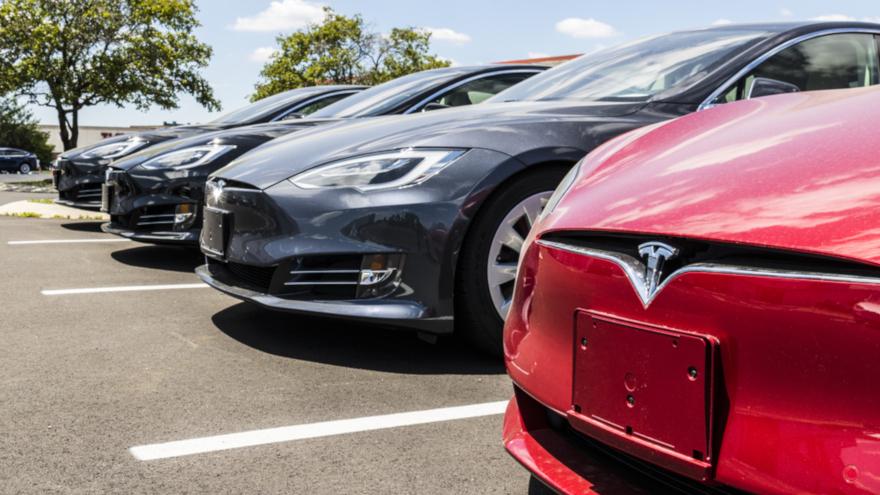
Cox Automotive Mobility Group manager of research and market intelligence Rachelle Petusky discussed the study results during the main portion of the presentation, saying that Tesla has done well in presenting itself as “the innovative leader in EVs.”
That is translating to high awareness of Tesla among consumers,” Petusky said. Toyota, she added, “has definitely had a halo effect, with the Prius being considered an EV brand among consumers.” Without Tesla, she said, EV market share has remained relatively stagnant.
Cost and other barriers to adoption
The study covered barriers to adoption among non-considerers, with 70% listing cost as a barrier and 83% listing charging/battery as a barrier.
Perceived initial cost of EVs is higher than for internal combustion engine vehicles, according to the study. Responding to a question on whether they think that the price for an all-electric vehicle on average is about the same, less, or more than the price for a gas-powered vehicle, 77% of considerers and 87% of non-considerers answered yes.
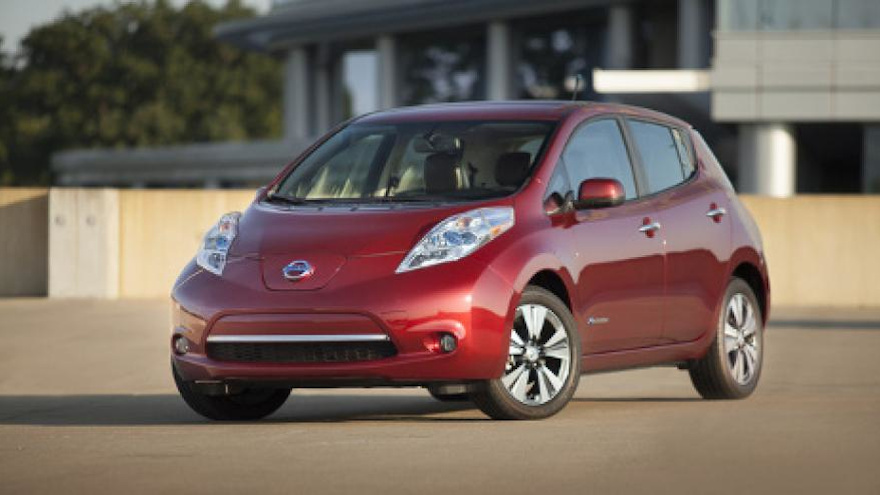
According to the study, affordability is in reach "as the price gap closes." The study showed average transaction prices of the Nissan Leaf compared to the Nissan Maxima and Sentra from 2012 versus 2019. The average transaction price of the Nissan Leaf has declined by 2.5% from 2012 to 2019, while the Sentra has increased 3.1% and the Maxima has risen by 7.5%.
Other study findings:
— The average five-year total cost to own savings for an electric vehicle versus an internal combustion vehicle is 58%.
— In response to a question on how long they perceive that a typical all-electric battery lasts before it must be replaced, owners said 7.2 years, while considerers said 6.9 years.
— Fifty-two percent of EV owners purchased an extended warranty for the battery.
— There is a clear need for more charging stations. In response to the question, “what is your perception of the number of electric vehicle charging stations around the area where you live and work,” 68% of considerers said two few charging stations existed in their area, and 63% said too few existed in their work area.
When Toyota first launched the world’s first mass-produced hybrid — the Prius — in 2000, it promoted the vehicle’s 41 miles per gallon combined city/highway. Nineteen years later, the Prius Eco’s lighter lithium ion battery improves by 15 miles per gallon at 56 MPG combined.
That is one reason why Toyota performed well in the Automotive Science Group’s 2019 Automotive Performance Index Study.
Consumers love their vehicles. But ASG says consumers have very limited product knowledge when looking at the environmental, socioeconomic and lifecycle costs of those vehicles.
Those costs, however, have a strong impact on the environment and the global community, in addition to the consumer’s financial interest.
ASG, wanting to bring transparency to the marketplace through comparative cost analysis in the environmental, socioeconomic and lifecycle cost areas, has released its 2019 Automotive Performance Index study, which named the top brands and specific vehicle models that performed best in those areas.
The study broke down its study into categories including leading cars, leading crossovers and SUVs, and leading brands, and it named winners in categories such as best overall performance, best environmental performance and best economic performance.
Looking at those factors, ASG named Mitsubishi as best all-around performance brand for 2019. In the cars category, Mitsubishi, Toyota, Nissan, Kia, Hyundai and FCA models led the 2019 API rankings.
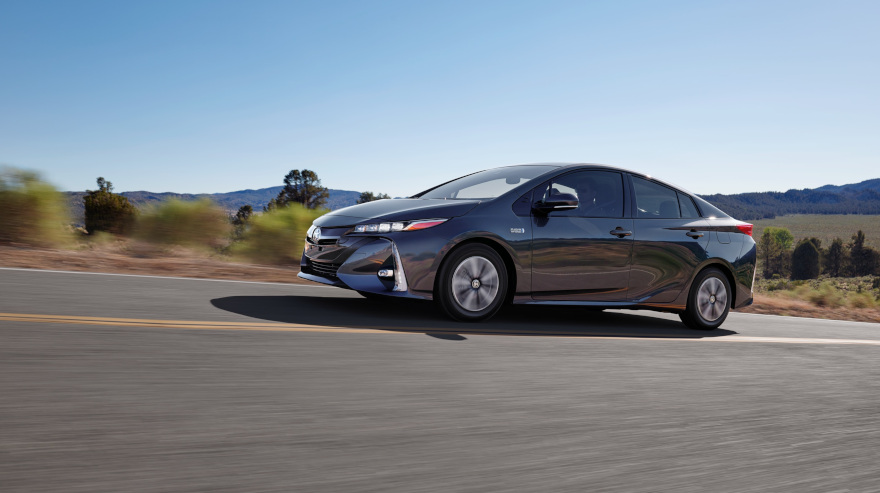
The Toyota Prius Prime won in the category of best all-around performance car.
ASG says its API index measures factors such as “natural capital,” the social and human capital, and the “economic efficiencies embodied within each vehicle” in coming up with its real market value compared to other 2019 vehicle offerings.
Assessing the comparative ecological economics of hybrid, plug-in hybrid, electric and conventional powertrains was key to ASG’s 2019 analysis, the company said, adding that electrification’s environmental benefits keep improving while the U.S. grid keeps getting cleaner.
Cars
In getting to its summary findings, the report discusses each segment, starting with cars. ASG said cars are showing “the most exciting transition in the automotive landscape since the first mass-produced vehicles rolled off the assembly line in the early 20th century.”
“We’re seeing a disruption in the market that is changing the competitive landscape,” ASG writes. “Automakers are being pressed for measurable innovation, not just shamelessly repackaging and rebranding the same technologies decade after decade.”
Mitsubishi, Toyota, Nissan, Kia, Hyundai and FCA models were tops in ASG’s 2019 API rankings. The company said technological tradeoffs between vehicle electrification and light-weighting strategies, which it said maximized lifecycle environmental and economic performance, were important factors in its findings.
“It comes as no surprise in ASG’s study that the effective use of both strategies is the winning formula,” ASG said.
In a news release, Mitsubishi Motors chief operating officer Mark Chaffin said his company’s 2019 lineup “continues to offer consumers the right mix of efficiency, style, technology and performance, and that blend is resonating with new vehicle buyers.”
"From the eco-friendly Mirage to the world's best-selling plug-in hybrid [based on IHS Markit new registrations of plug-in hybrid and all SUV body styles for January 2013 to September 2018 compiled from governments and other sources], the Outlander PHEV, we offer best-in-class vehicles with versatility and value, and the results of ASG's latest study bear that out," Chaffin said.
In naming the Toyota Prius Prime as best all-around performance car, ASG said that with the Prius Prime, Toyota is “bridging the technological gap once again and leading us into the battery electric era with this plug-in hybrid model.” ASG mentioned the Prime’s 133 MPG-e along with its 25-mile all-electric capability. ASG also said the lithium-ion plug-in hybrid model holds 154 grams of CO2-e emissions per mile driven lifetime, and the company said its lifecycle carbon footprint is 48% less than the first-generation Prius.
Crossovers
ASG assessed all 419 crossover variants (while disregarding the mini crossover, compact crossover and crossover segments), and the Kia Niro Plug-in had the smallest carbon footprint in the Environmental Performance Index (Crossover) category. Across its lifecycle, it topped the battery electric Audi e-tron, Tesla Model X and Jaguar I-Pace.
With its all-electric range of 26 miles, the Niro plug-in can handle most every day driving tasks, and ASG estimates daily mean driving distance at 38.4 miles in the U.S.
“At this rate, the Niro Plug-in will only require 10 fill-ups at the gas station per year,” ASG said.
SUVs
In ASGs assessment of the SUV segment’s 406 model variants, it named the Mitsubishi Outlander as Best All-Around Performance SUV. The Mitsubishi Outlander PHEV, Nissan Rogue and Rogue Hybrid, Hyundai Santa Fe, and Kia Sorento were ASG’s Best five All-Around Performance SUV selections.
Minivans
In the minivan segment, the Chrysler Pacifica Hybrid, with PHEV capabilities, won in the category of Best All-Around Performance for the third consecutive year. ASG said the Pacifica Hybrid showed the smallest carbon footprint of any model year 2019 minivan, and for the third consecutive year it won in the category of Best Environmental Performance award in class, also for the third consecutive year.
According to ASG, the Pacifica Hybrid produced 34% less CO2-e emissions over the first six and a half years of its lifecycle compared to the average vehicle in its segment.
In a news release, FCA quoted ASG managing director Colby Self as saying the Chrysler Pacifica Hybrid’s showing in the study was helped by its 32-mile all-electric range and advanced gas-electric combination.
“The plug-in remains unrivaled in the minivan segment, providing the best all-around performance in its class since the model was first introduced in 2017,” Self said.
Following is a list of the winners:
Best brands of 2019
BEST ALL-AROUND PERFORMANCE BRAND: Mitsubishi
BEST ENVIRONMENTAL PERFORMANCE BRAND: Tesla
BEST ECONOMIC PERFORMANCE BRAND: Mitsubishi
BEST SOCIAL PERFORMANCE BRAND: MINI
MOST DISTINGUISHED BRAND: Toyota
Best cars of 2019
2019 ALL CARS (irrespective of class, 1,640 variants assessed)
BEST ALL-AROUND PERFORMANCE CAR: Toyota Prius Prime
BEST ENVIRONMENTAL PERFORMANCE CAR: Hyundai Ioniq Plug-in
BEST ECONOMIC PERFORMANCE CAR: Mitsubishi Mirage
BEST 5 ALL-AROUND PERFORMANCE (SMALL CAR SEGMENT): Mitsubishi Mirage, Toyota Prius C, Toyota Yaris Sedan, Chevrolet Spark, Nissan Versa
BEST 5 ALL-AROUND PERFORMANCE (LARGE CAR SEGMENT): Toyota Prius Eco, Hyundai IONIQ Hybrid and Plug-in, Nissan Leaf, Honda Insight
2019 MINI-COMPACT CARS (100 vehicles assessed)
BEST ALL-AROUND PERFORMANCE: Toyota Yaris Sedan
BEST ENVIRONMENTAL PERFORMANCE: BMW i3
BEST ECONOMIC PERFORMANCE: Chevrolet Spark
2019 COMPACT CARS (235 vehicles assessed)
BEST ALL-AROUND PERFORMANCE: Mitsubishi Mirage
BEST ENVIRONMENTAL PERFORMANCE: Toyota Prius C
BEST ECONOMIC PERFORMANCE: Mitsubishi Mirage
2019 MID-SIZE CARS (303 vehicles assessed)
BEST ALL-AROUND PERFORMANCE: Toyota Prius Prime
BEST ENVIRONMENTAL PERFORMANCE: Toyota Prius Prime
BEST ECONOMIC PERFORMANCE: Honda Fit
2019 FULL-SIZE CARS (87 vehicles assessed)
BEST ALL-AROUND PERFORMANCE: Hyundai IONIQ Plug-in
BEST ENVIRONMENTAL PERFORMANCE: Hyundai IONIQ Plug-in
BEST ECONOMIC PERFORMANCE: Hyundai IONIQ Hybrid
2019 WAGONS (38 vehicles assessed)
BEST ALL-AROUND PERFORMANCE: Subaru Outback
BEST ENVIRONMENTAL PERFORMANCE: Subaru Outback
BEST ECONOMIC PERFORMANCE: Fiat 500L
Best Crossovers of 2019:
2019 ALL CROSSOVER SEGMENTS (419 models assessed)
BEST 5 ALL-AROUND PERFORMANCE Crossovers: Kia Niro, Mitsubishi Outlander Sport, Mazda CX-3, Nissan Kicks, Toyota RAV4 Hybrid
BEST ALL-AROUND PERFORMANCE Crossover: Kia Niro Plug-in
BEST ENVIRONMENTAL PERFORMANCE Crossover: Kia Niro Plug-in
BEST ECONOMIC PERFORMANCE Crossover: Nissan Kicks
2019 MINI CROSSOVERS (83 models assessed)
BEST ALL-AROUND PERFORMANCE: Mazda CX-3
BEST ENVIRONMENTAL PERFORMANCE: Lexus UX 250h
BEST ECONOMIC PERFORMANCE: Hyundai Kona
2019 COMPACT CROSSOVERS (101 models assessed)
BEST ALL-AROUND PERFORMANCE: Kia Niro Plug-in
BEST ENVIRONMENTAL PERFORMANCE: Kia Niro Plug-in
BEST ECONOMIC PERFORMANCE: Nissan Kicks
2019 CROSSOVERS (235 models assessed)
BEST ALL-AROUND PERFORMANCE: Toyota RAV4 Hybrid
BEST ENVIRONMENTAL PERFORMANCE: Toyota RAV4 Hybrid
BEST ECONOMIC PERFORMANCE: Jeep Compass
Best SUVs of 2019
2019 ALL SUV SEGMENTS (406 models assessed)
BEST 5 ALL-AROUND PERFORMANCE SUVs: Mitsubishi Outlander PHEV, Nissan Rogue and Rogue Hybrid, Hyundai Santa Fe Sport, Kia Sorento
BEST ALL-AROUND PERFORMANCE SUV: Mitsubishi Outlander
BEST ENVIRONMENTAL PERFORMANCE SUV: Tesla Model X
BEST ECONOMIC PERFORMANCE SUV: Nissan Rogue
2019 MID-SIZE SUV (184 models assessed)
BEST ALL-AROUND PERFORMANCE: Mitsubishi Outlander
BEST ENVIRONMENTAL PERFORMANCE: Tesla Model X
BEST ECONOMIC PERFORMANCE: Nissan Rogue
2019 FULL-SIZE SUV (222 models assessed)
BEST ALL-AROUND PERFORMANCE: Kia Sorento
BEST ENVIRONMENTAL PERFORMANCE: Toyota Highlander Hybrid
BEST ECONOMIC PERFORMANCE: Kia Sorento
2019 MINIVAN (52 models assessed)
BEST ALL-AROUND PERFORMANCE: Chrysler Pacifica Hybrid
BEST ENVIRONMENTAL PERFORMANCE: Chrysler Pacifica Hybrid
BEST ECONOMIC PERFORMANCE: Ford Transit Connect