An acquisition announcement in the fleet space literally on a global scale came to light on Thursday.
ALD Automotive said it signed of a memorandum of understanding to acquire 100% of LeasePlan from a consortium led by TDR Capital.
According to a news release, the proposed acquisition of LeasePlan is for a total consideration of 4.9 billion Euros and would be made through a combination of cash and shares.
The companies said they expect the deal to be completed by the end of the year.
LeasePlan is one of the leading fleet management and mobility companies in the world by fleet size with 1.8 million vehicles in its portfolio, prompting leadership to say that “with a global and extensive offering,” LeasePlan is “the perfect fit for ALD to shape the industry’s transformation.”
The proposed combination of ALD and LeasePlan into NewALD is expected to be “highly synergetic” and create an opportunity to cross-leverage the two companies’ complementary capabilities.
As a leading global player in mobility worldwide, NewALD explained that it would be able to benefit from a fast-growing market driven by strong underlying trends, including the:
— Shift from ownership to usership on all fronts: B2B, B2C and even B2E4
— Data-driven digital transformation of the mobility industry
— Transition toward zero-emission and sustainable mobility
Executives added that this “transformative” deal would position NewALD for long term fleet growth of at least 6% post integration. NewALD said it would target an improvement in cost to income ratio to 45% by 2025.
“Today marks the beginning of a new chapter in our history as a first step towards creating NewALD,” said ALD chief executive officer Tim Albertsen, who also will lead the combined company. “In the context of today’s transformation of the automotive and mobility sectors, which is proceeding at an unprecedented pace, this proposed transaction is instrumental in the creation of a leading global player in mobility.
“By combining the multiple strengths of ALD and LeasePlan, gaining size, joining forces in digital and creating a leading provider of sustainable mobility solutions, we would transform our industry and be best positioned to deliver even better solutions and value propositions to our enlarged client base,” Albertsen continued. “This transaction would create multiple opportunities to the joint management teams and talents of both companies, across geographies, underpin our focus on sustainability with a clear path to zero emissions mobility and not least deliver strong shareholder returns over the cycles.
“We are all very excited about the prospect of being part of this new venture,” he added.
The proposed transaction has received the support of LeasePlan’s board of directors, as well as its supervisory board
“The combined business would be instrumental in moving the automotive industry from ownership to subscription models and zero-emission mobility,” LeasePlan chief executive officer Tex Gunning. “By joining forces with ALD, we combine the best talents in the industry with the investment power needed to meet the next generation mobility needs of our customers.
“From day one, NewALD would be operating one of the largest fleets of electric vehicles and will continue to set the standard for ESG in the mobility industry. I am very proud of all LeasePlanners for bringing our business to where it is today. We are looking forward to working with the excellent team at ALD and taking our combined business into the exciting future of mobility,” Gunning went on to say.
Holman Enterprises shifted the responsibilities of three executives, as the company that already has 41 dealership franchises representing 20 brands as well as fleet leasing and management company ARI in its portfolio launches a new segment focused on the commercial space.
According to a news release distributed on Thursday, Holman executive vice president and chief commercial officer Rick Tousaw now will lead the newly created Holman Commercial Team.
The company said the Holman Commercial Team is comprised of four fundamental areas — market development, product and service development, customer experience and marketing — and will support the company’s strategic vision for sustained growth in an effort to strengthen Holman’s position as a leader in the automotive industry.
“Operating in support of all the Holman businesses, this newly established team will focus on driving key commercial initiatives forward, ensuring we continue to align our organization with what truly matters to our customers, and fueling our shared success for many years to come,” Tousaw said in the news release.
“The Holman Commercial Team is poised to play a vital role in our company’s mission to provide the industry’s best automotive-related services and exceed our customer’s expectations each and every day,” he continued.
In support of this team’s mission, company veteran Joe Foster has been named vice president of market development and will now oversee Holman’s market development and product and service development teams.
Under Foster’s guidance, the company said these teams will further optimize Holman’s existing products and services while also developing new automotive solutions that align with the ever-evolving needs of the company’s customers.
The company also mentioned Foster and his team are also tasked with ensuring Holman continues to leverage and maximize the natural synergies of the organization’s various automotive service divisions.
Additionally, Emily Graham has been promoted to director of sustainability.
In her new role, Holman explained that Graham will spearhead company’s ongoing sustainability programs and look to accelerate its various electrification as a service initiatives.
As this segment of the industry rapidly matures and becomes increasingly important for Holman’s customers, the company said Graham will lead the organization’s efforts to enhance its electrification and alternative fuel solutions with a particular focus on bringing innovative new strategies to the market.
“We are extremely excited to elevate Joe and Emily to these tremendously important new roles within the Holman Commercial Team,” Tousaw said. “Their keen business acumen and profound understanding of the needs of our customers will be invaluable as we strive to foster an environment of truly seamless collaboration across our entire organization to deliver the holistic automotive strategies and thoughtful customer experience that have long been hallmarks of the Holman family of businesses.
For additional information about Holman Enterprises, visit HolmanEnterprises.com.
HyreCar has an ambitious goal it wants to reach in four years. On Thursday, HyreCar took another step toward it with moves that include increased financing capacity for one of its key partners.
The carsharing marketplace for ridesharing, food and package delivery services announced an expanded strategic partnership to significantly increase vehicle supply in key markets on the HyreCar platform.
The formal partnerships include AmeriDrive Holdings, a leading automotive mobility fleet manager, and Cogent Bank’s specialty finance group.
According to a news release, Cogent has agreed to expand its lending capacity so that AmeriDrive can continue to build its fleet exclusively on the HyreCar platform.
Executives said this fleet will include electric vehicles in key markets which builds on a strategic commitment of HyreCar to provide EV cars to rideshare and delivery drivers in the United States.
“HyreCar’s expanded relationship with AmeriDrive and Cogent Bank utilizes an established platform to help our partners grow their business,” HyreCar chief executive officer Joe Furnari said in the news release.
“This expanded partnership will continue to fortify HyreCar’s ecosystem that serves the gig economy on a national scale and will help us meet our goals to add and utilize over 50,000 cars by 2025 on HyreCar’s platform,” Furnari continued.
Carlos Hernandez is CEO of AmeriDrive.
“AmeriDrive is the number-one fleet in the United States focused on gig drivers,” Hernandez said. “We are on track to scale the business into three new markets over the next four months as we further align with HyreCar’s growth objectives and obtain a vote of confidence from our banking partner at Cogent Bank.”
Michael Skat is executive vice president of specialty finance at Cogent Bank.
“Working with the respective teams, our group created an innovative debt structure that provides the necessary working capital and certain vehicle acquisition support to help achieve success for all parties,” Skat said. “We sincerely look forward to watching the progress made by these dynamic groups.”
The potential for electric vehicles seemingly is giving fleet operators quite a jolt of interest.
On Tuesday, behavior and analytics advisory firm Escalent released the latest findings from its Fleet Advisory Hub, a platform designed to explore the needs, expectations and emotions of commercial and fleet vehicle decisionmakers.
Read more
Especially when manufacturing capacity increases to make more new models available, Merchants Fleet now has more financial resources to take advantage of the opportunity.
On Wednesday, the fleet management company announced a major expansion of its core member funding group to include some of the top banks in the world, enabling the Merchants Fleet to access $2 billion of capacity to lease vehicles and equipment for clients as well as invest in continued growth.
Merchants Fleet highlighted that the new group of banks and investors is led by French international banking group BNP Paribas, which along with Merchants’ lead equity partner Bain Capital Credit, represents more than $20 trillion in assets.
“As we continue to expand into new markets, it is important that we align with the right financial partners who share our strategic vision,” Merchants Fleet chief executive officer Brendan Keegan said in a news release. “After receiving bids from some of the largest and most respected banks in the world, we selected BNP Paribas as our lead financial partner and collateral agent and are very excited to welcome other new partners into the group.
“We are proud to have these powerful institutions in our corner as we continue our trajectory as the fastest-growing fleet management company in North America,” Keegan said.
Merchants Fleet said it is positioned to seize major growth opportunities in all key areas of its portfolio including fleet, mobility, electric vehicles (EVs) and charging infrastructure.
The company mentioned that it already manages more than 150,000 vehicles throughout North America on behalf of some of the largest brands in the world.
Merchants Fleet added that it is set to register its strongest year ever in 2021, more than doubling its 2020 results, and is poised for continued growth in the coming year as it partners with an extensive ecosystem of EV experts to support fleets across the nation as they move forward with plans for electrification.
The company reiterated that the expanded funding capacity will enable Merchants Fleet to continue to fulfill funding requests while investing in the latest fleet technology.
“BNP Paribas continues to be a strategic partner to Merchants Fleet on this next phase of its growth ambitions,” said Andrew Strait, head of U.S. diversified industries coverage for BNP Paribas. “We look forward to supporting the company on its expansion as fleet electrification and charging infrastructure will be a key part of our transition to a more sustainable economy.”
Experts see electric vehicles eventually having a significant impact in the fleet space.
With that thinking in mind, behavior and analytics advisory firm Escalent recently released the latest findings from its Fleet Advisory Hub, a platform designed to explore the needs, expectations and emotions of commercial and fleet vehicle decisionmakers.
The newest report examined fleet decisionmakers’ familiarity with and opinions of many top brands with electrified vehicle plans across duty segments, as well as their likelihood of considering products from each brand for fleet implementation.
Escalent highlighted that among the key findings are clear indicators for the automotive industry’s biggest brands:
• Ford and Tesla earn top marks for electric vehicle (EV) applications in light and medium/heavy duty fleets.
• Tesla is the brand most synonymous and emblematic of the electrification movement, viewed as the “absolute leader for electrification” by approximately half of both light duty and medium/heavy duty fleet participants. This reflects similar Escalent EVForward findings, wherein retail consumers are most aware of Tesla as a leading manufacturer of electric vehicles.
• Among light duty brands, startups such as Rivian and Lordstown lag far behind legacy automakers and their observable products and accelerating marketing campaigns.
“With respect to electric vehicles, Tesla has carved out a unique position of ubiquity and alignment with the overall movement,” said Michael Schmall, vice president of automotive and mobility at Escalent.
“However, Ford is the clear winner from a consideration standpoint among fleet decisionmakers, a position it has reinforced with the introduction of the electrified Ford F-150 Lightning,” Schmall continued in a news release.
Escalent said the study also provides a closer look at the factors most likely to influence EV adoption among fleet decision-makers.
What didn’t surprise firm experts, they pointed out total cost of ownership (TCO) leads the factors most influential to adoption — though clarity also lacks, with many uncertain of EVs’ impact to the traditional TCO calculation.
Escalent added that fleet decisionmakers are also considering electrification potential around uptime, a brand’s reputation or their relationship with it, charging and infrastructure concerns and information available about brands’ EV offerings. including services to ease a transition to electric vehicles.
“Startup brands have a lot of catching up to do among light duty fleet decision-makers, where familiar brands and their electrified products dominate mindshare,” Schmall said. “The story is a bit different for those operating medium and heavy duty fleets, as few tangible products in this segment can be seen on the road, offering a more level playing field.”
Among fleet decisionmakers, Escalent said the road map for implementation has begun to come into focus.
Along with the needed definition for adjusting the TCO calculation, the study identified fleet decisionmakers’ perspective for the expected timeline to achieve operating cost parity with their internal combustion engine (ICE) counterparts, with most expecting to reach that point after two to three years of integrating an EV.
Fleet Advisory Hub is one of the largest collections of commercial vehicle and fleet decision-maker insights available on the market today. Currently, nearly 10,000 fleets collectively numbering more than 800,000 vehicles are represented.
More details about the Fleet Advisory Hub can be found via this website.
Fleet management company Donlen announced that it has joined the Climate Group's EV100 in an effort to push electric transportation to the forefront of mobility.
The EV100 is described as a team of companies committed to "shaping the market for EVs by building demand and establishing electro-mobility as a mainstream transport solution."
To join the coalition — comprised of various industries across the globe — each organization has to make a public commitment to be a "catalyst" for the uptake and adoption of EVs. as well as the installation of charging infrastructure.
Maria Neve, who is Donlen’s vice president of electrification and sustainability, said in a news release: "By joining the group, Donlen is committing to achieving net zero emissions on at least 154,327 units by 2030 which represents a significant portion of our customer fleet. Additionally, we will transition our internal fleet of approximately 68 vehicles to EVs and install charging infrastructure at all of our office locations."
Donlen said it has the "expertise" to guide customers to what it calls suitable EV options based on their specifica needs. And committing to EV100 offers the fleet company a chance to lead by example, as well as help ultimately make "electric transport the new normal."
Donlen chief executive officer Tom Callahans said: "As we lead the next era in fleet, we are laser focused on helping our customers use EVs to achieve the lowest cost per mile while reducing emissions and achieving sustainability goals."
It’s Brake Safety Week, an annual event organized by the Commercial Vehicle Safety Alliance (CVSA) to raise awareness among fleets of the importance of diligent brake maintenance. This year, the event comes at a particularly fitting time — as the economy reopens, schools go back in session and freeways flood with workers returning to the office.
The relatively empty roads last year provided a unique opportunity to study driving habits, with a Teletrac Navman study following thousands of vehicles across millions of miles revealing that the less-congested roads triggered several habitual changes — most of them for the worse. When not contending with traffic, many fleet drivers:
• Drove further past the posted speed limit (17% increase in speed)
• Took corners more harshly (15% increase in harsh cornering events)
• Rolled past more stop signs (10% increase in failure to stop)
The data suggests that sharing the road with more people once again will bring many of these bad habits back in line, but there was one common danger that plummeted during the pandemic: harsh braking. Less stop-and-go traffic meant far fewer occasions for truckers to have to slam their brakes – 54 percent fewer, in fact.
With renewed congestion, stop-and-go traffic and tailgating could once again become the status quo on the roads, prompting many commuters to regularly slam their brakes — perhaps causing professionally trained commercial drivers to do the same.
This is an especially critical time for fleet drivers to be mindful — during last year’s Brake Safety Week, CVSA reported that 12% of the 43,565 commercial motor vehicles inspected were pulled from service due to brake violations. Furthermore, the Federal Motor Carrier Safety Administration has found that trucks involved in crashes where braking capacity was a major player were 50 percent more likely to have a brake violation than those involved in other crashes.
Coupled together, these statistics paint a picture of the need for greater awareness of brake health — and the consequences of ignoring it. This isn’t all about maintenance, either; the mere act of harshly braking can put extreme strain on brakes and brake pads, causing them to wear out more quickly and less evenly. Drivers who make a habit of harsh braking run a higher risk of getting a violation or, worse, having their brakes fail when they need them most – potentially causing a severe accident.
Knowing that you have a problem is a good start, but fleet owners that want to get serious about preventing brake-related accidents and violations would do well to equip themselves accordingly. Telematics software can be especially helpful for staying current on maintenance or even implementing preventative maintenance practices providing far more accuracy than the manufacturer’s service schedule. The system automatically factors in mileage, fuel use, engine hours and more to give fleet owners an alert ahead of when each vehicle needs maintenance – preventing any unexpected lapses that could result in a violation or an accident. In addition, telematics allows for analytics of harsh braking and other bad driving habits in real time, giving managers the means to coach drivers with custom tailored feedback.
Of course, software is only one piece of the puzzle; drivers also need to be properly educated on the importance of brake safety. One of the best steps to take on this front is to stress the importance of the mandated Driver-Vehicle Inspection Reports (DVIRs) to drivers. These required inspections can be tedious, but the more thorough the driver is the more data coming in from these reports, the more accurate the picture of the fleet’s overall brake health and the less likely any individual vehicle will fall out of compliance. Monitoring tire pressure is another way to ensure safety, as low-tire pressure can impact the control drivers have of their vehicle. Not to mention properly inflated tires ease the wear on the tires themselves and improve fuel economy Detailed DVIRs will extend the life of costly parts and keep trucks compliant — and safe — for longer.
Given the timing of everything happening on the roads right now, Brake Safety Week couldn’t have come at a better time this year. For all the fleet owners out there — even those who are already vigilant on training and upkeep — the coming months will require both caution and care. To all the drivers, this week will serve as a chance to be mindful of bad habits that may have built up over the last year. Have a safe and uneventful Brake Safety Week!
Bryce Wilson is manager of integrated marketing at Teletrac Navman, a leading provider of telematics.
The fleet space is looking to keep “current” with the newest vehicles entering the sector.
On Wednesday, Merchants Fleet announced a partnership with Enel X — the Enel Group’s advanced energy services business line — to meet the infrastructure needs of the electric vehicle (EV) industry.
As part of the partnership, Enel X will provide smart EV supply equipment (EVSE), installation and charging infrastructure to Merchants Fleet clients to support the electrification of fleets nationwide.
The announcement follows an executive order from President Biden aimed at making half of all new vehicles sold in the U.S. be electric by 2030.
According to Bloomberg NEF, 100% of the world’s road fleet will need to run on electricity by the year 2050 to meet its Net Zero Scenario, requiring additional infrastructure to support the industry’s transition.
Through the agreement, Merchants Fleet clients will have access to Enel X’s portfolio of turnkey fleet electrification solutions, including JuiceBox smart charging stations and JuiceNet IoT software to manage electric fleets through optimized charging times, and remote access.
By electrifying fleets, the company explained that corporations can reduce emissions and fleet operating costs and help balance the grid by utilizing off-peak charging, which can generate bill savings and reduces strain on the grid during peak periods.
“Every day, the Merchants Fleet team works to develop and improve upon the fleet electrification solutions we can offer to our clients — solutions that not only elevate their brands environmentally, but integrate the latest innovations to reduce costs,” Merchants Fleet chief executive officer Brendan Keegan said in a news release.
“Bringing Enel X into our ecosystem expands the scale and capabilities of what we can offer to our clients, and supports us in our journey to over 50% electrification by 2030,” Keegan continued.
The partnership with Merchants Fleet continues to expand Enel X’s fleet electrification portfolio, including partnerships with Biogen, Uber, Vestas, Novartis and more.
Enel X is also working with transit agencies, including the Massachusetts Bay Transportation Authority (MBTA) to support the electrification of public bus fleets and Martha’s Vineyard on a microgrid that will power an all-electric public transportation bus.
“Across the country, we’re seeing enormous interest in EV adoption as businesses look to achieve corporate sustainability goals and get ahead of new or future regulations. Many of the world’s largest companies are electrifying their fleets, and relying on our smart charging infrastructure and services to reduce costs and emissions,” said Giovanni Bertolino, head of e-mobility for Enel X North America.
“Our partnership with Merchants Fleet makes the transition to EVs more efficient and more cost effective for Merchants’ clients,” Bertolino added.
Earlier this year, Merchants Fleet launched its Adopt EV program, which is designed to help clients make a seamless and cost-effective entry into EVs. The tool educates and guides clients throughout the EV and EVSE purchase process from concept to execution.
The company said the addition of Enel X to the ecosystem will give Merchants Fleet clients access to specialized engineers and advisors who will help plan, provide, and install custom fit EVSE, enabling the adoption of infrastructure and services that align with their needs and electrification goals.
Last year, Merchants Fleet set a goal to achieve 50% electrification of its mobility fleet portfolio by 2025, and 50% electrification of its managed fleet portfolio by 2030.
“Even before the first all-electric truck rolled off the production line, Merchants understood that infrastructure would emerge as the all-important factor for success within the industry,” the company said.
“To optimize operations while achieving sustainability goals for all clients, Merchants has implemented an ecosystem approach to provide highly customized and innovative solutions to integrate EVs into its clients’ fleets,” Merchants Fleet went on to say.
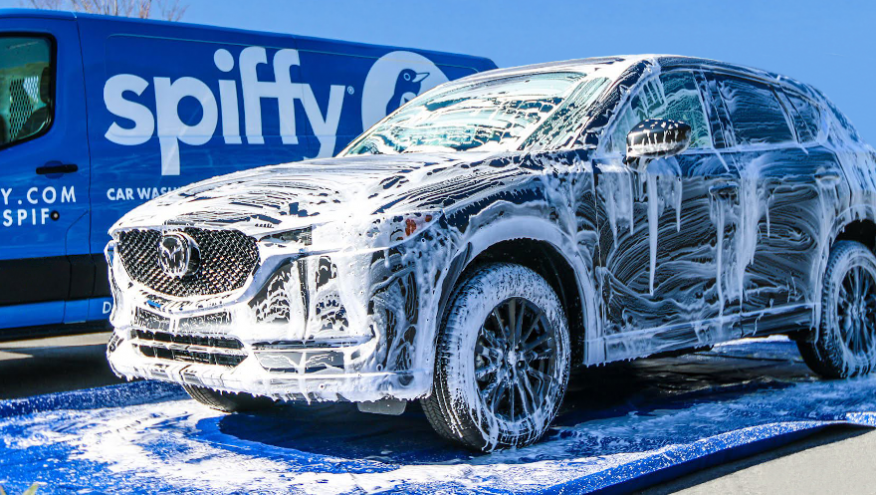
Spiffy didn’t have to go too far for its latest franchise launch.
The on-demand car care, tech and services company said Wednesday that its newest franchise has opened in Greensboro, N.C., which is roughly an hour from Spiffy headquarters.
This is the sixth franchise market in which Spiffy has opened since March.
The franchise owner, BJ Bodkin, detailed vehicles for nine years in North Carolina before spending the past 19 in the bottled water industry. In that post, he managed operations for home and office delivery.
“Spiffy has taken a disruptive approach to car care that I’ve dreamt about for 26 years: truly mobile car wash, detail and maintenance that prioritizes convenience for vehicle owners,” Bodkin said in a news release.
“I’m fired up to bring Spiffy to Greensboro because their on-demand business model has been sorely lacking throughout the Triad area,” he said. “We’re looking forward to seeing the smiles on our customers’ faces when we make their cars look brand new.”
Spiffy chief executive officer Scot Wingo added: “We’ve always seen the Triad area as a future Spiffy market, and BJ has brought an excellent blend of dedication and experience as our Greensboro franchise owner. He has a strong understanding of what consumers want from their car care provider, especially the importance of providing a convenience-oriented experience.”