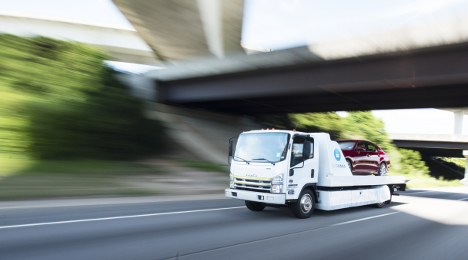
In November, New York- and Dallas-based Vroom — part of the growing direct-to-consumer online used-car space — announced it would start providing its services to dealers, as well.
Through an app built specifically for them, dealers can sell their vehicles to Vroom, with the same appraisal process as the consumer-facing side of Vroom’s services. Dealers can also have Vroom create a white-labeled “sell your car” page on their respective websites. Additionally, Vroom’s system is designed to fully integrate with the dealership’s inventory management.
So, it appears at least one of the so-called “disruptive” platforms is looking to involve traditional used-car players in its business model.
And vice versa.
In fact, Cox Automotive — home to such companies as Autotrader, Kelley Blue Book and Manheim — has a group specifically devoted to investing in start-ups, utilizing the company's own assets.
“We literally have a group of people internally who are looking outside as well as looking inside, and saying, ‘Hey, how can we recombine things that we see here to try to create new forms of value,’” Cox Automotive Media Group president Jared Rowe told Auto Remarketing in a late October interview at the company’s headquarters. “Some of them work, and some of them don’t work, but ultimately we’re making that specific investment internally.”
One of those is Cox Automotive’s Flexdrive product, a program the company said is designed to offer a “fresh alternative to traditional car ownership” that allows for weekly or monthly “subscription” to a vehicle rather than permanent ownership.
Another is alt_driver, a relatively new website designed to share car content gathered from social media and throughout the Web, including everything from stunts to videos of classic cars. It already pulls in an audience of 3 million unique visitors each month, according to Cox Automotive.
Rowe said that with alt_driver, Cox Auto has used “video content to create an automotive intending audience, mainly by leveraging social media.”
He said it’s a “great example of learning how to grow a new form of audience outside of our existing audiences,” and that the company is now working with the alt_driver team and Cox Auto clients to determine how the company can best leverage that audience.
Another way in which the company aims to harness disruption, largely within the Media Group division Rowe says, is “trying to, in a disciplined way, ask the question ‘why?’ of our most strongly held beliefs.”
Rowe explains that further: “We don’t get to say, ‘We’ve done it this way forever because it’s made us successful.’ We always have to ask the question ‘why.’ Because there’s something we talk about internally (called) the ‘tyranny of truth.’
“As soon as something becomes true, you cease to question it. As soon as you cease to question it, it will become a weakness eventually,” Rowe said. “It’s no different than what our clients have to do every single day. They have to continue to evolve how they interact with consumers. They have to continue to evolve how they manage the F&I process. We have to do the exact same thing.
“So, a lot of what we do in terms of trying to disrupt ourselves is really simply to question what has made us successful or at least what we think has made us successful,” Rowe said.
But perhaps the best example of how Cox Automotive embraces disruption was one within its own house: the 1997 formation of AutoTrader.com.
“And it was started at a time when the newspapers were actually the dominant generators of EBITDA inside of Cox,” Rowe said earlier that October day to media gathered at Cox Automotive headquarters. “So, if you think about the discipline and the foresight it took for that leadership team at the time to say, ‘Hey, we see a disruptive technology coming, and we don’t want to be disrupted by it. We actually want to benefit from it, so let’s build something that will actually focus on eroding our core businesses to a certain extent.’
“That is a great example of how Cox thinks about innovation and how Cox thinks about continuing to evolve their businesses over time,” Rowe added. “There are no such things as sacred cows inside of Cox; we need to continue to invest, grow and evolve.”
And dealers? They're getting in on the action, too. Stay tuned for Part II of this series, where we look at how dealers are using the disruptive model to their advantage.
Apparently, the days of Black Friday and Cyber Monday deals being reserved for discounted items that would fit on your office desk or living room mantle are long gone.
While some manufacturers got in the game early this year, another auto sales company is throwing its hat into the ring — in this case, it's Carvana.
And they’d like to make it as easy to buy a used car as it is to, say, replace your television.
Starting at 12:01 a.m. MST (2:01 a.m. EST) on Friday, Carvana is offering an additional $1,000 off of any car in its inventory for online shoppers in certain states.
This “Cyber Monday Deal” will stay valid through the weekend, ending at 6 p.m. MST (8 p.m. EST) on Monday, Nov. 30.
Carvana offers delivery to all of the contiguous United States. The company notes that, due to laws in certain states limiting vehicle price reductions, the deal will not be available in Alaska, Arkansas, Hawaii, Idaho, New York, Texas and Utah.
After a recent Autotrader study showed car technology trumps brand and color for new-car shoppers, new data from KPMG shows automakers might need to step it up in the tech department even more.
A recent KPMG study, titled, "The Clockspeed Dilemma," shows that automakers may need to start acting more like tech, software and consumer electronics companies. This shift, according to KPMG would include, “more highly customized products, quicker introduction of new, ‘sexy’ models, and nearly flawless quality to address competition from new entrants in the business.”
KPMG says the highly competitive landscape of large technology companies and startups operate at faster “clockspeeds.”
“Albert Einstein’s theory of relativity makes the point simply enough. Einstein taught us that time is relative. It sure is in the auto industry. Car companies obey a pace — a clockspeed — required of capital-intensive powertrain plants, stamping plants and assembly lines, to ensure cars work at Six Sigma quality every time and all the time, from -40 to 130 degrees Fahrenheit,” said Gary Silberg, national automotive leader for KPMG, in the report.
“Now they must also embrace a far faster clockspeed — actually, multiple faster clockspeeds. The faster clockspeeds are the result of new players entering the ecosystem, from technology giants to start-ups. Some of the new competitors operate at a much larger economy of scale. All of them fuel customer demands for cars to be repeatedly new, exciting, and sexy while still holding to the standards of Six Sigma quality. Thus the clockspeed dilemma: the need to serve two different paces at once,” he continued.
In other words, yes, automakers have to remain focused on quality and reliability; but as the tech industry seems to come up with something new and exciting for consumers every month — automakers may need to step up their tech game to keep consumers interested.
"Consumers expect as a given that cars get increasingly better fuel economy, better looking and safer on the road," said Silberg. "But the entrance of tech disruptors has created new expectations about the customer experience. Just look at how the iPhone changed the consumer experience and how we interact with our mobile devices. Auto companies must solve the clockspeed dilemma today or risk becoming obsolete very quickly."
KPMG explained the crossroads plays out as such:
- Automakers are familiar with what KPMG calls the “The Robust Industrial Machine,” or that timing that requires a 5-7-year clockspeed for powertrains, vehicle platforms, and other essential mechanical elements to provide a reasonable return on investment.
- On the other hand, automakers are being called to adhere to a speedier pace of innovation, stemming from consumer demand for what KPMG calls the “Sexy Dynamic Experience.” This experience hinges on three elements:
- Products repeatedly evolve and improve after purchase.
- Products are flexible, able to create environments or experience that is configurable with a consumer's tastes or usage situation.
- New enhancements are reverse compatible. They not only improve performance but work with earlier platforms.
Consumers are used to this type of experience with items they use every day such as smartphones and laptops, which are updated and improved on an annual basis.
Silberg said, “The power of the Sexy Dynamic Experience to drive innovation and to change markets should not be underestimated: sexy can kill robust, especially as consumers begin to see sexy as more important than robust.”
In today’s quickly changing market, automakers must continue to focus on reliability and quality, but the new KPMG study contends to stay relevant, the auto industry could serve to take a few pages from the tech world’s play book.
"First, however, a simple truth: There's no single answer to innovating successfully, no one-size-fits-all solution,” Silberg concluded.
Would it surprise you to find out that members of the Generation Y cohort may actually “love” their vehicles, on average, more than other generations?
That was the finding of Strategic Vision’s research on the subject, which they began after identifying “love” as the “holy grail of the customer experience.”
This led to the creation of its “Customer Love Index,” or CLI, to determine which vehicles are most loved by their owners.
According to the company’s quantitative New Vehicle Experience Study, which surveyed feedback from over 44,000 new-vehicle owners, the average CLI score came out to about 400. Millennials came in at 470.
They also found that these millennials are much more likely to purchase mass-market vehicles that weren’t necessarily designed to be “loved,” while also “loving” them just as much, or more, than other generations love more expensive vehicles.
According to Strategic Vision, though, this is nothing new, and shouldn’t be viewed as something millennial-specific — more often than not, the younger generations have tended to be more enthusiastic about such things.
“As new younger buyers enter any market they essentially crush hard on their choices, believing that their first love will always be their only,” said Christopher Chaney, senior vice president of Strategic Vision. “Of course, this isn’t new to millennials. Every generation in their youth can remember their first love and the deep emotional impact it had on their lives, and future decisions in life.”
Looking at the overall results, the Porsche Macan scored the highest on the CLI rankings, coming in at a score of 629, one of only two vehicles to score over 600 (the other being the Chevrolet Corvette convertible).
Which segment had the least love? While it was a vehicle in the minivan category that scored the lowest overall when separated by segment-leaders, Strategic Vision pointed out that, overall, minivans obtained higher CLI scores than most of the hybrid vehicles surveyed.
“Most U.S. customers will not spend more than an additional $50 per month for a vehicle just for MPG enhancing or environmentally friendly powertrain,” said Alexander Edwards, Strategic Vision’s president. “Instead, creating a product that customers can love will allow buyers to spend significantly more money because it has the right balance of styling, innovation, performance and environmental friendliness.”
Without further ado, here’s the full list, provided by Strategic Vision.
Strategic Vision's Customer Love Index Segment Winners
| Segment |
Winner(s) |
CLI Score |
| Micro Car |
Fiat 500 |
449 |
| Small Car |
Mazda3 Sedan |
438 |
| Small Multi-function Car |
Kia Soul |
408 |
| Small Alternative Powertrain (APT) Car |
Fiat 500e |
408 |
| Midsize Car |
Subaru WRX |
451 |
| Midsize Multi-function Car |
Subaru Outback |
408 |
| Midsize APT Car |
Toyota Prius / Toyota Camry Hybrid |
354 |
| Full-size Car |
Dodge Charger |
543 |
| Near-luxury Car |
Mercedes-Benz CLA-class |
564 |
| Near-luxury APT Car |
BMW i3 |
474 |
| Luxury Car |
Mercedes-Benz S-Class Sedan |
563 |
| Luxury Multi-function Car |
BMW 3-Series GT |
466 |
| Specialty Coupe |
MINI Cooper Hardtop |
547 |
| Premium Coupe |
Chevrolet Corvette Coupe |
598 |
| Standard Convertible |
Ford Mustange Convertible |
564 |
| Premium Convertible/Roadster |
Chevrolet Corvette Convertible |
617 |
| Standard Pickup |
Chevrolet Colorado |
423 |
| Full-size Pickup |
Nissan Titan |
482 |
| Heavy Duty Pickup |
GMC Sierra 2500/3500 |
467 |
| Entry SUV |
Jeep Renegade |
490 |
| Entry CUV |
Hyundai Tucson |
451 |
| Mid-size SUV |
Dodge Durango |
465 |
| Mid-size CUV |
Ford Flex |
460 |
| Full-size Utility |
GMC Yukon XL |
483 |
| Near-luxury Utility |
Land Rover Range Rover Evoque 5-door |
516 |
| Luxury SUV |
Infiniti QX80 |
524 |
| Luxury CUV |
Porsche Macan |
629 |
| Minivan |
Kia Sedona |
391 |
One final point of interest: while not reflected in the chart above, the manufacturer with the lineup of vehicles with the highest overall CLI scores was Volkswagen Group of America. Strategic Vision felt it was important to point out that this finding was based on data collected prior to September 2015.
According to a release from Strategic Vision regarding the finding, they had the following message on the subject: “The good news for VWGoA is that they will be working from a position where customers have initially loved their experience. When love is lost, that’s when the real work begins.”
Reynolds and Reynolds announced that it has joined on as an NIADA Member Benefit Partner for the National Independent Automobile Dealers Association.
Reynolds Document Services will now provide the business forms and sales contracts, compliance services, branding products and other dealership supplies to the NIADA’s dealer members in North America.
“We’re pleased to join the NIADA National Member Benefit program,” said Jerry Kirwan, Reynolds Document Services’ senior vice president and general manager. “We’ve worked informally alongside NIADA and its members for a number of years. This agreement helps solidify our commitment to providing a broad portfolio of business documents and supplies that help independent auto dealers manage their compliance risk, brand their stores and improve their operational efficiencies.”
Reynolds and Reynolds, in business since 1866, has provided automotive documents since the 1920s. Today, the company provides the Reynolds LAW 553 Universal Retail Installment Sales Contract, which the company says is the most widely accepted document in automotive finance.
“Our National Member Benefit program provides our members with an extensive, highly vetted roster of partners that supply the kinds of products and services our members use in their business every day,” said Scott Lilja, NIADA’s senior vice president of member services. “We’re pleased to now add Reynolds to the list of approved providers for business supply services.
“Reynolds documents and supplies are another set of tools we can offer to help our members streamline their processes, reduce their compliance risk and enhance the transparency of the vehicle sales transaction with their customers,” he continued.
CDK Global, in partnership with Zipwhip, a cloud-based texting provider, has created the former’s Text Connect solution, allowing dealer employees to send and receive texts from customers.
Employees with the system can text their customers via any Internet-enabled device, using existing landlines and toll-free phone numbers.
"Nearly half of consumers say they prefer SMS communication with their dealership for sales and service," said Bob Karp, president of Automotive Retail North America at CDK Global. "It's clear that consumers want to communicate with business differently than ever before. Text Connect enables dealerships to turn existing phone lines into communication tools that reach customers in their preferred method."
CDK says its research found that a majority of dealership employees are using their own personal cell phones to communicate with customers.
The company highlighted that Text Connect can also be used to deliver service-related notifications to customers, such as service appointment reminders, vehicle status updates while it is being serviced and parts delivery notifications, among many other options. The system also serves as a detailed, unified source of record keeping for communication with consumers, compared to messages being spread across many different systems and employees’ various personal devices.
Want to learn more? Check out the Text Connect site here.
J.D. Power has further thrust its hat into the ring of third-party auto sites by today launching its all-new consumer auto ratings and research website.
According to the company, the new site features the following:
- new car quality ratings
- new car performance & design ratings
- used car dependability/reliability ratings
- new car pricing (MSRP and invoice), fuel economy and vehicle specs
- robust search for new, used, and certified pre-owned (CPO) vehicles in local dealer inventory
- convenient get-a-quote options
The site also features J.D. Power’s proprietary “Power Circle Ratings,” which the company says are based on independent and unbiased “Voice of the Customer” feedback from millions of verified car owners. The system ranks each new-car model with five, four, three or two circles, five being a score representing “among the best.”
Frances Caille, the company’s vice president of strategic marketing, touts the new services highly.
"The J.D. Power consumer website is the only source of consumer ratings based on independent and unbiased feedback from millions of verified owners," Caille said. "Using J.D. Power quality, performance, design and dependability ratings helps consumers make better, more informed decisions when purchasing new and used vehicles."
Want to learn more about the site? Check it out for yourself here.
Dealers that fail to invest in consumer-facing technologies risk being trumped by competitors.
That’s the message from J.D. Power following its 2015 U.S. Sales Satisfaction Index Study released on Thursday.
J.D. Power’s study, in its 29th year, measures customer satisfaction with the sales experience for new-vehicle shoppers — for both buyers and non-buyers — to gauge what works and what does not to keep customers satisfied.
This year, the company highlighted especially the importance of utilizing consumer-facing technologies during the car-shopping process. One example, in particular, pointed out the use of tablets.
According to J.D. Power’s study, among both premium and non-premium buyers, the use of tablets by sales personnel to perform tasks such as recording customer vehicle needs, demonstrating a vehicle’s features and displaying pricing information yielded higher customer satisfaction.
Perhaps most notably in respect to tablets, the study shows that handwritten price quotes had a negative impact on buyer satisfaction.
The study also found that F&I products, such as extended warranties, pre-paid maintenance contracts and tire/road hazard protection helped increase satisfaction to the customers that were presented with the option.
“With retail vehicle sales in the United States in 2015 forecast to reach 14.2 million units and this positive momentum expected to carry into 2016, dealers face challenges in properly servicing a high volume of new-vehicle buyers who are increasingly tech savvy,” said Chris Sutton, vice president of the automotive retail practice at J.D. Power. “Dealerships should understand that customers want and trust technology and that it can enhance efficiencies. Dealers that disregard it may risk being left behind in three to five years. Customers are experiencing interesting uses of technology in many of their other retail transactions — and now expect this in auto.”
Here are some other key findings of the study, listed by J.D. Power:
- Sales staff remain vital to sales experience: The most impactful sales satisfaction key performance indicator (KPI)—best practice—is interacting with a salesperson who understands the customer’s needs completely (+106 points). Such salespersons are good listeners, ask relevant questions and are able to deliver on customer requests. This KPI demonstrates that even with the growing prevalence of online communications and emphasis on an efficient transaction, the salesperson still plays a key role.
- 5 of top-10 KPIs relate to working out the deal: Among the most impactful KPIs are five that involve making customers feel comfortable (not pressured) and confident they are receiving the most transparent and up-front information to aid their decision-making while at the dealership. Delivering on these best practices improves satisfaction and builds loyalty and advocacy.
- Gen Y equally interested in safety and protecting vehicle value as other generations: Among generational groups, Gen Y is as likely to purchase F&I products as other generations. For example, by generation, the following proportions of customers purchase tire/road hazard protection: Gen Y (21 percent); Gen X (21 percent); Boomer (20 percent); and Pre-Boomer (20 percent).
Among brands, Porsche ranked the highest on a 1,000-point scale in customer satisfaction with a score of 752, marking a 14-point increase over last year. MINI, for the sixth-year straight, ranked highest among the mass-market brands, with a score of 762 (35 points over last year).
Want to check out the full study? Click here.
Liquid Motors today launches a fleet marketing service to assist fleet management companies in the remarketing process. The company also recently announced several enhancements to its One-Click wholesale service.
First off, Liquid’s fleet marketing service includes an easy-to-use mobile inspection application for drivers to perform self-inspections on vehicles about to be turned in, as well as a secure online portal for drivers, employees, grounding dealers and wholesalers to use to purchase the vehicles when they’re being grounded.
The vehicle can also be listed online via Liquid’s One-Click wholesale service.
Michael Daseke, Liquid’s president and chief executive officer, says his company was approached by several fleet management companies seeking to leverage its upstream wholesale marketing services.
"The results of those discussions culminated in the development of a comprehensive fleet marketing service to overcome the challenges of getting photos of the vehicle and vehicle condition data for fleet vehicles and to help sell more fleet vehicles earlier in the remarketing process,” Daseke said.
Here’s how it works, according to the company: When a vehicle is about to be turned, its driver is sent a notification about when they need to complete an inspection. Via a mobile inspection app available for both Android and iPhone, the driver uses the app to confirm the VIN and color of the vehicle, current mileage and then takes specified photos and answers various questions about the vehicle’s condition.
"Fleet management companies are looking to provide more value to their customers." said Cynthia Meyer, vice president of sales at Liquid Motors. “Selling fleet vehicles to drivers and employees provides a great employment benefit to their customer’s employees and selling more vehicles earlier in the remarketing process provides a large financial benefit as well.”
In other Liquid Motors news, the company also announced a partnership with several independent auctions in the U.S. to provide a new service to dealers. Using One-Click, dealers can list aged units on the wholesale marketplace with no monthly subscription required.
"For the past year, we have piloted an outside the gate program with some of our independent auction customers." Daseke said. "This new service is the next step to growing the program to a broader dealer audience."
Dealers will have access to manually list their aged vehicles or use “auto-launch” to automatically push the units. The only requirement for using the program is that the dealer must list their aged inventory, the vehicle must be listed within a reasonable percentage of the Manheim Market Report value and one of the participating independent auctions must be selected to facilitate the transaction.
Speaking of MMR, Liquid also announced this week its added support of MMR pricing on its One-Click service. MMR pricing is now listed on the manual listing screens and is also available to reach a figure for the program’s “auto-launch” feature.
"We are very pleased to work with Manheim to improve the quality of the pricing of vehicles listed from our One-Click Wholesale Service." Daseke said. "We believe the integration of MMR pricing will fuel additional success for our customers."
For more information about Liquid Motors, visit its site here.
Canadian auto tech company Selectbidder, best known for its auction-centric dealer trade networking platform, has been busy lately with the signing of three new auction locations on the Eastern Seaboard.
Selectbidder signed Bloomsburg Auto Auction in Bloomsburg, Pa., a couple weeks ago, and penned an agreement with Acadia Auto Auctions on Tuesday. The latter has two auction locations that will be serviced by Selectbidder: Port City Auto Auction in Richmond, Maine and Acadia Auto Auction in Carmel, Maine.
Auto Remarketing caught up with Sean Liptay, Selectbidder’s chief executive officer and owner of the Great Northern Auction in Moncton, New Brunswick, to learn more about the additions.
“We’ve been really focused on proving the model fit in the U.S. and we’re having really good success,” Liptay said. “We’ve signed up four auctions in different markets and we’re really immersed in getting the up and running right now.”
That fourth auction, Space Coast AA, was signed as Selectbidder’s first U.S. client following the NAAA Convention at the end of September. Liptay says the Melbourne, Fla. auction is still building its dealer network but really excited to completely roll-out the system.
According to Liptay, the relationship with the Acadia auctions was stirred up the old-fashioned way: by doing the legwork.
“Originally the Maine auto auctions we had popped in to visit them way back when we had the concept of rolling it out to other independent auto auctions,” Liptay said. “Unfortunately, they weren’t even there at that time so we had to circle back to them. But we had really good conversations with them and just basically picking up the phone and calling them. That’s the way these relationships have started, really.”
Looking back at Selectbidder’s home auction of Great Northern Auction in Canada, the only location where the Selectbidder system is completely rolled out, Liptay says the response from his own auction staff and the dealers utilizing the network has maintained its strength since it officially hit the ground in April.
“We’re still getting new signups and the auction sales people are still loving it,” Liptay said. “And loving being out there helping dealers move their trade-ins quicker.”
He also says the auctions really love the idea of the auction being the center of the dealer-to-dealer network.
“We hear that a lot,” he said. “Especially on the buying side of it, they’re really happy to have the auction and the infrastructure within the auction providing those extra services for this dealer-to-dealer network with the auction as the central hub. We hear that time and time again.”
Stay tuned to Auto Remarketing’s sister publication, Auto Remarketing Canada, as we next take a closer look at Selectbidder’s operations in its home country in our November-December issue.