As one industry observer put it, Volkswagen dealers might be working within a “fairly sketchy framework” on how to handle about 500,000 diesel vehicles with compromised emissions systems the automaker has agreed to potentially buy back through various means based on negotiations brokered between the OEM and federal regulators.
A deadline-mandated preliminary agreement came to light on Thursday after former FBI director Robert Mueller served as moderator of the negotiations mandated by a U.S. District Court judge between Volkswagen and several federal agencies, including the Department of Justice, the Federal Trade Commission and the Environmental Protection Agency.
“A federal judge’s blessing of Volkswagen’s framework of a plan to take care of its customers is a long-awaited first step, but much more work needs to be done to flesh out the details in the coming months. Indeed, it is a fairly sketchy framework at this point,” Autotrader senior analyst Michelle Krebs said in comments sent to the media, including Auto Remarketing.
“Meantime, Volkswagen customers will have to stay patient a bit longer until all of the details of the compensation deal are hammered out,” Krebs continued. “Then they will have to carefully weigh all of their options, which include having Volkswagen buy back their cars, have them repaired if that is possible, or return their lease cars.”
Should all owners of the VW diesel models included in the controversy decide to give up their units, the impact in the wholesale market is difficult to project. That’s the assessment shared by ADESA chief economist Tom Kontos when Auto Remarketing reached him on Friday.
“There’s a lot of uncertainty as to how many cars will actually enter the wholesale channel again as a result of this as well as what corrective measures have to be made to the vehicles before they can be remarketed,” Kontos said.
To recap the situation, Kelley Blue Book again listed the vehicles included in the flap that could force VW to spend as much as $7.3 billion if the automaker must buy back all the units:
Generation 1:
2009-2014 VW Jetta Sedan and Jetta SportWagen TDI
2010-2014 Golf TDI
2012-2014 Beetle TDI
Generation 2:
2012-2014 VW Passat TDI
Generation 3:
2015 Jetta TDI
2015 Golf TDI and SportWagen
2015 Passat TDI
2015 Beetle TDI
“The consumers will not have to elect which option to pursue until the consumer has had the opportunity to fully evaluate the details of each option. There is nothing for the consumer or their counsel to do until they receive the actual formal notice,” U.S. District Judge Charles Breyer said when he presided over Thursday’s proceedings marking the deadline for VW and regulators to arrive at a “concrete” plan.
According to the transcript of the proceeding posted by the court, Breyer commented about how much work remains to rectify the situation involving VW and this emission controversy.
“I think it's worthy of further emphasis, is that the fact that there is confidentiality in the negotiation of the agreements in no way is intended to suggest that the public and interested parties will not have an opportunity to review and comment on any proposed agreement,” the judge said.
“I find it a disservice to have information about where people are in terms of negotiations sort of floated out there, which these consumers believe are probably the terms of any final agreement,” he continued. “It doesn't serve them well. It gives them some concern. It gives them some suggestion that perhaps maybe their particular concerns won't be addressed. And that doesn't further either the settlement process, nor does it further the decision-making processes that they themselves will have to be engaged in, in a determination of whether or not a settlement is appropriate for them.”
Krebs touched on a thought that VW franchised dealerships and managers with these diesel units or perhaps any vehicle from the brand might be thinking.
“The next big question will be do Volkswagen customers think the proposed compensation and repairs are adequate and will potential customers feel confident enough to put Volkswagen on their shopping list,” she said.
In a statement, VW made a pledge to rectify what Krebs mentioned.
“Volkswagen is committed to earning back the trust of its customers, dealers, regulators and the American public. These agreements in principle are an important step on the road to making things right,” the automaker said.
More legal wrangling
During Thursday’s court proceeding, representatives from the Justice Department and the FTC mentioned that their investigations of VW remain ongoing and more developments could be ahead.
Furthermore, state attorneys general also are awaiting their turn to bring charges against VW.
“The agreement in principle reached by certain parties to the Volkswagen litigation in federal court does not in any way resolve the consumer and environmental penalty claims of the states, or the states’ claims for injunctive relief,” New York attorney general Eric Schneiderman said.
“The multistate coalition — led by New York and the states of Connecticut, Massachusetts, Oregon, Tennessee, and Washington — continues to vigorously investigate Volkswagen’s misconduct, and will aggressively pursue the recovery of substantial penalties and other appropriate relief,” Schneiderman continued.
Despite the legal storm still impacting the OEM, Volkswagen lead counsel Robert Giuffra sounded upbeat when he made his statement during Thursday’s court proceeding.
“I’d like to first thank the court and director Mueller for all you’ve done to promote this process,” Giuffra said according to the transcript. “There’s nothing like a deadline to focus persons’ attention. We’re not aware of another (multidistrict litigation) that's moved as quickly as this one. I think we first met in December, and now we're at this point four months later. And I think that reflects that Volkswagen is committed to winning back the trust of its customers, its dealers, its regulators, and all Americans.
“And we think that these agreements are an important step forward on the road to making things right,” he continued. “And, as your honor indicated, these agreements and the settlements that we hope will result will compensate fully all customers and remediate all environmental issues. So we think they’re good for consumers, they’re good for the environment, and they’re good for Volkswagen.”
Now Volkswagen Group of America has another federal agency bringing actions against the automaker involving the diesel engine controversy.
In a court complaint announcement made on Tuesday, the Federal Trade Commission has charged that the OEM deceived consumers with the advertising campaign it used to promote its “clean diesel” VWs and Audis, which the regulator said Volkswagen fitted with illegal emission defeat devices designed to mask high emissions during government tests.
The FTC is seeking a court order requiring Volkswagen to compensate American consumers who bought or leased an affected vehicle between late 2008 and late 2015, as well as an injunction to prevent Volkswagen from engaging in this type of conduct again.
In a complaint filed in federal court, the FTC alleged that during this seven-year period Volkswagen deceived consumers by selling or leasing more than 550,000 diesel cars based on false claims that the vehicles were low-emission, environmentally friendly, met emissions standards and would maintain a high resale value. The cars sold for an average price of approximately $28,000.
“For years Volkswagen’s ads touted the company’s ‘Clean Diesel’ cars even though it now appears Volkswagen rigged the cars with devices designed to defeat emissions tests,” FTC chairwoman Edith Ramirez said. “Our lawsuit seeks compensation for the consumers who bought affected cars based on Volkswagen's deceptive and unfair practices.”
The FTC reiterated that it files a complaint when the agency has “reason to believe” that the law has been or is being violated and it appears to the commission that a proceeding is in the public interest.
“The case will be decided by the court,” the FTC said.
According to the FTC’s complaint, Volkswagen promoted its “clean” vehicles through a high-profile marketing campaign that included Super Bowl ads, online social media campaigns and print advertising, often targeting “environmentally-conscious” consumers.
For example, the regulator indicated Volkswagen promotional materials repeatedly claimed that its “Clean Diesel” vehicles have low emissions, including that they reduce nitrogen oxides (NOx) emissions by 90 percent and have fewer such emissions than gasoline cars. In fact, the FTC’s complaint stated that they emit up to 4,000 percent more than the legal limit of NOx — a dangerous pollutant that contributes to environmental harms and respiratory ailments.
The complaint went on to allege that Volkswagen also claimed that “Clean Diesel” vehicles met “stringent emission requirements,” were “50-state compliant,” and would maintain a high resale value. Yet, according to the FTC’s complaint, these claims were also false because without the illegally installed software, the “Clean Diesel” vehicles would not have passed federal emissions standards and the hidden defeat devices will significantly reduce the vehicles' resale value.
The FTC also charged that Volkswagen provided the means and instrumentalities for others to deceive consumers, and that installing the emissions defeat devices was an unfair practice.
The affected vehicles include 2009 through 2015 Volkswagen TDI diesel models of Jettas, Passats, and Touareg SUVs, as well as TDI Audi models. The suggested sale prices for the affected vehicles ranged from approximately $22,000 for the least-expensive Volkswagen model with a 2.0-liter engine to approximately $125,000 for the most-expensive Audi model with 3.0-liter engine.
The Commission vote authorizing the staff to file the complaint was 4-0. The complaint was filed in the U.S. District Court for the Northern District of California, San Francisco Division.
The development from the FTC comes on the heels of Volkswagen being given an April 21 deadline to submit a plan to federal regulators regarding how to fix or buy back vehicles included in the diesel emissions controversy; a situation that based on the estimates from Kelley Blue Book could cost the automaker more than $7 billion.
In a message provided to the media after the FTC made its announcement, Kelley Blue Book senior analyst Rebecca Lindland noted, “Every government agency that is even remotely impacted by this situation will sue to recoup what they consider damages to the agency’s constituents.
“There’s really no end in sight to this situation, and all Volkswagen can do is continue to cooperate and work on a fix,” Lindland added.
Volkswagen has until April 21 to submit a plan to federal regulators regarding how to fix or buy back vehicles included in the diesel emissions controversy; a situation that based on the estimates from Kelley Blue Book could cost the automaker more than $7 billion.
U.S. District Judge Charles Breyer on Thursday extended the deadline for VW to create a “concrete” proposal.
“Now, this proposal may include a vehicle buy-back plan or a fix approved by the relevant regulators that allows the cars to remain on the road with certain modifications or both or even other remedies,” Breyer said according to the court transcript posted after Thursday’s session.
“But whatever the proposal, by April 21, it must be specific and detailed as to proposed timing, what cars are involved in each proposal, payments to consumers and the like,” he continued. “I would hope by the 21st that as many outstanding issues as possible will be wrapped up, but at least the issues of what is to be done with these cars must be resolved by that date.”
If the automaker can’t meet that next deadline, the OEM could face even more challenges.
“On the other hand, being the unbridled optimist that I am, I have to interject a note of pessimism in that if no concrete proposal is made by April 21, then on that date, the court will set a schedule for determining whether the claims for declaratory, injunctive, and equitable relief can be resolved this summer,” Breyer said.
“In other words, as suggested by plaintiffs, the court would seriously consider whether to hold a bench trial this summer on such relief so that the polluting cars can be addressed forthwith,” he continued. “No one in this courtroom today needs to address that issue now as I am hopeful that by April 21, the need for a bench trial will be moot.
“I understand, because I've received it, that the parties' proposed agenda includes a number of additional items related to the progress of discovery and similar issues. However, in light of the substantial progress on a resolution as has been reported to me, I do not believe that any of these issues need to be addressed today. However, each will be addressed at the April 21 status conference if a concrete and detailed proposal for getting the polluting cars fixed or off the road is not presented by then,” the judge went on to say.
KBB and Autotrader investigated the potential cost if all the vehicles were to be purchased back by Volkswagen, and provided an analysis to the media. According to Kelley Blue Book, based on KBB private-party values as of Sept. 24, if VW were to buy back vehicles, the following figures would be the estimated cost based on the generation of the engine. The amounts are covering only on U.S. vehicles.
Generation No. 1: $4.4 billion
Generation No. 2: $1.6 billion
Generation No. 3: $1.3 billion
Total: $7.3 billion
“Volkswagen can’t move past its diesel challenge until a solution is confirmed for all cars that don't meet current standard,” Kelley Blue Book senior analyst Karl Brauer. “While any fix for these vehicles will be complex and costly, every delay extends the timeframe to get past this scandal and on to rebuilding the brand.”
Fellow KBB analyst Akshay Anand added, “A delayed deadline hints that this fix is complex. Regardless, Volkswagen needs a fix and time is of the essence. The longer it takes, the more the brand is damaged by the day.”
Autotrader senior analyst Michelle Krebs offered this insight: “Volkswagen clearly needs to get this fix for its diesel cars right, but it also needs to move faster and stop kicking the can down the road.”
To recap, here are the vehicles included in the matter:
Generation No. 1
2009-2014 VW Jetta Sedan and Jetta SportWagen TDI
2010-2014 Golf TDI
2012-2014 Beetle TDI
Generation No. 2
2012-2014 VW Passat TDI
Generation No. 3
2015 Jetta TDI
2015 Golf TDI and SportWagen
2015 Passat TDI
2015 Beetle TDI
In response to the number of vehicle recalls, technical service bulletins and complaints continuing to set records each year, J.D. Power developed a new application to help auto industry professionals analyze vehicle safety data more efficiently.
On Tuesday, the company launched what it has dubbed SafetyIQ, an online application that can integrate National Highway Traffic Safety Administration information with J.D. Power automotive data. J.D. Power highlighted the results are all searchable by vehicle make, model, year, age and component.
According to Renee Stephens, vice president of U.S. automotive at J.D. Power, “During the past 20 years, more than 428 million vehicles have been affected by safety recall decisions in the United States, with more than 51 million vehicles impacted in 2015 alone, more than in any previous year."
As the auto industry begins to take what J.D. Power described as “a hard look at vehicle safety,” the company insisted it is critical industry leaders, OEMs and dealers have a comprehensive resource that lets them quickly distill key facts from a wide range of disparate data sets.
“With SafetyIQ, we’re bringing together critical information that has been buried within piles of data to help automotive professionals analyze trends and quickly access the information they need to improve vehicle safety,” Stephens said.
J.D. Power highlighted that SafetyIQ is updated daily with the latest data on recalls, technical service bulletins, customer complaints, and investigations. All data is standardized through an easy-to-use interface, allowing auto industry professionals to spot trends, develop benchmarks versus competitors and prioritize areas of focus.
The application also can track completion and overall recall rates to provide an industry-wide view of vehicle safety-related data. J.D. Power pointed out the information is particularly valuable for data on vehicles more than 3 years old, which typically receive the highest volume of complaints and may have fallen off the radar of manufacturers because they are no longer under warranty.
J.D. Power SafetyIQ, powered by SpeedTrack’s patented technology, was developed to help automotive professionals quickly address some of the biggest safety concerns currently facing the industry.
The following is a data snapshot of the current state of recalls and other vehicle safety-related issues, as listed by the company:
—Record number of recalls in 2015: There were 860 vehicle recalls in 2015, the highest number in history, followed very closely by 778 recalls in 2014. In the first eight weeks of 2016, there have already been 84 recalls affecting 8.6 million vehicles.
—Record number of customer complaints: There were more than 76,000 customer complaints about their vehicle in the United States in 2015, following a record 77,000 in 2014.
—Lexus, Porsche, Toyota log fewest complaints: On a sales-weighted basis, Lexus, Porsche and Toyota had the fewest complaints registered with the NHTSA during the 2015 model year.
—Electrical systems drive highest number of complaints: The electrical system has generated the highest number of complaints (more than 120,000) of any system during the past 20 years.
—Peak vehicle age for complaints: During the past five years, most customers have filed complaints when their vehicle hit 7 years of age, on average.
Find more detailed information about the J.D. Power SafetyIQ, visit www.jdpower.com/safetyiq or watch the video at the top of this page.
It appears the demands stemming from millions of recalled vehicles flowing into dealership service bays are catching up with franchised stores.
The J.D. Power 2016 U.S. Customer Service Index (CSI) Study showed satisfaction with dealer service related to an automotive recall declined for the first time in six years.
According to the study released on Wednesday, the drop in satisfaction this year — which comes on the heels of a record number of recalls — stemmed from customers feeling that dealers do not give the same level of attention to recall work as they do to non-recall maintenance and repairs.
The study measured customer satisfaction with service at a franchised dealer facility for maintenance or repair work among owners and lessees of 1- to 5-year-old vehicles.
More than 51 million vehicles were recalled in 2015, according to the National Highway Traffic Safety Administration. As recall numbers soar, the study revealed customer satisfaction with recall service dropped to 781 on a 1,000-point scale in 2016, down from 789 in 2015.
In comparison, J.D. Power indicated satisfaction among customers with non-recall servicing averaged 809 in 2016.
Compared with customers having non-recall work performed, J.D. Power learned that owners having recall work done are less likely to have their vehicle returned to them cleaner and with the same settings as when they brought it in and less likely to be contacted by the dealer after the service is complete.
“While it may be tempting for dealers to focus more on repair or maintenance work, recall customers represent both an opportunity and a risk to the brand and dealer,” said Chris Sutton, vice president of the U.S. automotive retail practice at J.D. Power.
“There is a need for consistency in the service experience, regardless of the reason for the visit,” Sutton continued. “A lack of consistency, particularly for recall work, can damage customers’ perceptions of the brand and negatively impact their likelihood to recommend and repurchase the brand.”
The study showed overall customer satisfaction, which is based solely on the first three years of ownership, with dealer service averaged 854 in the luxury segment in 2016, up from 852 in 2015, and 797 in the mass market segment, up from 792.
The 2016 U.S. CSI Study is based on responses from more than 72,000 owners and lessees of 2011 to 2015 model-year vehicles. The study was fielded between October and December.
Five other key study findings
Along with the impact of recalls hitting the service bays, J.D. Power highlighted five other study findings that might interest franchised dealers.
1. Wait time
An hour or less is the magic number.
The study found that 70 percent of all service customers are willing to wait between one and two hours to have their vehicle serviced. Additionally, 17 percent of service customers will wait less than an hour or not at all for service, demonstrating the importance of providing loaner vehicles and offering shuttle service, as well as amenities in the waiting area.
J.D. Power mentioned customer satisfaction averaged 835 when the wait time is less than one hour and 40 minutes, and dipped to 756 when the wait is longer.
2. Service with a smile
The study revealed service satisfaction improves by 44 points when a service advisor greets customers within two minutes of their arrival. Yet, 27 percent of customers told J.D. Power they had to wait longer for a greeting.
3. In search of the elusive tire customer
In the first five years of ownership, the components that customers most frequently replaced during the past 12 months are
—Front wiper blades: 25 percent
—Tires: 22 percent
—Brake pads: 6 percent
—Rear wiper blades: 6 percent
—Batteries: 5 percent
Among these items, J.D. Power found that tires are the only replacement component that customers are more likely to have replaced at a non-dealer facility than at a dealer facility. Analysts explained why dealers should take note of this finding as their ability to retain customers for tires is important.
Among customers who purchased tires at a dealership, 40 percent said they “definitely will” repurchase the same brand compared with 31 percent of those who purchased from a non-dealer.
4. Dealers need to get on the text message bandwagon
J.D. Power pointed out that dealer service communication overwhelmingly takes place either in person at the dealership or over the phone as only 2 percent of all customers currently receive service updates via text message or email.
Yet, the study showed 37 percent of Gen X customers and 38 percent of Gen Y customers prefer to receive service updates via text message or email. Even 22 percent of Baby Boomer customers prefer text or email communication, according to the study.
“The willingness to communicate according to customer preference is a tremendous opportunity to increase satisfaction,” J.D. Power said.
5. The value of getting it right the first time
J.D. Power determined the vast majority of customers who take their vehicle in for service — 94 percent, in fact — indicated that the dealer fixed it right the first time.
However, among the 6 percent of customers indicating the service work was not completed right on the first visit, the study showed satisfaction drops to 611, which is 207 points lower than among those whose work was completed right the first time.
The most frequently cited reasons for the vehicle not being fixed right the first time included:
—Work performed didn’t correct the problem: 28 percent
—Dealership could not find the problem: 22 percent
Highest-ranked nameplates
Audi ranked highest in satisfaction with dealer service among luxury brands with a score of 874. Following Audi in the luxury ranking were Lexus (869), Cadillac (863), Mercedes-Benz (857) and Jaguar and Lincoln in a tie (856 each).
Mini came in highest in satisfaction with dealer service among mass market brands with a score of 858. Rounding out the top five mass market brands in the ranking were Buick (849), GMC (830), Chevrolet (818) and Hyundai (814).
Here is the complete rundown:
Luxury Brands
Audi: 874
Lexus: 869
Cadillac: 863
Mercedes-Benz: 857
Jaguar: 856
Lincoln: 856
Luxury Brand Average: 854
Infiniti: 852
Porsche: 848
BMW: 844
Volvo: 837
Land Rover: 831
Acura: 829
Mass Market Brands
Mini: 858
Buick: 849
GMC: 830
Chevrolet: 818
Hyundai: 814
Nissan; 813
Kia: 811
Toyota; 809
Volkswagen: 805
smart: 804
Mass Market Brand Average: 797
Subaru: 793
Honda: 789
Mazda: 786
Mitsubishi: 785
Scion: 780
Ford: 777
Chrysler: 775
Dodge: 754
Fiat: 747
Jeep: 744
Ram: 728
Toyota Motor Sales USA announced Wednesday it is expanding two of its previous recalls involving Takata-sourced front-passenger airbag inflators.
The recall expansion adds model years of certain vehicles that were already previously recalled and will include all remaining dual-stage front-passenger airbag inflators of a particular type as a precautionary measure.
According to Toyota, the expanded recall includes roughly 198,000 Corolla and Corolla Matrix vehicles from the 2008 model year as well as 2008-2010 model year Lexus SC 430 vehicles.
All vehicles involved with the recall are equipped with a Takata-produced dual-stage front-passenger airbag inflator which has the potential to be susceptible to rupture in the instance of deployment during a crash.
All known owners will be notified by Toyota and Lexus via first class mail. Dealers have been instructed to replace the airbag inflators or the airbag assemblies on affected vehicles with a newly manufactured one at no cost to the consumer.
If you’re a dealer, protecting your customers is about more than protecting your business; it’s about contributing to the overall wellbeing of your community.
So with issues on a large scale as huge as the potential risks caused by Takata’s airbag inflator ruptures, the more you know, the more you can potentially protect yourself, your business and your buyer base.
On that note, some big news broke this week about the Takata airbag inflator issues: a partnership of 10 automakers, called the Independent Testing Coalition, announced that an independent engineering firm has released the results of an investigation into the Takata airbag parts to see what, exactly, is causing them to sometimes rupture and subsequently maim drivers with shrapnel.
According to Orbital ATK, the aforementioned independent engineering firm behind the findings, the following are the three key factors that contribute to the rupture of Takata airbag inflators, as listed by the firm:
- The presence of pressed phase stabilized ammonium nitrate propellant without moisture absorbing desiccant;
- Long term exposure to repeated high temperature cycling in the presence of moisture; and
- An inflator assembly that does not adequately prevent moisture intrusion in high humidity.
In short, the vehicles with airbags whose inflators do not contain desiccants that spend great deals of time in hot and humid areas are the units most prone to rupture.
To be specific, some of Takata’s airbags contain desiccants and some do not. The results of this study apply solely to the inflators that are subject to National Highway Traffic Safety Administration recalls 15E-040 to 15E-043, which use a propellant of non-desiccated phase-stabilized ammonium nitrate, or PSAN. They make up the vast majority, roughly 23 million of the 28 million, of the Takata airbag inflators that have been recalled by NHTSA to date.
Backed by Orbital ATK’s 20,000 hours of testing and analysis by experienced engineers, scientists and technicians, David Kelly, former NHTSA acting administrator and ITC coordinator says this is a critical beginning to remedying the Takata issue.
“Identifying this multivariate root cause is an important first step,” Kelly said in the news release from Orbital ATK. “The ITC will use this data to develop our comprehensive understanding of this critical issue.”
Michelle Krebs, Autotrader’s senior analyst, resonated that sentiment in an Autotrader/Kelley Blue Book analysis.
“Finding definitive causes of what went wrong with Takata airbags is a huge step forward in ultimately resolving the problem and providing a pathway for the future in airbag development,” Krebs said. “Just as important, the process used to investigate flawed Takata airbags, which brought together outside experts as well as engineers from a host of automakers, is a great example of how industry problems can be solved.”
These results are the first phase in a multi-layered investigation into the defective Takata airbag inflators. In the next phase, the investigators will focus on all inflators that are being used as replacement parts for current recalls and analyze how they are expected to perform.
“The biggest challenge to this recall is getting the repairs done, and even then, those repaired vehicles may have to be reengineered if ammonium nitrate is found to be unsuitable,” KBB senior analyst Rebecca Lindland said in the same analysis. “This recall is not going away any time soon, and hopefully the death toll won’t rise while the investigation continues.
“The toll on resources this recall is absorbing within the affected parties cannot be underestimated. NHTSA, automakers, Takata itself and other parties all will be tied up in this for years to come while the expense mounts.”
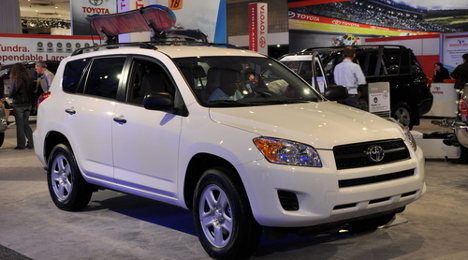
Toyota Motor Sales, USA announced that it is conducting a safety recall of model-year 2006 to 2012 RAV4 and 2012 to 2014 RAV4 EV vehicles for a potential seatbelt issue.
Affecting approximately 1,124,000 vehicles in the U.S., the involved vehicles are equipped with lap-shoulder seatbelts in both second-row outboard seats that can potentially separate during a severe collision. Numerous news outlets have reported that, on a global scale, the recall affects roughly 2.87 million vehicles.
Toyota says that in the event of a severe frontal crash, the lap belt webbing could contact a portion of the metal seat cushion frame, become cut, and separate.
The company will notify owners of the involved vehicles via first class mail and dealers will be instructed to add resin covers to the metal seat cushion frame at no cost to the customer.
For the most up-to-date recall information for Toyota, Scion and Lexus products, check out the Toyota recall site.
General Motors confirmed today that it will recall approximately 200,000 Saab and Saturn vehicles that contain Takata PSDI-5 driver front airbag inflators.
Covering roughly 180,000 units in the United States and 20,000 in Canada, the recall includes Saab 9-3 vehicles from model years 2003 to 2011, Saab 9-5 vehicles from model years 2010 and 2011, as well as Saturn Astra vehicles from model years 2008 and 2009.
According to a GM spokesperson, this is a precautionary recall, as neither Takata nor GM have any field reports of ruptures, injuries or deaths in the U.S. or Canada from the inflators in the aforementioned vehicles covered by this recall.
According to the National Highway Traffic Safety Administration’s website, there are approximately 19 million vehicles from 12 automotive manufacturers currently involved in Takata airbag recalls. For the current full list, click here.
There are over 47 million vehicles in the United States that have at least one unrepaired safety recall. That’s according to a recent analysis from Carfax, who pointed out that these 47 million vehicles are being driven, bought and sold, or sitting on a lot somewhere in our country, either because there’s not a fix available or because they're waiting on one or whoever owns the vehicle simply hasn’t taken the time to take it in.
To put that number in perspective, the current U.S. population is just short of 323 million (and has netted roughly 20 new Americans in the time it took to write this article) according to the United States Census Bureau.
Carfax says that 47 million number is more than a 1 million net increase in unrepaired recalled vehicles compared to last year. And every state in the union has at least 100,000 of them within its borders.
"Our data shows there's still much hard work to be done in addressing recalls," Carfax communications director Larry Gamache said in a news release. "Many people still are unnecessarily risking their lives by not staying informed or taking action when their vehicle is under a recall. It's one of the many reasons family-oriented vehicles, including one in four minivans, are the most-highly impacted. Carfax continues to work closely with the auto manufacturers so we can alert people in the U.S. and Canada that their vehicles have a potentially dangerous defect that needs to be fixed."
In a recent interview with Auto Remarketing about a separate recall-related matter, Karl Brauer, Kelley Blue Book’s senior director of automotive industry insights, discussed the changing environment of automotive recalls — which historically have carried a “fairly low priority.”
“Consumers, by the way, are just as much of a problem as the government or the dealers, because they have a horrible record of taking the vehicles in when they’ve gotten their notice,” Brauer said. “I don’t know what it is today, but in the past if you got anything over 50 percent of all vehicles involved in a recall to actually be processed and have it addressed, that was considered relatively good. And anything over 66 to 70 percent was like a home run… I just don’t think the patience now exists for that attitude.”
Citing data from the National Highway Traffic Safety Administration, Carfax points out that more than 51 million recalls were issued in 2015, more than any year prior.
"Millions more vehicles will likely be recalled this year, adding to the ones already with outstanding airbag recalls, ignition switch recalls, electrical system recalls and more,” Gamache said. “Resources like myCarfax that continuously monitor your car and send alerts to your mobile device are helping people everywhere find and fix more recalls.”