Perhaps owners of Volkswagen diesel vehicles swept up in the recent controversy aren’t unloading these units in droves. However, recent data from Kelley Blue Book and Autotrader indicated that these consumers are at least acquiring more information about what their vehicle still might be worth.
According to Kelley Blue Book’s recent website metrics, Volkswagen TDI trade-in value lookups have increased 79 percent, while trade-in value inquiries for the brand as a whole have jumped by just 10 percent. Those trends are based on a week-over-week comparison from late September data that KBB reviewed and released on Monday.
KBB also mentioned that Volkswagen TDI Research has increased 13 percent for new models, and increased 16 percent for used vehicles. Meanwhile, site officials noticed Volkswagen total research has increased 15 percent for new vehicles, but decreased 12 percent for used models.
All told, inquiries for VW increased 10 percent on KBB.com
“During the last week since news broke of the emissions crisis, traffic to both KBB.com and Autotrader.com has generally increased for Volkswagen, particularly for the diesel models, but at this point it is hard to determine the mindset and intentions of precisely what these early surges in activity represent," said Rick Wainschel, vice president of customer analytics and insights for Kelley Blue Book.
“The increased level of trade-in activity on KBB.com and private seller activity for Autotrader appear to show that consumers are curious to see if values of these models have dropped, and demonstrate they may have some level of concern on this aspect of the emissions issue,” Wainschel continued.
“At the very least, it indicates that consumers are hungry for information about values,” he added.
Over at Autotrader, officials determined that consumers shopping for Volkswagen diesel units is up 7 percent week-over-week, while shopping activity for the brand as a whole is off by 1 percent.
Autotrader also mentioned Volkswagen private seller activity for diesel models is up 19 percent as total VW private seller activity ticked 1 percent higher.
Autotrader Listing Information for Volkswagen
| Make |
Fuel Type |
Interest % Chg.
(VDPs / Listing) |
Price % Chg. |
Listings % Chg. |
Price Chg. |
| Volkswagen |
Diesel |
7.0% |
(0.7%) |
(3.9%) |
($175.45) |
| Volkswagen |
Non-Diesel |
(2.0%) |
(0.1%) |
1.1% |
($20.12) |
| Volkswagen |
All |
(0.7%) |
(0.4%) |
0.3% |
($82.91) |
| Non-Volkswagen |
Diesel |
(0.9%) |
0.2% |
0.4% |
$77.96 |
| Non-Volkswagen |
Non-Diesel |
(1.0%) |
0.2% |
1.3% |
$38.45 |
| Non-Volkswagen |
All |
(1.0%) |
0.1% |
1.2% |
$33.83 |
| Source: Autotrader Inventory, Sept. 12 to Sept. 18 (pre-announcement) versus Sept. 19-Sept. 25 (post-announcement) |
So what do all of these metrics means in light of the turmoil surrounding VW?
“This announcement impacts the diesel vehicles from Volkswagen, which carry higher residual values than their equivalent gasoline counterparts," said Eric Ibara, director of residual values for Kelley Blue Book.
“While early readings suggest that TDI vehicles are being affected by the news, it is possible that they could return to normal levels within a year,” Ibara continued. “This will depend on how Volkswagen handles this crisis and what they announce the fix will be for the U.S. market.”
A note about VW leasing
Another section of the VW story to watch is the leasing market. Swapalease.com reiterated that Volkswagen frequently offers aggressive lease deals on many of its makes and models, and as such, is well represented in the Swapalease.com marketplace.
As of Monday, Swapalease.com executive vice president Scot Hall said the site has not seen any “noticeable changes” in the behavior or patterns of either those individuals looking to get out of their lease, or those consumers looking to take over a lease.
“Please keep in mind that this pattern may change in the coming weeks due to Volkswagen’s pending plans for a fix on the diesel vehicles announced recently,” Swapalease.com said in a message to Auto Remarketing. “Leases under recall are not allowed to be transferred until documentation of a fix can be provided to the lease company, but so far customers are still allowed to make transfers.”
A weathered image
No matter what plan VW orchestrates to modify the diesel vehicles that regulators found to be not as efficient as previously believed, the automaker also has a public perception issue to tackle if surveys orchestrated by KBB and Autotrader are any indication.
Kelley Blue Book and Autotrader reported that more than 70 percent of KBB.com survey respondents believe the diesel emissions issue could spread beyond just Volkswagen.
As for the brand's reputation, the majority of those surveyed say they have “complete” or "general mistrust” in Volkswagen.
In addition, according to a recent Autotrader Quick Poll, 30 percent of the 914 respondents said they would be less likely to consider a diesel vehicle.
“Volkswagen can fix the mechanical problems and make reparations to owners, but winning back the confidence of shoppers and loyal buyers will be a daunting challenge that could take years to overcome," said Michelle Krebs, senior analyst for Autotrader.
“Every automaker should take note of the importance of integrity,” Krebs added
Kelley Blue Book's five-day survey wrapped up on Sept. 28 and gathered information from 1,002 respondents. The seven key highlights included:
— 64 percent of consumers are aware of the diesel emissions issue.
— 96 percent of those aware say that Volkswagen is the primary manufacturer involved.
— 63 percent cite "intentional deceit" as the most troubling aspect of this issue.
— 53 percent of respondents say they have "complete" or "general mistrust" in Volkswagen.
— 72 percent say they think this issue could spread beyond Volkswagen.
— 42 percent feel other automobile manufacturers also are secretly violating EPA emission rules.
— 58 percent are unsure if Volkswagen is taking proper actions in addressing this issue.
“Automotive consumers are well aware of the diesel emissions issue, and they have Volkswagen squarely in their sights as the manufacturer at fault,” Wainschel said. “As a result, the company's brand image is taking a hit.
“If this issue spreads, which consumers see as entirely plausible, other manufacturers — and diesel vehicles in general — also could be affected,” he went on to say.
In the latest development associated with the Volkswagen diesel vehicle matter, multiple online reports indicate that OEM leadership in Germany is making plans to modify up to 11 million units worldwide to correct the “defeat device” found by environmental regulators that circumvents emissions standards for certain air pollutants.
How VW plans to modify the vehicles — a plan that is projected to cost $6.5 billion — still is drawing a bit of a puzzled response from industry observers.
“The software change is the least costly option for Volkswagen at this point, and has the potential to affect performance and fuel economy more than the more expensive route of adding urea injection,” said Matt DeLorenzo, managing editor of Kelley Blue Book’s KBB.com.
“I find the use of the word 'refit' interesting, as it implies a hardware change, whereas I think they will be updating the engine control module software to make the engine run in the compliant test mode all the time,” DeLorenzo continued. “The other question is whether or not the refit includes any changes to the catalyst itself to make it more robust.”
Here in the U.S., the VW 2.0L 4-cylinder TDI vehicles that do not comply with applicable emissions standards include:
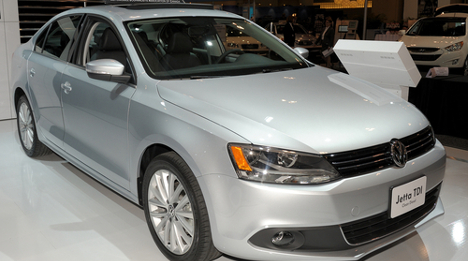
— VW Jetta TDI (model years 2009 – 2015)
— VW Jetta SportWagen TDI (model years 2009-2014)
— VW Golf TDI (model years 2010-2015)
— VW Golf SportWagen TDI (model year 2015)
— VW Beetle TDI and VW Beetle Convertible TDI (model years 2012-2015)
— VW Passat TDI (model years 2012-2015)
“As environmental protection and sustainability are among Volkswagen’s strategic corporate objectives, the company takes this matter very seriously and is cooperating with the investigation,” Volkswagen Group of America president and chief executive officer Michael Horn said on a special website the OEM created to push information about the matter at vwdieselinfo.com.
Horn’s latest statement can be viewed in the window at the top of this page.
The entire incident certainly has escalated — to the point that Volkswagen replaced its top executive last week.
Furthermore, VW also confirmed on Tuesday what reportedly was in the works — with activities in the U.S., Mexico and Canada being consolidated as one new North American region and Winfried Vahland, formerly the chairman of the board of directors at Skoda, as the leader of the region.
The OEM indicated this newly formed region with Vahland at the controls as president and CEO will be effective Nov. 1.
No matter who is charge within the U.S., Europe and beyond, the automaker is leaving an impression.
“It’s clear Volkswagen and the German government want to address this issue quickly,” Kelley Blue Book senior analyst Karl Brauer. “With those vehicles out of compliance, consumers and government regulators know additional pollutants are being emitted every day, putting pressure on the automaker to correct the problem ASAP.
“Until it’s resolved, it will be difficult for Volkswagen to move forward on resolving consumer trust. And even after a fix is finalized, the logistical challenge of processing millions of diesel vehicles will be daunting,” Brauer continued.
Angered lawmakers
What also might be daunting is the line of questioning lawmakers on Capitol Hill are poised to throw at Volkswagen leadership.
A U.S. House committee already has a hearing in the works to discuss the VW diesel engine issues.
Then earlier this week, a pair of U.S. Senators — Democrats Richard Blumenthal of Connecticut and Amy Klobuchar of Minnesota — urged the Department of Justice to take “strong” civil and criminal actions against Volkswagen for any violations following automaker’s actions that “misled hundreds of thousands of American consumers and resulted in tens of thousands of tons of additional pollution emissions.”
In a letter to Attorney General Loretta Lynch, the senators called for a “thorough but expeditious” investigation.
“Officials at Volkswagen should be granted no get out of jail free card, and the Department should accept no plea agreement with Volkswagen that does not ensure any and all information regarding criminal acts by high level officials is provided to the Department,” Blumenthal and Klobuchar said. “The U.S. government needs to make it clear that these actions, whether involving safety defects, consumer deception, or regulatory violations, will not be tolerated by the American public.”
Broader impact
London-based QUBE sees the appeal of diesel vehicles losing steam in the U.S. because of VW’s troubles.
QUBE’s research team now projects diesel penetration in the U.S. reverting to 3 percent to 4 percent of the market in the long-term against the previous forecast of more than 7.5 percent. It is considered that diesel, as a light vehicle fuel, will revert to mainly being used by medium- and heavy-duty pickup trucks.
“The Euro VI regulations closely align with current U.S. NOx requirements to the extent that offering a diesel on the U.S. market brings little incremental cost for OEMs,” QUBE head of development Calum MacRae said.
“Diesel as a light vehicle fuel in the U.S. has a bit of a trust deficit in any case,” MacRae continued. “For one, many consumers associate it with heavy commercial vehicles; second, many consumers will still recall GM’s failed Oldsmobile diesel engine of the early 1980s.”
In addition to the negative impact on new VW sales, which will run into the billions, one can only imagine the damage that this cover-up will have on residual values. The world can scrap last month’s ALG lease residual guidebook.
At lease termination, the current lease portfolio will experience significant losses. While, predicated on supply and demand, there is a buyer for every vehicle, what deeply discounted price will dealers pay? There will be much blood running on the floors in those auction lanes. In 1986, subsequent to the “60 Minutes” segment on Audi’s sudden acceleration problem, Audi experienced the same dynamic, albeit on a much smaller scale. It took Audi years to recover. For VW, the world’s largest automaker, the losses will be exponential.
Repossessions will experience similar losses — affecting both captive and non-captive financers of the VW product.
To overcome the emissions issue VW will need to retool the entire drive-train at a significant cost. Moreover, they will be unable to sell their product line in the U.S. until the emissions standards have been met. In the interim, single-point VW dealerships will close in the states. The problem will be exacerbated by the prospect of the residual effect on VW’s ability to hire new talent and retain existing employees.
How can they remediate the problem when their most valued team members — those who have options — flee the mother ship?
Stay tuned.
Editor's Note: Stuart Angert was the chief executive officer of Remarketing Services of America from 1991 through 2006.
Martin Winterkorn stepped down from the position of chief executive officer at the Volkswagen Auto Group on Wednesday, stating in an official announcement that he is “shocked by the events of the past few days” and that he is “stunned that misconduct on such a scale was possible in the Volkswagen Group.”
Saying that VW needs a “fresh start,” especially in terms of personnel, he also stated that he is “clearing the way for this fresh start” with his resignation.
“As CEO I accept responsibility for the irregularities that have been found in diesel engines and have therefore requested the supervisory Board to agree on terminating my function as CEO of the Volkswagen Group,” Winterkorn said. “I am doing this in the interests of the company even though I am not aware of any wrong doing on my part.”
In a separate statement from VW, the company reiterated that, “The Executive Committee notes that Professor Dr. Winterkorn had no knowledge of the manipulation of emissions data.”
While the Environmental Protection Agency initially took aim at 482,000 diesel passenger cars sold by VW and Audi in the U.S. since 2008, requesting the recall of the affected vehicles, VW admitted on Tuesday that it had used the same software in 11 million diesel engines worldwide.
According to a Reuters report on Tuesday, Sen. Bill Nelson, D-Fla., sent a letter to FTC Chairwoman Edith Ramirez urging the agency to explore remedies for car buyers who he said rely on VW’s claims of having “clean diesel” cars.
“I am outraged that VW would cheat its customers by deceiving them into buying a car that wasn’t what was advertised,” Nelson wrote, according to the report.
Karl Brauer, senior analyst for Kelley Blue Book, commented on Winterkorn’s departure.
"With more than 20 years at Volkswagen AG, during which he rapidly rose through the ranks to lead the automaker, Winterkorn appeared ready to bask in the glory of seeing VW become the world's largest automaker,” Brauer said. “But VW's intentional, widespread efforts to deceive regulators across the globe suggests a dark side to the company's growth. This activity has been going on for years, meaning Winterkorn either had full knowledge of the deception, and approved it, or he was negligent in uncovering and stopping it. Either situation reflects poorly on Winterkorn and his leadership skills, and given the tragic impact this scandal will have on VW, his resignation wasn't just likely, but necessary."
House Energy and Commerce Committee chairman Fred Upton, R-Mich., and Oversight and Investigations Subcommittee chairman Tim Murphy, R-Penn., also announced on Monday that the Oversight and Investigations Subcommittee will hold a hearing in the coming weeks to discuss the recent VW diesel engine issues.
“Strong emissions standards are in place for the benefit of public health. Manufacturers throughout the United States, and across the world, have developed leading technologies to reduce airborne emissions within the limits set by EPA and state environmental agencies. However, reported EPA allegations that certain Volkswagen models contained software to defeat auto emissions tests raise serious questions,” said Upton and Murphy. “We will follow the facts. We are also concerned that auto consumers may have been deceived – that what they were purchasing did not come as advertised. The American people deserve answers and assurances that this will not happen again. We intend to get those answers.”
In other related news, Bloomberg News also reported on Tuesday that VW has hired Kirkland & Ellis LLP to help handle the situation. If that name rings a bell, the latter is the U.S. law firm that led the defense of BP Plc during its criminal investigation of the Deepwater Horizon offshore oil spill in 2010.
Stay tuned to Auto Remarketing as we continue to track the situation with VW and its possible future repercussions on the used-vehicle industry.
The United States Environmental Protection Agency today issued a notice of violation of the Clean Air Act to Volkswagen AG, Audi AG and Volkswagen Group of America, alleging that five of its diesel-powered vehicles include “defeat device” software that circumvents EPA emissions standards for certain air pollutants.
Separately, the California Air Resources Board issued an in-use compliance letter to VW. Both the EPA and CARB have initiated investigations based on VW’s alleged actions.
Covering roughly 482,000 diesel passenger cars sold by VW and Audi in the U.S. since 2008, the affected diesel models include the following:
• Jetta (Model Years 2009 – 2015)
• Beetle (Model Years 2009 – 2015)
• Audi A3 (Model Years 2009 – 2015)
• Golf (Model Years 2009 – 2015)
• Passat (Model Years 2014-2015)
“Using a defeat device in cars to evade clean air standards is illegal and a threat to public health,” said Cynthia Giles, assistant administrator for the EPA’s Office of Enforcement and Compliance Assurance. “Working closely with the California Air Resources Board, EPA is committed to making sure that all automakers play by the same rules. EPA will continue to investigate these very serious matters.”
According to the EPA, a “sophisticated software algorithm” on certain VW vehicles detects when the car is undergoing official emissions testing and then activates full emissions controls only during the test. Otherwise, the effectiveness of the affected vehicles’ pollution emissions control devices is greatly reduced during all “normal driving situations,” resulting in the emission of nitrogen oxides, or NOx, at up to 40 times the standard legally allowed.
The discrepancy was discovered after independent analysis by researchers at West Virginia University, working with the International Council on Clean Transportation. In early September, the EPA and CARB asked for an explanation for the identified emission problems, which both organizations say that VW admitted that the cars contained “defeat devices.”
When reaching out to VW, the company responded to Auto Remarketing with the following official statement.
“Volkswagen Group of America, Inc., Volkswagen AG and Audi AG received today notice from the U.S. Environmental Protection Agency, U.S. Department of Justice and the California Air Resources Board of an investigation related to certain emissions compliance matters. VW is cooperating with the investigation; we are unable to comment further at this time. This is a notice of non-compliance that needs to be addressed. Volkswagen will develop a remedy in coordination with EPA and CARB. Owners of the affected vehicles should be aware that this is not a safety related issue. Owners of these vehicles do not need to take any action at this time.”
The folks at Edmunds.com offer a couple of key points for dealers to think about when judging the situation. Below is part of a note the company shared:
- In recent high-profile recalls, there has been very little — if any — impact on sales. With so many recalls in the news, they easily become white noise for a lot of consumers, and they don't appear to have much of an influence on shopping decisions. Nevertheless, Edmunds encourages all car owners to take any recall notices seriously and follow the instructions provided by their dealers.
- Edmunds counts 44 models that offer diesel-powered engines in the 2015 model year . VW and Audi combine to produce 17 models — or 39 percent—of those 44 total models.
Matt DeLorenzo, Kelley Blue Book's managing editor of KBB.com, also chimed in on the subject, saying this may result in a major hit for diesels in the U.S.
“Not only is this a black eye and a huge problem for Volkswagen, from an industry perspective it may set back diesel technology as a means for automakers to reach the requirements for high fuel economy," DeLorenzo said. "Manufacturers were counting on diesels to deliver fuel economy comparable to hybrids without the expense of having an engine plus electric motors and a battery pack. We may have reached a tipping point where now diesels will become more expensive to make than hybrids. That coupled with European cities looking to ban or limit diesels, there will be a shift away from that technology to hybrids and electrification through pure battery EVs and fuel cells.”
To check out the full statement from the EPA, click here.
To finalize the civil action with the multiple federal agencies connected with the faulty ignition switch recall, General Motors has one week to transfer $900 million into U.S. coffers.
The settlement announced on Thursday also detailed federal investigator findings of how the OEM “actively concealed the truth” about those faulty ignitions in six discontinued models that now are getting long in the tooth — if they’re even still in operation.
So what should dealers do if somewhere in their inventory there’s a Pontiac G5, a Saturn Ion or Chevrolet Cobalt that was originally equipped with an ignition that GM has acknowledged to have caused a total of 15 deaths, as well as a number of serious injuries?
“As for dealers, there is no reason to avoid these vehicles,” Kelley Blue Book residual value analyst Eric Ibara said in a message to Auto Remarketing on Thursday.
“Most people are unaware of the recall, so it is unlikely that they will shy away from these vehicles,” Ibara continued. “The important thing is for dealers to make sure that the recall fix has been made on the vehicle before they retail the car. For GM, it is obviously a win as it puts this incident behind them, and they can focus on the major launches coming up.”
GM explained that the settlement resolves a shareholder class action filed in the United States District Court for the Eastern District of Michigan.
In addition, the company has reached a memorandum of understanding potentially covering approximately 1,380 individual death and personal injury claimants. They include more than half of the personal injury plaintiffs who have lawsuits pending in the Multi-District Litigation (MDL) in the United States District Court for the Southern District of New York.
“The parties to these agreements have resolved difficult claims without the burden, expense and uncertainty of litigation,” GM executive vice president and general counsel Craig Glidden said.
As a result of these settlements, the company said it will record a charge of $575 million in the third quarter.
“Today’s settlement between General Motors and the federal government, highlighted by a $900 million fine, reflects the increased government scrutiny all automakers will face going forward,” said Kelley Blue Book senior analyst Karl Brauer.
“GM’s efforts to address the systemic elements surrounding the ignition switch failure, and its willingness to work with the government going forward, played a key role in resolving the issue,” Brauer continued.
“The terms of this agreement include tighter oversight between GM and federal regulators going forward, which is similar to the terms in the recent agreement reached between the government and FCA after that automaker’s failure to address recalls,” he went on to say.
Barra speaks again
Following the announcement by regulators at lunchtime, GM chief executive officer Mary Barra addressed employees in a town hall meeting later on Thursday afternoon at the GM Vehicle Engineering Center in Warren, Mich. Barra made multiple appearances on Capitol Hill last year where lawmakers lambasted her for how the automaker handled the situation, which stemmed from the ignition switching out of the run position while in motion — disabling the steering system, airbags and other critical components.
“Let’s pause for a moment and remember that people were hurt and people died in our cars. That’s why we’re here,” Barra said on Thursday.
“I have said many times how sorry I am for what happened. On behalf of all of us, I have apologized to the families who lost love ones and to those who were injured. I do so again today,” she continued.
“We let these customer down in this situation. We didn’t do our jobs. As part of our apology to the victims, we promised to take responsibility for our actions,” Barra went on to say.
Barra made a similar presentation to employees after GM hired former federal prosecutor Anton Valukas to investigate what happened, part of the process that led to the dismissal of more than a dozen higher-level executives who were a part of matter.
“I have said many times I wish I could turn back the clock. If I could, I would do so in a heartbeat. But I can’t,” Barra said. “What we can do is make sure we respond the right way. We have done that, and we will continue to do so.
“I concluded my remarks on the Valukas Report by saying I believe in GM and I believe in you. This past year has only strengthened my confidence in you and the company,” she went on to say.
Recap of federal investigation
GM eventually recalled more than 2.2 million vehicles during the matter that first surfaced early last year. The units involved included:
— 2005, 2006 and 2007 Chevrolet Cobalt
— 2005, 2006 and 2007 Pontiac G5
— 2003, 2004, 2005, 2006 and 2007 Saturn Ion
— 2006 and 2007 Chevrolet HHR
— 2007 Saturn Sky
— 2006 and 2007 Pontiac Solstice
“GM engineers knew before the defective switch even went into production in 2002 that it was prone to easy movement out of the run position,” federal officials from the Department of Justice and Department of Transportation said when announcing their settlement with the OEM on Thursday.
“Testing of a prototype showed that the torque return between the run and accessory positions fell below GM’s own internal specifications. But the engineer in charge of the defective switch approved its production anyway,” they continued.
Regulators determined that by the spring of 2012, GM knew that the defective switch presented a safety defect because it could cause airbag non-deployment in certain GM vehicles. But the National Highway Traffic Safety Administration indicated that it did not receive a notice about the problem from GM until February of last year. NHTSA said GM “egregiously disregarded” the regulator’s five-day regulatory reporting requirement for safety defects.
“GM’s delay in disclosing the defect at issue was the product of actions by certain personnel responsible for shepherding safety defects through GM’s internal recall process, who delayed the recall until GM could fully package, present, explain, and handle the deadly problem,” officials said.
“Rather than move swiftly and efficiently toward recall of at least the population of cars known to be affected by the safety defect and thus certainly destined for recall, GM personnel took affirmative steps to keep the company’s internal investigation into airbag non-deployment caused by the defective switch ‘offline’ — outside of GM’s regular recall process,” they continued.
“On at least two occasions while the defective switch condition was well known by some within GM but not disclosed to the public or NHTSA, GM personnel made incomplete and therefore misleading presentations to NHTSA assuring the regulator that GM would and did act promptly, effectively, and in accordance with its formal recall policy to respond to safety problems — including airbag-related safety defects,” officials went on to say.
The settlement agreement imposes on GM an independent monitor to review and assess policies, practices, and procedures relating to the automakers safety-related public statements, sharing of engineering data and recall processes.
And as far as criminal charges, officials said they are alleging one count of engaging in a scheme to conceal material facts from NHTSA and one count of wire fraud. However if GM abides by all of the terms of the agreement, the federal officials will defer prosecution for three years and then seek to dismiss the charges.
Transportation Secretary Anthony Foxx said, “General Motors not only failed to disclose this deadly defect, but as the Department of Justice investigation shows, it actively concealed the truth from NHTSA and the public.
“Today’s announcement sends a message to manufacturers: Deception and delay are unacceptable, and the price for engaging in such behavior is high,” Foxx continued.
U.S. Attorney Preet Bharara added, “For nearly two years, GM failed to disclose a deadly safety defect to the public and its regulator. By doing so, GM put its customers and the driving public at serious risk.
“Justice requires the filing of criminal charges, detailed admissions, a significant financial penalty and the appointment of a federal monitor,” Bharara went on to say. “These measures are designed to make sure that this never happens again.”
In a move impacting nearly every segment of its dealer business, AutoNation made a major procedure change on Tuesday, announcing a policy not to sell, lease or wholesale any new or used vehicle that has an open safety recall.
The dealer group indicated this policy will apply to each one of AutoNation's 293 vehicle franchises across the United States and stands as a “confirmation of the company's commitment to delivering a peerless customer experience.”
Under the policy, AutoNation explained all vehicles with open safety recalls are to be identified and physically pulled from inventory. The units will be given “Not For Sale” hang tags, and key tags will be placed on them.
The dealer group insisted there are defined internal procedures for the processing and disposition of these vehicles that each associate will be expected to follow.
The company acknowledged a blanket commitment not to sell vehicles subject to a safety recall is not without cost, as adequate parts are not always immediately available. AutoNation pointed out that it must hold the vehicles in inventory until they are repaired.
The dealer group emphasized that its customers’ protection is “worth” the investment in the process.
“They believe that the decision to do so is ultimately the right one, and economic considerations must take a back seat to safety concerns,” officials said.
For this reason, the program addresses AutoNation's entire inventory, going well beyond the vehicles in the showroom.
For example, AutoNation will not wholesale any vehicle that has an open safety recall. The company has taken an explicit position that it will not have any role whatsoever in these vehicles being on the road, and it will not use convenient methods such as wholesaling to rid itself of “problematic” inventory.
Furthermore, AutoNation highlighted another element of this new policy that officials believe is even more notable from a customer's point of view is associated with trades.
The company still will accept vehicles as trade-ins even if they have open safety recalls, valuing them according to standard guidelines even with the understanding that there may be additional time and investment in the processing of these vehicles as part of the reconditioning process.
“There’s no way to expect that customers would or should know of every safety recall on every vehicle they might purchase, so we will ensure that our vehicles have all recalls completed,” AutoNation chairman, chief executive officer and president Mike Jackson said.
“We make it our responsibility as a retailer to identify those vehicles and remove them from the market until their safety issues have been addressed,” Jackson went on to say.
Sen. Richard Blumenthal, a Democrat from Connecticut, continued his efforts against the retail sale of vehicles with open recalls by taking aim at CarMax on Monday, urging the Federal Trade Commission to “take immediate action to halt CarMax’s dangerously deceptive marketing of used cars with lethal safety defects.”
Blumenthal says he took these steps in light of a recent investigation by the Consumers for Auto Reliability and Safety (CARS) Foundation and M&R Strategic Services, which claims to have found 74 vehicles for sale by CarMax dealerships in Hartford and East Haven within two 24-hour periods in July, both in the senator’s home state of Connecticut, that reportedly have open safety related recalls.
According to Blumenthal, these vehicles were advertised as “CarMax Quality Certified” via the company’s 125-point inspection but “had not taken even basic measures to get known safety recalls repaired,” according to the senator’s release.
“CarMax’s practices endanger the lives of their customers, their customers’ families, and everyone who shares the roads,” Blumenthal said. “CarMax advertises that all its vehicles must pass a rigorous ‘125-point inspection,’ but no inspection that routinely ignores outstanding safety recalls can be called ‘rigorous.’ Regardless of whether they are buying a new or used car, all consumers deserve to know they are buying a safe car.”
In what she described as “playing recalled roulette with its customers’ lives,” Rosemary Shahan, president of the CARS Foundation, agreed that the sale of vehicles with open recalls, “is also putting their families, other passengers, and everyone who shares the roads at risk.”
Blumenthal continues to sponsor legislation that would make it a federal violation, enforceable by the National Highway Traffic Safety Administration, for dealers to sell or lease a used vehicle with outstanding safety recalls. The current iteration to make this a federal law is currently titled the Used Car Safety Recall Repair Act.
CarMax also issued a statement on Monday, outlining its “commitment to recall transparency,” stating that it provides consumers with information about open recalls prior to sale, as currently required by law.
According to CarMax, it provides every customer with VIN-specific recall information in the following ways, as it listed in a statement:
- Every online listing of a vehicle on the CarMax website includes a link to the NHTSA VIN lookup website.
- In store, before any customer purchases a used-vehicle, a CarMax associate reviews the vehicle’s NHTSA VIN-specific recall report with the customer prior to sale, with the latter signing a form acknowledging the receipt of the recall report.
CarMax also pointed out that, under the current law, independent used-auto retailers, like CarMax, are not authorized to complete recall repairs and close out recalls.
“Our experience shows us customers are in the best position to act on recall information directly with a manufacturer-authorized dealer,” the CarMax statement said. “We have found that dealers are often more likely to provide timely recall repair to customers rather than to a competitor, like CarMax, so we encourage customers to have recalls repaired at a manufacturer-authorized facility.”
For a video on how CarMax notifies customers about recalls, click here. For an infographic, click here.
Two members of the U.S. Senate Committee on Commerce, Science, and Transportation continued their quest for automotive safety by sending a letter to a Takata executive requesting that the company “voluntarily recall all vehicles containing Takata airbags.”
This request was made by Sen. Richard Blumenthal of Connecticut and Sen. Edward Markey of Massachusetts, citing a recent National Highway Traffic Safety Administration investigation into an apparent Takata side airbag explosion in a 2015 Volkswagen Tiguan in St. Louis in June.
At the time of this writing, VW Group of America and Tesla Motors are the only two automakers in the U.S. utilizing Takata airbags that have not announced any Takata airbag-related recalls.
In the letter sent on Thursday and addressed directly to TK Holdings’ executive vice president of North America Kevin Kennedy, Blumenthal and Markey point out the specific nature of the incident as one of the major reasons they believe Takata should recall all of its airbags.
“This is the first incident reported in a VW, the first incident reported in a side airbag, and – most importantly, the first involving the newest models of Takata airbags,” the signed letter states. “This directly undercuts Takata’s continued insistence – despite growing evidence to the contrary – that the flaws in its airbag inflators are limited to prior designs in older model cars and only present when the airbags have prolonged exposure to extremely humid conditions.”
The senators request that they receive a response from Takata by Sept. 3. You can read the letter in its entirety here.
Karl Brauer, senior analyst for Kelley Blue Book, provided Auto Remarketing with the following comment on the situation.
“The senators’ suggestion that every Takata airbag should be recalled may ultimately prove wise, but it’s a bit premature to take that position right now,” Brauer said. “The malfunction of the Volkswagen Tiguan’s side airbag could indicate a larger problem, or it could have been a one-off circumstance that doesn’t represent a systemic defect across all side airbags. The problem for Takata is a history of defective airbags, which can leave even the most optimistic person wondering how wide the company’s flawed designs stretch.”
That bit of doubt in the minds of automakers is certainly apparent. In a recent report from Reuters, it was announced that Toyota Motor Corp. has plans to purchase 13 million airbag inflators from Nippon Kayaku Co., a smaller parts manufacturer in Japan. According to the report, Toyota is utilizing the second-tier source as an attempt to reduce its risk from the inflators supplied by Takata.
Akshay Anand, an analyst with KBB, also says that it’s getting to the point where these types of measures have to be taken if the problems are reoccurring.
“While recalling every vehicle with Takata components may seem like a tall task, the reality is that as the recalls expand in volume, we’re at the point where these issues need to be corrected as soon as possible,” Anand said. “Takata has been more cooperative recently than they were for months and months when the investigations started, but lives are potentially at stake. As a result, governing bodies may feel they need to be harsh or over-the-top in order to get the issue fully resolved, and it’s tough to blame them for that.”
Software services provider NOBEL Systems recently announced the launch of RecallBuzz.com, a website designed to help consumers keep up with the ever-growing volume of auto recalls.
The RecallBuzz website is powered by VINSmart, another product of NOBEL Systems’ and an authorized National Motor Vehicle Title Information System consumer-access provider, and allows the search of a VIN or vehicle make, model and year to view past or current recall notices.
The site also offers the option for consumers to receive future recall notices via email or SMS text message alerts.
“Safety is a growing concern as millions of vehicles are identified as eligible for recalls each and every year,” said Julie Gomes, senior creative designer and marketing manager at NOBEL Systems. “We are proud to launch RecallBuzz today and are confident that this free and reliable service will play a vital role in keeping consumers informed and their vehicles current and on track for save driving.”
More information can be found on the RecallBuzz website.