After the National Highway Traffic Safety Administration denied the automaker an exemption, Ford disclosed in a filing with the Securities and Exchange Commission on Thursday that the company will be conducting a field service action to replace Takata airbag inflators in certain vehicles that are mostly at least 10 years old.
Ford said the recall will include approximately 2.7 million vehicles in the United States and approximately 0.3 million vehicles in Canada and other locations.
The specific vehicles included in the campaign are:
— 2007-2011 Ford Ranger
— 2006-2012 Ford Fusion
— 2007-2010 Ford Edge
— 2006-2012 Lincoln MKZ/Zephyr
— 2007-2010 Lincoln MKX
— 2006-2011 Mercury Milan
Ford said the cost of the action is estimated to be about $610 million and will be reflected in its fourth-quarter results.
“Consistent with our corporate policy, which considers the magnitude of individual field service actions, the expense will be treated as a special item. Accordingly, it will not impact our total Company adjusted EBIT or adjusted earnings per share,” Ford said in the filing.
Ford explained the recall applies to the PSDI-5 design desiccated Takata inflators, which are different in design and performance from earlier recalled non-desiccated Takata inflators.
“When NHTSA extended a finding of defect in 2017 to these desiccated inflators, we retained technical experts to conduct a comprehensive technical study and testing protocol,” Ford said. “In addition to confirming the absence of any field failures of this family of inflators, the study concluded that the PSDI-5 desiccated inflators did not evidence degradation that would lead to a risk of future failures warranting a recall.
“We filed a Petition for Inconsequentiality with NHTSA in July 2017, seeking exemption from the recall requirements of the Safety Act because the risks identified were so remote that they were inconsequential to safety,” Ford continued while noting that the petition was denied on Tuesday.
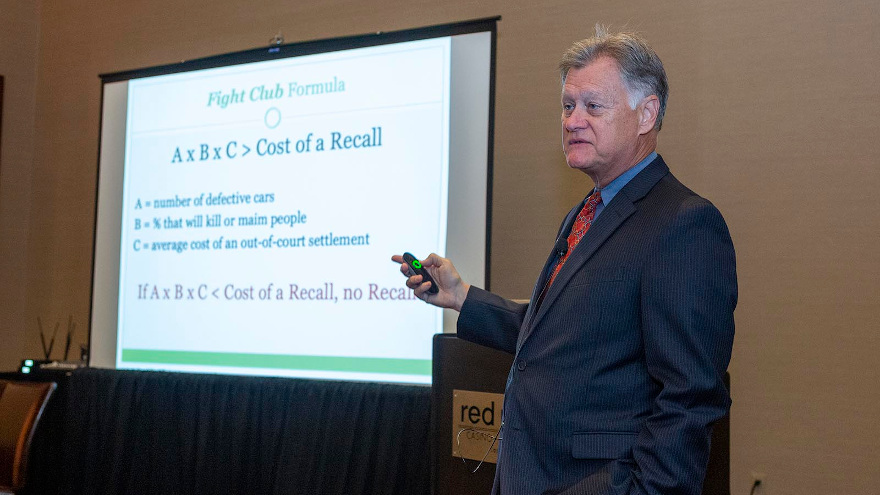
Jerry Cox, who is chairman and chief executive officer with Potomac Strategy Associates, returned for another appearance on the Auto Remarketing Podcast in December to discuss one of the most complicated — and potentially deadly — challenges currently facing the industry.
Cox shared how more automakers, including General Motors and Volvo, are being caught in the maelstrom created by defective Takata airbags. But Cox also described how auctions and dealers could be the key for the entire industry solving the problem and mitigating risk.
To listen to the entire conversation, click on the link available below, or visit the Auto Remarketing Podcast page.
Download and subscribe to the Auto Remarketing Podcast on iTunes or on Google Play.
Jerry Cox, who is chairman and chief executive officer with Potomac Strategy Associates, returned for another appearance on the Auto Remarketing Podcast to discuss one of the most complicated — and potentially deadly — challenges currently facing the industry.
Cox shared how more automakers, including General Motors and Volvo, are being caught in the maelstrom created by defective Takata airbags. But Cox also described how auctions and dealers could be the key for the entire industry solving the problem and mitigating risk.
To listen to the entire conversation, click on the link available below, or visit the Auto Remarketing Podcast page.
Download and subscribe to the Auto Remarketing Podcast on iTunes or on Google Play.
The industry took another step toward ensuring the ongoing Takata airbag recall campaign is successful.
This week, the Alliance for Automotive Innovation announced support for a new automaker-driven tool enabling anyone who handles aftermarket parts, businesses and associations to help identify recalled Takata airbags and work with dealers and others to identify and safely dispose of parts that cannot be re-sold under federal law.
Officials said a new website — FreePartCheck.com — will be especially important as automakers continue working to prevent recalled and non-saleable airbags and components subject to the Takata recall from appearing in inventory at salvage yards or recycling facilities.
“Our members are committed to working to keep customers safe,” Alliance for Automotive Innovation president and chief executive officer John Bozzella said in a news release. “This tool is designed to help prevent the purchase or resale of recalled Takata airbags and component parts that cannot legally be re-sold.
“The efforts of automakers, including the creation of this new tool, help make it easier than ever to identify parts that need to be replaced. This, in turn, promotes the safety of our roadways,” added Bozzella.
The free tool requires no account or log in and provides the ability to:
— Quickly check if specific parts are subject to recall by entering the part numbers in the search field and generating a report
— Search for parts using whatever information is known, including serial number, supplier part number, OEM part number, and/or OEM service part number
— Search for one or many parts simultaneously
— Provide information about free pickup and disposal for recalled Takata-manufactured airbags
At this time, officials said part information is available for the following manufacturers and brands:
— Audi
— Chrysler
— Dodge
— Ferrari
— Ford
— Freightliner
— Infiniti
— Jeep
— Lexus
— Lincoln
— Mercury
— Mercedes-Benz
— Mitsubishi
— Nissan
— Ram
— Scion
— Subaru
— Toyota
— Volkswagen
The tool will be updated to reflect any additional manufacturers and brands, according to the news release.
More information can be found at FreePartCheck.com.
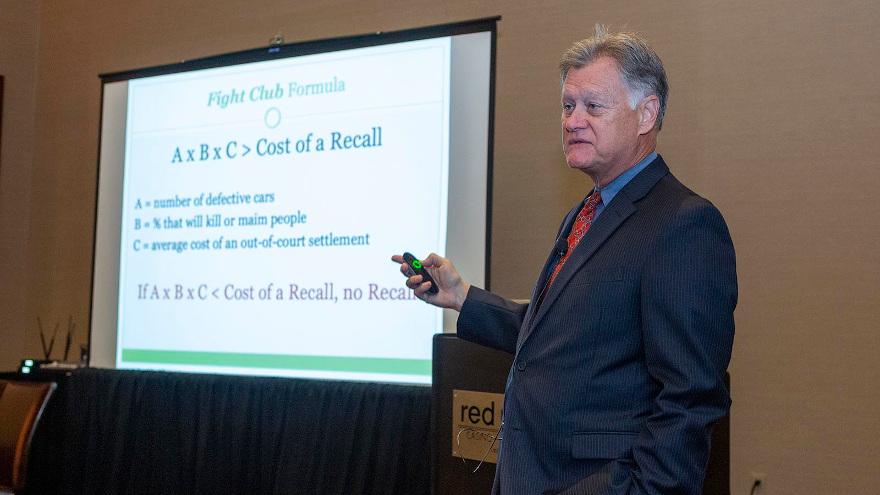
Jerry Cox, who is chairman and chief executive officer with Potomac Strategy Associates, addressed the complexities of the Takata recall during Used Car Week 2019. Cox recapped his presentation during an episode of the Auto Remarketing Podcast available below.
Perhaps another federal government program could eventually help to boost the service drive at dealerships.
The U.S. Department of Transportation’s National Highway Traffic Safety Administration on Thursday announced that states can apply for funding to help drivers learn about and repair open safety recalls on their vehicles.
“Recalls are serious. Recall repairs are completely free to the consumer. These grants will serve as an example to the rest of the country as we continue to work across government to reach consumers in new and creative ways with potentially lifesaving information about their vehicles,” U.S Transportation Secretary Elaine Chao said in a news release.
In 2017, NHTSA recapped that it entered into a $222,300 cooperative agreement with the state of Maryland, launching a two-year pilot program to provide open recall information to consumers when they register a new vehicle or renew a registration.
From April 2018 to January of this year, officials said Maryland had 4.6 million vehicle registrations renewed, with 456,000 of those vehicles identified as having 943,000 open recalls. Of those, 371,000 individual recalls were repaired, according to the Maryland Motor Vehicle Administration, and more than 32% of the recalls remedied were air bags.
NHTSA said on Thursday that this grant program provides funds totaling $1.5 million for as many as six states to notify consumers of open recalls during vehicle registration.
Officials explained participating States will notify owners and lessees of vehicles with open recalls along with registration notices. The states will also provide a brief description of the defect, the nature of the recall, and information on getting it fixed immediately at the manufacturer’s authorized dealer.
NHTSA went on to say the states will implement the notification program for a two-year period and evaluate the results.
The regulator emphasized this program is intended to supplement and does not in any way replace the manufacturer’s legal obligation to alert consumers of recalls on their vehicles and to provide a remedy free of charge.
“Getting a recall repaired could save your life — or the life of someone you love. Recalls are serious, and recall repairs are completely free. I encourage states to apply for funding and join us in spreading this life-saving message,” NHTSA Deputy Administrator James Owens said.
On average, only about 60% of recalled vehicles are repaired, according to NHTSA.
“Improving recall remedy rates is a NHTSA priority, especially due to the Takata air bag recall, the largest and most complex recall in automotive history,” officials said.
The grant application is available online on this website.
Potential buyers sometimes can quickly sour on a vehicle in your inventory if it has an unresolved recall.
To help used-car managers track recalls, AutoMap has integrated AutoAp’s comprehensive safety recall management technology into its solution, helping dealers reduce safety recall liability and increase warranty reimbursement revenue in addition to their automated vehicle electronic-tagging, location and flooring audit services.
While obtaining vehicle location status is designed to be simple with AutoMap, chief executive officer Mark Sargeant acknowledged that gaining insight to safety recall status has been time-consuming and error-prone. That’s why AutoMap leveraged its relationship with AutoAp.
“After reviewing potential sources of safety recall information, we found that AutoAp provides the highest-quality safety recall information available in the industry,” Sargeant said in a news release.
“AutoMap selected AutoAp based on our strict requirements and standards to provide dealerships the most accurate and timely safety recall technology available,” he continued.
Under license from AutoAp, AutoMap’s solution can provide dealerships an accurate and on-demand way to know the safety recall status of vehicles in their inventory. Dealers can check vehicles from within AutoMap to learn their safety recall status.
As a result, dealers can make even better vehicle purchasing decisions by knowing the accurate safety recall status of vehicles and get them repaired sooner.
Safety recalls are being issued in record numbers, according to the National Highway Traffic Safety Administration (NHTSA). As a result of these historically-high numbers, AutoMap pointed out franchised dealers have increased liability risk as vehicle safety recalls have gained significant media attention.
Although manufacturers and their suppliers are the source of vehicle defects, AutoMap stressed that dealers are being held liable for selling vehicles with open safety recalls, which may be one of the most significant legal exposures that a dealership has today.
“Dealers can find safety recalls earlier, which helps increase compliance, make their process more efficient and increases profitability,” Sargeant said. “We are pleased to have partnered with AutoAp. their CEO literally wrote the book on this topic.”
AutoAp cautioned that dealers who use SaferCar.gov to verify the safety recall status of off-brand vehicles can put themselves at risk from missed recalls “false negatives” from NHTSA’s site.
AutoAp also stressed that vehicle history reports can sometimes have errors, and timing delays from the OEMs and NHTSA, with often-inconsistent recall status, can further increase dealers’ liability and reduces consumer safety.
“Dealerships find it difficult to stay on top of safety recalls, due to the size and complexity of the problem. Worse, they think they’re ‘covered’ with current systems,” AutoAp chief executive officer Mark Paul said in the news release.
“Our proprietary processes generate the most-accurate, multi-sourced safety recall status available anywhere,” Paul continued. “We are excited to partner with AutoMap so that we can reach more dealers even faster to help address this significant problem”
AutoAp’s safety recall management technology can also be purchased as standalone dealer solutions to generate revenue and decrease liability for vehicle acquisition as well as for sold-customer recall service or as integrated into third-party dealer service providers like AutoMap.
For more details, go to www.automap.us or www.autoap.com.
A development that an expert on the topic discussed during Used Car Week 2019 arrived on Wednesday, involving older models that might be in your inventory or run sheet.
The National Highway Traffic Safety Administration said another 1.4 million vehicles are being added to the massive Takata airbag recall. A letter written by Joshua Neff, who is chief of the recall management division with NHTSA’s Office of Defects Investigations Enforcement indicated this batch of vehicles is from the 1995 through 2000 model years.
“Tens of millions of vehicles with Takata airbags are under recall. Long-term exposure to high heat and humidity can cause these airbags to explode when deployed. Such explosions have caused injuries and deaths,” NHSTA posted on its website.
“On Dec. 4, 2019, a separate group of 1.4 million vehicles was recalled because of defective Takata airbags. Unlike the airbag inflators in the larger Takata recalls, these vehicles contain Non-Azide Driver Inflators. The defect in the NADI inflators can result in the inflator either exploding or underinflating during deployment,” the regulator continued on its website.
“NHTSA urges vehicle owners to take a few simple steps to protect themselves and others from this very serious threat to safety,” NHTSA went on to say.
Jerry Cox, who is chairman and chief executive officer with Potomac Strategy Associates, appeared at Used Car Week and shared insights that could help auctions and dealerships that might be handling vehicles still impacted by these Takata recalls.
Cox also was a guest on the Auto Remarketing Podcast. That episode is available below.
In an email message to Auto Remarketing sent late on Wednesday, Cox elaborated on points made during his Used Car Week workshop and on the podcast.
"Today’s recall is for Takata inflators that were made with a strontium nitrate oxidizer — before 2000, when they adopted the super-cheap option of ammonium nitrate as the propellant. It has taken more than 20 years, but the chemical in the affected vehicles has crumbled. This creates more surface area for ignition, and that results in a powerful explosion that turns the inflator into a hand grenade," Cox said.
"The ammonium nitrate propellant in the more recently designed inflators will crumble even faster," he continued. "NHTSA pretended that a desiccant called Zeolite might slow that process when they recalled the first 42 million cars. The agency invited Takata (before it went bankrupt) to show that these desiccated inflators were safe for long-term use but NHTSA said it would force the recall of another 30 million cars if it didn’t receive such proof before December 31, 2019.
"To the best of my knowledge, nobody can argue with a straight face that Zeolite is a magic bullet," Cox went on to say. "If NHTSA is doing its job, it will bring the total number of vehicles under recall up to 70 million cars early next year. That will include millions of MY 2017 & 2018 cars and make life vastly more difficult and risky for dealers."
As part of our collection of podcasts originating from Used Car Week 2019, Nick connected with Jerry Cox, who is chairman and chief executive officer with Potomac Strategy Associates.
Cox shared insights that could help auctions and dealerships who might be handling vehicles still impacted by the massive Takata airbag recall and what federal regulators could be doing next in connection with this matter.
To listen to this episode, click on the link available below.
Download and subscribe to the Auto Remarketing Podcast on iTunes or on Google Play.
AutoNation says a report issued by a consumer group about recalled used cars at the nation’s largest vehicle retailer is “inaccurate” and does not provide the full set of facts as to how such vehicles are handled at its stores.
The United States Public Interest Research Group, a consumer group also known as U.S. PIRG, alleges the dealer group is “selling recalled, used vehicles that contain dangerous safety effects.”
Auto Remarketing became aware of the report Tuesday after a segment on “CBS This Morning.”
In the report, which was put together by the U.S. PIRG Education Fund, Frontier Group and the Consumers for Auto Reliability and Safety Foundation, U.S. PIRG said it surveyed 2,400 used cars at AutoNation dealerships in 16 markets. The group said one in nine cars in this survey had unrepaired safety recalls.
“Of the vehicles surveyed, 47 (16% of recalled vehicles) had an unrepaired safety recall for which a remedy wasn’t available at the time of the analysis. Consumers who purchase such a vehicle may have to wait for months or longer before their unsafe, recalled vehicle can be repaired,” U.S. PIRG said in the report.
It added: “All states prohibit licensed dealers, including those that sell used vehicles, from engaging in practices such as bait and switch, false advertising, unfair and deceptive acts and practices, fraud, violating express or implied warranties and the common law duty of care, negligence or causing wrongful death. AutoNation’s failure to repair recalled cars, despite promising that it is selling vehicles that are of high quality, may violate these provisions.”
However, the vehicle retailer said in a statement provided to Auto Remarketing that the company “is in full compliance with all laws and regulations regarding recalls and with all recall directives provided by the vehicle manufacturers,” and that the U.S. PIRG report does not provide context into the sales process at its stores.
In a statement, AutoNation said the report “does not accurately depict the buying process at AutoNation dealerships. The groups responsible for the report did not attempt to thoroughly review the purchasing process at any of AutoNation’s 200+ locations across the country. Nor did they reach out to AutoNation to obtain information about our policies and procedures surrounding recalls.
“Had they done so, they would be aware of AutoNation’s robust policies and procedures that are designed to provide a transparent buying process for our customers,” the statement said. “No new vehicle is sold with an open recall. No CPO vehicle is sold with an open recall unless permitted by the OEM.
“If the OEM issues a ‘stop sale’ for certain vehicles AutoNation will not retail those vehicles at same brand stores prior to completion of the recall,” the company said.
Additionally, all used-car buyers at AutoNation stores have to sign a recall disclosure acknowledgment before they buy the car.
“By signing the form, buyers acknowledge that prior to signing the vehicle contract the dealer provided documentation of any open recalls, and where possible the dealer gave buyers the opportunity to schedule or complete recall repairs prior to the purchase,” AutoNation said.
The dealer group also said all of its websites provide means by which consumers can check for open recalls on used cars.
“The suggestion, therefore, that AutoNation is knowingly or deliberately seeking to mislead consumers is entirely unfounded,” the company said. “AutoNation continues to have an industry-leading policy in place. We address every recall.
“If the parts are on hand, we repair the vehicle. If there are no parts available for the foreseeable future, contingent on manufacturer instructions we either hold the vehicle or sell it with full disclosure,” it added.
The U.S. PIRG report also lists recommendations for the U.S. District Court in Washington, D.C., Federal Trade Commission and state attorneys general.
AutoNation said, however, these auto retail industry policy recommendations go against directives of U.S vehicle safety regulators.
“The report issued by US PIRG recommends automotive retail industry policies that contradict the laws, regulations and guidance implemented by the U.S. Department of Transportation and the National Highway Traffic Safety Administration (NHTSA), the agencies charged with overseeing vehicle safety and the recall process,” the retailer said.
In September 2015, AutoNation made a major procedure change, announcing a policy not to sell, lease or wholesale any new or used vehicle that has an open safety recall.
Automotive News reported in December 2016 that AutoNation had ended this policy the previous month.
Vehicle safety-recall, monitoring, intelligence and reporting company AutoAp says its new reference guide and user’s manual for auto dealers “codifies the problems and challenges of the safety recall ecosystem.”
The reference guide and user’s manual for auto dealers, titled, “Safety Recalls: Think You’re Covered? – Mitigate Your Liability and Increase Profitability,” addresses the topic of recalls, which automotive think tank motormindz managing partner David Nathanson describes as “a cancer in the auto industry.”
In the foreword to the manual, Nathanson writes that recalls present “a grave risk to consumers and all players in the supply chain, with auto dealers on the front line.”
AutoAp says that for franchised auto dealers, 14.8% of inventory has open-safety recalls, even after checking current recall listing systems from OEMs, the National Highway Traffic Safety Administration, vehicle history reports and other sources.
“Our goal is to make plain to dealers the truth of the liability and loss to profit risk recalls present and remind them not to assume their safety recall identification process is protecting them,” AutoAp founder and chief executive officer and Safety Recalls author Mark Paul said in a news release.
These statistics illustrate the difference:
Actively managing safety recalls: Company A liability score 11
Not actively managing safety recalls: Company B liability score 81
Paul added, “Most dealers, when asked about their recall management practices, tell us, ‘We’re covered.’ We know from our industry analysis this is not reality — hope is not a strategy for dealing with such a dangerous risk.”
He continued, “When we first process VINs through AutoAp’s Safety Recall Dynamic Recall Management service, the reality is dealers have inventory with open safety recalls that their current recall-identification processes did not catch. Safety Recall details why this is so — and why this ‘cancerous’ risk continues to exist.”
To quantify how extensive this risk is, AutoAp has collected open rate data since 2015:
Open rates per segment
Government fleets: 36.9% open rate
Commercial fleets: 31.0%
Independent dealers: 20.3%
Franchise dealers: 14.8%
Rental car companies: 14.3%
After “professionalizing” safety recall management — implementing the necessary processes, developing a recall-handling policy, and having built safety into their culture — the results below show an 83% reduction in open rates for best-practice dealers.
Open Rates AutoAp clients
All AutoAp dealer, rental, fleet clients (average): 5.4% open rate
All AutoAp dealer clients: 4.7%
AutoAp power user clients: 2.6%
With millions of used vehicles changing hands each year and millions of individuals changing addresses, the task for finding vehicle owners who have a model subject to a recall can be incredibly daunting.
To help, LexisNexis Risk Solutions rolled out a new tool on Tuesday aimed at helping automakers reach vehicle owners to get critical repairs completed at franchised dealerships.
The provider of data, analytics and technology for automakers and insurers launched LexisNexis Recall Clarity, a solution that can assist manufacturers in the owner identification process for safety-related recalls. According to the National Highway Traffic Safety Administration, more than 1,000 recalls were issued in 2018, affecting more than 35 U.S. million motorists.
In the event of a recall, customer outreach teams are tasked with getting vehicles repaired by finding recalled vehicle owners and leading them to the dealership for service. LexisNexis cited two reasons why this process has become increasingly more difficult due to changes in vehicle ownership on secondary markets.
With more than 40 million used cars sold in the U.S. each year — compounded by the fact that more than 45 million people move each year — the technology company said the need for an efficient way of notifying the owner of a recall, “which in some cases can be life-threatening,” is crucial.
By combining propriety linking technology and unique identifier LexID, Recall Clarity can leverage billions of records from over ten thousand data sources to provide valuable data and insights to help recall customer outreach teams identify, locate and contact the right owner of those hard to find recalled vehicles.
LexisNexis added there are an estimated 57 million unrepaired vehicles on American roads today, so the benefit of increased clarity will ultimately serve as a measurable result when examining repair completion rates.
“Identifying a driver with an outstanding recall is no longer a convoluted process where outreach teams have to combat data latency along with data decay among the older vehicles still out on the road,” said David Nemtuda, senior director of connected car at LexisNexis Risk Solutions.
“Consumers who rely on their cars every day also rely on being properly notified in a timely manner if their vehicle has a component currently under recall,” Nemtuda continued.
Nemtuda added that the solution can aid in the reduction of organizational risk of non-compliance, while helping automakers increase efficiencies when analyzing campaign costs. Recall Clarity can meet the specific campaign outreach needs of an automaker by offering options around email addresses, mobile phone numbers and secondary home data.
Leveraging a high level of scalability over 280 million unique identities across all 50 states, Recall Clarity also can enable dealer-based campaigns to support automaker efforts regarding current safety and recall campaigns reinforcing a strong brand message of safety across the board.
“The cascade of benefits that this solution brings will notably come down to those directly impacted by recalls, the consumer,” LexisNexis said.
“By having a more robust contact database that connects OEMs with owners, the improved rate of meaningful contact by outreach centers can lead to increased completion of repairs, safer owners, safer roadways and peace of mind for auto manufacturers, dealers and their customers,” the company went on to say.
For more information including a case study about LexisNexis Recall Clarity, go to this website.