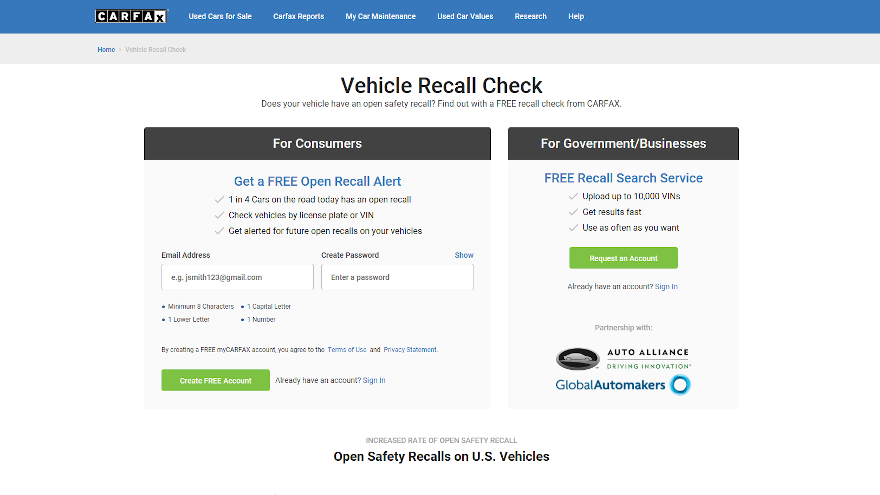
A search tool geared toward increasing consumer awareness of auto recalls has reached a milestone: One hundred million vehicles have now been processed through the tool.
Carfax, the Alliance of Automobile Manufacturers and the Association of Global Automakers jointly developed the Vehicle Recall Search Service, which launched in March 2018.
Those groups say approved commercial and government entities such as state departments of motor vehicles, auto insurers and finance companies can search for open recalls for thousands of autos at once. And they can do it free of charge.
According to the groups, the VIN search tool supplements automakers’ efforts and works toward informing the public so they can address recalls and improve safety.
Six state DMVs are currently signed up for the tool. New York is the first DMV to fully implement checks for open recalls during the vehicle inspection process, which the groups say helps improve public safety.
The New York DMV started using VRSS 10 months ago. In that time, it has checked 9.4 million vehicles and identified more than 1.6 million vehicles with open recalls. Drivers of vehicles with open recalls receive notification at the time of inspection, with recall details included on the state inspection report.
The California Bureau of Automotive Repair also seeks to implement VRSS into its emissions inspection process.
“BAR is actively working to integrate data provided by Carfax and provide vehicle-specific safety recall information to every consumer who receives a Smog Check,” said BAR chief Patrick Dorais. “BAR is committed to consumer protection and is excited about the opportunity to positively influence safety recall compliance rates in California.”
“The Alliance is extremely pleased that 100 million VINs have been searched through our Vehicle Recall Search Service,” said Alliance interim president and chief executive officer David Schwietert. “This milestone highlights the value of providing supplemental notification to vehicle owners about open recalls that are addressed free of charge. Simply put, our industry collaboration means that more vehicle recalls are remedied."
Interested parties can go online to apply for access and to learn more about the recall search tool.
It’s an undesirable situation perhaps some dealers have experienced. The dealership has an irate buyer return to the showroom — perhaps with a lawyer — because the purchaser took delivery of a vehicle without knowing the unit had an open recall.
In an effort to help stores avoid unhappy customers — and perhaps even a legal clash — AutoAp this week launched Safety Recall Insights. Using proprietary business intelligence technology, Safety Recall Insights leverages AutoAp’s Dynamic Recall Management (DRM) service, which is designed to provide accurate, timely and comprehensive recall management capabilities.
AutoAp acknowledged most dealers are unable to obtain the full liability and financial impacts of safety recalls, or the specific actions they should take to minimize these risks and maximize profitability. Worse, AutoAp said mainstream recall sources often fail to identify affected vehicles or provide delayed recall reporting for weeks to months later.
“Dealers can ill-afford to find out after selling vehicles that they were affected prior to sale,” the company said.
Safety Recall Insights can enable dealers to:
• Gain insights into their safety recall liability and financial impacts
• Reduce liability based on specific recommendations rendered by Safety Recall Insight’s on-demand business intelligence
• Generate additional warranty reimbursement by identifying more in-brand safety recalls
• Compare performance against dealers in their state, nationally, those who carry their brands, and Best Practices dealerships.
“I can see our safety recall performance at a glance, right on my phone. Before we started using AutoAp’s services, we thought we had recalls handled. I don’t think there’s anything else out there that can compare,” said Mike Baker, who is the digital media manager for the Antioch Auto Group in Antioch, Calif.
Safety Recall Insights incorporates AutoAp’s Safety Recall Liability Score and is also accessible from mobile devices for on-hand and on-demand recall insights, showing the results of their recall management efforts.
“AutoAp’s services are the key to our success in the market. Their new business intelligence service — coupled with AutoAp’s Dynamic Recall Management service — makes it simple for any dealer to solve the recall problem,” said Brad Sowers, who is the dealer principal with the Jim Butler Auto Group in St. Louis.
This proprietary SaaS (software as a service) product can enhance AutoAp’s DRM service, which is used by more than 1,000 dealership rooftops and by numerous rental car companies and fleet managers.
AutoAp’s research indicated that on average, dealerships nationwide have more than 15 vehicles out of every 100 in inventory with at least one open safety recall. DRM users have decreased their average “open rate” to 4.7% and power users have an open rate of 2.6%, an 83% reduction of ‘open-recalled vehicles’ in inventory, with a commensurate reduction in recall liability.
“This is a game-changer. We’ve evaluated the information that comes from other providers who claim they have a good recall solution. They simply don’t come close to the reliability we get from AutoAp. You’re taking your chances if you don’t use AutoAp’s services. It’s like an insurance policy that pays for itself, plus so much more,” said Brad Preble who is president of the Carr Auto Group of Beaverton, Ore.
Safety Recall Insights can enable dealers to easily visualize the full economic gain to their dealership when they resolve recalls quickly. Dealers can:
• Reduce holding costs
• Increase revenue
• Improve service bay efficiencies
• Boost service warranty reimbursement revenue
• Save significant time managing safety recalls
• Obtain the most accurate and timely safety recall alerting system available
“Without an automated service providing on-demand insights to the liability and costs associated with safety recalls, it is difficult to know the full safety recall impacts,” AutoAp chief executive officer Mark Paul said.
“AutoAp’s solutions are the only insightful, accurate, timely and comprehensive professional-grade services — which are what dealers demand in this frequent-recall and highly litigious market,” Paul went on to say.
For more details, go to www.autoap.com.
The 1,035 vehicle recalls reported in 2018 affected more than 35 million vehicles, and that number of recalls is an increase over last year, according to Selective Insurance Group, sourcing new data from the National Highway Traffic Safety Administration.
Selective Insurance Group, also sourcing information from the Consumer Federation of America, said in a news release that more than 70 million vehicles on U.S. roads are currently in need of safety recall repairs.
With those statistics in mind, Selective Insurance Company of America, the lead insurance company of Selective Insurance Group, is implementing proactive notifications using the company’s new Recall Alert System. Selective is working with its independent insurance agency partners to ensure customers know about potentially dangerous recalls affecting their vehicles and personal safety.
Selective says its system helps reach all current owners of insured vehicles with open recalls. That, according to the company, bridges the gap from manufacturers who often do not have accurate contact information after a vehicle is sold privately. As part of Selective’s safety management services, the new Recall Alert System can identify and alert current owners of recalled vehicles within a week after the recall is added to the NHTSA system.
Selective sends e-mail alerts, in partnership with each customer’s agent, to commercial or personal auto customers whose vehicle make, model and model year match a NHTSA recall. Each alert includes a link to the NHTSA website showing customers any open recalls that specifically affect their vehicle or vehicles. In addition, a Selective product and vehicle recall website page includes resources such as a NHTSA VIN Lookup to help customers check for open recalls.
Selective chairman and chief executive officer Gregory Murphy said two key areas of insurance for customers are putting their lives back together after a tragic event and making communities safer through Selective programs.
“Through our Recall Alert System, we can swiftly and proactively communicate relevant messages with our customers to help them avoid potentially devastating results from safety hazards they have not yet addressed,” Murphy said.
In addition to vehicle recall alerts, Selective recently launched Selective Drive for commercial auto vehicle policyholders. The product, designed to help encourage safe driving behaviors, is a safety sensor that can monitor driving speed, location, idle time and harsh driving events involving acceleration, turning and stopping. The product detects distracted driving and identifies phone calls and other phone use while the vehicle is in motion.
The last two years have seen drops in the number of vehicles with unfixed recalls on the road, something that Carfax finds to be “great news,” but tempers it with this: significantly more progress needs to be made.
There are currently more than 52 million cars with open recalls, compared to 57 million in 2018 and 63 million in 2017.
“We have seen a decrease in the number of recalled cars that are on the road, which is great news for the industry,” Carfax PR manager Chris Basso said in an episode of the Auto Remarketing Podcast recorded at NADA Show 2019 earlier this year.
“And we’ve worked hard; we’ve partnered with the federal government, we’ve partnered with manufacturers overall to alert as many people as people about the open recalls on their cars,” he said.
“Last year, we saw a decrease from 63 million down to 57 million vehicles with unfixed recalls on the road,” he said. “So, it’s great progress but it still shows that we have a long way to go.
“And as part of the Carfax4Life program, those recall announcements are going to be pushed out to customers,” Basso said. “Anybody on the myCarfax program can get those announcements. And the dealers that are partnered with us, they can go into their Carfax online account at any time and see the recalls that are on their inventory. We’re going to send them biweekly reports on the recalls in their inventory.”
The company said that there are 13 million people registered under the free myCarfax service. When a license plate or VIN is entered, myCarfax monitors for open recalls and sends recall alerts to the user through the myCarfax mobile app.
The podcast interview with Basso — where he also discusses transparency in buying/selling/servicing cars, Carfax's presence in fixed ops, its dealership website partnerships — can be found below.
As far as the open recall numbers, the 52 million-plus cars with unfixed recalls equates to about one-fifth of the registered vehicle population, the company said in a news release.
“Our research indicates that using Carfax to send and receive vehicle-specific recall information is one of the most effective ways of getting more recalls fixed,” Carfax president Dick Raines said in that release.
“We are encouraged by this year's results, but there’s still a long way to go. Open recalls are a critical safety issue that can impact everyone on the road,” Raines said. “It’s imperative that car buyers, sellers and especially owners stay informed about recalls and take action on them to maintain the safety of their vehicles and our roads.”
The states where the highest percentage of vehicles have an open recall are as follows, according to Carfax:
1. Mississippi (24.7 percent)
2. Texas (24.6 percent)
3. Louisiana (23.7 percent)
4. Alabama (22.2 percent)
5. New Mexico (22.1 percent)
6. Arkansas (21.6 percent)
As far as the most open recalls, that list is as follows:
1. California (6.3 million)
2. Texas (5.5 million)
3. Florida (3.2 million)
4. Pennsylvania (2.2 million)
5. New York (2.1 million)
The U.S. Department of Transportation’s National Highway Traffic Safety Administration knows defective Takata airbags still are in vehicles currently in operation, so the regulator wants automakers to take additional steps to make sure these units are repaired.
Late last week, NHTSA made an announcement, urging OEMs affected by the Takata air bag recall to make publicly available on their websites their plans for replacing all defective bags in their vehicles.
“It is imperative that manufacturers take every available step to reach each and every owner of a vehicle with deadly air bags and take action to ensure that those dangerous air bags are replaced as soon as is safely possible,” NHTSA Deputy Administrator Heidi King said.
“Public plans will be a resource to communities and to individual consumers to support effective recall implementation nationwide,” King continued.
King added that she has met with affected automakers and urged each to accelerate their remedy of defective Takata air bags. She asked that the plans include innovative methodologies for maximizing recall completion rates.
“To keep consumers safe in their cars and trucks, automakers should learn from their recall experiences to-date and from one another and innovate broadly and creatively when crafting plans to better engage with consumers and communities to replace every last defective air bag in their vehicles,” King said.
In cooperation with the independent monitor of Takata and the coordinated remedy program, NHTSA has engaged in direct consumer outreach and coalition building in key high-risk areas.
In 2017, NHTSA launched a geo-targeted campaign in the eight highest risk areas to increase public awareness in those locations about these dangerous air bags. NHTSA said it continuously monitors repair rates for vehicles affected by the Takata air bag recalls and posts that information on its dedicated Takata Recall Spotlight website to keep consumers informed on the current status of the recalls.
NHTSA pointed out that it also added improved search functions to its website. Consumers can view Takata air bag repair rates by priority group and repair rates over time for each affected vehicle manufacturer.
The agency also mentioned that it regularly informs the public about the recall through its social media channels of Facebook and Twitter.
NHTSA closed by noting it will continue its consumer outreach efforts in support of the Takata Independent Monitor’s localized Operation Find and Fix repair pilot programs in high-risk communities. The pilots will take place through the fall. Vehicles in these high-risk regions have been prioritized to get repair parts first, according to officials.
The agency said the Takata air bag recall is the largest and most complex vehicle recall in U.S. history, involving 19 vehicle manufacturers, 37 million U.S. vehicles, and approximately 50 million air bags.
In this episode, recorded at NADA Show 2018 in March, senior editor Joe Overby sits down with Chris Basso of Carfax to talk about the 57 million cars with open recalls.
They chat about how the company is working with dealers to help consumers get those cars fixed, Carfax's new partnerships this year and more.
The full discussion can be found below.
Download and subscribe to the Auto Remarketing Podcast on iTunes or on Google Play.
You can also listen to the latest episode in the window below.
Catch the latest episodes on the Auto Remarketing Podcast homepage and on our Soundcloud page.
Please complete our audience survey; we appreciate your feedback on the show!
Your potential buyers likely want to know if the vehicle they’re considering has features such as smartphone integration, all wheel drive or an extended warranty.
And, according to Autolist’s latest study, consumers overwhelmingly favor a nationwide law requiring dealers to disclose whether a used vehicle has an open recall, too.
The survey, conducted in early June, found that 89 percent of current vehicle shoppers agree that dealers should be required to disclose whether a vehicle they’re selling has an open recall and whether it’s been fixed.
Autolist’s study also found that more than half of consumers look into recall information before buying a vehicle, two-thirds of owners of recalled vehicles get them fixed in three months or less and that most consumers will still consider buying a brand again despite experiencing a recall.
The firm pointed out that recalls affect a wide swath of the American public; roughly 30.7 million vehicles were recalled in 2017. On average, only about 75 percent of recall issues are fixed annually, according to the National Highway Traffic Safety Administration.
Autolist explained this large number of recalls — particularly those stemming from the Takata airbag inflator crisis in recent years — increases the likelihood that used vehicles with open recalls are sold to consumers without them knowing.
Currently, no federal agency has the authority to ban the sale of vehicles with open recalls.
Recent efforts to enact legislation in Congress have failed. Policing the advertising of used vehicles with open recalls falls to the Federal Trade Commission, which does not require used-car dealers to explicitly disclose whether a vehicle they’re selling has an open recall.
Since 2016, the existing industry precedent set by FTC dictates that automakers and dealers cannot claim or imply that their vehicles are safe or have been thoroughly inspected unless that vehicle is free from open recalls or if the companies disclose the recall in “close proximity to the inspection claims.”
This means that only if the dealer makes claims about that vehicle’s safety in its advertising or presents it as “certified pre-owned” do they also have to mention its recall status.
This has earned the ire of consumer advocate groups, who say the “close proximity” language is too vague and that the FTC isn’t doing enough to protect consumers from potentially deceptive advertising of vehicles that have open recalls.
Just under 40 percent of consumers (39 percent) said they’ve had a vehicle recalled while they owned it; 52 percent said they hadn’t; seven percent said they weren’t sure and two percent said they weren’t sure what a vehicle recall was.
Despite a quarter of recalled vehicles remaining unfixed nationally, only eight percent of respondents in Autolist’s survey who experienced a recall said they didn’t get their recalled vehicle fixed at all.
Forty-four percent said they had it fixed in less than a month after being notified; 24 percent had it fixed within one to three months; nine percent had it fixed within three to 12 months and four percent took longer than a year to have it fixed.
Of the consumers who experienced recalls, safety and time stood out as their main concerns about the recall. Thirty-five percent said their main concern after being notified about the recall was the vehicle’s safety until it was repaired. Thirty-three percent of consumers polled were most concerned with the time it would take to fix their recalled vehicle.
Another 13 percent of respondents were most concerned about the cost of the repair, though it’s worth noting that most recalls are done at no cost to the vehicle owner, including the cost of a loaner vehicle during the repair.
When it comes to shopping for a new vehicle, the issue of recalls is on the minds of just over half of car shoppers, Autolist’s study found. Fifty-five percent of respondents said they look at recall info before buying a car; the remaining 45 percent said they do not.
Finally, Autolist found that recalls didn’t have an overwhelming impact on consumers’ faith in the brands that were recalled.
Sixty-eight percent of respondents said they would still buy the brand of vehicle recalled again in the future; 9 percent said they would not and 23 percent said they were unsure.
Autolist surveyed 1,126 current vehicle shoppers in June about the issue of recalls.
CarSoup.com has integrated fresh multi-touch attribution technology in an effort to help dealers verify which particular marketing sources are helping them move metal on the site.
The company announced Monday that dealers can get an increased holistic view of how their vehicles sell on the site via Clarivoy’s Attribution API software.
CarSoup is a national marketplace to buy, research and sell inventory, and has about 6 million new- and used-vehicle listings combined.
The site is populated by 20,0000-plus dealers and thousands of private sellers who post cars for sale on the site.
In addition to data on vendor website traffic, attribution technology from Clarivoy can provide dealers with insight on how each vendor and marketing source has performed each month.
“We are very excited about this partnership with Clarivoy. With Clarivoy’s new Attribution API, we can finally show performance according to the amount of sold vehicles that have CarSoup.com in the buyer’s purchase journey.” CarSoup president Brian Bowman said in a news release. “Dealers will no longer be reliant on salespeople to properly source where a buyer came from. This enables us to consult with our dealers and provide data they can trust. As a result, our dealers know they are spending their marketing budget in the right place; thus, we can truly prove our value.”
Furthermore, CarSoup suggested that the latest attribution technology from the Clarivoy goes a step further than last-click attribution models to ensure that proper credit is awarded to the specific marketing sources that are responsible for swaying a customer’s vehicle purchase.
Clarivoy’s API software uses proprietary technology to match a person to multiple devices across multiple channels.
“Our Attribution API software provides dealers with monthly visibility into the total number of vehicles sales that our Attribution API partners influenced each month. This will allow CarSoup.com, armed with more data, to consult with their dealers to improve their results,” Steve White, chief executive officer at Clarivoy, said in the news release.
Mazda is taking an extra step to ensure recalled vehicles it has manufactured are repaired, especially units with faulty Takata airbags.
CCC Information Services announced on Wednesday that it is working with Mazda North American Operations (MNAO) to address vehicle safety, creating a new method for the automaker to identify recalled vehicles and help third-party repairers notify affected vehicle owners so that necessary, safety-related repairs can be made at franchised dealerships.
MNAO said it is ensuring that its Takata airbag recall data is uploaded to the CCC ONE Platform, which alerts collision repair providers when the vehicle they’re working on is part of a participating manufacturer recall.
If an open recall is detected, collision repairers are encouraged to inform the vehicle owner and supply a printed copy of the manufacturer’s recall notification. Mazda dealerships then perform all recall repairs for free.
Collision repairers across the country use the CCC ONE platform to write millions of estimates annually. By utilizing the CCC solution, MNAO is able to identify those vehicles and vehicle owners affected by the Takata airbag recall, since implementing the system in March.
“Vehicle and driver safety is our top priority,” said Robert Davis, senior vice president of special assignments for MNAO. “In the event a recall situation arises, we want to move fast, notifying drivers through as many channels as possible.
“The recall solution offered by CCC gives us another avenue to reach drivers of affected vehicles, who may not be aware of a potential recall, or whose vehicles have not yet been repaired,” Davis continued. “With so many collision repairers in the U.S. using the CCC solution every day, we found that CCC is an ideal partner for this important initiative.”
Jim Kinsherf, vice president of the OEM group at CCC added, “Mazda has expressed its commitment to vehicle safety, and we’re pleased to assist them and their drivers with these important recall notifications.
“As vehicle complexity has increased, the industry has also seen the number of recalls increase,” Kinsherf went on to say. “Since launching our recall notification system in October 2016, we have detected more than 1.2 million recalls on our platform with a closure rate of nearly 40 percent.
“By supporting auto manufacturers in their recall efforts, we can help them make our roadways safer; a win for the consumer and a win for the industry,” he concluded.
The analyst team at iSeeCars.com combed through the federal database and compiled lists about recalled late-model vehicles that could be especially handy for your used-car manager, particularly if your store likes to shy away from inventory with open recalls.
Analysts collected the number of distinct vehicle recall campaigns from the National Highway Traffic Safety Administration’s recall database as of May 1 for vehicles from model years 2013 through 2017. The site then calculated an average recall rate based on the number of recall campaigns a year per 100,000 new units sold.
Finally, iSeeCars.com compared these recall rates to Used Car Reliability ratings from Consumer Reports.
“A recall means hours of lost time on top of potential safety issues,” iSeeCars.com chief executive officer Phong Ly said in the site’s report. “At the very least, it involves an appointment, a trip to the dealership, and waiting around while the repairs are being made or dealing with a loaner car if the dealership is even prepared to make the fix.
“Owners of cars with repeated recalls are faced with this hassle many times over,” Ly continued.
A majority of the vehicles with the highest recall rates (6 out of 10) come from domestic automakers, with a mix of four passenger cars, two trucks, and four SUVs. Most of the vehicles with the lowest recall rates (6 out of 10) come from Japanese brands, and the list includes a mix of passenger cars and SUVs.
Top 10 Cars with the Highest Recall Rates
| Model |
Avg Recall Rate (Campaigns/Year Per 100k Units Sold) |
Compared to Overall Average |
Avg Reliability, Consumer Reports (out of 5)* |
| Mercedes-Benz C-Class |
5.77 |
7.3x |
3.0 |
| GMC Sierra |
3.25 |
4.1x |
2.4 |
| BMW 3/4 Series |
2.95 |
3.7x |
3.6 |
| Dodge Durango |
2.71 |
3.4x |
2.0 |
| Nissan Pathfinder |
2.00 |
2.5x |
2.4 |
| Ram Pickup |
1.99 |
2.5x |
2.2 |
| Toyota 4Runner |
1.98 |
2.5x |
5.0 |
| Dodge Charger |
1.74 |
2.2x |
N/A |
| Chrysler 300 |
1.71 |
2.2x |
N/A |
| Chevrolet Tahoe |
1.52 |
1.9x |
2.4 |
| Avg Top 10 Highest |
2.73 |
3.5x |
3.0 |
| Overall Average (across all vehicles) |
0.79 |
— |
3.4 |
* Average Consumer Reports Reliability Ratings only included for models with ratings available in all five model years, 2013-2017. Source: iSeeCars.com
Top 10 Cars with the Lowest Recall Rates
| Model |
Avg Recall Rate (Campaigns/Year Per 100k Units Sold) |
Compared to Overall Average |
Avg Reliability, Consumer Reports (out of 5)* |
| Hyundai Accent |
0.10 |
0.1x |
N/A |
| Chevrolet Equinox |
0.11 |
0.1x |
4.2 |
| Toyota Corolla |
0.12 |
0.1x |
4.8 |
| Honda Civic |
0.14 |
0.2x |
4.2 |
| Honda CR-V |
0.14 |
0.2x |
4.6 |
| Honda Accord |
0.16 |
0.2x |
5.0 |
| Subaru Crosstrek |
0.18 |
0.2x |
4.0 |
| Toyota Camry |
0.23 |
0.3x |
5.0 |
| Hyundai Elantra |
0.23 |
0.3x |
4.2 |
| GMC Terrain |
0.26 |
0.3x |
4.2 |
| Avg Top 10 Lowest |
0.16 |
0.2x |
4.5 |
| Overall Average (across all vehicles) |
0.79 |
— |
3.4 |
* Average Consumer Reports Reliability Ratings only included for models with ratings available in all five model years, 2013-2017. Source: iSeeCars.com
More analysis of lists
The team at iSeeCars.com explained the recall rate can allow consumers to compare vehicles based on their history of recalls. For example, comparing two SUVs between the two lists — the Chevrolet Equinox and the Dodge Durango — the Durango has a history of more frequent recalls than the Equinox.
“Durango owners have to go through the rigamarole of recall-related repairs more often than Equinox owners, in order to replace airbag control modules, brake calipers, alternators, or even radios that could allow third party hackers access to the car’s control systems,” Ly said.
The Mercedes-Benz C-Class is the car with the highest recall rate. It has been recalled for a host of safety issues, from several different recall campaigns involving airbags to multiple campaigns involving failure in the steering column.
“Among the list of recalls is a campaign to fix the sunroof because it could have been improperly bonded to the car frame and stands the risk of falling on passengers,” Ly said.
“Luxury cars such as the Mercedes C-Class or the BMW 3-Series and 4-Series, which are third on the list, are packed with features, and each additional feature can be another point of failure. This could explain why C-Class owners have to contend with so many recall-related headaches,” he continued.
The GMC Sierra, second on the list after the C-Class, also has many more recall campaigns per year relative to the number of units sold.
Site analysts pointed out the Sierra was recalled for faulty seat belts, loss of power in steering, brake pedals becoming inoperative, and fuel tanks overfilling, among other issues.
“Given that only about a quarter of all recalls are actually addressed, consumers who buy a used GMC Sierra may have to bring their truck to the dealership to deal with open recalls many more times than those who buy a Hyundai Accent or Chevrolet Equinox, which have the lowest recall rates,” Ly said.