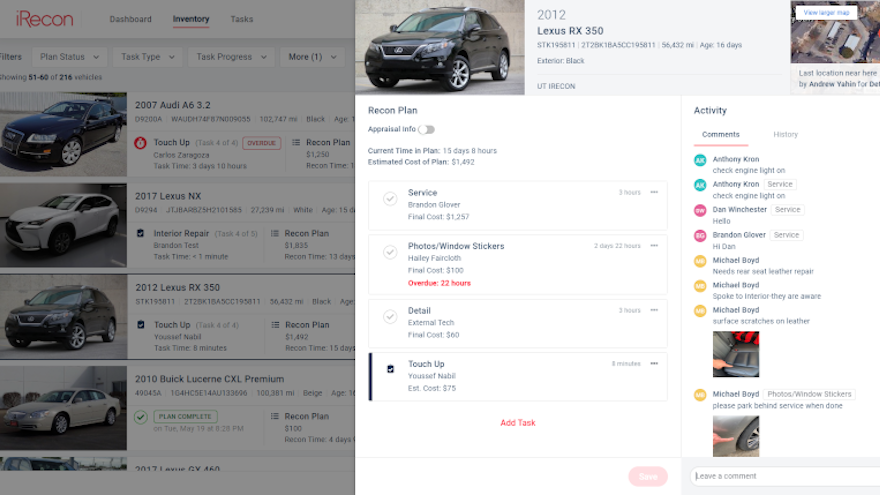
iRecon has revamped its reconditioning platform, with tool and capability enhancements for dealers including a Recon Dashboard.
With the Recon Dashboard, dealers can view the status of any vehicle and take action based on reconditioning metrics that can be tailored to a dealership’s unique workflow.
iRecon said its revamped reconditioning platform can help dealers gain transparency and eliminate bottlenecks that prevent inventory from reaching the front line.
The platform includes a new user interface, dealer-vendor mobile application and location tracking.
iRecon said it developed the enhanced platform through client feedback and market research. The company said it took dealer needs into consideration to improve the reconditioning workflow in today’s environment.
The company said time and cost efficiency are more important than ever as the auto retail industry adapts to a new way of working and shopping during the coronavirus pandemic.
iRecon said that is important to the reconditioning process. Dealers lose valuable sales opportunities every day a used vehicle sits in service or waits on a vendor for reconditioning. iRecon says its platform enables more informed and calculated decisions.
That, according to the company, “helps dealers spend the right money on the right vehicle for the right reason to take reconditioning from an expense to an advantage.”
In addition to the Recon Dashboard, the revamped iRecon platform features additional tool and capability enhancements for dealers, such as iRecon Mobile. Dealers using iRecon Mobile can communicate with reconditioning vendors in real time on the go through push, workflow and comment notifications from any iOS or Android device.
iRecon Mobile also introduces more transparency into the reconditioning process, which means dealers can send and receive photos and use VIN scanning to maintain efficiency.
Location tracking is another of the revamped iRecon platform’s tool and capability enhancements for dealers. That enhancement helps save time and uses GPS technology to pinpoint where physical vehicles are on the lot.
Recon templates are another enhancement, in which dealers can use two clicks to build custom plan templates for starting the reconditioning process.
With an additional enhancement, provision integration, dealers can use vAuto data throughout the reconditioning process to make more informed used-car decisions. Appraisal notes and reconditioning estimates automatically flow from Provision into iRecon, allowing dealers to gain early insight that can help improve each vehicle’s time to front line.
“Amid today’s uncertain economy, dealers may only have one shot to win a sale. Spending money wisely to better streamline reconditioning and get quality vehicles in front of customers faster will be vital to finding success and getting stores back to profitability,” iRecon senior director of business enablement and founder Mike Boyd said in a news release.
Boyd continued, “At iRecon, we are focused on providing dealers with the tools they need to help turn pennies into dollars by enhancing communications with vendors, boosting productivity and ensuring transparent time to front-line ready.”
“Greater visibility into the reconditioning workflow, costs and how long it will take to get a vehicle front-line ready is crucial to making sure every dollar counts right now,” said Jim Farkas, general manager, Germain Honda of Ann Arbor and MINI of Ann Arbor, Mich.
Farkas continued, “The refreshed iRecon platform makes communicating with internal team members and vendors simple and provides our team with the strategic insight and easy navigation necessary to ensure accountability and seamlessly track and complete reconditioning work.”
Dean Fisher says that as auto dealerships focus on sales and profitability in what he described as a very competitive new- and used-car market, those dealerships are looking for other dealership services to build their business.
Fisher, who is president of collision repair network CARSTAR, said the fixed operations department and collision repair services in particular, could be a strong opportunity “for improved efficiencies and performance.”
“However, most dealerships don’t have the resources to focus on building insurance business, maintaining the latest repair certifications, participate in new training, and marketing their services,” Fisher said in a news release.
“That’s where CARSTAR comes in,” Fisher said.
He continued, “We’ve created very dynamic partnerships with automobile dealerships that combine the local dealer’s brand name with CARSTAR’s proprietary operating procedures, insurance relationships and training programs. This allows CARSTAR to help deliver best-in-class KPI performance and the highest-quality repairs, while the dealership can focus on selling vehicles. That high-quality repair and customer service experience also helps the dealership retain customer loyalty for future vehicle purchases.”
CARSTAR says it continues to build upon its network of collision repair facilities based in auto dealerships throughout the United States and Canada.
The company expects that trend continue in the coming years, as dealership owners seek improvements in their collision repair facility performance and profitability.
CARSTAR, sourcing reports from NADA, says almost two of every five franchised dealerships operate collision repair centers.
In February, CARSTAR will showcase its resources from auto dealers from around the world. CARSTAR will exhibit at the 2020 NADA show, which takes place Feb. 14 to 17 at the Las Vegas Convention Center.
The company says that various dealership-based collision repair centers looked beyond their local resources over the past year for more support in their growing businesses. In addition to retaining their independent ownership and generations of family involvement, their goal, according to CARSTAR, is to also complement their current platform with new opportunities for growth.
“We needed to be able to compete on a scale with the consolidators while still maintaining our presence in our community,” said Jon Davidson, who operates three CARSTAR Davidson locations at his family’s auto dealerships in upstate New York.
Davidson added, “We had a stable, good operation with three collision repair facilities, but we knew we needed more resources. With multiple locations, the metrics became complicated, and we needed more transparency and analytics to understand and improve our performance. We also needed to take our insurance relationships to new level, and solid metrics are essential to that.”
Davidson chose CARSTAR after learning about the company from his paint partner.
“Being a franchise partner with a company like CARSTAR keeps this business in our family and provides the operational expertise we need to continue to succeed for the next generation,” Davidson said.
He continued, “As the industry evolves, we couldn’t keep running the collision repair business like we had been for decades. It required an innovative new approach that allows us to take our operations to new levels, succeed with our DRP relationships and continue providing the excellent customer service that has been a hallmark of our family’s business.”
Mike Hanna says his company’s platform “geo-automates complex reconditioning tasks.”
“Our platform basically puts vehicle recon on ‘autopilot,’” said Hanna, who is chief executive officer of TrueSpot, a new Internet of Things asset location platform. Last week, the company announced the commercial launch of TrueRecon, a reconditioning tracking platform for auto dealers.
TrueSpot said it developed the new technology to better manage automotive dealership inventory and speed up what it describes as “costly, highly dispersed auto reconditioning (recon) processes.”
The company said it can accelerate those processes by an estimated 15% to 20%.
TrueSpot said auto dealers “coordinate multiple phases of servicing to prepare vehicles for sale.” That, according to the company, often includes 10 to 20 tasks involving various on-lot and off-lot departments and locations.
Those tasks can include duties such as upholstery repairs, tire replacement/alignment, body work, paint, and detailing, the company said.
In a news release, the company described itself as “the industry’s first solution that pinpoints the exact location of vehicles and keys throughout this process.”
Formerly known as MOLOCAR, TrueSpot was founded in 2017 by mobile technology insiders and auto dealership owners and operators for the purpose of inventing an improved dealer asset management and on-lot selling system.
The system integrates dealer back-office data. That helps streamline workflows and Lot Management 360 (digitizing the dealership), the company said.
Hanna said TrueSpot eliminates the need for each department to manually call, schedule and transfer a vehicle for the next recon activity, which he said saves hours of staff time.
“It also alerts management when a vehicle falls overdue for a task, tracks and certifies all renovations and provides much more accurate analytical information for management,” Hanna said.
According to the company, dealers spend about $42 per day for each day a vehicle is in recon.
Because at any given time large dealerships can have hundreds of cars in recon, that has resulted in an environment that could cause misplacement of constantly moving keys and vehicles.
In that environment, auto dealers can spend tens of thousands per month replacing lost vehicle keys, TrueSpot said, adding that it can result in wasting hours of productive employee time searching for inventory.
With TrueSpot, dealers can place proprietary wireless locator tags inside vehicles and attach them to keys and other assets. TrueSpot combines that with a low-powered enterprise campus network and applications for Apple and Android wireless devices, which the company says helps dealerships quickly locate the assets and identify their recon status.
“Cars and keys move around the dealer campus constantly, especially during the recon process,” Hanna said. “Keys are being handed off from person to person and department to department, on and off the dealership lot, and can easily get dropped in a pocket, a desk drawer or file folder and forgotten. It’s a significant problem across the industry.”
The start-up said the $1 million in investment capital it is raising would add to the more than $700,000 it has already raised. The company serves about 12 dealer clients and is projecting to acquire 30 to 40 new dealer clients within the next nine months.
Carvana has been on an expansion streak over the past several months, with recent announcements in California and North Carolina being just two of many examples.
Just before Labor Day, Carvana said it will locate a new inspection and reconditioning facility in Cabarrus County, North Carolina, stating that over the next few years, it will invest more than $30 million in Concord, N.C.
The company’s new North Carolina project will feature a facility to inspect, recondition, photograph and store cars.
Carvana said facilities such as these take in and prepare used vehicles to then retail online. The procedure includes a 150-point inspection and a photography process that uses high-definition cameras and what the company describes as “patented, proprietary technology.”
“Carvana has been growing extremely rapidly over the last several years and we are working to bring ‘The New Way to Buy a Car’ to even more customers all the time,” Carvana director of infrastructure development and operations Benjamin Morens said.
“As part of our efforts to scale the business, we’re looking forward to working with Cabarrus County and the state of North Carolina to open a vehicle inspection and reconditioning center, and become a member of the Concord community,” Morens continued.
The location of the facility will create more than 400 jobs, North Carolina Gov. Roy Cooper said in a news release.
“The online marketplace only works for buyers and sellers when hardworking people are moving the supply chain forward,” Cooper said. “We know our quality workforce is a major reason why Carvana chose to grow and invest in our state.”
Brian Benstock of Paragon Honda and Paragon Acura sees “a direct correlation” between profitability and the short amount of time available between acquisition of a vehicle and making that vehicle retail-ready.
Benstock, who is general manager and vice president of the dealerships, chose ReconVelocity, which says it brings technology and pit crew precision to the reconditioning process. The company describes that process as an overlooked area of opportunity and its founder says the product can “turn reconditioning into a profit generator.”
“We're anticipating being able to reduce the amount of time it takes to get a car ready by 25%,” Benstock said in a news release. “That could add millions of dollars to the bottom line.”
ReconVelocity says it introduced its new product to fight what it describes as margin compression and workflow inefficiencies in the retail automotive industry. The company says it can help dealers get vehicles retail-ready faster and improve in-store communications.
ReconVelocity made its debut on Monday at the Digital Dealer Conference & Expo in Las Vegas and says more than 500 rooftops have already installed the system or are committed to using it.
ELEAD1ONE founder Hugh Hathcock said he developed the ReconVelocity product to address the margin challenges that dealers are currently experiencing.
The reconditioning process, he said, needs modernization.
“It’s significant profit hidden in plain sight,” he said. “For many, the ‘Recon Gap’ is a million dollar opportunity. Most dealerships don't have the technology to know their true retail-ready timeframe. With used vehicles becoming more critical to the profit of a dealership, this process needs new focus.”
Hathcock recognized that improving all areas of the business to deliver higher operating efficiencies — and applying innovation and automation to parts of the dealership operation that traditionally have been neglected — is a requirement of the next iteration of today’s dealership.
Described by the company as a historically cumbersome, manual process that lacks efficiency, automation and accuracy, the reconditioning process of vehicles for sale is an opportunity for dealers to capture unrealized profit quickly and easily, according to ReconVelocity.
Time-saving simplicity, with modern user interfaces designed for today, is one of the key features of the product, according to the company. Other features include:
- Mobile first, with flexibility to use the product anywhere, anytime on mobile phones, tablets and laptops
- “Insightful” tracking, with information from the moment of purchase or “trade to retail-ready, which the company says can prevent weak links from stealing profits
- Tracking of the exact location of vehicles at all times, with no more “lost” vehicles.
- Fast repairs, with the ability for ROs and recall notices to be assigned “with the press of a button.”
- High-touch service, with recon experts providing in-store training and support for the best results.
- Centralized communication between all departments and rooftops.
- Reporting that allows dealers to use the dashboard and a mobile device to check the reconditioning pipeline status anywhere, anytime.
- Full integration with DMS and inventory solutions.