On Tuesday, Cox Automotive shared details about an integration involving Clutch Technologies and Xtime that further supports its vision for fixed ops and dealer mobility services.
The integration involves Xtime’s fully integrated, end-to-end service experience platform and Clutch’s fleet sync and service pickup and delivery software serve that are combing to be the engine for this next-level service offering.
According to Cox Automotive’s recent Reimagining the Automotive Consumer Experience Study, a majority of consumers said — 89% to be exact — that an ideal ownership experience would include a service where a dealer picks up the vehicle in need of maintenance or repair and returns the vehicle when the work is complete.
“With the digital economy raising expectations of convenience, it’s critical for dealers to further modernize their fixed operations functionality to meet consumer demand,” said Adam Carley, vice president of product for Clutch Technologies. “This solution truly eliminates hassle for the consumer, boosting customer loyalty and driving higher retention on service.”
Functionality of the new Cox Automotive fixed ops solution offered by Clutch Technologies and Xtime will be available progressively over the second quarter of the year, according to the companies.
Xtime Schedule & Clutch Fleet Sync
For dealers on Xtime, customers can book their service appointment at the dealership with Xtime Schedule and reserve a loaner through Clutch Fleet Sync.
Leveraging Clutch’s partnership with TSD, a leading provider of loaner management software, Fleet Sync can provide current and projected loaner availability within Xtime, so that a loaner reservation can confidently be made as part of booking a service appointment.
When the service appointment is finalized, the loaner reservation will be created with the consumer’s information. The consumer will then receive a secure link to provide their payment card, driver’s license and insurance information, which are added to the loaner reservation.
Finally, as the appointment approaches, the system automatically can assign the right vehicle to the right customer. The dealer can benefits from increased efficiency at the loaner desk and higher utilization of the loaner fleet. Consumers benefit from greater availability of loaners and a streamlined experience.
Xtime Schedule & Clutch Service Pickup & Delivery
Scheduling a concierge pickup of their vehicle for service — with the option of a loaner to be dropped off when pickup happens — can be just as simple, according to the companies.
Dealers and consumers can add pickup to service appointments booked within Xtime’s multichannel scheduling tools. Xtime Schedule can display availability of both loaners and valets so that appointments can be made with confidence.
From that point, Clutch can handle the full workflow for the dealer, including scheduling concierge labor and messaging with the consumer. Through its integration with TSD Cirro, Clutch also has the ability to deliver digital loaner contracts for signature in seconds within Clutch’s Sideflip concierge app.
In addition to driving customer loyalty, Cox Automotive explained this collaboration is intended to generate extra service revenue for the dealership, with 67% of today’s consumers willing to pay more for a great experience.
Additional revenue will be realized over time with a more efficient usage of loaner vehicles and repeat business from customers, according to the companies
“Convenience is key when evaluating how to implement or enhance a dealership’s customer-centric service experience,” said Tracy Fred, vice president and general manager for Xtime.
“Marrying the very best of what Xtime and Clutch have to offer provides dealers with an opportunity to standout in the market and not only attract new business but turn them into repeat customers,” Fred went on to say.
A quartet of dealer groups with a presence in Pennsylvania is involved with another education program aimed at boosting the number of trained service technicians.
Universal Technical Institute (UTI) in Exton, Pa., recently launched what the school believes is a first-of-its-kind initiative aimed at developing skilled employee pipelines and giving students an inside track on rewarding long-term careers.
UTI explained its Early Employment initiative blends proven post-secondary skills education with on-the-job, apprenticeship-type training.
Under this new initiative, students can apply for jobs with participating local employers as soon as they enroll at UTI’s Exton campus. Employers registered with the program can screen and hire incoming students before they start school and provide on-the-job experience while students complete their education. Graduates who meet their employers’ criteria will receive reimbursement of school-related expenses and potentially other incentives, along with full-time employment.
“This initiative is a win for both employers and students,” UTI-Exton Campus president Bob Kessler said in a news release. “Students gain real industry experience and earn a living while they’re in school.
“Once they graduate, they have a good job with an employer they know well, who will help them pay back their tuition,” Kessler continued. “Employers have the opportunity to help train future technicians to meet their needs and fill a critical skills gap.”
UTI’s Exton campus is launching the initiative in February. Participating employers in the Early Employment program include:
— Bayshore Truck Centers
— CarSense
— Ciocca Dealerships
— Fred Beans Family of Dealerships
— Herc Equipment
— Republic Services
— Rothrock Motor Sales
UTI highlighted there will be more than 30 early employment positions available to incoming students this winter. The Exton campus is only the second of 12 campuses to offer the program. UTI started the Early Employment initiative at its Avondale, Ariz., campus last July and plans to roll it out to all UTI campuses across the country.
“The Early Employment initiative is a unique opportunity to bring together students and employers and demonstrate the benefits of a technical education,” Kessler said. “The program gives students a clear career path, bolstered by the confidence that employers are willing to invest in them from the start.”
Demand for skilled automotive and diesel technicians has never been greater. The U.S. Department of Labor estimated that by 2026, there will be more than 1.2 million job openings (100,000 per year on average) in the transportation sector.
According to a 2016 survey orchestrated by the federal agency, approximately 60% of dealerships cited recruitment as their most pressing challenge.1
Student applications are now being accepted for the Early Employment program at UTI-Exton. Students must apply by Feb. 12 in order to be eligible.
For more information about UTI, visit www.uti.edu.
The service drive can be just as important to dealer profitability as used and new vehicles rolling over the curb. With that thought in mind, Kelley Blue Book recently launched a new tool to help keep those service bays busy.
Kelley Blue Book recently unveiled its new Auto Repair Guide experience, addressing what the company says are needs of both the consumer and automotive industry for a principal source of “trustworthy” recommendations related to servicing and maintaining a vehicle.
The all-new experience on KBB.com can guide consumers through three primary service categories: recalls, maintenance and repairs. KBB.com is also including the ability to allow consumers to schedule service online through the Featured Auto Repair Center, a pilot with its sister company, Xtime.
To point consumers in the right direction, the Auto Repair Guide on KBB.com can help vehicle owners answer their top service and repair questions such as:
— What do I need to get done?
— When should I get it done?
— Where should I get it done?
— How much should it cost?
To help consumers answer those questions and potentially steer those individuals to dealerships, Kelley Blue Book’s all-new Auto Repair Guide includes:
• Information on recalls, maintenance and repair work
• A Fair Repair Range estimator — similar to the Kelley Blue Book Price Advisor tool — to guide consumers on service and repair price ranges, based on average dealer service pricing
• The ability to schedule service appointments with local dealerships directly on KBB.com through the Featured Auto Repair Center
Kelley Blue Book can enable both consumers and dealers to remain on the same page for pricing and now, in the service lanes with its integration with Xtime, an integrated software platform for retail automotive service departments.
“Car shoppers have long trusted Kelley Blue Book to provide them with vehicle values, new-car information and more,” Cox Automotive vice president Jim Roche said in a news release. “With this new auto repair feature on KBB.com, now they can rely on Kelley Blue Book throughout the ownership experience for guidance on service and repair costs, all while experiencing the same trust and transparency they’ve come to expect from the brand.”
According to the Cox Automotive Service Industry Study 2018, consumers have negative perceptions about getting their vehicle serviced at dealerships, citing unreasonable total cost, overcharging and labor or parts charges among top reasons for not using their dealership service department. In reality, that same study showed common maintenance and services provided by dealerships are on par from a pricing standpoint with independent offerings.
Kelley Blue Book’s new Auto Repair Guide also can make service appointment scheduling easier for both consumers and dealers. Owners can see the Fair Repair Range, select a service provider and book service without leaving the site. Meanwhile, the Featured Auto Repair Center can connect dealers with engaged car owners, increasing consumer trust and confidence by validating their service pricing within the Kelley Blue Book Fair Repair Range.
“The complexities of how to maintain and repair a vehicle, as well as understanding the associated costs, are a major pain point for most consumers,” said Tully Williams, fixed operations director of The Niello Company in Sacramento, Calif.
“Not only has our dealership increased service cost transparency and communication with our customers, but they also have an increased sense of trust from knowing they are being fairly charged for every service visit,” Williams went on to say.
Text communication is on the rise. To connect with consumers outside of the dealership, dealers can no longer rely on e-mail alone, according to auto dealer service department software company Xtime.
To communicate, consumers use email and many other channels, according to Xtime. If dealers ignore one or more of those channels, they could lose potential business, the company said.
Now, Xtime is launching a product that it says can help dealers reclaim these missed opportunities.
Text Marketing is an add-on available to clients using Xtime Invite. Xtime says that with its Text Marketing feature, dealers can diversify their outreach strategy. They can “cut through the marketing noise,” according to Xtime. That can help dealers better engage with customers through the mode of communication they prefer.
As an add-on to the Xtime Invite product, the feature is available immediately to all U.S. franchise dealers.
“Dealers have a hard time getting vehicle owners to respond to marketing communication, even when it includes convenient links and advantageous offers,” Xtime vice president and general manager Tracy Noonan Fred said in a news release.
Fred sourced data from OnSpot Social that showed 89% of consumers prefer to communicate with organizations via text.
“So being able to text straight from the SMS platform is an optimal way for dealers to capture a consumer’s attention and begin a conversation that leads to new business,” Fred said. Xtime also sourced Gartner in noting that texting response rates have increased to 45%. In addition, Xtime called attention to the 2019 Cox Automotive Car Buyer Journey study, which shows texting gaining as a method of communication among all age groups. That, according to Xtime, makes it an even more important marketing tool for dealers.
Xtime says some dealers who have noted the shift toward text have turned to impromptu methods of communication, such as personal cell phone use or other texting methods. But the company said those methods miss the opportunity for full integration with service scheduling systems or CRMs.
That, according to Xtime, compromises dealership business processes and customer experience. Also, Xtime said ad hoc texting methods might not comply with strict Telephone Consumer Protection Act rules and regulations, and they might not comply with other federal and state laws. Because of that, dealers could be at risk of substantial penalties for non-compliance.
Xtime Text Marketing offers a new channel that it says can boost customer engagement and conversion through a product that is Xtime Spectrum-integrated and Telephone Consumer Protection Act-compliant. Xtime said the product offers benefits such as in-message scheduling, which provides the ability to send targeted texts linking to Xtime Schedule and pass through relevant data. Xtime says other benefits include:
— Targeted marketing, which the company says provides flexibility to create and execute various marketing programs
— Regulatory compliance, which the company says helps with adherence to stringent text marketing rules and regulations. To do that, the product provides an opt-in auditable process for dealers to communicate with customers via text.
— Audience builder, which helps dealers acquire, retain, and build a text marketing audience with several customer “touchpoints” that encourage customer opt-in throughout Xtime Spectrum.
“The results we’ve seen from Xtime Text Marketing have been very exciting and impactful on our business,” said Kastner Honda service and parts director Luke Ammann. “Since launching, it’s clear that everyone involved prefers to communicate via text, and the response has been positive to the point that we’re currently working on opting in even more customers.”
Xtime says Text Marketing is the first of several new add-ons and enhancements help its larger mission to help boost dealership customer retention, loyalty, profitability and growth, even at low-sales-volume times.
The shortage of trained auto mechanics has been the subject of many news articles. Matrix Trade Institute’s 20-week accelerated auto mechanic training program is working to ease that shortage.
Noting the great demand for auto mechanics as many mechanics approach retirement and not enough prospective mechanics are looking to enter the profession, Matrix Trade Institute says it has trained more than 80 mechanics in northeast Ohio since it started out at the beginning of this year.
Matrix Trade Institute co-founder Dustin Peugeot says his company works toward “igniting careers.”
“If you want to learn the trade, we can get you there faster and more efficiently with interactive learning technology and hands-on skill and efficiency training,” Peugeot said in a news release.
The institute also trains local dealerships and auto repair shops in increasing their workforce’s efficiency. Matrix says its Upskill Efficiency Bootcamps helps dealerships and shops improve retention and recruiting efforts.
Matrix says it uses “upskilling” and efficiency training to help boost productivity, wages, and growth opportunities. The institute says it has helped “progressive organizations” such as Penske, Conrad’s, and Sunnyside.
Peugeot said shops that use “focused, off-site, hands-on education” to retain employees “never has a recruitment problem.”
“That’s what we're designed for,” Peugeot added. “We’re the lever businesses need to be better than the competition, produce more today, and prepare for tomorrow as the talent gap widens.”
When it comes to explaining the rewards of becoming an auto service or other transportation industry technician to the parents of children in middle- and high-school, Tina Smith and TechForce Foundation have this message:
“There are different roads to success, and even though your child doesn’t want to go to a four-year college, it doesn’t mean they’re not ‘good enough’ because they choose to go into a technical career,” said Smith, who ought to know.
Her journey to becoming director of national partnerships at TechForce Foundation started when she was “kinda kicked out” out of a traditional high school and landed in a vocational high school.
Smith went on to complete what was then Chrysler’s apprenticeship program for auto service technicians, which included earning an associate’s degree in automotive technology at a community college and hands-on training at a dealership. The dealership sponsored her through college.
TechForce Foundation is a non-profit 501 (c)(3) organization. Its mission is to reposition the image of the transportation industry technician from “grease monkey” to skilled professional and highlight their earning potential.
It also aims to expose middle- and high-school age students to the profession and when they are old enough, get those who are interested, into and through training. They also seek to get parents and other adults — who might otherwise discourage young people from seeking out the profession — onboard.
More transportation techs needed
Smith describes the transportation industry as including several transportation modes and disciplines such as diesel engines, motorcycles, aviation, marine and collision repair.
Headquartered in Scottsdale, Ariz., the foundation distributes more than $2 million annually in scholarships and grants to students, thanks to donations from corporate sponsors, auto and auction companies, aftermarket service providers, dealerships and others, according to its website.
A shortage of service technicians is a problem that is vexing the transportation industry, including dealerships and auctions.
In January, the National Automobile Dealers Association Foundation, started a “Workforce Initiative” including a consumer facing website, nadafoundation.org, which has videos featuring technicians speaking about what they like about their careers.
“An immediate goal of the initiative — which is gaining financial support from across the entire industry — is to fill OEM technician training programs to capacity,” NADA said in a blog on its website.
The National Auto Auction Association is a sponsor of NADA’s Workforce Initiative.
Citing data from the U.S. Bureau of Labor Statistics, Smith said that from now through 2026 the transportation industry is predicted to need 120,000 new technicians per year, but technical schools are graduating only about 40,000 new technicians a year.
“It’s a very professional career,” said Smith, 43, and who joined the foundation in October 2018.
“A couple of numbers I like to throw out is that on average, nationally, it costs $130,000 to $150,000 for a four-year degree. An education to become a technician is anywhere from $4,000 to $40,000.
Here’s another stat: only 2.4% of professional techs are women, Smith said.
TechForce Foundation is trying to increase those numbers.
Girls work on cars, too
It has recruited Sarah “Bogi” Lateiner, an ASE master technician and a host of reality TV show, “All-Girls Garage,” to serve as an ambassador and role model for girls who love cars and working on them. “All-Girls Garage” is a show about women who rebuild and repair vehicles that airs on MotorTrend Network.
In June, the foundation hosted a STEM (science, technology, engineering and math) center at a Barrett-Jackson auction which featured a station where girls and boys were invited to participate in a pit stop challenge where they removed and replaced lug nuts on tires, could check-out a plastic, transparent engine that allowed them to see how its parts operated and got information about the Shell Eco-marathon, a world-wide competition in which teams of high-school and college students design and build energy-efficient vehicles.
Lateiner was there signing autographs; and instructors from a local ommunity college were on hand, too. Barrett-Jackson auctions specialize in classic and antique vehicles.
“Without exposure, they’ll never know,” that the service technician field is a viable career for women, she said.
Smith acknowledges that technician pay, especially for new technicians, can be lower than the national average. Some companies are offering tool bonuses or incentives to help offset the cost of a basic set of tools which can easily range from $1,000 to $1,200 for an auto technician who is just getting started, she said.
Though many auto companies have their own programs to train technicians, Smith said some dealers help by sponsoring promising and/or deserving students from their local communities, and she urges them to continue doing so.
In 1994, the owner of Hamilton-Fairfield Dodge, Jeep, Eagle in Hamliton, Ohio, which is now closed, sponsored Smith’s education at Sinclair Community College, in Dayton, Ohio, during her enrollment in Chrysler’s apprenticeship program.
Self-described ‘car-nut’
A self-described “car nut,” Smith loves hot rods and muscle cars. Her first car was a silver and green 1968 Chevy Chevelle Malibu, equipped with a Cherry Bomb exhaust. The car’s two-speed, Powerglide transmission contributed to the exhaust “rumble” when shifted into low gear, she said.
Cherry Bomb is the maker of high performance and loud mufflers and exhausts.
“The noise, the sound associated with the horsepower, the torque, that’s all the sexy side,” she said.
As a child Smith regularly took things apart — the family toaster, her bicycle, a radio — and put them back together and enjoyed helping her father work on the family boat.
“I’d hand him tools, and I liked sticking my fingers in the grease bucket,” she said.
But school was a different story.
The traditional classroom setting that required her to “sit up straight, pay attention, be quiet, didn’t fly for me,” she recalled. “I couldn’t sit still; I was disruptive.”
So at age 15, “for lack of a better term, I kinda got kicked out of that high school,” she said, with a chuckle. “The high school counselor suggested I go to vocational school.”
At the local vocational high school she tried carpentry, machine trade, welding, auto body and graphic design. She liked the classes but didn’t feel passionate about them.
Auto mechanics, a natural fit
But when she got into the auto mechanics program, “it was a natural fit,” she said.
She excelled and after graduating, continued her education at Sinclair Community College.
During the two-year program, Smith spent a month training at the college and the next month at the dealership, paired with a mentor and putting into practice the things she learned the previous month.
After graduating, she worked at the dealership as a technician for two years.
Since then, she held other jobs, such as a dealership service writer, a benchmark technician for a manufacturer of wiring harnesses, and a lead engineering technician, during which she test-drove motorcycles and all-terrain vehicles.
She was groups manager at NGK Spark Plugs, in Wixom, Mich., when in February 2017 she heard TechForce Foundation chief executive officer Jennifer Maher speak at a conference about the importance of nurturing young people who want to become technicians, changing the profession’s image and getting “influencers” such as parents, school counselors, friends and neighbors to uphold that image.
Smith felt as if she was listening to her life story.
“I turned to my friend, who was my mentor, and said, ‘I’m going to work for her one day’,” she recalled.
“Given my background going from high school to voc tech school — it was labeled as a ‘bad kid’ school. But quite honestly, it was the best thing that ever happened to me.”
If Hyundai dealership customers cannot stay in the plush waiting area while their vehicles are being serviced, store managers now have another option to keep their patrons satisfied.
In the next several months, Hyundai dealers across the country that subscribe to Hailer service through CDK Global can give owners easy access to Lyft rides while their vehicles are being serviced.
Through Hailer, an application developed by CDK in partnership with Lyft, participating Hyundai dealers that subscribe to Hailer service through CDK can now help eliminate transportation barriers by providing Lyft rides for customers, which can either be offered free of charge or at a cost that can be automatically added to the customer’s service bill for seamless payment at each individual dealership’s discretion.
The companies explained these Lyft rides can help address significant customer hurdles around transportation while a vehicle is being serviced or inspected, minimizing time spent waiting at the dealership. Previously, service customers could take the dealer-offered shuttle or loaner vehicle, wait for their car to be serviced or find their own transportation to and from the dealership. Hailer has the opportunity to increase customer satisfaction through a decline in wait times, which reflects an industry shift that has the potential to improve customer experience and business efficiency.
“Hailer provides dealerships with greater efficiencies,” said Mahesh Shah, executive vice president, chief product and technology officer at CDK Global.
“We are excited that Hyundai is providing its customers with Lyft convenience at participating dealerships with CDK Drive, while affording its dealers seamless backend integration. We look forward to enabling improved customer experiences through this comprehensive dealer solution,” Shah continued.
As an example, a Hyundai customer calls their service adviser to schedule an appointment at a participating dealership. At the dealership, the service adviser offers a Lyft ride after writing up the work order. The Lyft ride arrives a few minutes later to take the customer to work, and when the work is complete, the service adviser arranges another Lyft ride back to the dealership. The customer gets a text message through Hailer when the Lyft ride is in route, and the rides are automatically added to the customer’s service bill by the dealership. The process is simple for customers and does not require that they have the Lyft app on their smartphone to order rides.
The companies also mentioned the integration is also easy for participating Hyundai dealers because it allows them to automate billing, set ride spending limits and approve service. The improved Hailer experience can simplify a dealership’s service to customers and ultimately reduces the number of customers waiting in service lounges.
“Our customers are going to really like the convenience of Lyft,” said Barry Ratzlaff, vice president of customer satisfaction, Hyundai Motor America. “Hyundai dealers who are already using Hailer have reported a smooth integration allowing them to call Lyft rides for their customers.
“Customers can now easily get on with their day while the inspection or service work is being performed on their car,” Ratzlaff continued.
Gyre Renwick, vice president, Lyft Business, added, “At Lyft, we’re passionate about providing transportation experiences that enhance customer satisfaction and create a streamlined, more cost-efficient solution for our business partners.
“Hailer has the potential to disrupt and evolve the auto dealership industry, and we’re excited to partner with Hyundai to introduce this solution at scale for participating dealerships across the country,” Renwick went on to say.
Especially for independent dealerships who have service drives catering to any vehicle that ends up in a bay, a new resource from the Auto Care Association could help find parts more efficiently.
This week, the association announced a new data product designed to connect parts data for nearly 1.4 billion vehicles, making going global easier for automotive aftermarket businesses that aren’t already and more efficient for those operations that are.
UniLink can help connect data so that subscribers can see which vehicles are similar across the world. With that information, researchers are able to determine which parts fit where and on what vehicle faster, rather than manually researching each vehicle. Now, auto care industry companies can analyze and understand vehicles across the globe and more quickly determine if current or future components can be sold in new markets.
Association officials explained this global vehicle identification solution can provide benefits including:
— Significantly reducing research time by showing which vehicles are similar across the world
— Optimization of supply chains so companies can easily and quickly identify all the country-specific vehicles that are likely to be compatible with a given product, enabling them to see where two parts are being used when only one would be necessary
— Allowing organizations to more effectively allocate resources to areas that make, sell and stock the right parts, resulting in significant cost savings
— Highlighting the potential to sell more parts in more markets with better product management data
This solution is the result of a unique collaboration between two leading organizations, the Auto Care Association and IHS Markit. Global vehicle production and sales insight from IHS Markit helped to link the aftermarket to details from the 1.4 billion global vehicle population like never before, ultimately enabling better business decisions.
UniLink will be available for purchase later this year, according to the Auto Care Association.
To learn more about UniLink and sign up for updates, visit autocare.org/unilink or send a message to [email protected].
Perhaps the day is coming soon when dealership service drive personnel or rental fleet staffs already will have a host of information about a vehicle’s tire condition and other data points before the customer even gets in line.
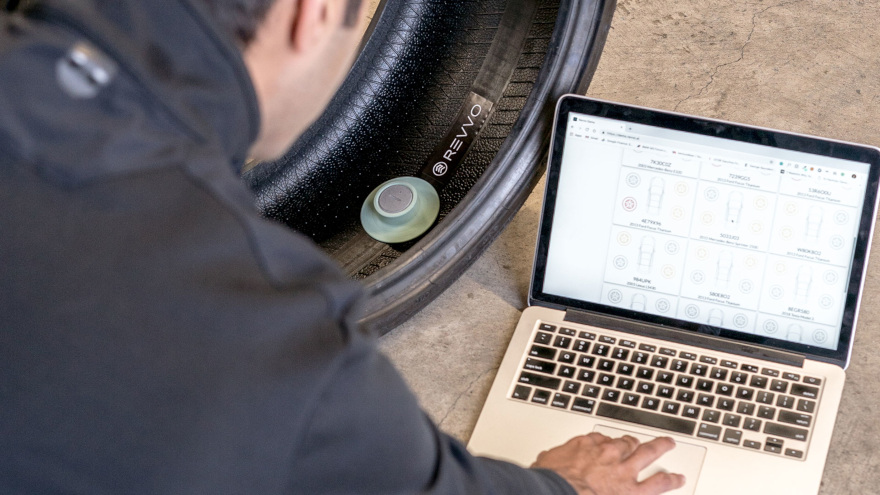
Revvo, a Silicon Valley-based startup formerly known as IntelliTire that offers an internet of things (IoT) “smart” sensor for vehicle tires, announced on Tuesday that it has raised $4 million in Series A funding.
Norwest Venture Partners led the round with participation from Vulcan Capital and AngelList, according to a news release.
Revvo said it will use the financing to continue to build the product and expand its technical and business development teams.
Revvo highlighted that the firm proudly joins the ecosystem of tech startups fueling the shift in the mobility and transportation sectors. Although autonomous vehicle and self-driving technology have made enormous advances, Revvo contends the tire has remained virtually unchanged, despite being one of the most critical components of a vehicle’s performance, safety and reliability.
The firm sees the market offering a massive opportunity with more than $225 billion spent on 2.2 billion tires in the last year alone. Revvo’s initial focus will be on the fleet sector, a segment consuming tires at a disproportionately high rate with clear pain points around tire usage.
Revvo explained that it has built what the company said is a first-of-its-kind, sensor-enabled artificial intelligence software platform to monitor tires while a vehicle is on the road. The technology includes proprietary sensors that are embedded inside the tire, which can generate a real-time feed of a tire’s condition and performance. The sensors capture thousands of data points per second from the interior of the tire which is sent to the cloud via an app on the driver’s phone.
Artificial intelligence and machine learning models are applied to the aggregated data set to better predict tire tread wear. This technology can helps the driver and fleet managers better understand the overall health of the tires on their vehicles which leads to increased vehicle uptimes, optimized efficiency, and improved safety.
“Until now, tires have not benefited from the mobility revolution. Through machine learning and AI, tires can provide an invaluable data set of road conditions, driver behavior, and feedback for vehicle performance,” Revvo chief executive officer Sunjay Dodani said.
“We’re extremely excited to have the support of the Norwest team, which will help us work toward our goal of enabling smart and connected tires,” Dodani continued. “Our team at Revvo is passionate about applying a data science-centric approach to bring intelligence to the only part of the vehicle that touches the ground.”
Parker Barrile, who is a partner at Norwest Venture Partners, added, “We live in a world of increasingly connected and autonomous vehicles, but tires haven’t changed in decades.
“We’re excited to work with the team at Revvo to make tires as smart as the vehicles that depend on them and to tap into a massive market that is shifting toward fleets and autonomous vehicles,” Barrile went on to say.
For more information, visit www.revvo.ai.