While some businesses have been rolling out their marketing plans for the New Year, many others’ marketing plans seem to have gotten lost in the hustle to get the year started. Goals don’t get set and soon hip-shooting becomes commonplace. If you find yourself and your business in this situation, you may see a storm brewing. You may feel a sense of urgency mixed with impending doom. A solid Social Media Marketing Guide can help you navigate the waters of the vast online ocean.
First and foremost, you’ll want to maintain a holistic approach to online marketing and advertising in 2015. Methodically integrate Social Media within your overall marketing plan. Social Media is now intertwined with blogging, SEO/search engine marketing, social ads, email marketing and online reputation management.
When steering your ship, it’s often difficult to know what you’re getting right and what isn’t paying off. A marketing checkup could help. (If you’d like a free one, click here).
Information is power. Good, dependable information can put revenue on your books. Unreliable information can hurt your bottom line and jeopardize your reputation.
Information gives you the power and insight to make great decisions. Whether you have someone in-house doing your marketing and advertising, or you’re outsourcing it, Social Media and online marketing can be a minefield without the best, most up-to-date information.
Some of the following information may be completely new to you, and that’s ok. Stay the course. Ask questions. The specific actions in this Social Media Marketing Guide will foster calm waters and just might help you accelerate leads and sales in 2015:
Social Media Marketing Guide for 2015
1. Start with a Solid Marketing Plan
Develop strategy, set goals and map out a timeline to implement your marketing plan. Here’s an outline of a proven, successful marketing plan:
Strategy:
- Determine your ideal client(s)
- Describe and document your vision
- Develop your core message
Content:
- Create a content strategy
- Designate your content creators
- Consider a community manager who monitors, responds, engages and nurtures leads.
Develop content strategies for each stage of the buying process – Marketing Hourglass:

Lead Generation:
- Social Media
- Advertising (including Social Ads)
- SEO/SEM
- Email Marketing
- Referrals
Lead Conversion:
- Prospect
- Present/Engage
- Nurture
- Transact
- Refer
Planning:
- Priorities
- Organizational Development
- Marketing/Content Calendar
- KPI Dashboard
- Budget
- Processes
Implementation: Routine + Consistency = Momentum
- Daily
- Weekly
- Monthly
- Quarterly
- Yearly
2. Choose the Right Partner or Candidate
I’m always struck by how many business owners jump right into Social and online marketing without knowing the “lay of the land.” We all need a GPS to guide us on the right roads to our destination. You need proven experience when communicating your business “brand value” online to generate leads and sales.
Depending on your unique needs and your operational structure, an experienced, skilled team member to run your marketing and advertising in-house may be the best choice. If you choose to outsource, you’ll need to select a qualified partner to support and help you achieve your business’ revenue goals.
Perform your due diligence. The Social Media marketing space is filled with poseurs who can sell you on their product but may be unable to follow through with results.
3. Audit All Your Online Profiles & Perform a Competitive Analysis
Take a look at your online “real estate” on a regular basis. Make sure each profile is filled out completely. Make sure all your profile images and headers tell a compelling visual story of your brand.
In order to set goals in your marketing plan, you’ll need to find out what the landscape is like. Are you aware of how your competitors are performing? How do you measure up to them? We provide a ton of valuable data about the players in our client’s market. The information buried in that data should inform your strategic decisions.
4. Identify Your Ideal Customer/Target Audience
The power of Social Media marketing and advertising is that it gives you the ability to laser target the type of customer who is most likely to buy from you. The better you can define your particular buyer personas, the more successful you’re efforts will be.
To start, define the demographics of your ideal audience: Location, age, interests, buying cycle, etc. Next, use these questions to guide your content strategy and sales processes:
- What’s important to them right now?
- What does success look like for them?
- What might hold them back from buying?
- Most research is done online. How do they come to a decision?
5. Implement a Solid Content Strategy
Based on the answers to the questions in #4, you’ll develop a content strategy that will answer those questions. Don’t sell something, solve something. Content should attract, entertain and eventually engage buyers in conversations that lead to sales.
6. Construct Your Content Hub (Your Blog)
I’m not going to sugar coat this: there are a lot of really sad and borderline harmful website solutions out there right now, especially in automotive retail. Very few “solutions” deliver the type of experience your customers and prospects are expecting. Every site looks the same as the next one.
Fact: your customers shop online. They visit sites like Amazon and Zappos. When you’re looking at a product on Amazon for instance, everything you could want to know as the potential buyer is there for you. Does your website offer the same experience?
Many businesses put their product front and center (above the fold) however, people don’t buy what you do, they buy why you do it. Of course it’s important to display your products for the customer that’s looking to buy today, but it’s just as important to offer great content/answers to theirs and others’ most frequently asked questions.
Your blog allows you to tell the story of your business. It addresses concerns and questions your customers have and helps you get found in search results more readily.
7. Modernize Your Operation to Include Content Creation
Teams and groups of employees are very often more than the sum of their parts. In the case of content creation, there’s strength in the crowd!
Each company we work with struggles when only one person is creating content for videos, blogs, Social Media, customer testimonials, and managing online reviews.
Don’t struggle, syndicate. Leverage the power of your employees to illustrate their expertise in their own way. It won’t be easy.
- Some will say they can’t write. If so, ask them to answer a question that one of your customers might ask. Extra points for them coming up with the question themselves.
- Some will be more comfortable talking in bullet points by email.
- Some will enjoy being in front of the camera. Others will run away.
- Some just won’t want to participate at all. In this case, remind them that customers and prospects are “Googling” salespersons’ names now. Do they know what’s out there for customers to see? Creating content is a chance for employees to build their own online brand as a member of your organization.
8. Follow Through with Social Advertising
Facebook ads are one of the most valuable platforms available to ensure that you achieve your goals. Done right, you can reach your ideal customers and spend less than you would for Google ads or traditional advertising.
There are 4 components to creating ads that drive leads and sales:
- Design
- Text
- Target
- Test, test and re-test
Remember: Routine + Consistency = Momentum
There are 4 types of ads you have at your disposal:

Every time you place an ad, you must first designate your goal:
- Boost posts – Goal: Increase engagement
- Promote your Page – Goal: Grow your Likes
- Send people to your website – Goal: Generate further interest in your product or content
- Increase conversions on your website – Goal: Visitors complete a Lead Form for follow up
9. Effectively Manage Your Online Reputation
96% of consumers’ buying decisions are influenced by online reviews.
Many business owners tend to be in a state of denial about their online reputation. In 2015, ignoring what’s being said about you online could have dangerous consequences, no matter how good or bad it is. Implement an internal process to capture your happy, loyal customers’ opinions.
- Leverage a cost-effective software solution.
- Promote culture and processes for Social Customer Service. There’s nothing worse than when a customer reaches out to you via Social Media and you don’t respond (or are slow to respond).
- Establish a plan for Social Crisis Management. Don’t panic. Be proactive, not reactive.
10. Establish Return on Investment (ROI)
Setting clear goals and objectives isn’t just an exercise, it’s the pathway to knowing real ROI. Take advantage of the tools available to:
Sit down monthly with your team or your vendor. Take those results they’ve achieved and tie them back to your goals. This information will guide you to making changes and improving your efforts. It should also prove to you that Social Media marketing can drive leads and sales.
The post Social Media Marketing Guide: 10 Accelerating Actions for 2015 appeared first on Kruse Control Inc.
 In case you missed it…back in November, Facebook announced some changes that will affect Facebook Business Pages and the people who love them – or do their marketing – or both. These changes have already been set in motion and many businesses either still aren’t aware of the changes or are confused about what to do going forward.
The Facebook changes effective Jan 2015 could mandate a shift in your content strategy. Now that the changes are in effect, it’s important to know and understand them so you can revise the content published on your Page.
Not usually forthcoming about the changes, I was happy to see Facebook published information before they put the changes into effect.
“Our goal with News Feed has always been to show people the things they want to see. When people see content that’s relevant to them, they’re more likely to be engaged with their News Feed, including stories from businesses.”
Translation: People don’t want to see promotional posts in their News Feed.
Deeper Meaning: If you’re business publishes posts with promotional content, we want you to pay for that privilege.
“News Feed has controls for the number of ads a person sees and for the quality of those ads (based on engagement, hiding ads, etc.), but those same controls haven’t been as closely monitored for promotional Page posts. Now we’re bringing new volume and content controls for promotional posts, so people see more of what they want from Pages.”
Bear in mind, this is NOT a negative change. Quite the contrary. What other mediums allow you to publish marketing messages for free? None that carry the impact Facebook does.
I spoke with a prospect recently about this and was able to convince him that for a few hundred dollars per month in Facebook ads budget, he could grow his Page, drive traffic to his website and convert fans into customers. Spending marketing dollars on ads requires a marketing plan and some expert tactics. This is nothing new. The only thing new is that you can reach intended buyers more readily. This is the cost of generating leads and winning sales.
As a novice Facebook marketer, you may be inclined to want to post promotional content on your page. It seems like that’s what you’d do (if you’re new or if you have the old school advertising mentality). If this is the case, then the biggest change in your Facebook content will be to stop posting organic promotional messages.
Here are some consistent traits that make organic posts feel too promotional:
- Posts that solely push people to buy a product or install an app.
- Posts that push people to enter promotions and sweepstakes with no real context.
- Posts that reuse the exact same content from ads.
This is an example of these types of Page posts:

As in similar algorithm changes, Facebook told us what NOT to do and were very vague on what TO do. They did say this: “Businesses should think about their Page as a cornerstone of their online identity, not simply as a publishing service.” (because if you want a publishing service, you need to pay them).
Every brand is different, however, for the smarter brands with a solid content strategy in place, these changes will have minimal effect. If you’re new or don’t have a solid content strategy, there’s still time to overcome the Facebook changes effective Jan 2015. Here’s a twist on how to get your product out there without being promotional in an organic post:
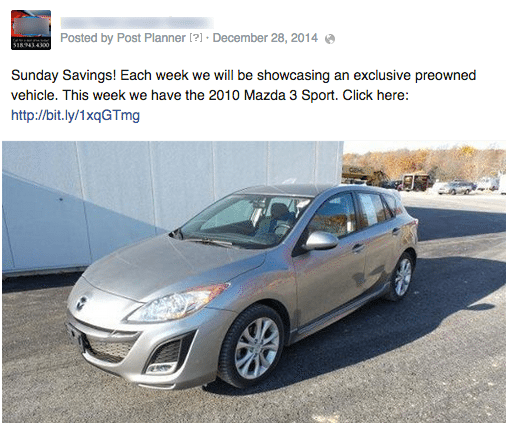
It will now be essential, rather than just advisable, to plan to boost sales content on Facebook from the start. It will also likely be a good idea that specifically sales-oriented content of the type that Facebook cited in its post be created as Dark Posts.
While sounding a bit evil, Dark Posts are simply the tactic of using the Power Editor to create News Feed-style ads that don’t actually get published to the News Feed of your page but do land in the News Feed and mobile devices of users.
The balance of what you do on Facebook should be geared toward engaging, conversing with and helping your fans, along with driving them to content across your other web channels.
Facebook marketing is not getting any easier, my friends. In 2015, it will become even more important to have an expert help you develop a marketing plan and assist with implementing it. When things get ultra-tricky, you’ve got to be better at playing the game.
If you find Social Media and online marketing overwhelming or just would like to be more effective with your marketing, we offer a free marketing assessment. We’ll review the information you provide – research it – compare it to your competitors – and then set up a time with you to share our recommendations. The goal is to provide you with at least 3 solid recommendations on how you could improve your marketing today. Click here to get started: –> Marketing Assessment 2015
Author information
Kathi Kruse is an Social Media Marketing Expert, Consultant, Blogger, Speaker, Author and Founder of Kruse Control Inc. Born in the heart of Los Angeles to a family of “car people”, Kathi’s passion for the car business spans a 30-year career managing successful dealerships in Southern California. Kathi is the author of “Automotive Social Business – How to Captivate Your Customers, Sell More Cars & Be Generally Remarkable on Social Media”. Her Kruse Control Blog is the leading Automotive Social Media blog in the US.
The post Still Confused About Facebook Changes Effective Jan 2015? Here’s the Scoop appeared first on Kruse Control Inc.
 More than ever, we’re seeing businesses take a holistic approach to marketing. Social Media marketing is no longer something you do as an afterthought. Businesses are taking steps to integrate content creation within their organization. There was so much growth in 2014 and now we’re seeing that Social Media and Content Marketing will be even bigger in 2015.
- Over 70% of US online adults use some form of social media networking. (Pew Internet Research)
- Social Media marketing budgets are projected to double over the next 5 years. (Social Fresh)
- Marketers will spend $8.3 billion on Social Media advertising in 2015. (NewsCred)
Your business will either capitalize on these trends to drive more leads and sales…or not.
New developments and changes are a constant in Social Media and content marketing. Trends come and go, and without spending most of your time immersed in it, Social Media can seem like a deep, dark forest with no way out. Thank goodness there are those of us who DO spend a lot of time in the forest and can become a sherpa for those unsure of their path.
Here are my top Social Media and Content Marketing predictions for 2015:
- Budgets continue to shift out of traditional advertising and into Social Media and Social Advertising.
- Owned media (content hubs, blogs) will become more prevalent, driving consumer trust.
- Content marketing gets the budget it deserves.
- TV advertising budgets will decline by more than 10%.
- Banner ads (not-including video or mobile) will also continue to decline.
- Video production inside companies (such as dealerships) becomes more consistent.
- Marketers will focus on entertaining and informing their customers through storytelling using all forms of media – video, images and text.
- Employees are tapped for their expertise and encouraged to contribute to brand-owned media (Social Media and blog content).
- Companies will take a more holistic approach to their marketing strategy by integrating website, blog, SEO, SEM, Social Media and Social advertising to reach goals.
- Social Selling becomes an integral part of the sales process.
- Online reviews will continue to influence buyers as businesses establish internal processes to capture those loyal, happy customers’ opinions.
- Customer experience comes to the forefront as programs to drive word-of-mouth online are integrated into marketing plans.
- ROI will be easier to identify as goals become more defined and scrutinized.
I know from being out on the front lines with prospects, clients and even the manufacturers, that many are still not convinced Social Media and content marketing is for them…or that it even works. I actually had the president of a large auto group recently say to me, “I think all this online stuff and social media is fad.”
The Internet is a forest full of Social saplings.
A few of those saplings will grow tall and get all the sunshine and attention, while shading out all the rest (just like Cal Worthington did on TV, all those years ago).
Being in the undergrowth sucks.
There’s still time to grow up and become a mighty tree. Somebody’s going to do it, why not you?
Unsure where to start? Get your marketing on-track with our FREE check-up! –>Here
Author information
Kathi Kruse is an Social Media Marketing Expert, Consultant, Blogger, Speaker, Author and Founder of Kruse Control Inc. Born in the heart of Los Angeles to a family of “car people”, Kathi’s passion for the car business spans a 30-year career managing successful dealerships in Southern California. Kathi is the author of “Automotive Social Business – How to Captivate Your Customers, Sell More Cars & Be Generally Remarkable on Social Media”. Her Kruse Control Blog is the leading Automotive Social Media blog in the US.
The post Top Social Media and Content Marketing Trends for 2015 appeared first on Kruse Control Inc.
 “The tiny cost of failure is dwarfed by the huge cost of not trying.” ~Seth Godin
Being relevant means to be closely connected. When customers align with your brand and feel connected, they start to develop trust in you and your products and services. Revenue grows as trust is strengthened.
When it comes to marketing, there is nothing worse than blending in. Being considered “not relevant” either through your marketing messages or by word-of-mouth, does no one any good. Companies send us information all the time but it’s often not very relevant or valuable (aka: spam). When you’re not relevant, you’re forgotten. Good content marketing makes a person stop…read… think… behave… differently.
Take a moment and think of a brand that you feel connected with. It could be a major brand or it could be your local restaurant or clothing boutique. There are components to their philosophy of doing business that resonate with you. There may even be personal relationships formed. The experience they deliver keeps you coming back.
Now contemplate your business or your personal brand. What components resonate with your customers? If you don’t know, then ask them.
The world is full of noise. Stop clawing your way to the bottom. It’s just plain lazy to publish messages that everyone’s seen or heard 100 times before. For instance, if your business is “Family owned and operated since…” then don’t tell people, show people. Illustrate it in the most creative ways you can possibly come up with.
As the bottom gets more and more crowded, it’s harder than ever to be more short-sighted than everyone else. If you’re going to need to work that hard at it, you might as well put the effort into racing to the top instead.
Content Marketing Tips to Avoid Blending In
1. First, stop broadcasting messages that no one cares about
Social Media and Social ads are designed to connect you with those most likely to buy from. Broadcasting messages that aren’t relevant to your target customers or to “everyone” is a waste of time and money. What’s more, you can damage yourself and your brand by publishing annoying updates.
2. Broadcast Your Brand “Personality” Instead.
“People don’t buy what you do, they buy why you do it.” ~Simon Sinek
There are 3 things that no one can ever take away from you:
- Your Name
- Your Image
- Your Knowledge & Expertise
Leverage your assets. Creatively show off your company and the people that work hard every day to keep the business running.
There’s so much content on the web now that getting attention has become very difficult. Find ways to differentiate yourself. Whether you’re a salesperson, an entrepreneur or a business, getting and staying relevant with your target customer is crucial to your success.
3. Create Remarkable Experiences for Your Customer
Your customer already has a deep, cross-functional understanding of what a great experience is. It’s the leadership’s job to make sure products and services are designed to give the customer a reason to talk positively about your brand.
4. Modernize Your Operations to Encourage and Inspire Content Creation
Employees are the one of our greatest assets but we often fail to empower them to talk in Social Media. This is a big mistake; you’re overlooking one of the greatest ways to build trust in your brand. Instead of having policies that say no, teach them, encourage them to recognize opportunities to create content. Employees are a wealth of information. Tap into their expertise and inspire them to contribute.
5. Exude Trust: Make Your Employees the Stars
The public wants to hear directly from employees as ambassadors for the company who can attest to its integrity, the quality and relevance of products and services offered and the operational strength of the company, including its leadership.
Edelman Trust Barometer 2014: “Employees are considered the most trusted source across most clusters of trust attributes, especially among those attributes grouped under engagement (50%) and integrity (37%).”
Engagement and integrity are keys to building trust and by extension, relevance. Content published around employee contributions demonstrates that the company:
- Is ethical
- Listens to customers
- Treats employees well
- Customers before profits
- Acts responsibly in a crisis
- Transparent and open
- Communicates often
6. Leverage the Heck Out of the Tools Available
Successful content marketing takes a lot of time, skill, effort and budget. With respect to your time element, make good use out of tools to help you automate some of your duties:
- Post Planner. This Facebook app will save you time and relieve anxiety. It’s got a powerhouse post scheduler and viral content suggestions to increase engagement.
- Hootsuite. A great app to schedule and manage content for Facebook, Twitter, LinkedIn and Google+ Business Pages.
- Canva. Like me, you may consider Photoshop just way too complicated. Canva will help you create striking images (with text) without any of the trouble of Photoshop…and it’s free. You can upload your own images or purchase images for $1.
- WordPress (self-hosted). The ultimate platform in content publishing. It’s truly the best for websites and blogs. Note: There’s an automotive-retail-specific solution called CarDealerPress.com. For car salespeople who want to blog, there’s MarsCars.com
These content marketing tips will help you differentiate yourself and your business. As humans, we crave to be relevant to those that matter to us. Take these actions to capitalize on your craving. Attract attention and avoid blending in!
Author information
Kathi Kruse is an Social Media Marketing Expert, Consultant, Blogger, Speaker, Author and Founder of Kruse Control Inc. Born in the heart of Los Angeles to a family of “car people”, Kathi’s passion for the car business spans a 30-year career managing successful dealerships in Southern California. Kathi is the author of “Automotive Social Business – How to Captivate Your Customers, Sell More Cars & Be Generally Remarkable on Social Media”. Her Kruse Control Blog is the leading Automotive Social Media blog in the US.
The post You’re Not Relevant: 6 Content Marketing Tips to Avoid Blending In appeared first on Kruse Control Inc.
 I’m not trying to be Captain Obvious here but unless you’ve been on a deserted island somewhere, you should know by now that Facebook is a valuable tool for marketing yourself and your business. Salespeople leverage it to stay in touch with customers and network with new ones. Businesses make it part of their marketing to generate leads and sales. Almost anyone can benefit from Facebook’s reach and it’s crazy to ignore it. I get asked a lot, “Do I need a separate Facebook account for business?” and the answer is not as simple as it seems.
Everyone talks about Facebook. The media loves to hate-on Facebook. So, it’s hard to know for sure whether the answer is yes or no. The answer to “Do I need a separate Facebook account for business?” depends on whether you’re a salesperson, an entrepreneur, or a business that sells to consumers or other businesses.
It’s important to understand what your goals are first before venturing out onto any marketing platform. Always put strategy before tactics.
Facebook For Business
As a business participating on Facebook, you’re required to engage Facebook as a “Business Page.” It’s actually against Facebook’s Term of Service to have a personal profile for a business. You wouldn’t want to do that anyway because a personal page doesn’t get access to Facebook ads, which can drive traffic to your website and get you leads.
You will however, need a personal profile in order to act as Admin on your Business Page. All Facebook Business Pages are run through personal accounts. It’s best to create an administrative Facebook personal account for the Business Page. Why? Because I’ve seen too often where business owners have left the Social Media up to someone, that person is no longer working for them and then they can’t access their own page.
Best Practice: When creating an account to run your business page with, always use an email address with your business’ domain name so you have control over it. Once you’ve got your Business Page created, then add trusted users (including your own personal profile if you have one) as Admins on the page.
Facebook For Salespeople and Entrepreneurs
For a Salesperson or Entrepreneur, the answer to “Do I need a separate Facebook account for business?” is more complex. It’s mega-important to identify what you feel comfortable with. Social Media should be a positive experience for you. If it isn’t, it will show in how you connect and engage.
Here are a few scenarios to help determine if you need a separate Facebook account for business:
1. If you’re new and don’t know what to do, start with a Personal Profile (Account). Fill in all your contact information and remember to put your work contact info, not your personal info. That way, you can make your Profile public without worrying about your personal data. When your Profile is public, you’ll be found by customers and prospects.
2. If you have a robust network already on Facebook with your Personal Profile, then continue leveraging that account. Be sure to present yourself as you would if you were at your desk or place of business. It’s important to be deliberate in any social setting. You wouldn’t show up to a formal affair in shorts and flip flops, right? This is where Personal Branding comes in handy. It helps you know how to present yourself online.
3. If you really want to drive leads and sales, create a Facebook Business Page for yourself and utilize Facebook ads. You’d be surprised what you can do with $100-200/month in ads. What we’re talking about now is “Social Selling” (leveraging Social Media to network for referrals and sales). This option is for the more advanced user who should have his/her personal branding in place, along with a website and a blog.
More and more, consumers are searching for quality. They’ve experienced a great customer experience from brands like Amazon and Zappos and they expect the same from you. Look at your marketing through your customers’ eyes. Master Facebook with the goal of delivering the customer experience they’re searching for. Chart your best course of action and go for it!
As always, please reach out if you have any questions.
Author information
Kathi Kruse is an Social Media Marketing Expert, Consultant, Blogger, Speaker, Author and Founder of Kruse Control Inc. Born in the heart of Los Angeles to a family of “car people”, Kathi’s passion for the car business spans a 30-year career managing successful dealerships in Southern California. Kathi is the author of “Automotive Social Business – How to Captivate Your Customers, Sell More Cars & Be Generally Remarkable on Social Media”. Her Kruse Control Blog is the leading Automotive Social Media blog in the US.
The post Do I Need a Separate Facebook Account for Business? appeared first on Kruse Control Inc.
 Every business and its salesforce should be focused on the prospective customer. The most important action you can take in your Social Media marketing and advertising requires you to know who that prospect is, inside and out. Your ability to find a customer, sell your product to that customer, and satisfy the customer so that he/she buys from you again should be the central focus of your business.
The greater clarity you have with regard to your ideal customer, the more focused and effective your marketing efforts will be. But many business owners and salespeople don’t take the time to identify and examine who their ideal customers are. They revert to a shortsighted view and get get caught up in the “next deal.”
Businesses waste a lot of time and money trying to sell their product to people who aren’t good potential customers.
The most important activity for every business is to clearly identify the very best customers for your product (or service), and then focus all marketing, advertising and sales efforts on these particular types of customers.
Why You Need to Identify Your Ideal Customers for Social Media Marketing
- Building personas of your core audience can help improve the way you solve problems for your customers.
- Content will be relevant thereby attracting more and more fans and followers.
- Your relevant, useful content will be shared by fans and followers, increasing your Social presence.
- Blog content shared through Social Media directly reflects your relevancy to Google and other search engines.
Why You Need to Identify Your Ideal Customers for Social Advertising
- The key to successful Facebook ads is targeting.
- Facebook ads give you the ability to target very specific audiences thereby reaching your ideal customers rather than blanketing the land with messages that people don’t want to see.
- The more specific you can be with your targeting, the better results you’ll see.
- Achieving optimal results with the least amount of budget = cost-effective lead generation.
How to Identify your Ideal (Target) Customers
Ideal (target) customer “personas” are created with a combination of raw data and educated guesses, representing slices of your overall group of prospective customers. These sketches provide a touchstone for creating content and targeting the optimal audience for your Facebook ads.
The following 10 questions and their answers represent your most important action in Social Media marketing and advertising:
1. Name 4 types of customers who buy your products or services. Break it down by age, location, gender, relationships, education and employment.
2. What types of information do your ideal customers consume online?
3. When consuming content they like, what type of media do they choose? (Blogs, Podcasts, eBooks, Newsletters?)
4. What sources do they trust most?
5. Which Social networks do they spend time on?
6. They most likely use the Internet to research and buy products. Describe their journey to your product.
7. What are their top three headaches right now?
8. What motivates them to consider a purchase?
9. What would make them ready to buy from you?
10. What causes delays in their purchase decision?
The answers to these 10 questions will undoubtedly give you a deeper knowledge of your ideal (target) customers. It’s all about laying the foundation for your Social Media marketing and advertising success. Stop hip-shooting and take the time to do it right. You’ll spend less time and money and get much better results!
Author information
Kathi Kruse is an Social Media Marketing Expert, Consultant, Blogger, Speaker, Author and Founder of Kruse Control Inc. Born in the heart of Los Angeles to a family of “car people”, Kathi’s passion for the car business spans a 30-year career managing successful dealerships in Southern California. Kathi is the author of “Automotive Social Business – How to Captivate Your Customers, Sell More Cars & Be Generally Remarkable on Social Media”. Her Kruse Control Blog is the leading Automotive Social Media blog in the US.
The post Your MOST Important Action in Social Media Marketing and Advertising appeared first on Kruse Control Inc.
 A brand is no longer what we tell consumers it is. It’s what consumers tell each other it is.
The customer journey is more connected than ever. Your customers’ experiences get shared whether you’re in the conversation or not. Customer Experience Marketing gives your customers the microphone. It’s your job to give them something to talk about.
Customer experience is the sum of all experiences your customer has with you over the lifetime of the relationship. It includes a person’s behaviors, attitudes and emotions about using your product or service.
Customer Experience Marketing is similar to customer experience management, except instead of focusing on ‘managing customers’, it focuses on improving the customer experience through engagement. Engagement with your brand, your content and your employees. By consistently illustrating customer experience via your marketing, you reach prospective buyers during their research process and get recognized as a trusted seller.
It’s difficult to ignore the facts:
- 47% of Social Media users have sought customer service via Social channel.
- 71% of those who receive positive Social care are likely to recommend your brand to others.
- Only 19% of those who don’t get any response are likely to recommend that brand.
It takes 12 positive experiences to make up for one unresolved negative experience. With the widely-accepted use of social media, including online review sites, Customer Experience Marketing should be part of your overall plan for 2015…and beyond.
To succeed in Customer Experience Marketing, you must first start by actually delivering a great customer experience. Take a good, hard look at what it’s like to be one of your customers. I’ve always thought the Golden Rule applies to business: “Treat others as you would treat yourself.”
You may believe in this principle but do your team members? It’s best to develop strategies, policies and operational systems to ensure your customers’ experience turns out the way you want it to.
The next step in Customer Experience Marketing strategy is to listen and respond. Now this might seem too simple but when you dive deeper, you realize it does take quite an effort to execute. You need:
- A community manager to field all customer engagement.
- A solid content strategy for illustrating customer experience.
- A brand advocacy strategy for spotting customer engagement and how to leverage it in your marketing.
The lasting effects of Customer Experience Marketing are very similar to word-of-mouth, only much more dramatic. Here’s an example:
I like to fly on Jet Blue out of Long Beach, CA because they consistently deliver a great customer experience and they’re responsive. I always check-in when I get to Long Beach and tag Jet Blue in my tweet. They’re fantastic about tweeting back to me, always with a cheerful message. I respond with appreciation.
Here are the consequences of that short exchange:
- It makes me happy and I feel important when a big brand cares enough to respond.
- My 10K+ Twitter followers witness the exchange providing evidence of a positive customer experience.
- I talk about Jet Blue to my friends and family on social networks and in person.
- I use the exchange to illustrate Customer Experience Marketing on my blog, thereby mentioning Jet Blue again in a positive light.
Voila! Customer Experience Marketing at its finest.
Here’s another exchange that happened a few days ago on Facebook. My friend, Mike Correra, had what started out to be a negative experience with Wells Fargo. Kudos to them for listening:

Mike wrote: “Was very impressed by Wells today! It’s a little thing but meant a lot to a customer and that’s what I am sharing with my team today as a result! A customer service training point provided by my own bank!”
He adds: “I think that if a company makes the decision to be on a social network they should pay attention to it or not be on it at all. What impressed me most was that they picked up on their brand #hashtag and responded, well done on their behalf! Wells Fargo, WIN!”
There are far too many negative customer experiences that live their lives into eternity online. We know what that can mean for every business and perhaps you’ve gone through it yourself. It’s not pretty when mistakes are made and social media get a hold of it.
Your best solution is to implement a system of Customer Experience Marketing within your business. When your customers love you and express it through their own networks, it’s clear evidence of a positive experience. Isn’t that what well crave when we’re looking to purchase?
Author information
Kathi Kruse is an Social Media Marketing Expert, Consultant, Blogger, Speaker, Author and Founder of Kruse Control Inc. Born in the heart of Los Angeles to a family of “car people”, Kathi’s passion for the car business spans a 30-year career managing successful dealerships in Southern California. Kathi is the author of “Automotive Social Business – How to Captivate Your Customers, Sell More Cars & Be Generally Remarkable on Social Media”. Her Kruse Control Blog is the leading Automotive Social Media blog in the US.
The post Customer Experience Marketing: Give ’em Something to Talk About appeared first on Kruse Control Inc.
 Even though marketers are consumers themselves, they’ve forgotten how to think like a consumer. They live inside the data and the trends in consumer behavior and end up unable to recognize their own motivations for doing what they do. Sure data is important, but to learn how to be a better marketer you have to get your head out of the calculations and into the conversations.
Some companies that say they provide “Marketing” are actually doing something else. The foundation of their business was formed around gadgets, tools and software. They put tools and tactics before strategy. They don’t advocate diving into the components of their clients’ business to help them understand the customer better. These companies prefer to “sell to the masses” and that’s fine…for them.
Everyone wants a quick fix to gain more customers but as a business owner, you should know that these gadgets, tools and software only go so far.
“Strategy without tactics is the slowest route to victory. Tactics without strategy is the noise before defeat.” – Sun Tzu
Marketing that sticks and drives revenue is something else altogether.
This shift from propaganda about the business’ products and services to conversations with customers and prospects is very challenging.
“Experience Marketing” is a trend for 2015. CX (customer experience) and UX (user experience) – you may have heard these acronyms around the web and wondered what they meant. They’re both considered the sum of all experiences your customer has with you over the lifetime of the relationship.
Customer experience involves a person’s behaviors, attitudes and emotions about using your product or service. If you want to learn how to be a better marketer, you must dive deeper into your ideal customers’ opinions and behaviors and apply your discoveries to your marketing and advertising.
Now, Experience Marketing is new and I don’t expect you to adopt it into your current marketing strategy immediately (unless you want to sell more than you do now). However, there is ONE thing you can do right now that, if infused into your marketing strategy and culture, would not only make you a better marketer but just might increase revenue too!
Think Like a Consumer.
As a marketer, your perspective may be skewed if you make assumptions about customers based on your own behavior, rather than that of the people you want to reach.
I came across a great post by the Ad Contrarian called “Marketers are from Mars. Consumers are from New Jersey” which illustrates how marketers think and how consumers think couldn’t be more different.
How marketers think:
- How can I engage consumers with my brand?
- How do I connect the personality of my brand with my target audience?
- How can I co-create with my target and develop a conversation?
How consumers think:
- Is there parking?
- Will this f*#king thing work?
- How badly are they going to screw me on the price?
- Will there be anyone there who knows what the f*#k he’s talking about?
Exactly. Think Like a Consumer.
Being a better marketer means understanding your customers’ needs, wants and concerns. Developing a “Think Like a Consumer” mindset not only improves your marketing but also your customers’ experience. Every time they come in contact with you, they feel understood and that keeps them coming back.
How to be a better marketer by thinking like a customer:
- Perform a Signature Brand Audit to learn just how effective your marketing really is at this point.
- Develop a solid marketing strategy to fill in the gaps found in your Signature Brand Audit.
- Monitor and Listen. Dive deeper to find out what your customers are saying about your business. Invest in a social dashboard that will track the conversations around your business.
- Respond. Leads happen and you need to be savvy about it. Answer consumer questions and respond with another question. Help them figure out what’s best for them.
- Provide relevant content. Now that you think like a consumer, your content will be much richer and more relevant, thereby attracting more buyers and increasing your visibility in search.
- Fish where the fish are. If your customer is online then your salespeople better be too. Salespeople must recognize the need to market themselves, so provide the guidance needed for them to act accordingly online.
Thinking like the consumer means empathizing with the experience they’re going through. Chances are, their purchase is a milestone in their life. Don’t treat it like just another transaction or your latest deal.
Think like a consumer. Adopt this ONE thing and it will change everything. Set your strategy in place and provide leadership to guide your culture.
Author information
Kathi Kruse is an Social Media Marketing Expert, Consultant, Blogger, Speaker, Author and Founder of Kruse Control Inc. Born in the heart of Los Angeles to a family of “car people”, Kathi’s passion for the car business spans a 30-year career managing successful dealerships in Southern California. Kathi is the author of “Automotive Social Business – How to Captivate Your Customers, Sell More Cars & Be Generally Remarkable on Social Media”. Her Kruse Control Blog is the leading Automotive Social Media blog in the US.
The post How to Be a Better Marketer: ONE Thing That Changes Everything appeared first on Kruse Control Inc.
 Mastering online marketing to make sure your business stands out amongst the noise is not an easy task. Designing quality content in marketing is the first step to win your customers’ attention. They crave information about the products and services they’re shopping for and it’s getting more and more difficult to get them that information first, before your competitor does.
The marketing channels are growing and becoming more complex. Social advertising is prevalent and is required on certain channels just to get your content seen. Algorithms change rapidly and, as a business owner or even as a salesperson, it’s hard to compete with bigger companies. However, the right content in marketing can provide real value to your target customers and that’s where you can stake your claim.
The competition to gain your target customers’ attention increases daily. Each day 92,000 articles are posted on the web. Small businesses can’t compete with the big media publishers based on sheer volume. However, where you can compete is understanding, defining and communicating your company’s unique promise of value.
Content is still the king in all marketing and advertising and implementing a solid content strategy will win you the business. Small businesses have a unique advantage over the large media companies and larger, less-nimble competitors: They can provide real value – like they do in real life with the relationships they have with current customers they see everyday. The real value lies in the quality of your content and follow through with a solid strategy that attracts and engages your target customers.
It’s time to start providing real value, not just content in marketing.
In 2015, it will be crucial to your bottom line to engage prospects and customers with valuable content. Here are four crucial actions to take now to win business:
1. Create Compelling Content
Compelling is in the eye of the beholder. Compelling to whom? Compelling how? To create compelling content, you must know what’s already compelling to your prospective clients and customers. Most buyers begin their journey by some recognized void or need. They realize the status quo no longer serves them and they’re motivated to make a change.
Content that speaks to their needs or desires is compelling because it’s aligned with what your customers need right now. It serves them (creates real value) because it helps them understand their needs and puts them on the path to finding answers.
You must also create content that should be compelling to them. What do your customers need to know that they don’t already know about you, your company, your products and services? Leverage your employees’ expertise. Providing value by showing your authentic true customer experience helps cement your business in their minds.
2. Construct a Content Calendar
Systems are awesome. They help you stay focused and keep you out of danger and alleviate that “overwhelmed feeling.” You can rely on a system to do the thinking for you.
Taking the concept of creating compelling content for your prospects a step further, construct a weekly or monthly calendar of the subjects you want to discuss in your content. Start with your customers and prospects’ biggest struggles. Pick subjects that you know they want to know about: their frequently-asked questions.
Plan out weekly or monthly what you’ll cover in your content on your blog and social media. When you have a plan, you can refer back to it whenever you need to. It takes the guesswork out of “what to share on social media.”
3. Leverage Your Content Hub
Your website is your content hub. It’s important to take a holistic view of your marketing channels and they should all point back to your website. Your blog should live on your site so that when your posts are found on other channels, prospective buyers will be guided to your site.
Now that you have a system started with your content calendar, use the subjects to formulate your blog posts. Create an additional system component in your blog frequency. Pick the days of the week you’re going to publish and stick to the plan.
Once you get a routine happening, you’ll find it’s much easier to publish content that provides real value. You’ll come up with great ideas as you’re driving home or taking your morning shower…it happens to me all the time!
4. Publish Compelling Content on Social Media
The ideal place to get more visibility for your blog content is on social media. “Syndicating” posts on a regular basis not only allows customers and prospects to witness the real value provided by them but when they click to read, they’re taken back to your site. “Social signals” carry a heavy weight in SEO. Traffic from social media back to your site increases your site’s authority. Your posts are also indexed for the keyword phrases you write about and want to be known for.
Providing real value and nurturing customer loyalty will be big trends in 2015. Boring, irrelevant marketing content has a negative effect on your brand – both with users and on your bottom line. Set yourself up for success by adopting these four actions into your marketing right now, before your competition figures it out.
Author information
Kathi Kruse is an Social Media Marketing Expert, Consultant, Blogger, Speaker, Author and Founder of Kruse Control Inc. Born in the heart of Los Angeles to a family of “car people”, Kathi’s passion for the car business spans a 30-year career managing successful dealerships in Southern California. Kathi is the author of “Automotive Social Business – How to Captivate Your Customers, Sell More Cars & Be Generally Remarkable on Social Media”. Her Kruse Control Blog is the leading Automotive Social Media blog in the US.
The post 4 Actions to Provide Real Value, Not Just Content in Marketing appeared first on Kruse Control Inc.
 “The best referral engine there is… is a happy customer.” ~John Jantsch
In a transaction-based business, sales are driven by good customer experience. When shopping and researching their purchase, your customers look for evidence of a good customer experience. They look at your blog content, your Social Media profiles and your online reviews.
Online reviews are actually digital referrals. Even though users may not know each other, online referrals are full of trustworthy information about customer experiences that help others in their quest for the best place to buy.
Most business owners and salespeople believe that whether or not customers refer them is entirely out of their hands. But science shows that people can’t help recommending products and services to their friends – it’s an instinct wired deep in the brain. And smart businesses can tap into that hardwired desire.
The secret to online referrals is in understanding how customers refer and to tap into that process with specific, proven practices.
8 Ways to Rev Up Your Online Referrals
1. Set Yourself Up for Success
- Identify who you are as a “brand” What do you do better than anyone else? What is your chief competitive advantage? This is why your customers buy from you.
- Identify your ideal customers. Your product cannot possibly be all things to all people. Until you accept the notion that you must keep your market focus tight, you’ll constrict your business’ ability to grow. Explore this scenario that I’m sure you’ve had happen once or twice in your years in business: “You know, if we had ten more customers just like this, life would be great!”
- Believe that you deserve referrals. This mindset must pervade your entire organization. Everyone must accept that they’re committing a disservice by NOT providing an easy path to bring the tremendous value of your products and services to those who need it.
2. Become a Publisher of Valuable Information
Leverage Social Media to talk with your customers, not at them. We all can recollect where we’ve heard great information. It could be something as simple as a weather report that saved you from traveling at the wrong time. Or something complex, like the best way to navigate the purchase of a car or home.
Those businesses and their salespeople can become instant “likable experts” with the delivery of valuable information. Create and maintain a blog to help new buyers decide. Post 2-3 times per week (or more) and syndicate it on your Social networks to drive traffic, leads and sales back to your site.
3. Educate Your Customers
Your customers are naturally qualified to act as your volunteer referral sales force. But to fully reap the benefits of this referral source requires more than just asking your customers if they “Know anybody who needs what you got.”
If you’ve set yourself up for success by identifying your ideal customers, you’re more fully prepared to teach others how to spot and ultimately refer that ideal customer to your business.
4. Ask for Online “Referrals”
In today’s retail environment, the number of reviews and average rating correlates closely with conversion to purchase. 96% of shoppers say that online reviews influence their purchase decision. However, very few businesses or their salespeople think to actually ask for the referral (aka: online review).
The very best time to ask for a referral is at the point when you realize and acknowledge a job well done. We’ve all had these situations happen, some more often than not. Those times where we’ve hit it out of the park with customer experience. It’s all a matter of creating a mindset to ask for referrals. I have found this phrase to be very productive:
“My business is based on referrals and I’d really appreciate you taking a moment to share your experience with others. Here’s how to do it…”
5. Relentlessly Work Your System
What you focus on and pay attention to can transform your business. Implement a system to:
- Monitor and listen to what your customers are saying
- Introduce and remind your customers about referral programs
- Perform periodic reviews – find out what kind of job you’re doing and correct course accordingly
6. Don’t Forget Social Media Crisis Management
Every time I present or talk about the subject of online reputation and referral building, someone (or two) asks about what to do when a “hater” comes knocking. It’s never an easy subject to cover because every business and every situation is different. My first piece of advice is to institute a solid “best practices” procedure for you and your employees.
Social Media crisis management is part of your overall marketing system and you MUST have a process in place for when disaster strikes. Don’t pretend it will never happen. It always does at some point.
On the subject of negative comments or reviews, in some cases, you can just let the haters be haters. If you’re doing everything right, the crowd will either come to your defense or ignore the silliness. But when there’s an issue that needs to be addressed (and this WILL HAPPEN), you’ll be glad you have a Social Media Crisis Plan in place to help you through the storm.
7. Ask for Customer Feedback
Just like asking for referrals, get comfortable with asking for customer feedback. Do this in person or in survey form. Take nothing personal. Be genuinely interested in what they have to share because there’s so much to be learned from customer feedback, especially the negative things.
Make it easy for your current customers to share what they liked and what they didn’t like about their experience.
8. Measure & Analyze
Stoking the fire of your referral engine requires diligent goal setting and review of key performance indicators (KPIs).
If you’re a salesperson, it can be as simple as a spreadsheet or Google doc to track your referrals. Social CRMs such as Nimble work really well for those more advanced in the Social Media and online reputation channels.
For businesses, measuring and analysis requires steady attention put on tracking KPIs and leadership of your sales force. You’ll want to track:
- Online reviews
- Referred leads
- Closed deals
Measuring and analyzing these will get you closer to your goals quicker. The time you spend pays you back with dividends.
Online referrals and questions about them are by far the most common subject of conversation during my consulting. These 8 ways I’ve shared will get you traction and hopefully alleviate some apprehension. When you’re ready to go to the next level and solidify your efforts to gain new customers, reach out to me with a call or email.
Author information
Kathi Kruse is an Social Media Marketing Expert, Consultant, Blogger, Speaker, Author and Founder of Kruse Control Inc. Born in the heart of Los Angeles to a family of “car people”, Kathi’s passion for the car business spans a 30-year career managing successful dealerships in Southern California. Kathi is the author of “Automotive Social Business – How to Captivate Your Customers, Sell More Cars & Be Generally Remarkable on Social Media”. Her Kruse Control Blog is the leading Automotive Social Media blog in the US.
The post 8 Ways to Rev Up Online Referrals, Guarantee a Steady Flow of New Customers appeared first on Kruse Control Inc.