 Social Media ROI may seem elusive but there are specific steps you can take to leverage the medium without going broke.
Marketing to generate leads for any business today requires a holistic approach that includes SEO, content (blog), Social Media and Social advertising. It’s difficult to know where to concentrate your resources but it bears close attention due to the investment it takes to succeed.
Now that Social Media marketing has gone mainstream…
Many business owners are left wondering which sites will give them the biggest ROI. The simple answer to that question is…whichever sites your customers are on.
However, true Social Media ROI is not that simple.
You must know your audience well to know where they spend their time. You must know your audience in order to engage them and convert them into customers.
Social Media sites are channels, just like radio or TV channels. Marketing campaigns are run on the channels where your ideal customers spend their time. Content is developed and published on those sites (just as it would be on traditional channels) and in return, people engage with your business.
But this is only a portion of your overall quest for Social Media ROI.
The only true way to establish and achieve Social Media ROI is with a solid marketing system.
A solid marketing plan will outline clear objectives, goals, a budget, a timeframe and trackable metrics. Your system’s goals could look something like these:
- Increase Facebook likes by 1,000 in 30 days.
- Improve Facebook page engagement by 20% within the next 6 months.
- Generate traffic to our site and collect 500 new blog subscribers in the next 90 days.
- Convert Facebook fans into customers by leveraging a budget of $500/month for social advertising.
- Grow our Twitter following by 1,000 users in the next 90 days.
- Develop and implement a solid content strategy that includes our employees’ participation in blog posts to increase visibility and reach with search engines.
I’ve always been a person who likes to think things through and create a plan with a system that brings me the best results for the time, money and effort I put into it. Many businesses simply hip-shoot their way onto Social Media, perhaps misunderstanding that since it’s free, they should participate. Here’s a little secret: Nothing is free.
People use Social Media sites to check in with friends, connect with their network, and share relevant opinions about the products and services they use. Your business needs to be there to listen, answer questions and nurture the sales process with those most likely to buy from you.
Below is a breakdown of the most popular Social Media sites. This is a bird’s eye view but it will give you a starting point from which to plan your quest for Social Media ROI:
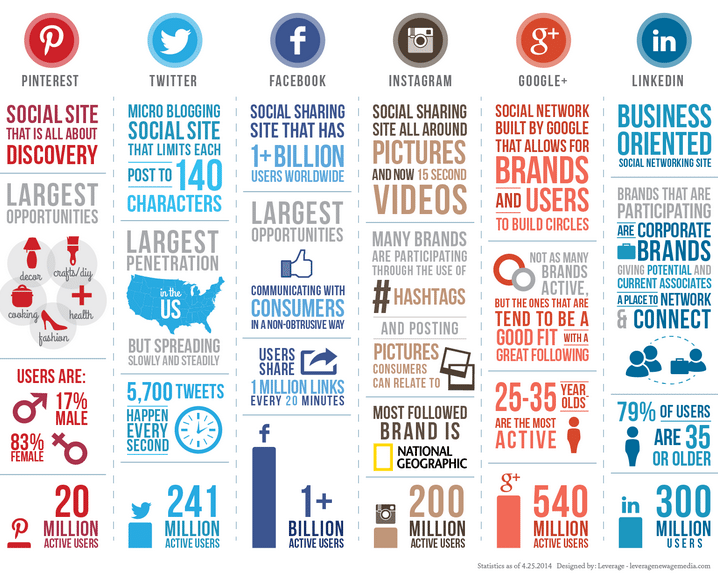
infographic: Leverage New Age Media
- If you’re new and only have budget for one site, start with Facebook. It’s the biggest and offers the most opportunity.
- Facebook also offers established businesses many opportunities, especially with Facebook ads. The ability to target those most likely to buy from you makes Facebook an obvious choice when you’re looking for the biggest Social Media ROI.
- Twitter is great if your target audience likes to consume information on the go in 140 characters. It’s also an outstanding way to prospect by leveraging Twitter’s advanced search and industry-related hashtags.
- Instagram is ideal for showing another side of your brand – perhaps the fun-loving, not-so-serious side of your business. However, the images you share need to be hi-quality to stand out. I can’t tell you how many businesses share images that are just so sad.
- Pinterest is great for reaching women. In the car business, 85% of vehicle purchases are influenced by women so develop a content strategy that speaks to them.
- Google Plus is a great platform for engaging with niche groups of people. The Circles tool allows you to tailor content to specific groups. Google Plus is also ideal for sharing your blog posts and gaining authority with search.
- LinkedIn is the ultimate platform for your salespeople to develop a referral network and prospect for new customers. With LinkedIn Premium, your salespeople can leverage advanced search to locate those they want to connect with. Example: many car manufacturers have financing programs through large companies. Your salespeople can search for employees within those companies to prospect with.
Social Media ROI is clearly where your focus should be. Start with a solid marketing plan, a proven system, and identify your ideal audience before you begin any online marketing.
Goals and objectives provide a starting point from which to measure. During the lifecycle of your campaigns, track and analyze your results. When it’s time, you tie your results back to your goals. That’s true Social Media ROI.
Author information
Kathi Kruse is an Social Media Marketing Expert, Consultant, Blogger, Speaker, Author and Founder of Kruse Control Inc. Born in the heart of Los Angeles to a family of “car people”, Kathi’s passion for the car business spans a 30-year career managing successful dealerships in Southern California. Kathi is the author of “Automotive Social Business – How to Captivate Your Customers, Sell More Cars & Be Generally Remarkable on Social Media”. Her Kruse Control Blog is the leading Automotive Social Media blog in the US.
The post Which Social Media Sites Will Give Me the Biggest ROI? appeared first on Kruse Control Inc.
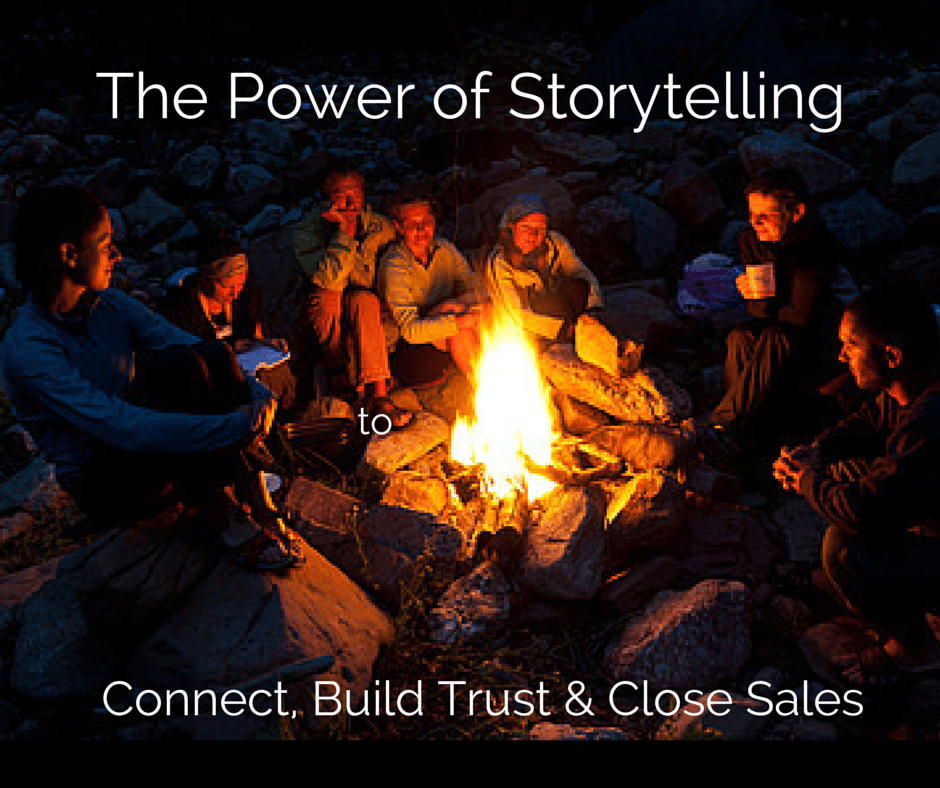 Great stories attract attention. A well-constructed narrative builds an emotional connection and the power of storytelling can be very useful in the road to the sale. Character-driven stories with emotional content result in a customer’s better understanding of the key points a salesperson wishes to make. Relevant, useful stories enable better recall by the customer, often weeks, months or years later.
Our brains love good storytelling. In studies over a decade ago, it was discovered that the neurochemical oxytocin is a key ‘it’s safe to approach others’ signal in the brain. Oxytocin is produced when we’re trusted or shown a kindness, and it motivates cooperation with others. Prospects connect with sellers more often when salespeople understand that people don’t buy what you do, they buy why you do it.
Social is a medium made for storytelling. If we take the facts outlined above and leverage them to create marketing content that tells great stories, imagine the result!
I love Facebook groups. One of the reasons I enjoy them is people can come to vent their frustration and the rest of us can often listen and give advice. It’s a collaborative way of solving problems and supporting each other.
Even though not all of my clients are automotive, many are because I spent my life managing car dealerships. I feel like I can provide value to the automotive industry, who happens to be going through a major transition. Many industries are finding themselves in uncharted territory when it comes to customer perception and expectation; many are suffering disruption and transition issues.
The best way to navigate transitional periods with your business is to never forget why you do what you do. Change will always be a constant. When you’re able to harness the power of storytelling (and telling your own story), whether in your marketing or through your sales process, adaptation becomes less difficult.
I happened upon a post in one of the Facebook groups I belong to that illustrates the power of storytelling in order to close a sale.
In this example, the interaction took place in-person at a car dealership. The method of communication here doesn’t play a huge part in the overall picture. Whether it’s in-person, email, telephone or more commonly now, social media, there’s a specific sales process that needs to take place. When managed correctly, things can conclude rather nicely.
Salespeople often get caught up in solving the sales puzzle – piecing together the necessary components with a disproportionate emphasis on the close of the sale. Those pieces are important, but as your sales career evolves you realize where the fun resides – and where the close becomes a natural conclusion – is in the questions asked and the story told.
Studies show that well-constructed narratives motivate people to engage in cooperative behaviors (ie: buy). As the salesperson, you must be savvy and work your process without going for the close too quickly:
- Ask Questions
- Listen
- Ask More Questions
- Listen
- Tell a Story: Utilize an event or situation that you’ve personally witnessed to illustrate how valuable your product/service is.
- Facilitate the Buy
Two Simple Tactics to Utilize Storytelling in Sales More Effectively
- Write down your own success stories. I use my phone to keep track of stories and ideas that inspire me. Creativity doesn’t always happen when you want it to; it happens when it happens. Document the ideas and stories as they come to you, because you never know when you’ll need them.
- Gather stories. In the beginning, you may not feel like you have any stories to tell. Go find them. Read blogs. Subscribe to RSS feeds. Follow industry news. Do some homework. Get plugged in.
An Example of the Power of Storytelling to Close the Sale
In this particular Facebook group, the members are dealership employees who share their experiences with their customers in order to obtain advice or sometimes they just vent frustration.
A member of the group posted this story:
“Young lady is in with her mom/coach purchasing a 2004 Nissan. I offer them GAP (GAP Insurance covers the difference between market value and the loan payoff should something catastrophic happen to the vehicle) and the mom tells the daughter no way, don’t take it. I move on. At the end, they thank me and tell me that it was a great experience and that I have no idea what they’ve been through. Naturally, I ask them what they’ve been through. Well, yesterday her car caught fire and is totaled. No GAP.”
I believe this story might win the prize for irony. The obvious irony is that if the customer had GAP insurance on the car that was totaled, they wouldn’t have to pay the few thousand dollars between market value and their payoff.
The not-so-obvious irony is that had the salesperson been asking questions, listening and telling a story illustrating the value of GAP, he might have sold it. Instead he asked the questions after his “pitch.”
Another member commented on this post with tips to solve his problem next time:
“Tell a Story of how it helped someone. I leverage GAP as a gesture to show I care. I explain exactly what it is, state my wife has used it (true story) and if I think they need it, I urge them to get it. This establishes rapport and trust making it easier to transition to offering other products.”
Action Steps in the Power of Storytelling
- Tell a true story to create a connection and illustrate the value.
- Your compelling story signals the buyer that ‘it’s safe to approach.’
- Develop rapport and trust so the buyer will remember it for weeks, months, years to come.
- Look and listen for signs of voluntary cooperation.
- Close the sale.
People want to be happy. They’ll buy from you if they can visualize being happy with their decisions. When you weave a tale that allows your customers to insert themselves within the story, they’ll identify and start to create their own similar and powerful visualization. There will be no other option but to move forward.
It’s not always easy to leverage the power of storytelling and it takes a lot of practice. But I guarantee it will make your job more fun and improve your rate of success.
Author information
Kathi Kruse is an Social Media Marketing Expert, Consultant, Blogger, Speaker, Author and Founder of Kruse Control Inc. Born in the heart of Los Angeles to a family of “car people”, Kathi’s passion for the car business spans a 30-year career managing successful dealerships in Southern California. Kathi is the author of “Automotive Social Business – How to Captivate Your Customers, Sell More Cars & Be Generally Remarkable on Social Media”. Her Kruse Control Blog is the leading Automotive Social Media blog in the US.
The post The Power of Storytelling To Connect, Build Trust and Close Sales appeared first on Kruse Control Inc.
 In this world of constant noise and heightened mistrust, it’s dangerous to assume your buyer will notice you easily. Even the most loyal customers can waver and not recognizing this can be a costly mistake.
According to the National Center for Biotechnology Information, the average attention span of a human being has dropped from 12 seconds in 2000 to 8 seconds in 2013. This is one second less than the attention span of a goldfish.
Linkedin launched in June, 2003. Facebook launched in 2004. YouTube launched in 2005. Twitter in 2006. And now we also have Pinterest. And Instagram. And Snapchat. All of these channels push content across a world that also sends millions of texts per second. It’s no surprise that attention spans have been decreasing with the increase in external stimulation.
This afternoon, I went to see my hairdresser Brandy who, like me, enjoys documentary films. We compare notes on the ones we’ve both seen and share the ones we’ve seen that the other one hasn’t. She let me know about a great one on Lance Armstrong that’s airing right now on Showtime. I was surprised to find out that I had no idea about its existence.
In this world where our every move is tracked, it struck me as wrong that I wouldn’t have known about this particular documentary. I’m a Showtime subscriber and it’s pretty easy to track my preferences for documentaries. For instance, I always know when HBO docs are coming because HBO has a set schedule, they promote them where I spend my time (social media, online), and they make them accessible through On-Demand and HBO-Go. HBO understands me and pays attention to where I spend my time. They go where I go, in order to connect with me, and that keeps me coming back.
Showtime on the other hand doesn’t connect with me. How do I know? Because I had no idea about the documentary until my friend told me about it. Showtime hasn’t connected with me and that’s a shame. I’m a loyal customer who would consume every one of their docs but there are just too many choices to distract me on the road to Showtime’s content.
In my example, does your business behave like HBO… or does it act like Showtime?
What have you done to make sure your most interested buyer knows that you offer what they want and informs them how to get it?
Do you meet buyers where they are and engage them…or do you expect them to come to you?
Now, my guess is that Showtime didn’t sit in their programming meeting and plan to ignore people like me. However, there is a disconnect somewhere. They may simply not know the value in tracking consumer preferences or leveraging data to increase their viewership. They may simply not understand today’s consumer. Whatever the reason, it’s their loss.
Data allows companies to target their ideal buyers. Social Media allows companies to connect with those targeted, interested buyers in very visible and important ways. If your business isn’t connecting, how much are you losing?
Never expect buyers to seek you out. There are just too many places for them to detour. Avoid these 3 mistakes that cost you sales to your most interested buyers:
1. No Content Strategy
Digital, social and mobile access have changed the world. Marketing has become highly ineffective because consumers tune out. What do they tune in to? Stories. Stories that connect on a human and emotional basis.
Great stories (content) drive all forms of marketing and advertising. The “right now” amplification of content on social media requires even closer attention to storytelling.
Your business’ content fights for space in your buyers’ newsfeeds. When you’re competing with buyers’ friends, family and other pages they’ve liked, your story better be compelling. If what you’re posting is boring or they’ve seen it before, buyers will scroll right on by.
Remedy this by leveraging research and then develop a winning content strategy. Figure out what you want to say and how you’ll say it. I’m not going to sugar coat it: this exercise is tough and not many are cut out for it. Most everyone of our clients came to us because they had no clue where to start. Each business is different, even if you sell the same thing as the guy down the street. Buyers come to you for their own unique reasons and it’s your job to figure out what those are.
The more you know about your buyer, the better your content will be. The better your content, the more interested your buyers.
2. No Action Plan
Lack of planning and goal setting is the quickest route to failure. To capitalize on your brand’s strengths and optimize your budget, you must know:
- Where are you now?
- Where do you want to go?
- What will it take to get there?
- What happens if you fail?
- What happens if you succeed?
3. No Community Manager
I hear a lot of business owners and managers ask if they have to “be social” on social media. Being social is a big part of sales, so the answer is yes. There are a myriad of reasons principles and managers push back on this and sometimes it’s just that they don’t want to ” be social.”
If this is the case with your business, you must designate a Community Manager to listen, respond, inform and engage your interested buyers. They’ll also need to know how to ask the right questions if the buyer is looking to buy right now and be able to discern what next steps are required to close the sale.
Being social on social media is not about passively monitoring what’s being said. That’s the real-life equivalent of not acknowledging a customer when they visit your store or ignoring the phone when it rings. Yes, you must “be social” because being social is part of the sales process.
Don’t let your most interested buyers get caught up in the noise and miss the information they want to know. These mistakes that cost you sales can be avoided once you know the right strategies. It’s easy for your buyers to get distracted. Give them something to remember you by and their attention will focus solely on you!
Author information
Kathi Kruse is an Social Media Marketing Expert, Consultant, Blogger, Speaker, Author and Founder of Kruse Control Inc. Born in the heart of Los Angeles to a family of “car people”, Kathi’s passion for the car business spans a 30-year career managing successful dealerships in Southern California. Kathi is the author of “Automotive Social Business – How to Captivate Your Customers, Sell More Cars & Be Generally Remarkable on Social Media”. Her Kruse Control Blog is the leading Automotive Social Media blog in the US.
The post Mistakes That Cost You Sales to Your Most Interested Buyers appeared first on Kruse Control Inc.
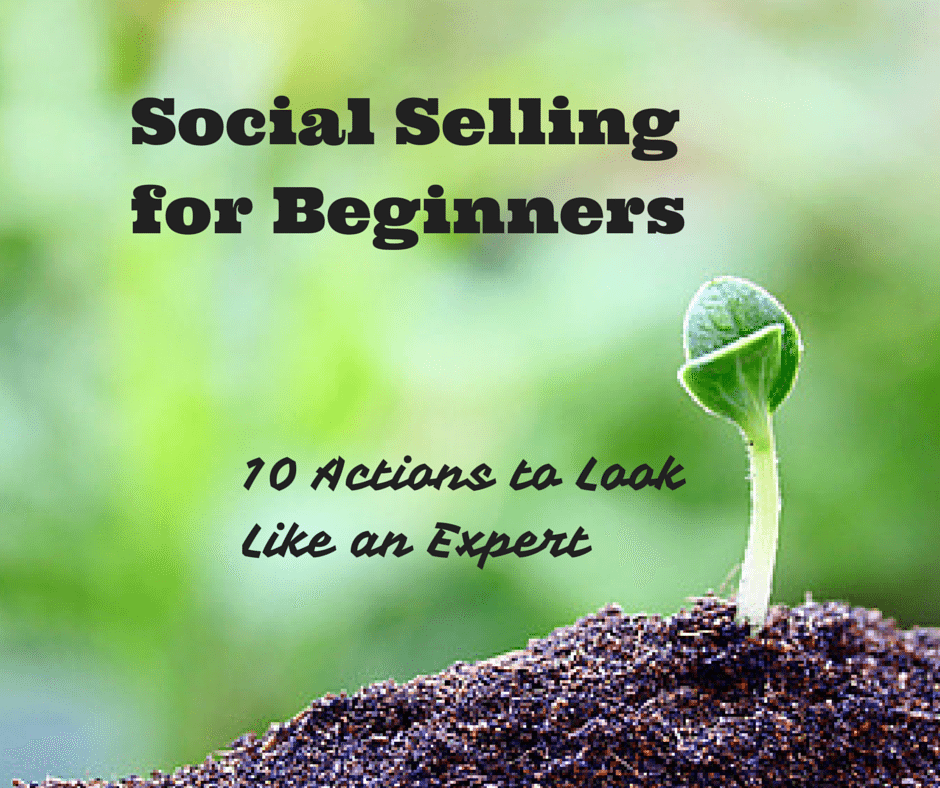 Everyone wants to be remarkable. Every salesperson wants to be the ONE who customers choose, over and over again. But many salespeople are lost with today’s technology. The advancements in social media and content management platforms have made it easier than ever to engage and stay connected with those ideal customers. There’s never been a better time to incorporate Social Selling into your sales process but if you’re a beginner, it’s a scary place.
“79% of salespeople using social media outsell their peers.”
As a salesperson, it’s easy to fall into the familiarity trap doing your job. You go to work, you do your job and you go home. Complacency sets in and the next thing you know, leads dry up and you’ve got nothing in the pipeline.
All Social Selling starts with a customer-centric mindset. Right now, you may look at every customer the same way: another chance to sell them something. It’s dangerous to ignore what they might be going through. You may look at the potential sale as only a transaction.
But to each customer, the purchase of a car (or any other product or service that’s important to them) is a milestone. Maintaining a customer-centric mindset keeps you focused on “what’s in it for them” (instead of what’s in it for you). Think about it from their standpoint; summon your empathy. You probably remember every single car purchase in your life: what you bought, where you bought, who you bought from and how enjoyable it was.
Applying how you’d feel during the entire Social Selling process helps you understand your customers better. Your next steps are crucial.
10 Social Selling actions to look like an expert.
1. Know Thyself.
There are three things that differentiate you from any other person: Your name, your face and your expertise. No one can ever take those away from you. The best way to leverage those three things is to develop your personal brand. Identify the values you want to be known for; the reasons people buy from you. When you dissect the components of your unique promise of value, it’s much easier to represent yourself online in the best light.
2. Research Where Your Customer Spends Time.
Pinpoint which channel your ideal customers occupy the most. With B2C industries (like auto retail), Facebook is where most people spend their time. For other industries like B2B, LinkedIn would be a good choice. The other channels should be investigated as well. Think about it this way: as a salesperson who wants to build a network of loyal customers and referral partners, start with a map of where you want to go first!
3. Launch the Social Channel that Scares You the Least.
Go easy on yourself. Pick the platform you feel the most comfortable with. If you don’t have one, dive in and make a choice. Set your privacy setting high to give your “lizard brain” a sense of control.
Spend at least 30 minutes a day on this first platform. Look around, see who you know and participate a little. As time goes on, you’ll get more and more comfortable.
A good plan that’s well executed always trumps fear. Research who you know and who you want to know. Does your company have a special product, service or pricing that’s ideal for a particular customer? Make a plan to connect with that customer and start providing value to the relationship.
4. Build Your Profiles.
Success in Social Selling starts with a great looking profile. Take advantage of the “free real estate” and be consistent with your image and text. Even if you’re not going to leverage every channel right now, it’s best to have a placeholder. Social Media changes quickly so stay up-to-date on the values of each network.
5. Develop and Commit to a Solid Content Strategy.
Content is what drives Social Selling and social marketing. Heck, it’s what drives any advertising too. If you tune into ESPN and find commercials for feminine products, that’s a content strategy fail. Successful content strategy is getting the right message to the right customer at the right time.
As a disciple of Social Selling with a customer-centric mindset, the components of a good solid content strategy are:
- Always represent your personal brand
- Know your customers inside and out
- Answer your customers’ most frequently questions
- Show what it’s like to do business with you by incorporating your repeat customers’ testimonials
Provide value by answering prospects’ questions and offering thoughtful content until the prospect is ready to buy.
6. Content is King; Images & Video are the King’s Court.
Many beginners are apprehensive about being in front of a camera. As an introvert, I can relate. However, it gets easier every time you do it.
If you feel comfortable using video, go for it. If not, still go for it. You’ll find a happy, comfortable place that works.
7. Implement Social Selling Tactics
- Connect with friends and customers
- Be the first to provide value in the relationships
- Participate in conversations
- Like, comment or share content
- Listen and ask questions
- Don’t forget to ask for the sale
8. Start a Blog.
A blog is the best way to display your personal brand and expertise. A blog is also the perfect way to provide content on the web for search engines to index.
Writing may be a deterrent for you but consider this: You’re already answering your customers’ questions in real life. Those interactions need only be written down and edited. 200-250 words is all you need for a blog post. Are there specific components to a good blog post? Yes, and we provide help with that. You’ll learn something new every time you post. Everyone has to start somewhere. You have something to say…so say it!
9. Master the Art of Networking.
Building a referral network is no easy task. It takes time and diligence but it pays off tremendously, especially when you find yourself in dire situations like losing a client or your job.
When you’re a beginner at networking, your first notion is to connect with as many people as possible. However, the exact opposite action is much more effective. Identify who you want to know. Leverage your current network to build more circles of influence. The more selective you are, the more valuable your network is.
10. Show Up to Give.
“Show up to give, not to get. Share your ideas to help others and others will share your ideas.” ~Simon Sinek
Simon Sinek is naturally shy and doesn’t like speaking to crowds. However, his TED Talk is the 3rd most-watched talk (20 million views and counting).
“People don’t buy what you do, they buy why you do it.” When you’re able to convey why you do what you’re doing, you connect on a much deeper level than say just a “transactional” level. Show up to give, look for opportunities to help solve your customer problems, and watch your network grow – online or off!
If you’re new to Social Selling, these tips will give you a head start. You’ll need advice a long the way. If you’re a sales manager or business owner, the only true way to leverage Social Selling with a sales crew is to train them to leverage it correctly. Our clients conquer the Social Selling frontier because they know it’s about building a solid foundation for long-lasting success.
I’m happy to talk with you about you and your business goals. Just send me a quick message here.
Author information
Kathi Kruse is an Social Media Marketing Expert, Consultant, Blogger, Speaker, Author and Founder of Kruse Control Inc. Born in the heart of Los Angeles to a family of “car people”, Kathi’s passion for the car business spans a 30-year career managing successful dealerships in Southern California. Kathi is the author of “Automotive Social Business – How to Captivate Your Customers, Sell More Cars & Be Generally Remarkable on Social Media”. Her Kruse Control Blog is the leading Automotive Social Media blog in the US.
The post Social Selling for Beginners: 10 Actions to Look Like an Expert appeared first on Kruse Control Inc.
 Whew! There’s a lot of conversation lately asking “Is Facebook Dead?” A lot of users are unhappy about the continued lack of valuable content in their newsfeeds. Business marketers are troubled over negligible organic reach and how Facebook ads cost more to reach less. What does it all mean for you?
Ignore the hype and look at the facts. Facebook continues to be THE social network where most people spend their time. Their revenue charts seem more like cell phone reception bars – consistently on the rise:
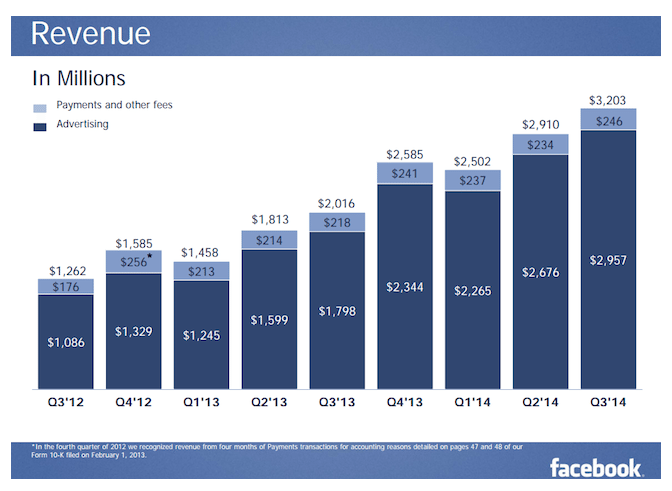
photo: Inside Facebook
It looks like another strong quarter for the remainder of 2014 is in the works. Facebook’s numbers for Q3 continue to not disappoint:
- $3.2b (yes, billion) in total revenue over 3 months (Q3 2014)
- Advertising revenue grew 64% year over year
- 1 billion video views a day in September 2014
- 8,300 employees, up 40% from Q3 2013
- 1.5 million total advertisers on Facebook
- 64% of monthly active users log on every day;
- 864 million daily active users, up from 829 million in the Q2 of 2014
- 703 million use Facebook mobile each day (40% growth for the year)
- 700 million people use Facebook groups every month
- Price per Facebook ad increased 247% due to higher quality
- 1.12 billion use Facebook mobile each month, which is up 250 million since last year
- Mobile is 66% of ad revenue up from 49% during the same time last year
Things are looking insanely good for Facebook for the Q4 and on into 2015.
What plans have you made for leveraging Facebook now that it’s clear that Facebook is not only NOT DEAD but thriving and ready to help your business get more traffic, leads and sales?
Here are 5 reasons to leverage the value of Facebook for your business and stake your claim:
1. Facebook is the largest Social Network.
In traditional advertising, there’s a premium when businesses want to broadcast their messages on the most popular channels. Why? Because that’s where the customers are! Facebook has become the most popular network and that makes it ideal for business marketers.
The only question is how will you deliver your messages appropriately and authentically so that your customers and ideal prospects will want to buy from you and recommend your business to their friends and family?
Awesome content still drives user experience on Facebook. Our clients do two things to facilitate their content strategy:
- They leverage the expertise of their employees to produce valuable, relevant content that attracts ideal customers.
- They run smart Facebook ad campaigns that target only those who wish to connect and look forward to your content in their newsfeeds.
2. Facebook Ad performance is outstanding.
There’s no better channel to laser-target your ideal buyers with ads they’re interested in, at the optimal times during their shopping process, without wasting valuable budget to reach those that’ll never buy from you.
While it’s not easy or simple to do on your own, Facebook Ads drive traffic, leads and sales. Facebook Ads can deliver new customers while at the same time engaging your current (repeat) customers.
For the cost of acquisition, Facebook is still one of the cheapest ways companies create new customers. Plus, interaction with existing customers helps build a better relationship with them.
3. Facebook is ideal for driving prospects to your website.
Publish your blog posts on Facebook. Use the “Boost Post” option to let more users see them. Every click brings someone to your website. You accomplish two main marketing goals:
- You inform would-be buyers of the products and services they’re researching.
- Search engines notice the clicks from Social sites and reward your site with higher rankings.
4. Facebook is the gateway to Social Customer Service.
Who doesn’t want access to the “boss” when you have a positive or negative experience with a company? When customers know you’re listening, they feel comfortable buying.
- 47% of Social Media users have sought customer service via Social channel.
- 71% of those who receive positive Social care are likely to recommend your brand to others.
- Only 19% of those who don’t get any response are likely to recommend that brand.
5. Your Facebook page sets up sales as consumers research their next purchase.
78% of people say that a company’s social media posts impact their purchase decision. Just as if you were meeting them in your store, your salespeople can connect and answer questions on Social Media.
Social Selling has become the go-to process for reaching today’s connected buyer. Establishing a Social Selling process inside your operation is key to reaching these connected buyers. How much money are you leaving on the table by not embracing the Social Selling method?
As we move into 2015, Facebook should be an integral part of your marketing and advertising strategies. It can be confusing and at the same time, daunting. Take a serious look at Facebook now because news stories of Facebook’s demise are greatly exaggerated. Is Facebook dead? Not by a long shot.
Author information
Kathi Kruse is an Automotive Social Media Marketing Expert, Blogger, Speaker, Coach, Author and Founder of Kruse Control Inc. Born in the heart of Los Angeles to a family of “car people”, Kathi’s passion for the car business spans a 30-year career managing successful dealerships in Southern California. Kathi is the author of “Automotive Social Business – How to Captivate Your Customers, Sell More Cars & Be Generally Remarkable on Social Media”. Her Kruse Control Blog is the leading Automotive Social Media blog in the US.
The post Is Facebook Dead? 5 Reasons To Ignore the Hype and Stake Your Claim appeared first on Kruse Control Inc.
 There are some things that marketing will never fix.
It doesn’t matter what industry you’re in, disruption is at the door. In the auto industry, not only has it entered the room but it’s crashing the party. Sticking with the status quo may be a coping mechanism but it’s hazardous to your business’ health.
Everywhere I go I see dealers, business owners and managers taking the path of least resistance to keep their businesses in tact. Playing it safe and sticking with the status quo might seem like a good bet…except we’re in the middle of a revolution. In fact, so many facets of how we do business are evolving it’s hard to keep track.
Customer Experience
Buying Experience is THE Differentiator. 53% of consumers indicate customer experience in the sales process is more important than brand, product, service and price in creating meaningful differentiation and customer loyalty.
Changing Consumer Buying Preferences
78% of people say that a company’s social media posts impact their purchase decision. (Small Business Trends)
About one in three consumers in the U.S. say they expect to buy their next car online. (USAToday) Three out of four consumers worldwide say they are open to alternative ways to test drive a car rather than the tradition of going to a dealership.
Shifting Consumer Needs and Desires
It used to be that having your own car provided the ultimate sense of freedom for young adults. Now that technology facilitates their freedom, a surprising number of Millennials are passing on car ownership. From 2007 to 2011, the number of cars purchased by people aged 18 to 34, fell almost 30%.
Increased Mobility and Disruptive Marketing Strategies
91% of consumers say that access to content across all devices is important. (ExactTarget) Navigating social media and social advertising is a necessity. Companies need to engage customers on the social channels where they spend their time, often 24/7.
The Collaborative Economy
Ten years ago, it was forecasted that social media would be disruptive to businesses. It was, but mainly to marketing functions and customer care.
Fast forward to today, using these technologies and mobile apps, we’re seeing the rise of people getting what they need from each other: They’re sharing homes, cars, rides, money, goods, and their time.
This Collaborative Economy is forcing companies to rethink the relationship they have with their customers as the crowd is starting to become a competitor.

photo by Tom Fishburne – Marketoonist
The alarm bell rings loud for giving up the status quo.
No matter the industry you’re in and whether you like it or not, disruption is coming your way. Maybe you’re more worried about sinking the boat rather than missing it. That’s natural. But playing it safe is riskier than you think.
Overcome the Status Quo, Goodbye Denial
There are all sorts of reasons one can muster up for sticking with the status quo: “We’re having the biggest month ever, there’s no need to adapt right now.” “We’ve always done it this way and it’s always worked.” or “Sure business is off a bit but it will come back, it always does.”
These stories you tell yourself are great when quantifying the risks of trying something bold. But when disruption comes calling, you may be far less adept at reckoning honestly with the risks of staying the course. “What’s the worse that could happen if we do more of the same?” A lot!
Our clients are in business to win. They know it’s not about coping. Here are 3 actions you can take to say goodbye to the status quo:
1. Assess how your business is prepared for disruption and shore up all the holes.
- Do you have a solid marketing plan in place to attract those that will want to connect with you and buy?
- How well do you know your customers and prospects?
- Have you established your “Why Buy Here” and integrated it into your marketing strategy?
- Are your salespeople online developing their social selling techniques?
2. Take a hard look at your workforce. Most employees can’t do enough for a great boss. Are you a great boss? You can’t surprise and delight customers when you have miserable employees.
“Learn to look after your staff first and the rest will follow.” ~Richard Branson
3. Stop leaving money on the table. Embrace digital marketing and take a more holistic view to your strategy. Today, SEO, Content (Blogging) and Social Media are the recipe that feeds your revenue engine.
94% of customers have discontinued communication with a vendor because they received irrelevant promotions and messages. Engage buyers of all demographics. Implement a solid content marketing strategy for people who want to know more about your products and services.
Our clients know there’s never been a better time to take a calculated risk. The costs are high when choosing to do nothing. Resist the status quo and sail your business into lucrative waters.
Author information
Kathi Kruse is an Automotive Social Media Marketing Expert, Blogger, Speaker, Coach, Author and Founder of Kruse Control Inc. Born in the heart of Los Angeles to a family of “car people”, Kathi’s passion for the car business spans a 30-year career managing successful dealerships in Southern California. Kathi is the author of “Automotive Social Business – How to Captivate Your Customers, Sell More Cars & Be Generally Remarkable on Social Media”. Her Kruse Control Blog is the leading Automotive Social Media blog in the US.
The post The High Costs of Sticking with the Status Quo in Sales and Marketing appeared first on Kruse Control Inc.
 What we say and do speaks volumes about us. Our words and actions tell the story of what it’s like to do business with us. Social channels are ideal for leveraging our network to “promote” good intentions and tell the story of our personal brand. But here’s the thing about social media: everything you say and do creates a perception in your customers’ minds. If you don’t want to be a failure in social networking, shouldn’t your image be a positive one?
Having been an advocate and practitioner of Social Selling (using Social Media to sell yourself and your product/service) for over 5 years now, I regularly look for outstanding examples from within my network. On my quest, I come across many negative examples too. In fact, the ratio is about 10 to 1, negative to positive. I hope we can turn that stat upside down in the coming years.
It is natural to be negative. Negativity gets more airplay.
As Homosapiens, and as Louise Leakey so beautifully points out in her TED Talk, we constantly make frightening choices. Her father, Dr. Richard Leakey, noted paleoanthropologist and archaeologist:
“We are most certainly the only animal that makes conscious choices that are bad for our survival as a species.” ~Dr. Richard Leakey, January 2008
I’ve discovered two frightening examples of failure in social networking (aka: Social Selling) that illustrate this fact. As you read these, visualize the players standing in a room full of people who are within earshot. This should give you a better context from which to observe it and serve to embody how cringeworthy it would be if you were on receiving end of these remarks in real life.
Social Sales Suicide by Facebook
A Facebook friend of mine (we’ll call her Mary) shared an image on Facebook talking about how one political party had voted against equal pay for women. Sure the post was political and I always recommend refraining from the “Big 3″ (politics, sex and religion) in social situations, including social media. The following is an excerpt of the comments section below her post from her “friends” who happen to be car salespeople (their names have been changed to protect the insolent):
George: “Yawn, trying to help you understand how things work in politics is quite daunting. You are aware of the tactics used to ensure the conservatives had to vote against this reform, aren’t you? Of course not. What was I thinking.”
Mary replied: “No, its not. I understand perfectly.”
Mark: “Gerry, why are you arguing with this idiot? Seriously! You’re above this.”
George: “That’s a bit over the top don’t you think Mark? Mary has many views similar to ours yet she persists in thinking……”
Mark: “Not at all. I have seen many of her posts. She is an idiot. Anyone who re-posts anything from the {media source} is an uninformed moron. The {media source} is nothing but misinformation and hyperbole.”
Many people seem to think that hateful, rude and borderline misogynistic rhetoric is okay on social networks. Regardless of your political stance, as a representative of your company and your personal brand, this is not how you want to be perceived, is it?
Facts:
- 85% of vehicle purchase decisions are influenced by women (women-drivers.com)
- 45% of new vehicles are purchased by women.
Result of witnessing these remarks:
- Reinforcement of the stereotype that car salespeople can’t be trusted.
- Significantly limited sales potential. You have no idea how many people saw this post.
Social Sales Suicide by Social Spam
I welcome new people who follow me on Twitter. I have a process for following them back that’s simple: once you follow me, I look at your profile and your tweets. If what you tweet is valuable to me and/or my audience, I will follow you back. I’m a consumer just like you so I track my thoughts and actions and compare them to how prospects might behave.
Recently, a person followed me. He had a little over 1,000 followers and he was a marketing guy. I thought, “Well, maybe you’ve got something interesting to say or to learn from.” so I followed him. I had never heard of him before his follow.
Fifteen minutes after my follow back, I got a DM (Direct Message) from him saying that he “Noticed a few things on my website that are hurting your conversion ratio. Let me know if you’d like some feedback.”
The result? His behavior established that his effort to connect with me was simply to sell me something.
What goes through a customer’s mind when they’re subjected to this behavior?
- “I don’t know you!”
- “Anyone can reach out and tell me what you told me.”
- “What’s different about you?”
- “I don’t know anything about you except one thing: I learned that you are a Social Spammer.”
There’s more to the story…
Thirty minutes later this Social Spammer sought me out on LinkedIn and requested to connect with me.
Again, I don’t know you. I don’t know anything about you. Why would I do that? What’s in it for me?
If he’d put himself in the prospect’s shoes and explored answers the above questions, he might not have spammed me. Maybe he’d have spent a little time politely and respectfully getting to know the prospect (and thereby letting the prospect get to know him).
When you begin a relationship without giving value, there is no reason for a prospect to connect with you because:
- You look like the hundreds of others who’ve said the same thing; the same sales pitch.
- There’s nothing in it for me.
Here’s what we advise our clients to do:
- Always approach your prospects with respect for their time and attention.
- Determine exactly who you want to network with and publish content that attracts those ideal customers and/or referrals.
- Never forget WIIFM (What’s In It For Me). If someone doesn’t know you, they won’t connect with you simply because you asked. Give them a reason to connect:
- You’re different than anyone else because….
- You were first to bring value to the relationship.
Show up to give. Giver’s gain.
It’s in my nature to reply to people who’ve taken the time to reach out. Had that spammer given me a reason to reply, I would have. But he took his eye off the ball. He was only thinking about himself and his sale.
There’s no reason on earth that you need to experience failure in social networking. Please, before you hit send, ask yourself, “Would I follow or buy from me based solely on this one post?”
Author information
Kathi Kruse is an Automotive Social Media Marketing Expert, Blogger, Speaker, Coach, Author and Founder of Kruse Control Inc. Born in the heart of Los Angeles to a family of “car people”, Kathi’s passion for the car business spans a 30-year career managing successful dealerships in Southern California. Kathi is the author of “Automotive Social Business – How to Captivate Your Customers, Sell More Cars & Be Generally Remarkable on Social Media”. Her Kruse Control Blog is the leading Automotive Social Media blog in the US.
The post Two Frightening Examples of Failure in Social Networking appeared first on Kruse Control Inc.
 One of my favorite things to do is listen. It feels natural because I’m an introvert and it’s provided me wonderful insight with those I interact with daily, including prospects and clients. With respect to Social Media and other digital marketing, active listening can be the best tool you have in your arsenal.
I was privy to a conversation the other day during a training I was conducting. It was at the beginning of the workshop and the attendees were just getting to know each other. The conversation always comes around to Social Media, mainly because that’s what they’re there to learn but also because so many business owners and salespeople have difficulty understanding what’s “right” and what’s “wrong” to post.
Content strategy (getting the right message to the right customer at the right time) is something that gets ignored as people venture out into Social Media marketingland.
- You need to know your brand’s purpose and value.
- You need to know who your ideal customers are.
Dissecting these two “creatures” is often not part of people’s Social Media marketing plan, even though it’s the most important. Without content strategy, you have nothing to build from.
So, in this conversation I witnessed, they were talking about the “Do’s and Don’ts” of Social Media. As students of the medium, they ultimately had this burning question:
“What sort of content should I be pushing on Social Media?
Begin with the ideal mindset
“Pushing” content is not the right approach. Refrain from the idea of pushing and embrace the act of engaging. Content strategy is your friend. It’s what’s going to support you when you run out of ideas and get overwhelmed.
Refrain from taking old media paradigms and applying them to New Media
Doing this will get you nowhere, fast. Blasting sales messages on Social Media is exactly what not to do. Rather than “pushing” content, consider what your audience (re: ideal customers) are looking for and give it to them.
Provide the ideal content mix
Listen to your customers. What are they asking? Admittedly, Social Media and content strategy does require an intuitive sense; an ability to empathize with your customer.
Your content mix should reach all stages of the buying cycle:
- Those who are not in-market yet
- Those who are thinking about buying
- Those who are ready to buy
- Those who have bought before
Focus on “Hyper-Local Content”
Hyper-Local Content is that content which comes from inside your business’s daily operation and it’s what shines on Social Media. Hyper-Local content stars your employees and your customers. Those stories are what’s unique about you and your business and that’s what will get you noticed.
Learn to tell your story with pictures, written word, and videos. Choose the medium that you feel most comfortable with and start creating. Act like a publisher not a pusher.
If you’re new or you’re unsure about what type of content to publish on Social Media, it’s best to work with a Social Media content strategist to lay down the components of your own brand (“Why People Buy From You”) and your ideal audience (their needs, problems and concerns) before you venture out onto social channels.
Remember, act like a publisher not a pusher.
Get your Social Media content strategy in place and it will be 100 times easier to create and produce valuable content that fosters leads, customers and sales.
Author information
Kathi Kruse is an Automotive Social Media Marketing Expert, Blogger, Speaker, Coach, Author and Founder of Kruse Control Inc. Born in the heart of Los Angeles to a family of “car people”, Kathi’s passion for the car business spans a 30-year career managing successful dealerships in Southern California. Kathi is the author of “Automotive Social Business – How to Captivate Your Customers, Sell More Cars & Be Generally Remarkable on Social Media”. Her Kruse Control Blog is the leading Automotive Social Media blog in the US.
The post What Sort of Content Should I Be Pushing on Social Media? appeared first on Kruse Control Inc.
 Buckle up, friends. SEO is changing again and in order to stay relevant in search, some things may have to change at your company. Content marketing has been a buzzword for a few years now and many people have ignored its impact. Sure there are those of us who adopted early but now there’s no time to waste. Your blog, social media and SEO now all mash up together and your business needs to master them all if you want to win the internet!
To show you how much things have changed with your digital presence, I’m going to share some pretty compelling facts with you. From there we’ll explore the building blocks that your business needs to embrace in order to capture organic search traffic.
1. Insights from Search Engine Journal’s PubCon Digital Marketing Conference:
- SEO is getting a lot harder than it used to be. There are more variables than ever, and a lot more restrictions from Google as to what you can and cannot do.
- Today’s SEO now involves publishing your own unique content, building an audience on social media, and getting your name out there as an expert by getting content published on other sites. Sound like a lot of work? You’re right!
- Many people are leaving the world of SEO because of how much it’s changed – it’s become too much for some to keep up with.
2. Google’s Latest Update: Panda 4.1
It’s always been in Google’s best interests to deliver search results that meets or exceeds the needs of the user. These periodic updates work toward that goal.
Google says Panda 4.1 is supposed to be more precise and will allow more high-quality small and medium-sized sites to rank better.
Google’s Pierre Far: “Based on user (and webmaster!) feedback, we’ve been able to discover a few more signals to help Panda identify low-quality content more precisely. This results in a greater diversity of high-quality small- and medium-sized sites ranking higher, which is nice.”
- Roll out began September 25, 2014
- Rewards “quality” content
- Penalizes “thin” content
Now that you know how things are changing, let’s talk about how your business can roll with it and come out on top.
Your Blog, Social Media and SEO
1. Your Blog
It’s vitally important for your business to have a blog. Not only to rank higher in search but also to increase credibility, visibility and influence with your prospects and customers.
“Thin” content with little to no added value will be penalized. These techniques don’t provide users with substantially unique or valuable content and they’re in violation of Webmaster Guidelines.
- Automatically generated content
- Content from other sources. For example: Scraped content or low-quality guest blog posts
- Doorway pages
- Thin affiliate pages
With Panda 4.1, Google is rewarding “quality” content. What is quality content? Broadly speaking, it’s information you publish that answers your ideal customer’s questions, helps them research their purchase, and informs them of things they didn’t even know they didn’t know. To determine what is “quality” for your particular audience, it’s best to go through a process with an expert to determine your best content strategy.
The 12 key elements of “quality” content
- Content Length. If you want your content to rank highly in the search engines and to attract links, go for longer 1000+ word posts. However, if your resources don’t allow longer posts, don’t stop posting. Quality 500-word posts can rank too.
- Supplement Posts with images, video, infographics and other media.
- Grammar and Spelling. Google has placed a huge emphasis on the trustworthiness of pages and sites. Poor spelling, grammar or typos is much less likely to be seen as trustworthy.
- Page and Text Formatting. High quality content is aesthetically attractive, easy to read, and suitable for scanning and skimming (which is how the majority of your website visitors will consume your content).
- Your Readability Score (based on Flesch-Kincaid readability test)
- Authoritative Content. Posts need to be written by someone who’s got expertise in the subject matter. Best practice: incorporate your employees’ knowledge and expertise in your content.
- The Credibility & Reputation of the Author. What else has the author written? The more content an author publishes, the higher that author’s content will rank in Google search results.
- Social Media (Social Proof Signals). When your posts are shared via social media and users click back to your site, this increases authority.
- Internal & External Links. Links to bad neighborhoods or known spam sites will kill the credibility of your article or site. Likely the most important indicator of the quality of a page is the number and quality of inbound links to that page.
- Domain Quality. If other pages on your site are deemed to be poor quality, this can negatively impact the rankings of the high-quality content.
- Comment Quality. Posts that have a high number of thoughtful comments may be deemed as higher quality than those that don’t. Spammy comments are likely to be seen as negligent.
- Content Value. Your content solves a problem, answers a question, provides entertainment or provides unique expert insight.
2. Social Media and SEO
Now that we’ve outlined how valuable it is for your business to produce quality content, let’s talk about how to develop and execute a strategy where your posts will be seen and engaged with.
Social Signals are actions taken by users that spread web content across social sites. Examples include Facebook likes, Re-Tweets, Pinterest pins or Google +1’s. These signals serve four main purposes:
- To indicate reputation among a target audience.
- To help search engines, especially Google, decide what content is best for users.
- To give web users faith in content, because it has been ‘voted’ on by the masses.
- To help you earn brand loyalty by strengthening your social presence.
Some innovative ways to increase Social Signals:
- Remain active on social media sites. Engage with your audience. Develop leads where appropriate.
- Produce and post “quality” content (as mentioned above). This includes your blog but also means other content you post on social media.
- Post “quality” content from other authoritative sites.
- Embed social share buttons on your website and blog. Google crawls your site and these stats help determine social signals.
- Request readers to share your content.
Some or all of these elements may not be part of your overall digital marketing. If you’re performing your own marketing, now may be the time to seek some expert advice. If you have a provider doing your marketing, these points will be valuable as you review their efforts and results.
Author information
Kathi Kruse is an Automotive Social Media Marketing Expert, Blogger, Speaker, Coach, Author and Founder of Kruse Control Inc. Born in the heart of Los Angeles to a family of “car people”, Kathi’s passion for the car business spans a 30-year career managing successful dealerships in Southern California. Kathi is the author of “Automotive Social Business – How to Captivate Your Customers, Sell More Cars & Be Generally Remarkable on Social Media”. Her Kruse Control Blog is the leading Automotive Social Media blog in the US.
The post Your Blog, Social Media and SEO: Mash Up…For The Win appeared first on Kruse Control Inc.
 A good story gains its own life on social media. A great story gets shared…a lot. Is your content on social media worth sharing? Storytelling remains one of the key factors in attracting leads and closing sales. No matter where your “content” is published (on social media and online, TV, radio or even a billboard), masterful storytelling techniques play a significant role in the outcome of your campaigns.

Hope at rescue and 4 weeks later
I’ve been following this little dog named “Hope” on Facebook. She was rescued severely emaciated and near death. Her slow recovery in the last 4 weeks has been wonderful and, as I observe my own behavior, I WANT to see how she’s doing every single day.
I volunteer at Hanaeleh Horse rescue in Orange County, CA. A year ago, we took in a severely malnourished horse who had been left in his stall for 2 years. Horses require daily exercise in order to survive. Needless to say, he barely did.

Quixote at rescue and 1 year later
We took him in and with care and love (and food and exercise), he’s become an amazing horse. His name is Quixote.
Storytelling is what social media is meant for. The good people that run both these rescues have learned that authentic stories attract people. Both rescues live off the donations of others. Sharing their stories helps keep them in business. They practice great storytelling techniques perhaps without realizing the effects. They’re doing it authentically and with a passion for others to join them in their experience.
I use these extreme examples to prove a point: your business may not rescue abused animals but there are still many stories to tell, as long as you bring passion and authenticity to the party and master some great storytelling techniques.
In this world of getting as much traffic as possible and growing our business, sometimes we forget that it’s the people who make our business successful. Great storytelling techniques start with customers and employees. Everyday there are wins and losses and many deserve to be told.
To master great storytelling in social media you must have someone available to listen and document things inside your daily operation. Not as an afterthought but as a key player in your content marketing strategy. So many business owners bristle at this idea and, honestly, it’s a big hurdle. There are options and you don’t have to go it alone. Hire an expert to help craft the stories, brainstorm on blog posts, and give advice for image stories and videos.
Superior storytelling is not easy. You have to educate your content person as well as your audience. The ideal result is to ignite a feeling that inspires a commercial transaction. You lift prospects out of their ordinary worlds and invite them to consider a journey that ultimately leads to a purchase.
If you’re not on-board with content marketing and social business, storytelling and social media are not for you. The reason so many have been slow to the table is because it requires so much from the business and they try to measure it the same way they measured old media. They’d rather wait and see what others are doing and that’s leaving money on the table. Hope is not a strategy.
If you’re ready to leverage of the benefits of social media for your business, you must publish content worth sharing.
4 storytelling techniques to use in your content marketing & social media
1. Show Don’t Tell
Your brand is no longer what you tell customers it is. It’s what consumers tell each other it is.
Waste no time with this technique. Start gathering specific stories where your customers and employees are showing what it’s like to do business with you.
A good example: A client of mine has a customer who brings her iguana/bearded dragon with her when she comes into the dealership for service. She loves it because they’re so accommodating and happy to see her. She’s happy to tell her story and it shows in the content they share.
2. Be The Hero
The reality is – no matter what you sell – you need to master the know-like-trust factor first. You have to educate people step-by-step both in your product and the experience they’ll receive when they buy.
A good example: I have a client who had an elderly woman walk into the showroom one day. She was lost and asked the salesperson if he could help her. She had actually been driving so the salesperson got the sales manager and they drove her car and a car from the dealership to go looking for the poor woman’s house. It turned out that she only lived a short distance away and got confused on the last few blocks home. My client told this story in a blog post and on social media with much success.
3. Tell Stories You Like
“Passion is energy. Feel the power that comes from focusing on what excites you.” ~Oprah Winfrey
I’ve been blogging now for four years and not every post has been easy. The easy ones happen when I feel passionate about the topic. I was just at a conference where the keynote speaker was so outstanding that I went back to my room and wrote a post in one hour.
Ask yourself what you’re passionate about. Ask your employees what their passionate about. Those passions are contagious and many prospects and customers share the same passions.
4. Build Drama with a Beginning, Middle and End
Travel through your story stage by stage. Craft it for your intended audience but also craft it as you would like it told to you.
It’s sometimes hard to determine what to leave in and what to leave out. Using this formula, you can place the beginning, middle and end in their context and fill in around them. Everyone likes to hear about resolution. If the reader is going to spend time on a story, they need to come away with something.
A good example: A client of mine had a social media debacle on their hands. They reached out to me to help them sort through it and make it right. It’s always a tricky situation when a customer has “gone nuclear” and each situation requires a savvy response. This particular customer had a wife who was an accomplished author with quite a large following and they threatened to use it if they didn’t get satisfaction. My client readily admitted that they were at fault. Things happen and people make mistakes. We were able to not only satisfy the customer but turn them into advocates.
Telling the story later was quite dramatic. It was a good example of “Show Don’t Tell” as the audience learned what their experience might be like should the same thing happen to them. Illustrating it with a beginning, middle and end help them formulate it and convey just the right amount of drama.
Social Media was made for storytelling. Learning how to market your business with storytelling techniques is a worthwhile way to establish your business as an authority and create value with your ideal customers. What’s your story?
Author information
Kathi Kruse is an Automotive Social Media Marketing Expert, Blogger, Speaker, Coach, Author and Founder of Kruse Control Inc. Born in the heart of Los Angeles to a family of “car people”, Kathi’s passion for the car business spans a 30-year career managing successful dealerships in Southern California. Kathi is the author of “Automotive Social Business – How to Captivate Your Customers, Sell More Cars & Be Generally Remarkable on Social Media”. Her Kruse Control Blog is the leading Automotive Social Media blog in the US.
The post Is Your Content Worth Sharing? Storytelling Techniques in Social Media appeared first on Kruse Control Inc.