Kathi Kruse
Kruse Control Inc.
I am a humble student of customer experience and it’s been a week of fascinating debacles. I believe there’s a direct connection between customer experience and a company’s revenue, having lived it during my years managing car dealerships in Southern California. We served some of the most demanding customers on the planet and now that people are connected through social media, customer experience might just be the new marketing.
Disruption is here and many companies aren’t ready for it. It used to be that sellers had the upper hand in transactions but those days are gone. In fact, it’s possible that today’s informed customer knows more than one or more of your salespeople. Customers are no longer powerless and salespeople who embrace this shift and roll with the change will survive and thrive during this disruption.
Any industry that’s incited loathing and disgust is ripe for disruption. I say this to those in the auto industry or any other business who believe that the status quo is sufficient. Superior leadership is mega-important (as if it wasn’t already) in this transition from past practices. If you don’t have a passionate, committed leadership team who’s focused first on customer experience, you may not get past the starting gate.
Current State of Customer Experience
Every week I hear more stories about people in auto retail who just don’t seem to get it. Even though these instances happened just last week, they show how far the car business has to go. And if you’re in a different industry, listen up. You can learn from these examples because stories like these aren’t exclusive to the car business:
- BIRMINGHAM, Ala. — A sales manager, finance manager and three salespeople who either work for, or previously worked for, Serra Nissan are facing federal charges in connection with a scheme at the dealership to fraudulently boost loan approvals and car sales. The 11-count indictment charges the defendants with conspiring with others at the dealership to defraud financial institutions, Nissan North America and Serra Nissan customers by fraudulently increasing vehicle sales in order to boost personal profits.
This is a perfect storm and right now we are in the middle of it: easy credit, especially sub-prime, with some calling it a Bubble, lack of leadership and outright criminal behavior. I suspect we’ll see more of this. They never learn.
- KIRKLAND, Wash. — A lawsuit filed this week alleges a local car dealership sales manager hurled racially insensitive remarks at an employee from India and his immigrant customers. Attorneys also filed a second, class-action lawsuit alleging the dealership withheld commission from the employee and other workers.A former salesman at Toyota of Kirkland says he was fired by text message after complaining about the remarks to superiors at his office. The first suit alleges the general sales manager at the dealership told the salesperson, who was born in India, that he “belongs working at a 7/11 not in a car dealership.” The suit also contends that the same sales manager used negative terms in referring to immigrant customers and would say things such as, “who let them into our country?”
Are you starting to see where our industry is ripe for disruption? If you look around, it’s already started with the maneuvers of Tesla and business models like Uber and Lyft. The Collaborative Economy has already begun.
Customer Experience is the New Marketing
Steve Cannon, President & CEO, Mercedes-Benz USA recently spoke about how the stakes for customer experience have changed.
“Now with social media and the connected environment we live in, a good experience can lead to thousands of connections and a negative experience can lead to potentially more than that.”
Cannon fundamentally disagrees with the traditional CSI model, which takes the transaction and breaks it up into its component parts. “Operational excellence is the ticket for entry,” he said. “We need to eliminate the word satisfied from our vocabulary. Satisfied for me is vanilla. We need to delight. We need to amaze. We need to provide extraordinary.”
An extraordinary customer experience creates word of mouth. There’s no better medium to foster word of mouth than social media. However, you need to make sure these components are in place first:
- There’s no way to deliver an outstanding customer experience with miserable employees. Yep.
- Examine your operation and develop a solid content creation process within it. Employees and customers are both valuable resources.
- Study how the online customer shops, where they spend their time and how you can meet them where they are and serve them.
- Provide an online customer experience that mirrors your real life customer experience. Establish value with customers by answering questions, solving problems and differentiating yourself from your competitors.
Customer experience is the new marketing. It’s people-driven, it’s trust-driven and it takes superior leadership. How equipped are you to make loyalty and customer experience your priority?
Need help? Let’s talk about your specific challenges and turn them into a resounding success. Click here.
Author information
Kathi Kruse is an Automotive Social Media Marketing Expert, Blogger, Speaker, Coach, Author and Founder of Kruse Control Inc. Born in the heart of Los Angeles to a family of “car people”, Kathi’s passion for the car business spans a 30-year career managing successful dealerships in Southern California. Kathi is the author of “Automotive Social Business – How to Captivate Your Customers, Sell More Cars & Be Generally Remarkable on Social Media”. Her Kruse Control Blog is the leading Automotive Social Media blog in the US.
The post Is Customer Experience the New Marketing? appeared first on Kruse Control Inc.
 There are those who believe that Social Media and sales should never be in the same sentence. In fact, many of you are probably scratching your head right now hearing it come from me. But aren’t we all in business to turn a profit? The last time I checked, you can’t do that without sales. So, let’s talk about the best way you can be an engaging social business while also putting numbers on the board.
Now, there are a lot of “social media experts” out there telling everyone that social media isn’t for selling. They use a lot of flowery talk about how it’s only for brand awareness or recognition. They say social media is not sell-to-me media and of course, that’s true. However, a real expert knows that social media, especially Facebook, offers many ways to reach buyers. Only savvy marketers know that social media and sales can and should co-exist.
On the other side of the fence are those that subscribe to the old advertising model of blasting messages about the company, mistakenly thinking those tactics will magically bring more leads and sales. Some publish blogs and other content that talk all about the product or service and nothing that helps the customer think through their decision. Some even believe that Facebook Likes are leads. This approach is just as fraught with problems as the “social media isn’t for selling” approach and both are myths.
A strong business leader knows that myths can be dangerous and a well-balanced approach to anything is usually the most successful. Social Media is confusing, especially to business owners who need to make sales. There certainly is plenty enough content out on the web to sway you 100 different ways. At the end of the day, you need an illuminated pathway to make the right choices where your brand and sales are concerned.
The way out is always through.
Follow this map to bust those myths. Lay down some solid groundwork for Social Media and Sales success:
Before you travel: Set Goals
The only way to know where you’re going is to outline where you want to end up. The more specific you can be, the better. If you’re new to Social Media and sales, these are some attainable goals:
- Grow your fans and followers
- Increase engagement and conversation around your brand
- Implement a workable content collection process inside your business
If you’ve been on Social Media for awhile, then sales should be your ultimate goal. Here are some steps toward it:
- Create catchy and unforgettable Social marketing campaigns
- Track what you do with analytics tools
- Implement a fool-proof follow up system to field leads and convert sales
Plan your route: Content Strategy
Content strategy means getting the right messages to the right customers at the right times. It starts with WHY.
- Why do people buy from you?
- What is your unique selling proposition?
- What value to do you bring to the table that nobody else does?
If you’re confused by this, simply ask your customers why they choose you. Hint: if it’s because you’re the lowest price, keep digging for the real answer.
Great strategy comes from comprehensive information. Identify who you are as a brand and identify who you want to reach. Describe your ideal customers:
- What are they like?
- What questions do they have?
- How do they research for your product or service?
The more you know about your ideal customers’ shopping behavior, the better you’ll be at creating and publishing content that matters to them.
Begin your journey and enjoy the trip: Create & Publish Content
Something magical happens when you put your knowledge on “paper.” Publishing information about your business – what it’s like behind the scenes – helps people connect with you in more meaningful ways than your competition.
Sharing the right mix of content is important. Make sure your content mix reaches all levels of the consumer buying phase, not just the “ready to buy now” group.
Syndicate your blog posts on Social channels to encourage engagement and traffic to your site.
Enjoy the act of content creation. Talk about subjects you’re passionate about. Develop relationships and trust by encouraging people to engage with you.
The road to the sale is paved with your trustworthy information.
Don’t forget to gas up: Social Ads
Social advertising plays a valuable role in Social Media and Sales. Social ads support your content and get it seen by more of those ideal customers we were talking about. Facebook ads in particular provide a great value by giving you the ability to laser-target those who might prefer to see your ads, at a reasonable cost.
Use Facebook ads to:
- Grow your likes
- Increase engagement with your posts
- Drive traffic to your blog (website)
- Convert fans into customers
Look for markers: Capture Leads
There are two types of leads in the Social Media and Sales world:
1. Organic leads: these come in the form of comments and interaction with your content. It’s crucial to listen for organic leads and respond quickly in a social manner. Don’t respond to customers questions with one-word, closed-ended replies. Answer their question and ask another one. Help them create the lead themselves.
2. Paid Leads: these are the leads you’ve paid to obtain. One of the first clients we ever got at Kruse Control failed to follow up on the leads we obtained. It was the catalyst for my shifting parts of my business toward education and training because this dealership was not prepared for Social Media and Sales.
Learn the best ways to follow up with your social sales leads. Whether you’re one person or you’re managing a team, if you don’t follow up, you never get the sale.
Arrive at your destination: Close sales
Warm leads close faster. How many times have we heard that? But so many simply ignore it. Social Media is your vehicle to develop warm leads. With virtually all consumers starting their purchase process online, doesn’t it make sense to greet them and engage with them there?
By developing a Social Media and sales process inside your organization, each employee understands how the road to the sale happens:
- Attract ideal customers with your content
- Connect with them on your Social channels
- Provide useful information for those in-market
- Accelerate your efforts with Social ads
- Ask for the sale when appropriate
Social Media and sales DO belong in the same sentence. They also belong in your sales department’s daily operation. We’re all in this to make a profit. It’s time to get the show on the road.
When it’s time for assistance, call me.
Author information
Kathi Kruse is an Automotive Social Media Marketing Expert, Blogger, Speaker, Coach, Author and Founder of Kruse Control Inc. Born in the heart of Los Angeles to a family of “car people”, Kathi’s passion for the car business spans a 30-year career managing successful dealerships in Southern California. Kathi is the author of “Automotive Social Business – How to Captivate Your Customers, Sell More Cars & Be Generally Remarkable on Social Media”. Her Kruse Control Blog is the leading Automotive Social Media blog in the US.
The post Social Media and Sales: Follow This Map, Bust the Myth appeared first on Kruse Control Inc.
 Blogging for business is an integral part of your overall marketing strategy whether you’re marketing your business or integrating Social Selling into your sales process. Blogging has been around since the late ’90s but many businesses and salespeople are still very new to it. The steps to writing a great blog post aren’t always easy to figure out and that can make you unsure of where to start or what to say.
The benefits of blogging are many:
- Establishes Authority: you become the “Likable Expert” to your customers and prospects
- Drives traffic to your website
- Helps convert traffic into leads and sales
The benefits of blogging are so huge that you’d be crazy not to have a blog. However, there are many components of a blog that make it successful and with so much content being published on the Interwebs, you need to have a solid product or people simply won’t engage.
Your goal is to make an impact on prospects and customers. Today, we need to use all methods of reaching customers and your blog is the foundation from which to launch from.
Follow these 10 indispensable steps to writing a great blog post:
1. Write What You’re Thinking
There are many, many people who believe they’re “not writers.” Simply put, blogs are merely your thoughts and advice on paper (or video, images or even spoken into a microphone for the world to hear). When you put your thoughts to paper, something magical happens. Inspiration takes you to places you never thought you’d go. Start by writing what you’re thinking.
2. Put Yourself in Your Reader’s Shoes
Ask yourself, “What’s the ONE thing I want the reader to takeaway from reading this post?” Write with one concept in mind – don’t get caught up in a bunch of different ideas. Save all those other ideas for other posts. Stay focused on the one concept, one solution, one story that will keep them coming back for more.
3. A Clickable, Shareable and Compelling Headline
You only get one chance to capture your readers attention and that’s your headline. There are many formulas to write great headlines and studying headlines has been sort of a hobby of mine. One of the my favorite formulas is this:
Number + Adjective + Keyword + Rationale + Promise
- Numbers win readers i.e. 1o Tips…
- Use interesting adjectives such as killer, amazing, ultimate, powerful, exciting etc. I use this great list here–>
- Use rationale such as tips, tricks, reasons, principles, elements etc.
- If possible, include trigger words like ‘Why’ and ‘How’
- Make a promise, such as 10 Powerful Tips to help you…
- Make your headline shorter rather than longer to avoid Google truncating it for you
- Include a keyword when possible because you still want organic traffic
4. Tell a Story
There is simply nothing more compelling than a story. The best way to illustrate why people buy from you is to tell stories about your everyday interactions with customers. Let their actions convey the trust that you’re looking to build with your prospects. Stories paint a picture and evoke emotions in the reader. Blogs are at their best with they build trust and telling great stories draws people closer.
5. Grab Them With Your Opening Paragraph
The headline’s job is to get people to read your first paragraph. The first paragraph’s job is get them to keep reading!
Your opening paragraph should have two components: Expertise and Empathy
- Expertise – Mention that people come to you with a problem or concern. Say, “Customers come to us all the time…”or “Recently, a client asked me the following question…” By doing this, you’re making it clear that you/your company are an expert in solving this problem.
- Empathy – No one wants to feel alone in their problems. Everyone wants to feel understood. Phrases like “we can relate” or “we appreciate” or “this is understandable” go a long way to help the reader perceive you as someone who’s not only trustworthy, but “gets” them—opening up the doors for a potentially great working relationship moving forward.
6. Include an Irresistible Image
Images help tell stories. Sometimes, they are the story. Include an irresistible image with your post so that people who learn visually (65% of your readers) will connect with your post.
Another important reason to include an image is so that when you publish it on Social Media, the thumbnail populates, thereby optimizing your content for readers’ newsfeeds.
7. Readability
Many people will scan your post. Some will read 50% of it and some will read all of it. Make your post readable to each type of reader:
- Break up long paragraphs
- Use sub-headings
- Use bullets
- Take advantage of block quotes when possible
8. Optimize for Search
Blog posts are valuable in two ways:
- Humans (customers and prospects) read them during their shopping research.
- Search engines look for fresh, relevant content when ranking sites and blogs are the best at providing it.
You can spend time figuring out how to exactly optimize your blog posts for search OR you can use this handy plug-in I use on my WordPress site. It’s called WordPress SEO by Yoast. Install it and it will guide you through the process of optimizing your post for search engines.
9. Call-to-Action
In this sharing economy, we’ve all become accustomed to getting information for free…and that’s an awesome thing. However, it’s still important to remember that you need to guide readers down your sales funnel when appropriate.
Include a Call-to-Action at the end of your post. It reminds them that, if they need further assistance or deeper expertise, you’re there to help.
10. Perfect is the Enemy of Done
When I first started blogging, I would fret over my post until it made me crazy. I’ve learned that blogging is a conversation you have with your readers, prospects, peers and customers. It doesn’t have to be perfect. It also doesn’t mean that you shouldn’t proofread. My routine is:
- Write from the heart (“Bleed onto the page,” as Hemmingway once said)
- Edit accordingly
- Link back to sources where applicable
- Proofread twice – at different times
- Publish
Now that you’ve learned my 10 indispensable steps to writing a great blog post, take a moment and jot down the subjects you want to write about. If you’re still not sure about subject matter, start with your customers’ most frequently asked questions.
“Don’t die with your music still in you.” ~Dr. Wayne Dyer
For more blogging assistance and guidance, reach out to me here. My focus is to support your marketing efforts with the ultimate goal of traffic, leads and sales.
Author information
Kathi Kruse is an Automotive Social Media Marketing Expert, Blogger, Speaker, Coach, Author and Founder of Kruse Control Inc. Born in the heart of Los Angeles to a family of “car people”, Kathi’s passion for the car business spans a 30-year career managing successful dealerships in Southern California. Kathi is the author of “Automotive Social Business – How to Captivate Your Customers, Sell More Cars & Be Generally Remarkable on Social Media”. Her Kruse Control Blog is the leading Automotive Social Media blog in the US.
The post 10 Indispensable Steps to Writing a Great Blog Post appeared first on Kruse Control Inc.
 One of the most powerful attributes of Social Media is that sellers can engage buyers during all phases of the purchase process. That may seem easier said than done…but it doesn’t have to be. Great content is your path to victory. Expert content marketing “touches” the buyer no matter where they are in the buying cycle and turns fans into customers.
Content marketing is getting the right message to the right customer at the right time. One of the most overlooked factors in content marketing is a solid, workable content strategy. If your organization isn’t ready to produce meaningful, relevant content that attracts buyers, content marketing isn’t for you. If you’re “not sure” what to post, it can lead to failure and that may be the very reason you’re avoiding making a plan in the first place.
Content Marketing Strategy
There four important things to define in order to solidify your content marketing strategy:
- Why people buy from you
- What you’ll do
- Who you’ll do it for
- What benefits will accrue for your brand and your customers
Telling amazing stories is key and in order to do content marketing well, you must have a continuous “Culture of Content” in your organization. This means two things:
- Someone inside your organization must be in charge of content.
- Your organization must integrate the actions of content creation in daily operations.
There’s a natural tendency for every business to want to talk about itself. A Social Media manager and/or content marketing manager must resist this and focus their efforts on the audience’s needs, wants and concerns. They must understand that marketing and sales are two separate functions and trying to close the sale too soon leaves everyone empty-handed.
John Jantsch of Duct Tape Marketing (and Duct Tape Selling) spoke at a conference recently about the functions of marketing and sales going into 2015. He outlined 7 touchpoints in the buyer/customer experience. “It’s marketing’s job to develop “know, like and trust.” It’s sales’ job to foster the “try, buy, repeat and refer.”
In many small businesses, the distinction between marketing and sales is not so prevalent. Everything gets lumped into the endeavor of making sales and profit. As the business owner or as a salesperson, the more you explore the marketing and sales functions and understand how you must master both in today’s world, the better you’ll be at content marketing.
Utilize these 7 touchpoints as a foundation to guide your content marketing strategy.
1. Know
- You only get one chance at a great first impression. Make sure every profile on the web is visually-consistent and welcoming.
- What are the ways that you can differentiate yourself and/or your business online? If people have seen what you’re offering before, they won’t engage.
2. Like
When you’ve done the work to figure out who your ideal customers are, you can target them with content that brings them closer to you. People love stories and by publishing what I call Hyper-Local Content, you’ll increase your chances of engaging them. Hyper-Local Content is information (as images, video and written word) about your business that depicts how awesome it is to be a customer.
3. Trust
Relationships build trust; trust builds relationships. Make it a component of your content marketing strategy to show how other customers trust you.
Blogging builds trust. When I spoke at a conference recently, I asked, “Who has a blog for their store?” Only about 1/4 of the room raised their hands. Let me tell you straight:
- If you don’t have a blog, you’re leaving money on the table.
- If you don’t have a blog, you’ve missed a chance at developing trust with your prospects.
- If you have a blog and you’re not optimizing its content for search, you’re selling yourself short.
- If you have a blog and post benign information about your product/service, no one will click on it or share it on Social Media.
4. Try
If there’s any way for you to let people try your product/service out before they buy, do it. In the car business, this would be the test drive. One of the biggest challenges dealers face is getting people to come in for the test drive. There are some great ways to use small incentives to guide prospects to the next level of the sale.
People need an incentive. They want to feel like they’re sought after and important. They want to know what’s in it for them. Offer an e-Book or white paper that helps them in some way. Let them try your business on for size.
5. Buy
In this stage of the buying cycle, customers want to see content that assures them they’re making the right choice. They’ve done their research and are looking for an insurance policy. Examples of great content to share with them would be customer testimonials and stories about your best customer’s experiences.
Your content strategy here must also include Facebook ads. When prospects are close to a decision, it’s crucial to keep them engaged.
6. Repeat
71% of consumers have ended their relationship with a company due to poor customer service (Kiss Metrics). Nobody likes to see customers defect.
A high repeat rate indicates outstanding customer service. Therefore, if you don’t have a solid customer retention process in place (including training on how to achieve it), Social Media will amplify your inadequacies.
To jump start or motivate repeat business, your content strategy should include examples of customer loyalty. Who are your raving fans? These are people who’ve bought from you again and again. How can you include them in your content? One client I have went to their house to interview a sweet older couple who were not very ambulatory. Going the extra mile to meet them where they were meant the world to that couple…and it showed in their video interview!
7. Refer
When you’ve made them so happy they’ll tell others, complete the circle with a process to ask for the referrals:
“Our business is based on referrals. We’d really appreciate you telling your story to others.”
Your content strategy should include a process to capture your happy, loyal customers opinions online. It should include training of salespeople, email marketing and, of course, Social Media. Review sites like Yelp and Google+Local are ideal ways to let others know what they can expect, should they decide to do business with you.
If you’re seriously considering Social Media and/or content marketing and you’re unsure what the next step is, reach out to me. We focus on a customized solution to set your mind at rest and get where you want to go.
Author information
Kathi Kruse is an Automotive Social Media Marketing Expert, Blogger, Speaker, Coach, Author and Founder of Kruse Control Inc. Born in the heart of Los Angeles to a family of “car people”, Kathi’s passion for the car business spans a 30-year career managing successful dealerships in Southern California. Kathi is the author of “Automotive Social Business – How to Captivate Your Customers, Sell More Cars & Be Generally Remarkable on Social Media”. Her Kruse Control Blog is the leading Automotive Social Media blog in the US.
The post How to Use Content Marketing in the 7 Touchpoints of Buyer Experience appeared first on Kruse Control Inc.
 Social Selling is the art of using technology to attract and engage prospects, grow referrals and retain customers. Success in Social Selling does not come easy.
It’s a process that not every business is ready for. Its processes need to come from the top through superior leadership and training. Only then can Social Selling become part of your business’ daily operations.
I just returned from the Digital Dealer conference where I spoke about ways to get traffic, leads and sales from Social Media. Part of your success in Social Media marketing depends greatly on how engaged your employees are in what I like to call “hyper-local content.”
Hyper-local content consists of examples from inside your store or business that show why people buy from you. Here’s a great example from one of my clients. This is just a simple picture of a car salesperson watching a customer’s dogs while they’re on a test drive. The positive results from a post like this are many:
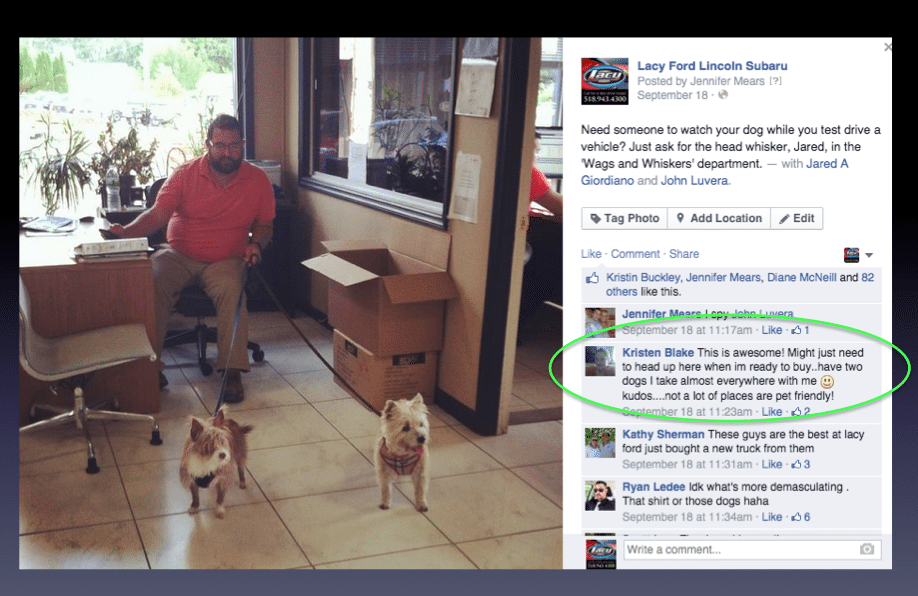
- This act of kindness speaks volumes about trust. Not only from the customer but with other’s researching their next purchase.
- People want to shop on their terms. Sometimes, they bring their dogs with them. The picture says, we welcome you and care about your needs.
- Inside the green circle: “This is awesome! Might just need to head up here when I’m ready to buy…have two dogs I take almost everywhere with me. Kudos…not a lot of places are pet friendly!” This is proof that, when done right, hyper-local content attracts other prospects.
During my four days at the conference, I heard arguments against Social Selling. These are valid concerns coming from those that haven’t yet realized that 95% of consumers go online first when researching their purchase. Some are even still stuck solely in their online ads world, not recognizing that a good portion of consumers don’t click on banner ads.
I just had an owner call me who’s been spending $45,000 per month on Google adwords and Pay-per-Click. He told me that his phones aren’t ringing like they used to three years ago. All the signs are pointing to a shift in your organizations’ need to explore collaborative marketing and sales. Salespeople marketing themselves and participating in the organization’s content strategy is how businesses are able to prosper today.
Success in Social Selling requires a certain type of culture. There were 3 main arguments I heard at the conference and they were similar to the questions I get regularly wherever I go.
1. Your Company Culture.
For years, some dealers and other businesses have treated employees as liabilities. I worked for a guy once who would scream obscenities on the showroom floor when customers were around. He hated everyone and let me know that regularly.
Today, employees are trusted by the consumer more than any other position in your business. Why wouldn’t you want them out there representing you? A business owner who doesn’t value his or her employees’ expertise and contribution, most likely doesn’t value their customers either. If you take a look in the mirror and see this type of person, Social Selling is not right for your organization. Your company culture must be ready for prime time if you want success in Social Selling.
2. “So, once I’ve paid these salespeople to access Social Media and/or learn Social Selling, what’s to stop them from taking my customers and going elsewhere?”
Nothing.
That’s why it’s mega-important to have a solid plan and strategy in place. If you behave like the boss I mentioned above, retaliation is a valid concern. However, most don’t behave that way and employees want to stay in an environment that helps them succeed.
3. “How can we protect ourselves from rogue salespeople who post inappropriate things on Social Media?”
Make sure you have a good Social Media Policy in place so that everyone knows what they can and can’t say. Remember, your employees know their boundaries when they use other forms of communication – in person, on the phone and email. Social is just another layer.
When you have a strong process in place to attract and engage prospects, grow referrals and retain customers, employees stay within those boundaries. They want to sell more (and so do you), so the more help and guidance you give them, the more things keep moving forward.
Consider these obstacles to your success in Social Selling – see if they sound like something you’re struggling with and take action. My hope is that you can overcome these obstacles and embrace the power of success in Social Selling.
If you need help, I’m ready to be your Social Selling sherpa.
Author information
Kathi Kruse is an Automotive Social Media Marketing Expert, Blogger, Speaker, Coach, Author and Founder of Kruse Control Inc. Born in the heart of Los Angeles to a family of “car people”, Kathi’s passion for the car business spans a 30-year career managing successful dealerships in Southern California. Kathi is the author of “Automotive Social Business – How to Captivate Your Customers, Sell More Cars & Be Generally Remarkable on Social Media”. Her Kruse Control Blog is the leading Automotive Social Media blog in the US.
The post 3 Biggest Obstacles Keeping You From Success in Social Selling appeared first on Kruse Control Inc.
 Ethics and selling go hand in hand. Trust is built when integrity leads the conversation. The pursuit of wealth can often trump the importance of ethics in the business world. We’ve seen it happen over and over in our culture. A true leader is one who’s resisted the seductions and reached beyond financial success to create true wealth.
I’ve just had the pleasure of attending a keynote from Jordan Belfort at the Digital Dealer conference in Las Vegas. In the 1990s, Belfort built one of the most dynamic and successful sales organizations in the nation’s financial circles before his well-publicized fall. During that time, he soared to the highest financial heights, earning over $50 million a year, a feat that earned him the name “The Wolf of Wall Street.”
In the months leading up to Mr. Belfort’s keynote at Digital Dealer, there was a lot of talk (gossip) amongst the car people crowd about the decision to invite such a “controversial” individual to speak at a conference of car dealers. People were concerned about “how it looked.” Many people went out of their way to voice their opposition without really knowing what Mr. Belfort’s message was: “Oh, car dealers already have a stigma to overcome, why do we need to reinforce it by aligning ourselves with The Wolf of Wall Street?”
I can say now, having witnessed it, that Mr. Belfort’s story is very compelling and important to hear as we move through these challenging times. You could hear a pin drop in the ballroom as he told how he came from nothing to build his empire. He talked about his fatal decision-making and the consequences of failed ethics. He shared with us his sales principles and techniques that earned him $50 million a year before his fall and how those same techniques today propel him to repay everyone who suffered due to his poor decisions.
I found Mr. Belfort to be a true entrepreneur and masterful at sales leadership. I’m so happy I didn’t listen to the naysayers that I’m sure “chime in” wherever he goes. There are so many things I learned in the short 75 minutes he spoke and many will most likely appear in future entries to my blog.
One of the stand outs of his address reminded me how important sales leadership is in Social Selling.
95% of shoppers turn to the internet first when researching their purchase. Masters of Social Selling know that greeting the customer/prospect where they are – to help them, solve things for them – puts you in a great position to turn conversations into sales.
In Social Selling, you’re presenting yourself online to prospects. It’s vital to be a recognized authority in your industry. There’s no arguing Jordan Belfort’s authority – he lives and breathes his truth as a sales leader, warts and all. He spoke about the 3 traits of great salespeople and outlined how prospects react and buy when these traits are present during the road to the sale.
These 3 traits of great salespeople can be a guiding force in your Social Selling. It can be a minefield just taking your own sales principles and networking techniques onto to Social Media. It doesn’t have to be if you remember to use what you know, what you learn and then practice being social. Your demeanor online and the content you publish needs to reflect these 3 important traits of great salespeople.
Be Sharp as a Tack
What are some of the actions you can take in order for a prospect or customer to consider you as sharp? In Social Selling, it’s listening to your client, responding quickly with thoughtful answers, and always being on your game.
How do you communicate this on your social channels as you converse and network? Be there ready to answer questions and support customers in ways your competition can’t (or won’t). This is how you differentiate yourself. Be the first one in the relationship to provide value.
Be Enthusiastic as Hell
Everyone loves enthusiasm. We’re uplifted just by having someone who’s pumped and positive around us – we WANT to be around that person. Check yourself and take actions to remain enthusiastic when you’re online. Don’t get pulled into the negativity or petty arguments that can happen, especially around controversial subjects like politics, sex and religion.
Take your enthusiasm to everything you share on your social channels. When you’re passionate about yourself, your expertise, and your product/service, it’s contagious. Adding the connectivity of Social Media amps that infectious positivity and may be the deciding factor in the sale.
Be an Expert in your Field
This sales leadership trait is where Social Selling really shines. The content you write or produce and then share on social channels lets your prospects and customers see you as the “likable expert.” Who doesn’t want to buy from someone they know, like and trust who’s an expert in the field?
If you don’t have a blog, get one. If you do and you’re lost a bit on what to write about, start by answering your prospects’ questions. Experts always come from a place of serving. How can you serve your customers in ways that only YOU can? Look for ways to be inspired.
Jordan Belfort inspired me to share these insights with you. It’s all a continuing conversation. Take the things you learn, assimilate them and put your own insights and story with it. Sales leadership goes hand-in-hand with Social Selling. Make it your own and build your community of loyal, referring customers.
Author information
Kathi Kruse is an Automotive Social Media Marketing Expert, Blogger, Speaker, Coach, Author and Founder of Kruse Control Inc. Born in the heart of Los Angeles to a family of “car people”, Kathi’s passion for the car business spans a 30-year career managing successful dealerships in Southern California. Kathi is the author of “Automotive Social Business – How to Captivate Your Customers, Sell More Cars & Be Generally Remarkable on Social Media”. Her Kruse Control Blog is the leading Automotive Social Media blog in the US.
The post Social Selling and Sales Leadership: 3 Traits of Great Salespeople appeared first on Kruse Control Inc.
Kathi Kruse
Kruse Control Inc.
Would you like to sell more? Consumers are starving for relationships they can understand with entities they can trust. It’s not easy to know how to develop trust with your customers and prospects, especially if you’re new to online marketing and Social Media.
It’s hard to ignore the numbers when it comes to developing trust using quality content:
- 61% of consumers say they feel better about, and are more likely to buy from, a company that delivers custom content. (Custom Content Council).
- Interesting content is a top 3 reason people follow brands on social media. (Content+).
- Social media sites and blogs reach 8 out of 10 of all U.S. Internet users. (Content Marketing Institute).
- 43% of consumers are more likely to buy a new product when learning about it on social media. (Source: Nielsen)
Years ago, in the salad days of the car business, we used to go across the street after work to grab a drink. It would sometimes turn into a longer night than we expected and (without naming names) some of us would have a few cocktails. I had a good friend who always had the best one-liners.
For instance, he bought a Harley having never ridden one in his life. He loved that bike and rode it as much as he could. One day we took in a black ’69 Lincoln Continental with suicide doors as a trade in. (I know, why would someone trade in that beautiful classic car?!). My friend immediately “put a rock on it” and bought it.
A few days later, he came into work driving it. Everyone was wondering where his beloved Harley was and he said, “Oh, I decided to drive the cage today.”
During one of these nights after work at the bar, he’d been drinking and he nearly fell down (no judgment). As we were calling him a cab, he looked me straight in the eye and said, “Gravity: it’s not just a good idea…it’s the law!”
I was thinking about my friend today while having a conversation about trust and consumer behavior. If you think about how you buy today, or spend any amount of time observing the shift in how shoppers make their decisions, TRUST is not just a good idea…it’s the law.
It’s the law in the sense that if you want to survive in today’s right-now, spotlight-on-all-your-mistakes world, you better have some trust built up to support your business’ future revenue.
Ted Rubin wrote recently saying the only way to build your personal or business brand on Social Media is through trust. People want to communicate with people, not corporations. Small business owners have a great opportunity in this arena because they can be nimble and responsive. But you need a plan and good leadership before you embark on your journey.
Selling from price is lazy. There, I said it. No one wins in the race to the bottom but everyone sure tries. Why, because they think it’s easier. In the race to the bottom, you can only go so low and then what?
In the absence of trust, price becomes the only focus.
The only thing that differentiates you from the store down the street (online or offline) is your customer’s experience. When you learn how to develop trust, the words consumers use to describe you to others helps build trust exponentially. Whether you’re a business or a salesperson trying to sell in today’s market, you must built trust on Social Media.
If you’ve tried Social Media and think it doesn’t work for you, it’s time to do more, not quit. There’s a huge opportunity for those who produce original content for Social Media. Here are three ways to start right now to do more:
1. Write What You’re Thinking.
Whether you’re a busy business owner or a salesperson, you have information that your customers need and want. Even if you start with writing valuable “one-liners” that get you noticed, that’s something! Soon you’ll start feeling passionate and inspired from things happening around you. You’ll graduate to a blog so that your ideas will all be in one place and you’ll enjoy more consistent traffic from search. Blogs give websites 434% more indexed pages. (Content+).
Write blogs, get noticed. Write blogs, build trust.
2. Engage in Conversations.
This is the part where, as a salesperson (yourself or your business), your prospecting, networking and trust-building converge. If you were doing this in person, you’d go to a networking event and, if you’re new, you’d spend time getting to know people not try to immediately sell them something. Social Media allows you to engage in conversations right from your phone or your desk.
You do need to be savvy and patient. No one will buy from you if you start talking about your product or service right at the first meeting. Be genuinely interested in people. Ask questions. Listen.
You can work on these relationships through your content. Build trust by looking people in the eye, digitally.
3. Comment on The Things You Read.
Every salesperson and business owner today must remain skilled and knowledgable in ways to keep your business thriving. I consume content every single day that helps me further my goals at Kruse Control. I follow blogs that are important to me and I save them all in Feedly to make it easier.
Start commenting on other people’s blogs and newsletters, media publications and anything else relevant to your business. You’re already absorbing the content and you probably have opinions when you’re reading it, so go ahead and comment on those blogs. What’s in it for you?:
- People will start recognizing your name.
- It gives you material for a blog post.
HOT TIP: I found this new app called Meddle.it (thanks, Ted Rubin!). You can grab excerpts from pages you’re reading and re-publish them along with your comments on Social Media.
Is learning how to develop trust and building meaningful sales relationships easy? No. But using your self-published content to show you’re honest, authentic and capable of delivering on your promises certainly gets you ahead of the pack and pays off in the end.
Author information
Kathi Kruse is an Automotive Social Media Marketing Expert, Blogger, Speaker, Coach, Author and Founder of Kruse Control Inc. Born in the heart of Los Angeles to a family of “car people”, Kathi’s passion for the car business spans a 30-year career managing successful dealerships in Southern California. Kathi is the author of “Automotive Social Business – How to Captivate Your Customers, Sell More Cars & Be Generally Remarkable on Social Media”. Her Kruse Control Blog is the leading Automotive Social Media blog in the US.
The post How to Develop Trust With Consumers in an Untrustworthy World appeared first on Kruse Control Inc.
Kathi Kruse
Kruse Control Inc.
Old habits die hard. We’ve all learned subconsciously how to respond to ads. That response guides our behavior and the decisions we make when advertising and marketing our business. When you introduce Social Media marketing into your strategy, there’s a tendency to place that same template of those learned behaviors over the top of it. That’s where people go awry – that’s where failure stops them from moving forward.
Advertising is part of the bedrock of American culture. We still today look forward to Superbowl ads and consider buying a certain type of whatever because we saw it in an ad. We can’t help ourselves, it’s part of our DNA.
Many of us grew up around TV shows that role-modeled exactly how great a career in advertising was. In some ways, we haven’t changed much from the days when characters like Larry Tate (from Bewitched) were what we aspired to do. Don Draper is loved by many today partly because we idolize his ability to convince people that buying a product makes us better somehow.
I meet people and talk to prospective clients everyday whose idea of Social Media marketing is to broadcast messages. They truly believe that’s all that there is to Social Media marketing. The mindset from the old days of “spray and pray” is so engrained that changing it could very possibly be the most difficult endeavor they’ll face as marketers.
What many don’t realized is that if they took a moment to ask themselves how they’d react to these types of messages, they’d understand why their Social Media marketing isn’t getting results.
If you honestly examine your methods of broadcasting incessant messages about your business, you might just say, “Oh, wow, I wouldn’t click on that!” Well, if you wouldn’t click on it or engage with it, why would you expect your customers to respond differently?
All the content you create – including blog posts, social updates and ads – isn’t worth the time and effort you put into it unless you’re willing to be social.
I’ve come across blogs lately that are clearly being written to serve search engines. Their headlines and content are “optimized” to “be found” on search but no human would ever read it or share it on Social Media.
Furthermore, a content marketing best practice is to syndicate your blog posts on Social Media with the intention that your posts will be clicked on, read on your site and shared through the reader’s social channels. When you blog about the “spectacular savings available right now!” and fill your post with search-engine-speak, NO ONE will take any of your intended actions!
Constant broadcasting on Social Media sends the message that you don’t care. You’re telling the world that you don’t want to socialize. From the consumer perspective, your “not being social” looks like this:
- You don’t care
- You’re not paying attention (which looks just like visiting your store and getting ignored)
- You’re not interested in gaining them as a client
“Silence is a lot quieter online than it is face-to-face.” ~Ted Rubin
When you’re silent online you’re actually screaming, “We don’t want to make the effort to build relationships or pay attention.”
Even though you’re saddled with the unconscious habit that broadcasting messages works, you can break free. And it’s not as difficult as you may think. Humans are social animals. Each of us has something to contribute and we crave connectedness.
Start building relationships now.
- Choose your platform and start engaging
- Be the first one in the relationship to provide value
- Be genuinely interested in what others are talking about
- Offer information that helps people
- Practice gratitude and appreciation with those you encounter
- Actively listen
- Ask questions, get answers and ask more questions
- Pay close attention to what your hearing or seeing and identify prospects as relationships grow
Social Media marketing encompasses PR, advertising, marketing, sales, networking and conversation. It won’t be easy to change your habits but all the signals are saying you must. Be Social. Be successful!
In case you’re missing him, here’s Larry Tate in action:
Author information
Kathi Kruse is an Automotive Social Media Marketing Expert, Blogger, Speaker, Coach, Author and Founder of Kruse Control Inc. Born in the heart of Los Angeles to a family of “car people”, Kathi’s passion for the car business spans a 30-year career managing successful dealerships in Southern California. Kathi is the author of “Automotive Social Business – How to Captivate Your Customers, Sell More Cars & Be Generally Remarkable on Social Media”. Her Kruse Control Blog is the leading Automotive Social Media blog in the US.
The post In Social Media Marketing, Do I Actually Need to Be Social? appeared first on Kruse Control Inc.
 By now, you’ve probably heard about Facebook ads. What you may not have heard about is how valuable they’ve become. Facebook has continuously improved the ads platform since its launch in 2007 and if you don’t already have some good Facebook Ads Strategies in your back pocket, then it’s time to move, son!
Like all social media, Facebook ads strategies require great content. It’s not enough anymore to simply post great content on your page (and that’s not easy!). Now, you have to make sure people see your content and you must supplement it all with well-designed ads in order to reach your revenue goals.
It’s becoming critical for businesses to employ someone on the inside of their operation to brainstorm, create and publish content. With the need to add Facebook ads into the mix, start thinking about how you can re-organize your workforce to accommodate this new position. And please, for heaven’s sake, don’t get cheap about training! A few dollars spent on coaching and/or training will go a long way to get you those leads and sales you’re craving.
I’ve coached some of the best and brightest in the retail automotive industry and they’re miles ahead of their competition right now. They can walk on water because they know where the rocks are!
Now that I’ve got you thinking about how you can make some changes in your operation to grow your revenue, let’s talk about where you can start when it’s time to focus on your Facebook marketing.
Before I go further, I need to point out that targeting your ideal customer is the cornerstone to great Facebook ads strategies. I wrote about targeting at length here.
4 trusty Facebook ads strategies to grow your page and your sales
1. Goal: Grow Your Page Likes
Ad’s Manager Option: “Promote Your Page”
It’s still very important to grow your community on Facebook. The best and quickest way is to target your market area and use ads to promote your page. The default image for a page like ad is your timeline cover. Make sure it works for an ad (ie: it’s visually stimulating/attractive and it doesn’t have more than 20% text).
- Before you create your ad, decide who you want to reach. If you’re a local business, you’ll want to target people in your market area (or your competitor’s market area). I typically choose the name of the city where the business is located and then 50 miles around it.
- If there are any attributes about your audience that you feel are important then please include those in your ad targeting.
- If you’re new, start with a budget of $5/day. That way you can learn without going broke.
2. Goal: Increase Engagement (Likes, Comments & Shares)
Ads Manager Option: “Boost Your Posts”
It used to be that all you had to do was publish great content your audience wants to see and you’d get all the Facebook love you needed. Not anymore. You must pay to promote your content so that people see it in their newsfeeds.
Target “fans and their friends” to start and test it. I find that it’s better to build engagement with people who already like you and if their friends see it, the “social proof” aspect kicks in and you increase the size of your community. I’ve done many campaigns to increase engagement and ended up getting new page likes as a bonus.
3. Goal: Drive Visitors to Your Website
Ads Manager Option: Send People to Your Website
You should master the first two Facebook ads strategies I’ve outlined above before you get into the more advanced options.
Once you’ve got some experience under your belt, this option would be great for growing your email list. If you have a blog, even better. I always recommend some type of incentive in exchange for the visitor’s contact info. A cool e-book, case study or white paper on buying tips works wonders. Use a non-invasive popup like Optin Monster or Pippity to increase your conversions.
4. Goal: Convert Visitors Into Leads
Ads Manager Option: Promote Conversation to Your Website
This is perhaps the most advanced option in your Facebook ads strategies. People like to complain that “you can’t sell things on Facebook.” Well, you can’t sell things using any advertising medium – that’s your salespeople’s jobs. Facebook ads that promote conversions on your site DO generate high-quality leads but you have to do them right.
For this strategy you’ll need:
- A website landing page with enticing language and a call-to-action
- Install a Tracking Pixel to track your ads perform
- Lead form to capture the visitors info
- IMPORTANT: Someone to monitor the leads and follow up
Facebook ads are a great way for businesses to grow their page and their sales. People may complain about ads in their newsfeed but when it comes down to it, they’re seeing ads for things they may want to buy. You’re business is able to target those that will most likely want to buy your product and you won’t waste money on those who don’t.
Author information
Kathi Kruse is an Automotive Social Media Marketing Expert, Blogger, Speaker, Coach, Author and Founder of Kruse Control Inc. Born in the heart of Los Angeles to a family of “car people”, Kathi’s passion for the car business spans a 30-year career managing successful dealerships in Southern California. Kathi is the author of “Automotive Social Business – How to Captivate Your Customers, Sell More Cars & Be Generally Remarkable on Social Media”. Her Kruse Control Blog is the leading Automotive Social Media blog in the US.
The post 4 Trusty Facebook Ads Strategies to Grow Your Page and Your Sales appeared first on Kruse Control Inc.
 If you walk into a networking event not knowing anyone, what’s the first thing you do? Hopefully, you’ve come with an understanding that sales referrals and leads happen once you’ve developed some kind of connection. You work the room making your introductions and ask questions. You’re savvy and deliberate about who you talk to and you take care to treat those connections with respect.
I was recently at an Automotive Roundtable lunch meeting where most everyone in the room was a “captain of industry.” My good friend, who used to run a big auto group, invited me and there were about 12 of us attending. I have to say it was a little intimidating being around people who’ve been THAT successful; some who’ve sold their companies for hundreds of millions of dollars.
Each person in the room was delightful. Some I knew from my days managing dealerships and some I had never met before. In each case, I worked the room with the intention of leaving with a few more names to add to my list of friends. It was really fun and I achieved my goal. How did I do that? By asking questions and being genuinely interested in what they had to say.
The subject of Facebook Likes has come on my radar recently. I’ve had a few conversations from prospective clients on how they understand the dynamics of a Facebook LIKE.
The tenets of traditional advertising are well-ingrained in their minds: you put up an ad and people buy. Many people come to Facebook with the same very linear approach. They believe that when someone likes your page, that constitutes a lead, and it’s okay to reach out to them to try to sell them your product.
I liken it to attending that networking event and walking up to someone you’ve met once in passing to say, “Would you like to buy my product?”
No one likes to think they aren’t valued in a relationship and selling before solving sends that message loud and clear.
If Facebook LIKES aren’t leads, then what are they?
1. They’re a thumbs up from your prospects and community members. They’ve given you permission to market to them.
2. They’re the first step to generating leads. Every journey to the sale starts with building trust with your intended audience (aka: ideal customers). When someone likes your page, they’re giving you the chance to prove you’re trustworthy. They want to see what kind of value you can bring to their lives.
3. They’re your advocates as you grow your page. If you’ve spent time and effort growing your likes, many of them will engage on a regular basis and become customers. A savvy Facebook marketer looks for opportunities to convey why people buy from them and the first place to look is your advocates.
If Facebook LIKES aren’t leads, then what else aren’t they?
1. They aren’t a license to contact people with a sales opportunity. One of my prospective clients had been doing this and needless to say, he was failing. This tactic will damage your brand because Facebook users look at this ploy the same way they look at telemarketing.
2. They aren’t a sign of how successful your Facebook page is. It’s better to have 500 interested prospects than it is to have 5,000 disinterested, apathetic zombies.
3. They aren’t a sure sign that you’ll ever develop leads. You have to be proactive about engaging people with your page. You have to design, develop and carry out well-defined Facebook marketing campaigns that include spending on Facebook ads to drive people to your website.
When someone likes your page it’s like they’re saying, “Hey, you might be what I’m looking for.” Don’t disappoint them. Be a responsible community leader: ask questions, deliver value and listen. Leads can happen organically in the newsfeed comments or by way of a paid effort. Either way, your LIKES are the gateway to sales…once you know how to create the path.
Author information
Kathi Kruse is an Automotive Social Media Marketing Expert, Blogger, Speaker, Coach, Author and Founder of Kruse Control Inc. Born in the heart of Los Angeles to a family of “car people”, Kathi’s passion for the car business spans a 30-year career managing successful dealerships in Southern California. Kathi is the author of “Automotive Social Business – How to Captivate Your Customers, Sell More Cars & Be Generally Remarkable on Social Media”. Her Kruse Control Blog is the leading Automotive Social Media blog in the US.
The post Facebook Likes Are Not Leads appeared first on Kruse Control Inc.