If your child came to you with a great story or an issue they were having, would you outsource it to another person?
Of course the answer is no but ask yourself why that would be wrong. After all, a lot of other people probably know the answer or would like to hear your child’s story.
Undoubtedly, you see this notion as absurd and dangerous. It’s a bit facetious but I’m using this scenario to illustrate my point that there’s no substitute for the real thing. Online or off, people can tell when the message is forced or inauthentic.
If it’s wrong to outsource parenting then doesn’t it stand to reason that leaving your business’ reputation to just anyone is risky too? After all, you’ve spent your blood, sweat and tears growing your business and building your business relationships. But we must be realistic and in some cases, you have to trust others to deliver your brand’s message.
Many companies completely outsource their social media marketing. Most have really good reasons for doing so. However, they (and you) can easily fall into a false sense of security. We all get busy and after all, we’re paying to have something done on our behalf so why should we have to babysit them?
To avoid the pitfalls of outsourcing social media, please consider these 5 important tips:
1. Don’t take the “set it and forget it” stance.
Today, all social media marketing is a collaborative effort. Whether it’s a collaboration between you and your customer, you and your employees, your employees and your customers or all of the above, interaction is essential. If you’re outsourcing social media then you must collaborate with your vendor to provide the most valuable content to drive leads and sales. “Set it and forget it” just won’t cut it.
2. Don’t do anything unless you’re willing to develop an in-house process for content creation.
Nobody watches your brand like you do. Quality content takes time, skill, effort and a budget. Sometimes that’s more than you have. What you do have access to is hyper-local content (i.e.: the stories that occur on a daily basis within your organization). Simple changes within your operational goals will allow you and your employees to capture and document those stories. Hyper-local content is the most engaging, impactful and lead-generating content you can provide your customers and prospects.
3. Don’t leave your message in someone else’s hands without having control.
In the same vein as “set it and forget it”, require your outsourcer to meet with you regularly (i.e.: weekly at first then twice a month) to talk about goals. You should have specific KPIs (Key Performance Indicators) that your vendor will need to answer for. Growth of audience, engagement, reach and number leads are some of the KPIs we use here at Kruse Control.
4. Don’t let a “stand-in” try to build your relationships.
As we agreed earlier, there is no substitute for the real thing. If you’re going to outsource, make sure you have a solid engagement strategy in place. A voice for your brand: someone within your organization who will monitor, respond, ask questions and lead the prospect down the sales funnel. I see a huge disconnect with companies who outsource social media and see no results. If you want results, you have to participate not watch from the sidelines.
5. Don’t necessarily leave all your social media marketing to one company.
Outsourcing social media can be the best option for your business at this point in time. Consider the answers you provided about why you’re outsourcing: maybe it’s a lack of time and resources, maybe it’s that you don’t fully understand it, or maybe you feel you lack the creativity. There are individual solutions for all of these issues.
You may have resources in some areas but not in others. For example:
- You may have the ability to collect valuable content but just don’t know how and where to publish it. Solution: training.
- You may have time for Facebook but not for a blog. Solution: hire a creative content writer to do your blogging for you.
- You may have a social media manager but your content isn’t getting results. Solution: hire a content strategist.
- You may have a horrible online reputation that doesn’t tell the true story of your customers’ experiences. Solution: hire an expert to help you capture your happy, loyal customers’ opinions online.
- You may not know what to do or even where to turn. Solution: hire a social media consultant to design a roadmap for your success.
By dissecting your social media and online marketing needs, you can easily tap into your own talents while utilizing others’ to build your in-house social media team over time.
The decision on outsourcing social media for your company is a difficult one. Use these 5 critical guidelines to avoid the pitfalls and you’ll find that you’ll be able to sleep better at night knowing you’ve made the right choices for your business.
Author information
Kathi Kruse is an Automotive Social Media Marketing Expert, Blogger, Speaker, Coach, Author and Founder of Kruse Control Inc. Born in the heart of Los Angeles to a family of “car people”, Kathi’s passion for the car business spans a 30-year career managing successful dealerships in Southern California. Kathi is the author of “Automotive Social Business – How to Captivate Your Customers, Sell More Cars & Be Generally Remarkable on Social Media”. Her Kruse Control Blog is the leading Automotive Social Media blog in the US.
The post How to Avoid the Pitfalls of Outsourcing Social Media appeared first on Kruse Control Inc.
 What are you doing to leverage social media as a platform for driving leads into your sales pipeline?
According to a new study by the CMO Council, social media is stimulating extensive auto-related conversations and content that create huge sales opportunities to identify likely buyers and engage them based on their individual preferences and purchase intent.
Social media is currently influencing purchasing behaviors and smart marketers should be doing more to capitalize on their investments and efforts.
The study states, “And while proving ROI may be elusive, few marketers should be content to watch from the sidelines.” I agree that you should never watch from the sidelines however, social media ROI is not as elusive as it seems.
We’ve never been in a more data-driven marketing environment. Technology now exists to measure and analyze social streams. Where before we blasted messages to the masses without much hope of ever knowing for sure if they were heard, today we use analytics to understand consumer attitudes, reputational issues, identify personal preferences and profile individual needs depending on where they are in the buying cycle. We can laser target those we identify as our ideal customers, engage them in conversations (as we would in real life) and guide them through to lead generation and ultimately, close the sale.
Social Media ROI is here.
In retail today, including automotive retail, too many owners are waiting for others to show them the way. Manufacturers are certainly not taking the leadership role so that creates something similar to a rudderless ship. Holding onto this idea that social media ROI is a myth stops good retailers from becoming great trusted resources in their community.
Erich Marx, Director of Interactive and Social Media for Nissan USA, states in the study that, “While measuring ROI still may be elusive, I believe there is a significant COI, or cost of ignoring. If you’re not at least swimming in the shallow end of the social pool, I would say you’re well behind where you should be.”
Folks, your customers are online, your inventory is online, why wouldn’t you and your salespeople be online? There’s plenty of evidence that social is a fertile channel of opportunity. Consider the following:
• 38% of consumers say they will consult social media in making their next car purchase.
• 23% of car buyers say they use social media to communicate their purchase experience.
• 84% of automotive shoppers are on Facebook, and 24% of them have used Facebook as a resource for making their vehicle purchase.
• 40% of new car purchases over the next 10 years will be made by millennials.
• 94% of millennial car buyers gather information online.
• Clicks on auto ads on Facebook climbed from 16 percent to 39 percent between October 2012 and April 2013.
Despite these and many other very compelling statistics, using social as a sales tool and lead generator is one area of opportunity that’s still in a very early phase of experimentation within many business, including the automotive industry. Social media can profoundly influence purchase decisions but somehow this is lost on many business owners. Steps need to be taken to integrate social media more directly into the customer acquisition process. This may be where dealers and other business get stuck. They’re still puzzled by what social media ROI actually looks like.
Social media ROI is not as elusive as some believe. I spent a good portion of my years managing car dealerships as a CFO or GM. Every time an employee or manager wanted to spend money, I insisted that they show me how it was going to improve our business. That behavior was ingrained in me from my childhood when my granddad was a car dealer in the 1950′s in Downtown Los Angeles.
I use the same approach with dealership social media solutions and ROI: “What’s it going to do for my clients?” I became a social media consultant and marketer because I saw the huge value (ie: leads and sales) it can bring to businesses.
Return on Investment requires nothing short of certain, deliberate thought and action. It’s not an endeavor where hip-shooting will do the trick. With social media ROI, a business must take these steps in order to track and prove the return on investment:
- Acquire a clear understanding of what you want to achieve – what success looks like to your business.
- Set clear objectives and goals.
- Develop a solid content strategy: who are you as a brand? Why do people buy from you? Who are your ideal customers? The deeper you go into these answers, the better your content will be.
- Design a winning promotion strategy: how you’ll grow your online community and build your fan base.
- Define your engagement strategy: how you’ll successfully monitor and engage with your community.
- Build the framework for your conversion strategy: how you’ll turn your fans into customers.
- Implement a system to analyze and measure your results.
Success is not just about measuring results. Your results MUST tie back to your objectives. Once you’ve done that, you’ve got social media ROI. The most common goals for marketers are traffic, leads and sales but you must dive deeper into those components. Sure the result you’re looking for is traffic, leads and sales but breakdown their foundational tactics and metrics. Create a solid plan on how you’ll get there!
Social media ROI is not a myth. Social marketing and online reputation management are cornerstones in revenue generation. While others my wait on the sidelines oblivious to the COI (cost of ignoring), isn’t it time you took action to grow your business and secure your store as a trusted retailer that everyone wants to buy from?
Author information
Kathi Kruse is an Automotive Social Media Marketing Expert, Blogger, Speaker, Coach, Author and Founder of Kruse Control Inc. Born in the heart of Los Angeles to a family of “car people”, Kathi’s passion for the car business spans a 30-year career managing successful dealerships in Southern California. Kathi is the author of “Automotive Social Business – How to Captivate Your Customers, Sell More Cars & Be Generally Remarkable on Social Media”. Her Kruse Control Blog is the leading Automotive Social Media blog in the US.
The post Sad But True: Social Media ROI Still in Question appeared first on Kruse Control Inc.

I had a former client tell me the other day about how growing fake likes on their Facebook page using dubious means will “look” good. There’s a lot of snake oil out there telling dealers and other businesses what success looks like on social media. They describe your problem for you and let you in on the little secret they have to remedy it. Their solution jumps over the hard work and magically promises an engaged audience. There are no secrets, there are no shortcuts.
There is no work-around that will bring you traffic, leads and sales. Is anything worthwhile ever achieved from trying to game the system? Any ‘get rich quick’ scheme should be viewed as relevant as the snake oil it’s made of. There’s no shortcut on the road to successful social media marketing but with the right strategies, you can achieve your goals…and sometimes for less than what those get-rich-quick schemes cost.
Social media marketing generates traffic, leads and sales and a winning content strategy gives you traction. Content is at the center of social media (and all other) marketing. It’s how you attract your ideal customers to engage with your business. Facebook updates, tweets, videos, blog posts – all should do one thing:
Inspire.
Inspire you to communicate the vision you have for your company. Inspire your employees to deliver an outstanding customer experience and participate in social storytelling. Inspire your customers to like, comment and share the content you serve them. Inspire your customers to buy.
Inspire yourself.
A house is only as strong as its foundation. Remember, people don’t buy what you do they buy WHY you do it. Inspiration keeps you connected to your WHY. As the leader of your business, develop habits that keep you inspired:
- Never stop learning. Read a book, write a blog post, network with others in your field.
- Practice gratitude. Every night before bed, write down 5 things you were thankful for that day.
- Figure out what you’re passionate about and devote yourself to it. We all can get sidetracked from what’s really important to us. Spend time in nature, meditate, exercise, listen to music. Do what feeds your soul.
Inspire employees.
Employees are THE trusted authority on a company’s culture, programs, integrity, working conditions and related issues. I cannot overstate the importance of employee’s contributions to content in your social media marketing. If you’ve done the work and you’re feeling inspired, there’s a pretty good chance it will be contagious. Take it a step further:
- Ignite passionate performance. Ask them to take the same road you have: continuous learning, practice gratitude, cultivate your passions.
- Help them love their jobs. Grow leaders, reward leadership, provide regular training and support.
- Encourage employees to be their best selves. Inspiring leaders tell powerful, memorable, and actionable stories. The most effective social media marketing tells stories that inspire people to take action.
Inspire your customers.
Every business wants to create fierce loyalty in their customers and their community. The power of social media is not in direct selling to the customer; it’s to inspire a customer who made a purchase to talk about your business to others. Useful content drives social media and only through users’ inspiration does your content get likes, comments and shares.
- Listen more than you talk. Engage when you can contribute or be helpful rather than hijack the conversation, turning it into a sales pitch.
- Ask questions and answer them thoughtfully. Social media is a marketing medium but the added bonus is being able talk with customers and prospects in real time. Inspire customers by being the likable expert.
- Inspire customers to leave reviews! Institute an internal process to capture your happy, loyal customers’ opinions. Today, the key to building your online reputation using social media marketing seems to be less about a specific incentive and more about making it super easy to create a review – especially now that a majority of people are accessing the internet on mobile devices that aren’t always conducive to writing out a long review.
By inspiring yourself and those around you who are connected with your business, you can pull off very successful social media marketing and achieve your ultimate goal.
Inspire = traffic, leads and sales.
P.S. If this post inspired you, please tell me how in the comments below. I work with those that gain great satisfaction from seeing the fruits of their hard work unfold into leads and sales. Social Media marketing works if you work it!
Author information
Kathi Kruse is an Automotive Social Media Marketing Expert, Blogger, Speaker, Coach, Author and Founder of Kruse Control Inc. Born in the heart of Los Angeles to a family of “car people”, Kathi’s passion for the car business spans a 30-year career managing successful dealerships in Southern California. Kathi is the author of “Automotive Social Business – How to Captivate Your Customers, Sell More Cars & Be Generally Remarkable on Social Media”. Her Kruse Control Blog is the leading Automotive Social Media blog in the US.
The post Social Media Marketing’s Ultimate Goal and How to Achieve It appeared first on Kruse Control Inc.
 All digital marketing today is driven by content. Your company blog is an integral part of your overall content strategy. Social and SEO are now an old married couple and if you don’t have a sufficient, well-designed blog strategy, you’ll miss out on increasing your search engine rank, boosting your thought leadership position and generating new leads for sales.
One of my favorite TV shows is Chasing Classic Cars with Wayne Carini. If you’ve seen it, you probably feel like me – excited to hang out with Wayne (the consummate car guy) to see what will happen next. He goes to auctions (once those were my home away from home) and win or lose, we all have a great time witnessing the excitement. He gets calls from customers all over the world to come look at and bid on their automotive family heirlooms, which have been sitting in their garage for years. He always finds a way to get them to crank up and next you see Wayne motoring down the road with another great find.
Blogging can seem like an old car that’s been forgotten in the garage. You might have heard once that blogging can be highly beneficial to your business so you fumbled your way and got your blog up and running. I’ve seen many company blogs where it was clear they had great intentions but for some reason, just couldn’t follow through.
If your blog is new, it can be hard find the time to commit, to know what to write about, to know how to optimize it for search and to know what to do with your posts once you’ve written them. A winning blog strategy is key. There are certain specific fuels and tactics that make cars (and blogs) run well. Here are 5 fuels that will ignite your blog strategy and get you over the finish line with flying colors!
1. Know Who You Are. It’s essential to know why people buy from you. I don’t mean things like, “We have the lowest price.” or “We’ve been in business for fifty+ years.” It’s important to delineate the reasons in detail so you can show evidence of that every time you publish content. If you’ve never gone through a brand discovery to define your specific content strategy, it would be a good idea to hire a content strategist to help you discover your WHY. It will be the launchpad for every bit of content you create and publish going forward.
2. Understand Your Buyer(s). Part of any successful sales strategy is to know everything about your customer. Take time to define who your ideal new customers are. Take some more time to define who your current happy, loyal customers are. When you have this information, you can publish content that attracts, engages, and generates new leads for sales.
Now that Google has eliminated organic search data from Analytics [ie: Keyword (not provided)] it’s never been more important to understand who your ideal customers are and what types of content they require to make purchase decisions. There are certain words and phrases your customers search for that relate to your business and what you sell. Having a very clear idea of your “buyer-personas” will improve your ability to get your content into the right hands.
3. Establish Goals. Never start any social or online marketing without clearly defining your goals. Maybe your goal now is to just have a strategy in place. Here are some additional goals to look at when kickstarting your blog:
- Blogging Frequency – How often will you publish?
- Blog Editor – Who will manage content submission and publication?
- Training – Great content doesn’t just happen. How will you know what success looks like? Successful blogs have specific characteristics that only an expert can guide you on.
- Plan for syndication – How will you get people to read your blog?
- Analytics – What tools do you need to measure your blog’s success?
4. Develop Original Content. The first place to start is to write what you’re passionate about. Next, outline what your customers/prospects are passionate about. To get traction, ask your frontline personnel to give you their customers’ 3 most-frequently-asked questions. If you have 20 salespeople in your organization and each gives you 3 then you’ve got enough blog content to last for 7 months if you post twice a week.
Utilize an Editorial Calendar. Managing content (blogs, social media and other marketing) can be very challenging. Content marketing has lots of moving parts that come together at different times to form cohesive campaigns. It’s imperative to have an editorial calendar to manage the process. Your Editorial Calendar will serve as a road map for the months ahead to ensure your content is optimized to meet your business goals and targets the right audience. It will also provide assurance that your contributors, stakeholders, and distribution channels are working in concert.
5. Extract Gold from your “Content Producers.” Employees are your gold mine but it’s up to your content marketing manager to extract the gold (and that ain’t always easy!). Leverage the power of these 4 types of content producers within your organization:
- The Writer. This is the employee who is willing and able to write. It’s extremely rare to find more than one or two within most organizations but do your best to find them and get them on board. Added benefit: other employees will see this happening and may want to join in the process.
- The Actor. These is your “showmen” (or “show-women”) who go 1,000 MPH and jump from one activity to the next. Extracting gold from an Actor comes in the form of video-based interviews. Produce 6-10 video segments and turn those into blog posts.
- The Talker. This person is a lot like the Actor but doesn’t want to be on video. Generally speaking, a 1-hour interview (audio or written) with a Talker can generate up to 10 potential blog articles/pieces of content.
- The Questioner. Some employees aren’t good writers, they’re not good on camera, and they don’t make a good fit for interviews either. However, just because they don’t have these communication skills doesn’t mean they can’t help with the process of brainstorming the types of content the company should be producing—basing said content on the types of questions consumers ask and seek out every day. The Questioner understands the customers well and is most likely introverted. Very often, support staff are Questioners.
So get that car out of the garage and let’s see it run! Your customers are waiting to drive business to your door.
Author information
Kathi Kruse is an Automotive Social Media Marketing Expert, Blogger, Speaker, Coach, Author and Founder of Kruse Control Inc. Born in the heart of Los Angeles to a family of “car people”, Kathi’s passion for the car business spans a 30-year career managing successful dealerships in Southern California. Kathi is the author of “Automotive Social Business – How to Captivate Your Customers, Sell More Cars & Be Generally Remarkable on Social Media”. Her Kruse Control Blog is the leading Automotive Social Media blog in the US.
The post 5 Fuels to Ignite Your Company Blog Strategy appeared first on Kruse Control Inc.
 Successful content marketing has several important components that work together to attract your ideal customers.
A solid content strategy and defined goals are your foundation. Choosing the right platform to reach your ideal clients is key and then it comes down to the actual creative component. How will you, either as a business owner, marketing manager, or even salesperson, put words on the page, shoot videos and take pictures of all the stories that happen within your business?
It’s clear that creating useful content for your clients and for search engines is a big job. It’s one that should not fall on any one person’s shoulders. Of course, a marketing manager will edit and schedule content but he/she will need a legion of support to make your published content engaging, relevant and useful. The answer to that is involving your employees in the content marketing process.
Marketing today for dealerships and other local businesses means to draw and organize helpful, useful information from the “teachers” that are within the company. The biggest mistake you can make in social media and content marketing is not recognizing the wealth of knowledge and inspiration you have in your employees. They have the ability to be the most helpful and effective teachers in the world at what you do.
I’m not going to sugar coat this: It’s a huge endeavor to introduce and integrate the added job of content marketing to your already busy employees. However, with expert assistance, you can extract content from employees, even if they push back.
To begin, the key is WIIFM (What’s In It For Me). In order to motivate employees and get them excited about producing content, they must see what the payoff will be for them. Of course you can force them to do it but the resulting mix of half-baked content will be nearly worthless. Instead, help them see these benefits of participating:
- Online visibility and influence. Social media and blogs provide an ideal way to get noticed. If your employee is named in any post or online review, it gets indexed by search engines. Instruct your staff to Google themselves and then ask, “What does your online presence say about you?” Chances are, not much. Participating in the content process will change that dramatically.
- Increased sales. Nearly 80% of salespeople who use social media in the selling process outperform and outsell those that don’t. Need I say more?
- Be known as the “Likable Expert.” Those that are able to show and communicate their expertise establish themselves as thought-leaders and likable experts. Trust develops around the employee’s “brand” and through digital word-of-mouth, they become known as a trusted resource on a grander scale.
Now that you’ve got their attention, you’ll need to have some outstanding tactics to bring your employees/content producers around to the winner’s circle. As with all employee initiatives, a clear process, communicated well and peppered with certain motivational components is how it’s done:
- Provide training to help employees recognize content opportunities. This is a creative process and every idea is welcome. Seek the advice of a content expert who can walk your staff through the process from content idea to creation to launch.
- Incentivize those that perform well. This could be something as simple as a $25 spiff for the best video testimonial of the week. It can also be as rewarding as someone writing the outline to their first blog post.
- Leverage your “first-adopters”. There are those (you may have a few) at dealerships who’ve done their homework and already see the value in creating content that teaches. They’re willing to share the stories that happen to them, inside and outside of work. Leverage their knowledge and eagerness. When other employees see the “first-adopters” on board and loving it, many may want to join in.
- Never force anyone to provide content. As we touched on earlier, social media and blogging are authentic, right-now mediums. Users can tell when it’s forced and they immediately disengage. It’s best to seek out what your “teachers” are passionate about and tap into that.
Don’t miss out on your most powerful resource for content marketing: employees! Every store must now incorporate content creation and publishing into its daily operation. Leverage the power of your employees. Let them teach your prospects and customers how awesome it is to do business with you!
Author information
Kathi Kruse is an Automotive Social Media Marketing Expert, Blogger, Speaker, Coach, Author and Founder of Kruse Control Inc. Born in the heart of Los Angeles to a family of “car people”, Kathi’s passion for the car business spans a 30-year career managing successful dealerships in Southern California. Kathi is the author of “Automotive Social Business – How to Captivate Your Customers, Sell More Cars & Be Generally Remarkable on Social Media”. Her Kruse Control Blog is the leading Automotive Social Media blog in the US.
The post Your Biggest Mistake in Content Marketing and How to Avoid It appeared first on Kruse Control Inc.
 We’ve heard a lot about content marketing and how it can create traffic, leads and sales for your business. What we haven’t heard a lot about is utilizing content marketing to help build and retain your online reputation.
Up until now most business owners have felt like they were powerless over the online review sites like Yelp and Google+. The information on these sites can dictate whether a prospect will buy from you or not. When 94% of consumers say that online reviews influence their purchase decision, it’s time to take back your power to build your own online reputation by publishing content you authentically create yourself.
I was listening (as I always do) to Marcus Sheridan’s podcast about the future of content marketing. He evangelizes the idea that content, created by your employees and customers, sets your business apart from everyone else, especially when it comes to search results. Your business’ self-published stories win every time. Taking it one step further, it’s possible to use content marketing to improve your online reputation.
Like Marcus, I spend my days teaching dealerships and other businesses to capture the power of content marketing. I go through a brand discovery process that defines who my client is, why people buy from them, and who their ideal customers are. We create a solid content strategy that’s rolled out over the various social media platforms and their blog. Not all dealers see the value yet and that’s ok. It certainly leaves a lot more for the taking from those that do!
I recently wrote about what content marketing is why you need it. In that post, I outlined 5 topics that your business should be writing about:
- Cost/Price questions
- Problems/issues/concerns questions (“How to” falls in this category too)
- Vs/comparison questions (compare products and services both within your business and with competitors)
- “Best” questions (best and worst choices when purchasing)
- Review/opinion-based questions
This last one – Review questions – holds great value for your business because you can talk about your authentic customer’s opinions before anyone else does (positive or negative). I’ve spent my life managing car dealerships and contrary to the stereotype, there are literally thousands of happy, loyal customers who frequent the dealership. It’s just that those stories rarely get told. Negative experiences are going to happen and those customers who have them naturally want to share the info with others.
How can your business minimize its exposure when a negative review is published on 3rd party sites? Superior content strategy and well-positioned marketing. Here’s how it works:
- A prospect types in search, “Reviews for XYZ Motors.” The top results will certainly contain Google+Local and Yelp reviews. People search online all the time for negative reviews because they want to make sure they’re getting a good product and want to have a good experience.
- What happens now that your prospect or customer sees that you have some negative reviews on these 3rd party sites? They decide to click away and look for another company that has more positive reviews. At this point, I hear many dealers and other business owners say to me, “I hate Yelp” or “We’re screwed by people and we can’t do anything about it!” Does this sound familiar to you? If so, read on.
How to stop allowing review sites to dictate your sales revenue
Create your own review engine with your blog. Use your valuable from-the-heart “Review” blog posts to push those online review sites to page two of search. Here’s what your posts would look and feel like:
- “The truth is we’ve sold and serviced thousands of vehicles and we’ve delivered some negative experiences. Here are some of the mistakes we’ve made in the past and here’s what we’ve done to correct them.”
- “We give our customers a list of references that they can contact. We want you to know that although we haven’t always been perfect, we’re always addressing the issues and getting better and better and better.”
- “We know you’d like to know everything about us and we’re happy to show you. Of course you’re smart enough to know that no dealership is perfect. Here’s how we stumbled and still lived to tell about it.”
- “We don’t mind sharing our missteps. We don’t always make them but when we do, we learn. This is what’s going to be the great gauge for you to pick which dealer is the best for you.”
The consumer will say WOW.
With your authentic approach, you’re not going to give someone else the opportunity to address any negative subject before you. If somebody ever types in “negative reviews for XYZ Motors”, your consistent, regular “Reviews” content will show up instead of Yelp’s or Google+Local or anyone else. Your going to capture the hill first! It’s simple, direct and it’s called being honest and transparent.
You know the questions consumers are asking. Stop allowing 3rd party review sites to dictate your sales revenue!
You can’t leave your business in the hands of other people. Some of the these review sites are run so poorly that competitors are writing negative reviews of your business. Use content marketing to improve your online reputation. Take control of your future, think like a consumer and address their questions before anyone else does.
Author information
Kathi Kruse is an Automotive Social Media Marketing Expert, Blogger, Speaker, Coach, Author and Founder of Kruse Control Inc. Born in the heart of Los Angeles to a family of “car people”, Kathi’s passion for the car business spans a 30-year career managing successful dealerships in Southern California. Kathi is the author of “Automotive Social Business – How to Captivate Your Customers, Sell More Cars & Be Generally Remarkable on Social Media”. Her Kruse Control Blog is the leading Automotive Social Media blog in the US.
The post Stop Allowing 3rd Party Review Sites to Dictate Your Sales Revenue! appeared first on Kruse Control Inc.
Content marketing is the plan, strategy and process of getting the right message, to the right customer at the right time. Content marketing (sometimes called Inbound Marketing) is the linchpin to your business’ digital marketing strategy. When it comes to search rankings, the importance of good quality, relevant content cannot be understated. Content is the currency of… [Read More]
The post What is Content Marketing and Why Do I Need It? appeared first on Kruse Control Inc.
 11 Twitter accounts are created every second! 67% of Twitter users are more likely to buy from a brand they follow. But Twitter can be a pretty terrifying place when you don’t know exactly where to begin or what success looks like.
Talking with customers and prospects using Social Media brings about challenges within the daily operation of a business. Integrating Twitter into your marketing requires some specific tactics to make it work for you. It’s a great way for customers to communicate with companies they do business with but you need to have a Twitter marketing plan in place before you take to the airwaves.
Consumers often use Twitter to communicate with brands. In fact, just this week I was having trouble getting my insurance company to help me with an issue. After a week or so of frustrating phone calls on hold and emails with canned responses and a “no-reply” address, it dawned on me that I could tweet them! You can bet I couldn’t pick up my phone fast enough. I tweeted something that clearly got their attention and guess what? They replied and my issue was handled within 24 hours.
Social customer service isn’t the only reason businesses can utilize Twitter. It’s a very valuable tool for driving leads and sales. However, many people are confused by it and that stops many businesses from realizing the benefits of Twitter marketing. It’s one thing to “like the idea” of Twitter marketing for your business or to even venture out into Twitterdome to see what it’s like. It’s quite another to succeed at Twitter marketing to generate leads and sales.
If you’re new or can’t seem to get traction with Twitter, here are 20 tips to help you conquer Twitter marketing:
- Build your followers thoughtfully. Use tools like refollow.com and tweetadder.com to find established users who have customers similar to yours. Load in the list of their followers and start following them (50 or so per day so you don’t look like a spammer). Not everyone will follow you back but like we used to say in sales training, “Some will, some won’t, so what.” Use a tool like manageflitter.com to weed out those you’ve followed who didn’t follow you back and who aren’t providing quality content for your feed.
- Keep your followers by publishing the content they want to see and share. If you aren’t sure what to post, work with a content strategist who will help you differentiate your business from all others by defining what you want to say.
- Follow thought leaders that will help you improve yourself and your marketing. Follow all the people and blogs that inspire you.
- Don’t let your free real estate look like an abandoned ghost town. Look objectively at your profile and bio and ask yourself, “Would I follow this brand?” Install a brand-specific Twitter background and header. If you’re not a designer, spend the money to have these created for you. Beautiful design helps welcome visitors and you stay consistent with your message.
- Figure out your customers and prospects’ questions and answer them.
- Answer consumer questions just like you would if you were talking to them on the phone or in person. Reply to everything (except spam of course).
- If you’re out of ideas on what to share, refer back to your documented content strategy. Always post relevant, useful content that your followers enjoy. Make it a priority to consume content (blogs, etc) on a daily basis. This is super important because you want to stay inspired. Take the time, do the work and you’ll never run out of ideas.
- Jab, Jab, Jab, Right Hook. (Translation: Give, Give, Give, then Ask). If you haven’t read Gary Vaynerchuk’s book of the same name, you’re missing out. Twitter is one of the best platforms to publish useful content and converse with potential customers. Give them quality information, start engaging and networking. Then, ask for the sale.
- Practice gratitude. When you get re-tweeted or mentioned, thank that person and then follow with a genuine question that you’d like to know. (example: @pammktgnut Thx Pam for sharing my post. How are things in Tampa today?)
- Share awesome quotes. A lot of people see this as a crutch to get more RTs, and if your intentions are not in the right place, then they’re right. However, when I find great quotes that speak to me, I post them. They typically get a lot of RTs and I’m smiling because I got to make an impact on those who passed the quote along.
- Use #Hashtags thoughtfully and with purpose. On Twitter, a hash sign (#) turns any word or group of words that directly follows it into a searchable link. This allows you to organize content and track discussion topics based on those keywords.
- Participate in Twitter chats. Twitter chats are held typically once a week at a certain time and many are industry-specific. You meet a lot of cool people in Twitter chats (some turn into prospects) and if you participate often enough, you’ll increase influence and visibility. Be sure to follow those in the chat too because those are some connected people!
- Share pictures as often as possible. Why? You get noticed. You get more RTs. Your tweets get Favorited more often. You get more click-throughs.
- Take advantage of Lists. Lists give you the effortless ability to group customers, thought leaders, influences, etc. into specific lists which you can refer to quickly to catch up with tweets you may have otherwise missed.
- NEVER send auto-replies. Some users have these set up so that when you follow them, they send you an auto-reply back. You only get one chance to make a positive first impression. Automated replies and DMs (direct messages) make me wanna scream. They are seen by your new follower as annoying. It’s ok to reply to them if they’ve followed you but do it from the heart. And for goodness sake, don’t ask me to like your Facebook page!
- Use Social Media tracking software to monitor your links and progress. There are a lot of options out on the market and one we use is Sprout Social. You can’t manage what you don’t measure. You need to know what your followers are responding to and for that, you need tracking software.
- Use Hootsuite GeoSearch or NeedTagger to monitor tweets in your market area. Listen in to conversations going on in real time about the products and services you sell. You CAN prospect on Twitter.
- Be authentic. Join conversations with humble intentions, not as an opportunity to promote your product or service. When sharing content, ask yourself, “Would I follow this brand based solely on this one tweet?”
- Refrain from broadcasting. Broadcasting is using old school advertising methods on new media. Twitter is a social network, not a place to constantly bombard people with specials and deals. Keep sales-related content to about 10% of your overall Twitter marketing content.
- Leverage content scheduling tools to manage your time. Hootsuite is a free tool that I use to schedule tweets so that I can spend more time interacting and networking. Sprout Social also allows you to schedule content.
With all things that involve time, effort and budget, make sure you have the tools in place to meet your Twitter marketing goals. If you’re not sure, ask for help. A little spent now can turn into a lot of revenue later.
Author information
Kathi Kruse is an Automotive Social Media Marketing Expert, Blogger, Speaker, Coach, Author and Founder of Kruse Control Inc. Born in the heart of Los Angeles to a family of “car people”, Kathi’s passion for the car business spans a 30-year career managing successful dealerships in Southern California. Kathi is the author of “Automotive Social Business – How to Captivate Your Customers, Sell More Cars & Be Generally Remarkable on Social Media”. Her Kruse Control Blog is the leading Automotive Social Media blog in the US.
The post 20 Killer Tips to Conquer Twitter Marketing appeared first on Kruse Control Inc.
By Kathi Kruse
Featured Contributor
Social media usage is increasing at a frenetic pace. It's gone far beyond the actions of sharing photos and updating activities. It's now a vital component to the customer experience and is a significant medium to drive leads and sales.
According to Pew Internet Research, 67 percent of all Internet users participate on Social Media. This is up from 59 percent a year ago.
It's difficult for dealers and their fixed ops departments to adapt and evolve to social marketing, especially when you factor in the changes that seem to happen on a daily basis. It's hard to figure out who to trust, where to spend budget, what training you may need and how to know if you're moving in the right direction. Information is power. The following are my views on the trends I see happening in fixed ops social media. I've included four hot tips to help you capture those leads and sales right now (before somebody else does!).
1. Customer-Centric Marketing. If you sell something, you make a customer today. If you help someone, you make a customer for life.
It's not about you. It's about them. This trend is not new, it's just evolved in ways we haven't seen before. In Jay Baer's book Youtility, he writes, "Smart marketing is about help not hype.
"Today's consumers are staring at an invitation avalanche, with every company asking for likes, follows, clicks and attention. This is on top of all the legacy advertising that envelops us like a straitjacket. There are only two ways for companies to break through in an environment that is unprecedented in its competitiveness and cacophony. You can be ‘amazing’ or you can be useful."
Not everyone can be amazing all the time. However, everyone can be useful. When you focus your marketing on informing rather than promoting, you’ll drive fixed ops sales, but in a very non-traditional way. It's a completely different, out-of-the-box approach and as with all operational change, it can be difficult.
Consider the ways you can help people who are looking for trustworthy car repair. Your blog is ideal for this because it’s useful, it communicates your brand and it feeds search engines fresh, quality content. Try these tactics:
- “How To” videos starring your lead master tech (or someone who likes to share their expertise).
- Tap into the power of your loyal repeat customers. Create blog posts centered on your “Raving Fans.” How did they get to be Raving Fans? Interview them (using a few well-thought-out questions).
- Employee spotlight. People trust employees more than they do your management. Interview your advisers, technicians, warranty admins and support staff. Do this on video or in writing. Syndicate it using all your social media channels.
2. Radical Transparency Igniting Customer Experience. Social media is now an integral component to providing a positive customer experience. The consumer is gathering information to make their car repair decision and 96 percent do that online. CMSWire puts this in great context showing how Social plays a roll in the consumer's car repair buying process. It's called ESP:
- First, they use these tools or channels to explore their options and find out what their friends are buying and recommending.
- Then, they share their experiences and information to get validation and feedback.
- Lastly, they go beyond sharing and promote by encouraging others to make similar purchases.
Having a customer-centric culture has never been more important. Everything you say and do — including how you treat your employees — is being broadcasted throughout the Internet. Make sure your culture is ready for prime time!
When happy customers tell stories about their experience with you using social media, it establishes connections to future prospects. By communicating how you do business, it initiates the customer experience long before they stop in the drive.
3. Facebook Advertising Comes Into Its Own. When you first launch your Facebook page or when you've had a page for a while without much action, you need something to spark interest and build a larger audience. Awesome content drives engagement, but you need eyeballs on that content to make your page work. Whenever I'm talking to potential clients, I always include a promotion strategy that involves Facebook ads.
With the newest changes to the ads platform, it's never been more valuable to boost your visibility and reach with Facebook advertising.
- Facebook ads target your ideal customer and save you from spending on those who will never buy from you.
- Facebook ads are inexpensive compared to other advertising platforms.
- Facebook ads uncover new brand advocates (prospects).
- Facebook ads drive leads and sales.
The newest additions to the Facebook ads platform are:
- Custom Audience: Download your service and/or parts customer database and serve ads that drive leads to your website landing page.
- Website Retargeting: Capture leads from those that have visited your service or parts pages by tracking them and serving ads on Facebook.
- Partner Categories: Use lists from data-mining companies to advertise to those most likely to buy from you in the future.
4. Content is Still King. A recent study from Outbrain showed that 90 percent of all digital marketing professionals believe content marketing will become even more important in the next 12 months. Develop and execute a clear content strategy that will encompass the "help not hype" credo.
If the idea of content scares you because you don’t know what to post, consider obtaining advice from a fixed-ops-specific content strategist. You must identify who your service and parts departments are as a local, trustworthy shop and why people buy from you.
The top three types of content that are working best for Fixed Ops marketers now and for the foreseeable future are:
- Social media posts and updates (83 percent)
- Email newsletters (78 percent)
- News or feature articles, such as blog posts (67 percent)
Keep in mind that this is all a process. It’s not easy and you need to consider each step you take. Certainly taking action is a best practice but make sure your steps are in the right direction.
I’m happy to hear your thoughts on these four hot trends. Like you, I strive to be useful in all that I do.
 By now you may have heard that Facebook changed the algorithm that determines which “stories” show up in the News Feed. Some users are seeing posts from brands drop by as much as 88%.
Facebook changes happen regularly (especially in the last few months) and I don’t know about you but I like to have a little more control over how my business speaks to its customers. Facebook changes always cause a stir but this latest algorithm change has pushed some people off the cliff.
Here’s a surprise: Facebook would like to make more money. To do that, they’re restricting the content your fans see in their Newsfeed. How do you get your fans to see more of your content? You pay Facebook for the privilege.
On a certain level, I see their point. Facebook began as a platform for people to connect easily and regularly with their friends and family. Soon they figured out that brands would like to connect with those people easily and regularly so Business Pages were born. Now that they’ve gone public, Facebook has a new beast to feed: shareholders. They’ve built quite an amazing platform with some really valuable information that every business can derive value from. If you’re Facebook, why not change things up and increase revenue every way you can?
What drew businesses to Facebook in the first place was the perception that it was free. The idea of reaching millions of fans at practically no cost was just too good to pass up. Since traditional media was faltering and brands were seeing less and less results from their advertising, the consensus was, “Why not jump in, it’s free.” That idea of “free media” was only a myth because it does take time, a budget and skill to succeed on Facebook.
With these latest Facebook changes, we’ve all been slapped back to reality and the stakes just got a whole lot higher. How can your business weather this latest storm and be prepared for the next changes to come down the pike?
Don’t focus on understanding the tools. Focus on understanding the people using the tools.
Olivier Blanchard, author of “Social Media ROI”, puts it this way: Social media marketers need to become less concerned about how to influence Facebook algorithms and more concerned about how to influence people, their client’s audience and target market. Companies forgot to look at how social channels could help them do all sorts of things that went beyond push marketing and messaging to their would-be customers.
You may remember a post I did a few months ago on how your marketing content needs to attract and engage at each customer’s purchase consideration stage. It’s the See – Think – Do Marketing Framework. When you adopt this framework as part of your strategy, you become focused on your customer not on the tools:
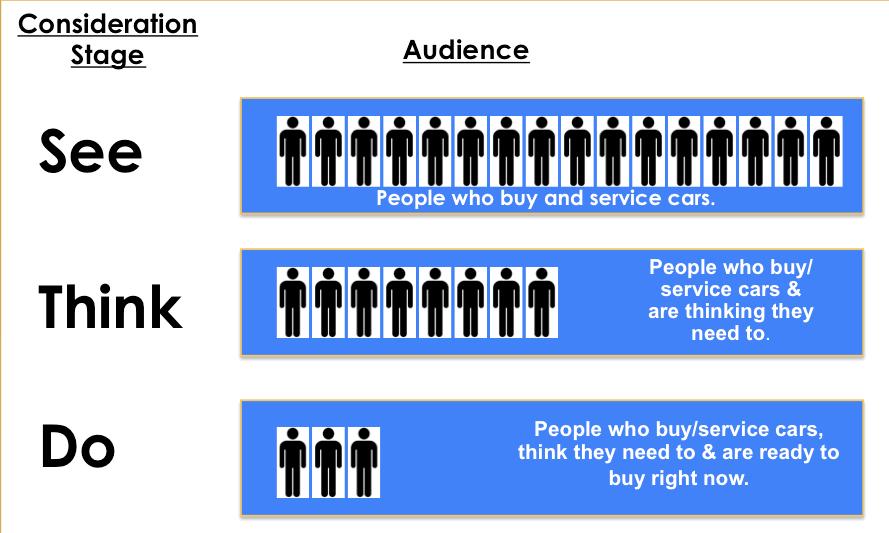
When you stop obsessing with the tools and focus your understanding and study on who you actually want to reach, any change that Facebook throws at you will become a non-starter. When you know your customer, no one and nothing can keep you from reaching them, where ever they happen to spend their time. Sure you might have to pay-to-play on Facebook but you’ll already know how to spend your budget.
There’s a second component to your success moving forward from these Facebook changes and it’s about you. For years now, I’ve been evangelizing that Facebook users like to stay on Facebook and your marketing should connect with them there. The best way to do that is to install Facebook landing pages to drive leads. This tactic still works but I no longer recommend it as the only solution.
Plant Seeds in Your Own Garden
Facebook pages come at a price. Yes, you have potential access to thousands of buyers and you can stay connected to current customers, but ultimately, Facebook controls how and even if you get access.
It’s smart to grow your flowers in your own garden. While you’re at the whims of Facebook when it comes to your content and engagement strategies, you have far more control over channels you own such as your website, blog or email list. Social Media channels can be used to syndicate that content and when changes come, you won’t be as affected.
For now, Facebook ads are still the best game in town. They do take skilled expertise but they are relatively cheap compared to Google ads. Staying with our See – Think – Do framework, marketers should use Facebook ads to:
- Drive “See” and “Think” Customers to your Blog. ”See” customers are at the top of the sales funnel. They’re looking for and connecting with relevant content. “Think” customers are in the middle of the funnel and are looking for more focused, brand-related content that will help them “think” through their purchase decisions.
- Drive “Do” Customers (prospects) to your website landing pages. “Do” customers are ready to take action and need very specific information like pricing and terms. Your landing pages should bring them further down the funnel and generate the lead.
Ironically, Facebook’s latest changes to further restrict the content that fans see may ultimately drive users away from Facebook. We’ll have to see how that shakes out. The whole idea was to attract more people to Facebook but if users start migrating away then Facebook will have to alter their strategies.
Facebook is still the mac-daddy for dealerships and other local businesses and it’s not going away anytime soon. They have a lot of opportunity ahead and so do you. Focus on your customers needs and plant seeds in your own garden. You’ll never have to worry about Facebook’s changes again!
Author information
Kathi Kruse is an Automotive Social Media Marketing Expert, Blogger, Speaker, Coach, Author and Founder of Kruse Control Inc. Born in the heart of Los Angeles to a family of “car people”, Kathi’s passion for the car business spans a 30-year career managing successful dealerships in Southern California. Kathi is the author of “Automotive Social Business – How to Captivate Your Customers, Sell More Cars & Be Generally Remarkable on Social Media”. Her Kruse Control Blog is the leading Automotive Social Media blog in the US.
The post Change Schmange: How to Never Worry about Facebook Changes Again! appeared first on Kruse Control Inc..