It’s clear that the more contact you have with customers and prospects, the easier it is to develop and sustain sales relationships and ultimately, close more sales. Unfortunately, you’re one of thousands who are vying for your customers’ attention.
If you’ve been around marketing for a while, you’ve probably heard of the Rule of 7.
The Marketing Rule of 7 states that a prospect needs to hear the advertiser’s message at least 7 times before they’ll take action to buy that product or service. It’s a marketing maxim developed by the movie industry in the 1930s. Studio bosses discovered that a certain amount of advertising and promotion was required to compel someone to see one of their movies.
Today, unless you have a clearly-defined marketing strategy that maps out how you’ll touch that prospect at least 7 times, you significantly reduce your odds of sales success. In fact, today you might need more than those 7 times just to be heard through all the clutter that’s in people’s newsfeeds or fields of vision. What you say in these messages matters. Will it be spam or some sales pitch? Not all touches are created equal.
Social Media affords you the opportunity to touch the customer often 7 times every day! You do that by sharing content and interacting with customers and prospects. You move some of them further down the sales funnel and because you’re using a medium that touches the customer regularly, that’s how Social Media beats other forms of marketing.
Social Media marketing takes thoughtful content strategy that’s implemented in an on-going process. If you do it right, 7 can still be the magic number. These messages are not like the ones you may be using now. These messages come in the form of useful content that delights your audience. They come from stories that create an emotional connection with your customer.
Buying decisions are shaped by two things: stories told and the memories they leave behind.
Storytellers make emotional connections. You can’t create an emotional connection with interruptive advertising. If you can tell stories about what it’s like to do business with you and enlist your happy, loyal customers in the process, now you’re on your way to “touching” that prospect 7 times.
How do you tell your story? All content must speak to your brand and the ideal customer you want to reach. There are many forms of content and many mediums with which to publish it:
- Images: Tell the story of what it’s like to do business with you.
- Videos: Customer interviews and “How To” videos get you a lot of visibility and establish influence.
- Blog Posts: Write about the answers to your customers most frequently asked questions, especially those that whose questions cause them to hesitate in their purchase decision. Incorporate and illustrate the expertise your employees possess.
Keep in mind that while great stories attract new customers, your awesome content keeps your current and repeat customers coming back for more. One of the most powerful outcomes of Social Media marketing is that those who have purchased from you before can tell your story too!
We talk more passionately about things we care about than things toward which we’re ambivalent. We listen more closely to people we care about than to people we don’t know. We’re talking and listening in unprecedented numbers, and our opinions and purchasing decisions are being affected and influenced even as we shop online or stand in the store aisle and weigh our options.
Tap into this awesome resource of Social Media and touch your customer during all the stages of the buying process. 7 may be your magic number and thousands of sales to happy, loyal customers can certainly become the new rule!
Author information
Kathi Kruse is an Automotive Social Media Marketing Expert, Blogger, Speaker, Coach, Author and Founder of Kruse Control Inc. Born in the heart of Los Angeles to a family of “car people”, Kathi’s passion for the car business spans a 30-year career managing successful dealerships in Southern California. Kathi is the author of “Automotive Social Business – How to Captivate Your Customers, Sell More Cars & Be Generally Remarkable on Social Media”. Her Kruse Control Blog is the leading Automotive Social Media blog in the US.
The post The Rule of 7: How Social Media Beats Other Forms of Marketing appeared first on Kruse Control Inc.
 Social Media is not free. Many people think it is because the platforms give you real estate to use as you wish. If you’re using social media for personal reasons, there’s very little financial investment needed. However, if you’re a business who wants to connect with customers and prospects, engage them in daily conversations and ultimately drive leads and sales, you need to allocate a portion of your budget to invest in Social Media marketing.
I wrote recently that investment in social media is now a necessity, not a luxury. Many dealers and other business owners are warming to this idea but stop short of pulling the trigger. Why the hesitancy? Because when you don’t have all the facts or your questions remain unanswered, you’re not likely to take action.
Even still, many business owners don’t believe that sales will increase with social media marketing. They just don’t buy that it’s effective at generating leads, and that’s okay. What I’m advocating for is Information. I’m asking you to investigate the possibilities with those you trust. Seek out expert information from thought leaders in your industry and then taking action will seem like the next best step.
Making a financial investment in social media will only come when you have all the facts you need. In an effort to help you decipher which financial investment you need or where you might be lacking, I’ve compiled a list of the 6 factors that require an investment in social media marketing.
If you’ve been a regular reader of mine, you know I’ve been advocating for 5 years that dealerships grow their own in-house marketing manager or department. I’ve managed car dealerships my entire life so I didn’t come to this stance without careful thought and consideration. Social and online marketing is now so advanced that you must seriously consider growing your own talent. Here are the places you’ll need to invest in Social Media marketing:
1. Coaching for your marketing manager. One-on-one coaching is ideal because it focuses solely on the specific components of your store’s unique brand and helps your marketing manager work smarter not harder. I’ve had many clients come to me with someone who has the potential to walk on water but just doesn’t know where the rocks are. A coach will set attainable goals and show you how the results are meeting those objectives. Coaching usually starts out weekly and then progresses to larger time intervals as the marketing manager becomes self-sufficient and successful. You’re able to “grow your own” and have better control over the outcome of your marketing campaigns.
Before you hire, utilize the expertise of a coach/consultant to help you with hiring the ideal person. It’s hard to know for sure what metrics you’ll use to measure their progress so you’ll certainly want to have a job description in place before you move forward.
2. Training your staff. Content is what drives social media success. Very few users are interested in hearing about what you have to sell. They want to be entertained and informed. Remember “WIIFM” (what’s in it for me) is the driver in everything we do. The content you post must be likable and/or sharable and training your employees is an integral component to achieving this.
The most likable and sharable content on a store’s Facebook page comes from the staff’s contributions. Employees should be trained on what to look for and how to recognize opportunities for content. Often, a weekly brainstorming session will happen between the marketing manager and the staff. This process is valuable not only for your marketing but for your online ratings. Every store must have an internal process for capturing those hundreds of happy, loyal customers’ opinions.
3. Tools and Apps. There are many great tools and apps that are free but once you start getting to the sweet spot in reaching your ideal customers, you’re going to need to invest in the more robust options. Why? Because you get what you pay for and you need the best analytics to do the best marketing. You’ll need content scheduling tools, landing page apps, social media monitoring (to measure your results), a WordPress website for your blog, and online reputation monitoring/management software.
4. Design work. Unless your marketing manager has been to design school or has a background designing online marketing materials, you’re going to need a designer. You need a seamless, consistent presence on all your chosen platforms including a profile pic, Facebook Timeline Cover, Twitter background and header and blog design, to name a few.
5. Advertising budget. Social media advertising is fast becoming the most valuable way to attract fans, followers, leads and sales. Facebook has spent its time and resources on gathering consumers’ preferences and created a very valuable ads platform for marketers. Being able to micro-target users is not only efficient but very cost-effective.
6. Social Media Marketing outsourced to a provider. If you choose to outsource, understand this: there is still a commitment needed from you and your staff to produce dealership-related content. Why? Because no one knows and communicates your store’s brand and local community like you do. That content is what sets you apart from the store down the street.
If you outsource, there will be charges for Social Media content management and charges for Social Media ads creation and monitoring.
In a dealership setting, outsourcing Social Media can cost you more money than doing it in-house and depending on the provider, can harm your brand. I’ve seen many dealerships getting burned by providers who post silly, irrelevant or benign content. I’ve seen some providers purchase Facebook Likes (which is against Facebook Terms of Service and really hurts your page when running ads). I’ve seen providers keep their clients in the dark about Social Media just to keep them from waking up to the reality that they can do it themselves with expert guidance and training.
If you don’t have the resources to do social media marketing in-house, a trusted well-proven provider can certainly get you the traction you need to communicate your brand online. It requires your commitment to collaborating on content and won’t succeed if you choose the “launch it and leave it” mindset. Never leave your online identity to someone else without constant monitoring and guidance.
Social Media is not free. However, investing wisely will help your store be remarkable online.
Author information
Kathi Kruse is an Automotive Social Media Marketing Expert, Blogger, Speaker, Coach, Author and Founder of Kruse Control Inc. Born in the heart of Los Angeles to a family of “car people”, Kathi’s passion for the car business spans a 30-year career managing successful dealerships in Southern California. Kathi is the author of “Automotive Social Business – How to Captivate Your Customers, Sell More Cars & Be Generally Remarkable on Social Media”. Her Kruse Control Blog is the leading Automotive Social Media blog in the US.
The post 6 Factors of Social Media Marketing that Call for Financial Investment appeared first on Kruse Control Inc.
 I love the first part of the new year. It feels like a reboot, a chance to shift things and redefine your goals, personally and professionally. In marketing your business for 2014, that means aligning your objectives and designing a strategy that ultimately generates traffic, leads and sales. Unless you’ve been hiding under a rock, social media has taken its well-deserved place as one of the crucial components of your marketing plan.
Investing time and resources into a social media and content strategy was something I definitely recommended before this new year, but now that we’re into 2014, the tipping point from “should have” to “must have” has happened and you no longer have the luxury of waiting to see what everyone else is doing.
Many businesses have come to terms with integrating their social media efforts within their organization and those who have see the impact of social media on referral traffic and revenue. We’re seeing a move away from assigning social media tasks to existing employees and replacing that ineffective strategy with the hiring of a social media strategist or a full-time marketing manager.
Social Media has very real and measurable benefits. There’s no longer the argument that it’s a fad or a waste of time. If you’re not seeing results, you’re doing it wrong. Many dealers I see do not invest the time, effort or budget required to succeed and then sit back and say, “Social media doesn’t work.”
Why Invest in Social Media?
The benefits of social media are many. Here are a few of my experiences over the last 5 years:
- Increased brand awareness
- Gives your business an organic, human feel
- Differentiates your business from thousands of others
- Allows you to tune in to what’s being said about your business
- Facilitates word-of-mouth marketing
- Gives you a medium through which to communicate with your customers & prospects
- Increases customer loyalty
- Builds consumer trust
- Engages the customer long before they’re in the market to buy
- Develops warmer leads
Where to Invest in Social Media
When you’ve made the decision to invest in social media, it’s difficult to know where to devote your efforts. To find out, you must first ask yourself this question:
Where does my ideal customer spend their time?
Social is a very new medium and it’s best to work with a content strategy coach first to help you identify where your customer spends their time and how you should ultimately approach them with content. For dealerships, Facebook is the clear first choice simply because it’s the mac daddy of all the platforms. Once your content strategy is in place, then you can venture out into other networks like Twitter, YouTube, Instagram and certainly your Blog.
What to Invest in Social Media
Many people think social media is free. Of course the real estate is, it’s designed that way. They want users to spend time there so their likes and dislikes can be tracked. In the case of Facebook, this gathering of consumers’ preferences has created very valuable ads platform for marketers. Being able to micro-target users is not only efficient but very cost-effective.
These are the areas where you’ll need a financial investment for social media:
- Coaching for marketing manager
- Training of staff
- Apps
- Design work
- Advertising budget
Investment in Social Media is a Necessity, Not a Luxury
Do you really want your competitor to have the upper hand? The migration to online marketing has been happening for some time now and social is where you need to commit your time and resources. What are you waiting for? Invest in social media and get your business on track for 2014.
Author information
Kathi Kruse is an Automotive Social Media Marketing Expert, Blogger, Speaker, Coach, Author and Founder of Kruse Control Inc. Born in the heart of Los Angeles to a family of “car people”, Kathi’s passion for the car business spans a 30-year career managing successful dealerships in Southern California. Kathi is the author of “Automotive Social Business – How to Captivate Your Customers, Sell More Cars & Be Generally Remarkable on Social Media”. Her Kruse Control Blog is the leading Automotive Social Media blog in the US.
The post Social Media 2014: Investment is a Necessity, Not a Luxury appeared first on Kruse Control Inc..
 By now you may have heard that Facebook changed the algorithm that determines which “stories” show up in the News Feed. Some users are seeing posts from brands drop by as much as 88%.
Facebook changes happen regularly (especially in the last few months) and I don’t know about you but I like to have a little more control over how my business speaks to its customers. Facebook changes always cause a stir but this latest algorithm change has pushed some people off the cliff.
Here’s a surprise: Facebook would like to make more money. To do that, they’re restricting the content your fans see in their Newsfeed. How do you get your fans to see more of your content? You pay Facebook for the privilege.
On a certain level, I see their point. Facebook began as a platform for people to connect easily and regularly with their friends and family. Soon they figured out that brands would like to connect with those people easily and regularly so Business Pages were born. Now that they’ve gone public, Facebook has a new beast to feed: shareholders. They’ve built quite an amazing platform with some really valuable information that every business can derive value from. If you’re Facebook, why not change things up and increase revenue every way you can?
What drew businesses to Facebook in the first place was the perception that it was free. The idea of reaching millions of fans at practically no cost was just too good to pass up. Since traditional media was faltering and brands were seeing less and less results from their advertising, the consensus was, “Why not jump in, it’s free.” That idea of “free media” was only a myth because it does take time, a budget and skill to succeed on Facebook.
With these latest Facebook changes, we’ve all been slapped back to reality and the stakes just got a whole lot higher. How can your business weather this latest storm and be prepared for the next changes to come down the pike?
Don’t focus on understanding the tools. Focus on understanding the people using the tools.
Olivier Blanchard, author of “Social Media ROI”, puts it this way: Social media marketers need to become less concerned about how to influence Facebook algorithms and more concerned about how to influence people, their client’s audience and target market. Companies forgot to look at how social channels could help them do all sorts of things that went beyond push marketing and messaging to their would-be customers.
You may remember a post I did a few months ago on how your marketing content needs to attract and engage at each customer’s purchase consideration stage. It’s the See – Think – Do Marketing Framework. When you adopt this framework as part of your strategy, you become focused on your customer not on the tools:
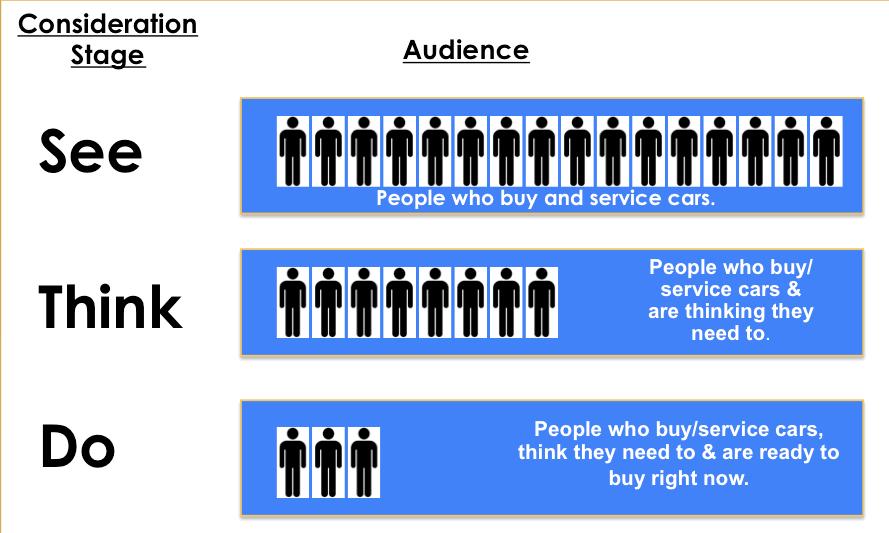
When you stop obsessing with the tools and focus your understanding and study on who you actually want to reach, any change that Facebook throws at you will become a non-starter. When you know your customer, no one and nothing can keep you from reaching them, where ever they happen to spend their time. Sure you might have to pay-to-play on Facebook but you’ll already know how to spend your budget.
There’s a second component to your success moving forward from these Facebook changes and it’s about you. For years now, I’ve been evangelizing that Facebook users like to stay on Facebook and your marketing should connect with them there. The best way to do that is to install Facebook landing pages to drive leads. This tactic still works but I no longer recommend it as the only solution.
Plant Seeds in Your Own Garden
Facebook pages come at a price. Yes, you have potential access to thousands of buyers and you can stay connected to current customers, but ultimately, Facebook controls how and even if you get access.
It’s smart to grow your flowers in your own garden. While you’re at the whims of Facebook when it comes to your content and engagement strategies, you have far more control over channels you own such as your website, blog or email list. Social Media channels can be used to syndicate that content and when changes come, you won’t be as affected.
For now, Facebook ads are still the best game in town. They do take skilled expertise but they are relatively cheap compared to Google ads. Staying with our See – Think – Do framework, marketers should use Facebook ads to:
- Drive “See” and “Think” Customers to your Blog. ”See” customers are at the top of the sales funnel. They’re looking for and connecting with relevant content. “Think” customers are in the middle of the funnel and are looking for more focused, brand-related content that will help them “think” through their purchase decisions.
- Drive “Do” Customers (prospects) to your website landing pages. “Do” customers are ready to take action and need very specific information like pricing and terms. Your landing pages should bring them further down the funnel and generate the lead.
Ironically, Facebook’s latest changes to further restrict the content that fans see may ultimately drive users away from Facebook. We’ll have to see how that shakes out. The whole idea was to attract more people to Facebook but if users start migrating away then Facebook will have to alter their strategies.
Facebook is still the mac-daddy for dealerships and other local businesses and it’s not going away anytime soon. They have a lot of opportunity ahead and so do you. Focus on your customers needs and plant seeds in your own garden. You’ll never have to worry about Facebook’s changes again!
Author information
Kathi Kruse is an Automotive Social Media Marketing Expert, Blogger, Speaker, Coach, Author and Founder of Kruse Control Inc. Born in the heart of Los Angeles to a family of “car people”, Kathi’s passion for the car business spans a 30-year career managing successful dealerships in Southern California. Kathi is the author of “Automotive Social Business – How to Captivate Your Customers, Sell More Cars & Be Generally Remarkable on Social Media”. Her Kruse Control Blog is the leading Automotive Social Media blog in the US.
The post Change Schmange: How to Never Worry about Facebook Changes Again! appeared first on Kruse Control Inc..
 “Social Media doesn’t fix anything. I just amplifies things. If your restaurant sucks, it just sucks harder on Social Media. It doesn’t make your chicken fingers taste better or your beer taste bolder. Social Media is not a good place to go if you’re terrible at what you do.” ~Scott Stratten @Unmarketing
How awesome is it to do business with you? Customer experience is one of the single most talked about subjects on Social Media. People love to spread the word to their friends and family about their buying experiences. They love to tell stories of Social Media failures. The negatives get a lot of airtime, just like in real life. The positives have to be spotlighted, nurtured and yes, even called upon when the time is right.
70% of buying experiences are based on how the customer feels he or she is being treated. (Source: McKinsey)
For years I’ve heard dealers and other businesses complain about Social Media (heck, they’re still complaining). At the root of these complaints is the concept of change and the fear that goes along with it. Sure it’s scary, especially if your company culture isn’t ready for prime time. But folks, we’ve had several years to be ready for this. Fear is certainly normal if you’re contemplating change and you know now that information will alleviate that fear. The more you know, the easier it is to take action.
But for those who haven’t explored the tenants of social media, it’s uber-important to know that whatever you’re doing right now will be amplified. How long has it been since you put yourself in your customer’s shoes? Staying stuck or ignoring what’s happening around your business can be hazardous to its health!
If your customer experience sucks, social media works against you.
I speak to groups of dealers regularly, many with high marks in CSI (Customer Satisfaction Index). This old model of surveying customers and the results published only to dealers and their manufacturer has lost its sheen. Today, prospects and customers can find out information about your business in a matter of a few clicks. They trust “people like them” much more than some report published once a year.
The danger in maintaining that 1990s attitude.
Assuming customers are loyal for loyalty’s sake is a good way to destroy the experience. Just ask Kodak or Borders. Ignoring the reality of today’s marketplace is ignoring what your customers really want. If your customers HAVE BEEN loyal, it doesn’t mean they WILL BE. Treat them as you’d want to treated. Don’t assume they’ll be there tomorrow with the status quo of today.
You’ve been a customer elsewhere, right? What keeps you coming back? It’s how you were treated and the experience you had.
Before you venture out into the world of Social Media marketing (or if you’re there and aren’t getting results) take a hard look at what it’s like to do business with you. Spend some time defining your vision to your employees because they drive your customer experience.
Customers regularly use social channels to research their next purchase. Make sure what your customers say is a true picture of what it’s like to do business with you. And of course, fix it if you don’t like what you see.
Author information
Kathi Kruse is an Automotive Social Media Marketing Expert, Blogger, Speaker, Coach, Author and Founder of Kruse Control Inc. Born in the heart of Los Angeles to a family of “car people”, Kathi’s passion for the car business spans a 30-year career managing successful dealerships in Southern California. Kathi is the author of “Automotive Social Business – How to Captivate Your Customers, Sell More Cars & Be Generally Remarkable on Social Media”. Her Kruse Control Blog is the leading Automotive Social Media blog in the US.
The post Be Extraordinary in Business or Social Media Works Against You appeared first on Kruse Control Inc..
 Unless you’ve been hiding under a rock lately, you know that Facebook has been diligently working on ways to improve the newsfeed. To keep the newsfeed relevant, Facebook tweaks its algorithms regularly to keep more people on Facebook. They’ve shifted it so that promoted content is getting greater visibility. Facebook is getting serious about revenue and it’s time you should too.
One of the actions Facebook has taken is to address the growing number of users who are liking more and more business pages. Every 60 seconds on Facebook: 510 comments are posted, 293,000 statuses are updated, and 136,000 photos are uploaded. As a user’s likes increase, that means more content in their newsfeed. The problem then for Facebook is how to decipher exactly what content is the MOST relevant for that user. It’s clearly now the content that businesses pay for to get seen.
As the newsfeed gets more and more crowded, it only goes to figure that Facebook charge for that prime real estate. What this means for businesses is that the Facebook free lunch is over.
It should be! How much longer did people think they could get by with using Facebook as a squatter? They’ve had many years to recognize the value and start utilizing Facebook and other social media to reach customers and prospects.
Those that have waited on the sidelines are kicking themselves. Yesterday’s free tactics to build your page and your community now cost money, just like all other forms of marketing. Now that it’s going to cost you to do what you used to be able to do for free, it’s time to get serious about your Facebook marketing results.
When you talk about visibility and exposure on Facebook, there are two kinds reach: Organic and Paid. Facebook made this announcement recently:
“We expect organic distribution of an individual page’s posts to gradually decline over time as we continually work to make sure people have a meaningful experience on the site.”
Many saw this and said, “Organic reach is dead.” During the week of that announcement, pages saw a significant drop in Organic reach: an average of 44%. We saw this with many clients, although some had a less significant drop. Facebook had announced previously that pages’ Organic reach on average was 16%. Since this latest announcement however we’ve seen pages Organic reach go as low as 3%.
Is Organic reach really dead? No, but you’d be smart to look much closer at what you’re doing on social media, how it’s paying off and reallocate some budget for Facebook ads.
What does this mean for 2014? It means that you must continue to refine your content strategy, publish relevant content and pay closer attention to your mix of organic and paid promotion. If you’re not utilizing Facebook ads, it’s time to start. If you are and maybe you’re not seeing the results you expected, here are 3 important factors that lead to success with Facebook ads:
1. Size of your audience
Facebook ads can increase in cost as you increase your fan base. Promoted posts from pages with 300 fans cost significantly less than pages with 3,000 or 30,000. You’ll want to budget for ad spend depending on your goals and the size of your pages’ audience:
- New page: weight your spend more toward growing your audience
- Established page: weight your spend toward increased engagement and specific campaigns.
Make sure you target people within your market area. These are the people most likely to buy from you.
You’ll want to track your cost per acquisition (CPA). Fan acquisition can be anywhere from $10+ down to 19 cents or below. Keeping this cost down takes serious expertise so be prepared to seek help if you’re new or you’re spending a lot and not seeing results.
2. How likable your industry or business is in general
I volunteer at a horse rescue and part of my promise to them is running their Facebook page. After spending the bulk of my time with car dealership social marketing, I must say it is significantly easier to build fans and develop a community when you’re talking about saving horses from inhumane treatment.
I don’t have to tell you that car dealerships have an extra layer of difficulty raising positive awareness around their store and compelling those that are connected to stay engaged. However, it’s totally possible to have a vibrant dealership Facebook page to reflect the fun, inviting culture of your business (provided it’s that way in real life).
Facebook ads are vital when you have a business that isn’t particularly likable. Tap into the platform to get the word out about how awesome it is to do business with you!
3. The quality of your ad creative
You never get a second chance to create a good first impression. Creative ads make people look twice.
Facebook ad creativity is where a lot of businesses fall short. Working with a content strategy coach helps. Make sure you have these components worked out:
- Engaging image
- Compelling text with a call-to-action
- Targeted audience
- Ad placement
Again, the more creative you are with these principles, the better your results. The more you refine your creative the more cost effective your ads will be. Don’t be afraid of asking for help from an expert. I’ve had many clients who’ve never created an ad before get great results.
With Organic reach shifting, explore the Facebook ads platform for your business. Be prepared for every change that Facebook (and other social networks) throws at you. When you’ve got a solid content strategy and a clear paid promotion plan, you won’t have to suffer every time Facebook changes something else.
Author information
Kathi Kruse is an Automotive Social Media Marketing Expert, Blogger, Speaker, Coach, Author and Founder of Kruse Control Inc. Born in the heart of Los Angeles to a family of “car people”, Kathi’s passion for the car business spans a 30-year career managing successful dealerships in Southern California. Kathi is the author of “Automotive Social Business – How to Captivate Your Customers, Sell More Cars & Be Generally Remarkable on Social Media”. Her Kruse Control Blog is the leading Automotive Social Media blog in the US.
The post Facebook Ads Success Depends on These 3 Important Factors appeared first on Kruse Control Inc.
 Change is difficult. Not changing is fatal.
Let’s face it: Social Media marketing is hard. Adapting to it is one of the biggest challenges your business will ever face. I’m seeing lots of businesses investing time and energy in platforms to get likes and followers and not really being social at all. Many find success in social media marketing elusive. It doesn’t have to be.
We’re clocking in at 10+ years since the beginning of the Social era. There’s been a lot of brilliant people writing, speaking and sharing case studies about its value. In 2014, your best solution will be to seek out the best expert in the industry and execute the content strategy they prescribe specifically for your store.
If you’re a beginner, it’s important to stay grounded and not get overwhelmed. Start with one platform. Choose the place where your customers/prospects most likely spend their time everyday. For most businesses that sell to consumers, that’s Facebook. Once you’ve mastered the strategies for Facebook content, you can use those tactics to structure your content on the other platforms.
When you’re new, it’s hard to know how to succeed in social media marketing. To help you, I cover three platforms here that are most certainly the solid foundation you need to get started. Social Media is ridiculously hard to do well. It doesn’t have to be if you get the right information from a trusted resource and you follow these steps for beginners.
Facebook. The world’s largest marketplace.
These 7 elements are your roadmap and they’re very handy when designing content on other platforms as well:
1. Clear Objectives. Set realistic goals. It isn’t enough to say you “see” results. Measurement is about more than just results. It must tie back to your objectives. You’ll never know your ROI without first setting objectives.
2. Great Design. Visual content has a lasting effect on all of us humans. Whether it’s your Timeline Cover, status updates, landing pages or Facebook ads, what the audience sees is what they’ll remember. Make sure it’s compelling and gets the point across.
3. Solid Content Strategy. When you’re new, it’s hard to know what to post on your page. If you work with an expert content strategist, you’ll be guided through a “brand discovery” process. What is it about your store that makes you unique, that makes people want to buy from you? Answer that question in detail. Then, describe your customer: what are their interests, what are they passionate about, what problems can you solve, how can you help them buy? You can’t always be awesome but you certainly can be useful.
4. Promotion Strategy. You need a defined strategy to promote your page and continually grow your fan base. The best way is Facebook Ads. A small budget ($300-500/month) with carefully-selected photos and ad copy will grow likes for your page.
5. Engagement Strategy. You need a plan to engage your fans and build relationships. I recommend designating one person internally to listen, respond, ask questions and engage with your audience. People want to hear from you. If you’re posting content without any conversation, it’s just noise.
6. Conversion Strategy. Once you’re growing likes and engaging them, you need a strategy on how to convert those likes into leads. This more advanced form of Facebook marketing utilizes Facebook ads and campaign-specific landing pages. Done right, conversions happen. However, I’ve found most dealerships and other businesses need advice and support. Find the right person to advise you and train your people so you get where you want to go faster and more efficiently with the lightest burden on your marketing budget.
7. Measure & Analyze. You can’t manage what you don’t measure. In marketing, we launch our campaigns with what amounts to be our “best educated guess” at what people will respond to. The only way to know for sure if your efforts are successful is to look at your numbers. Daily.
Twitter: One big conversation made up of billions of smaller conversations that can turn into leads.
1. Create your profile. Optimize your bio. Brand your header and background. Take advantage of the real estate that Twitter gives you. Make sure you stay consistent with your brand’s visual message.
2. Follow your thought leaders. When you’re new to Twitter, it helps to follow people who’ve been there a while and then emulate their actions. In this knowledge-based, sharing economy, we’re all able to learn from each other and support each others’ success.
3. Follow your customers/prospects. Use the tools available like Refollow.com, TweetAdder and Twitter Advanced Search to locate your customers on Twitter. Follow them and if they don’t follow you back within a few days, unfollow them. It’s about attracting those that are most likely to buy from you, not every person on the planet.
4. Connect with others by sharing awesome content. The more you talk about yourself, the less people want to follow you. The goal in social media is to get others to talk about you. Leverage the content strategy you designed for your Facebook page. People only share and interact with awesome and useful content. Think about what’s relevant to them and do your best to give it to ‘em.
Your Blog: Exhibits your business as a trusted resource and totally gets you found.
1. Start with a solid framework. I suggest WordPress (self-hosted). WordPress provides great SEO right out of the box, it allows you to easily update your content, and there are literally limitless customization options.
2. Commit to posting at least once a week. Be consistent. Be awesome. Get traction by asking your front line personnel to give you their 3 top customer FAQs. Answer each one of those FAQs with a blog post.
3. Write what you’re passionate about. This is where leveraging your staff’s expertise can really come in handy. You may already have a blogger as an employee! Capitalize on your team members’ passions. Share interesting stories mixed with super-helpful tips.
4. Make sure you’re seen. Syndicate your blog posts on social media, email newsletters and your website.
Follow these tips on how to succeed in social media marketing in 2014. You’ll tap into this great opportunity and get traction in the social economy.
Author information
Kathi Kruse is an Automotive Social Media Marketing Expert, Blogger, Speaker, Coach, Author and Founder of Kruse Control Inc. Born in the heart of Los Angeles to a family of “car people”, Kathi’s passion for the car business spans a 30-year career managing successful dealerships in Southern California. Kathi is the author of “Automotive Social Business – How to Captivate Your Customers, Sell More Cars & Be Generally Remarkable on Social Media”. Her Kruse Control Blog is the leading Automotive Social Media blog in the US.
The post How to Succeed in 2014 If You’re New to Social Media appeared first on Kruse Control Inc..