Online reviews are now an integral part of the purchase journey as consumers seek out opinions from “someone like me.” 88% of consumers trust online reviews as much as personal recommendations. But getting online reviews is not a simple task. The number one criticism I hear from business owners and managers is how difficult it […]
The post Do’s and Don’ts for Getting Online Reviews appeared first on Kruse Control Inc.
Everybody wants to be in shape. Whether it’s your business or your body, achieving good health isn’t always easy. When it comes to answering your customers’ questions, solving their concerns and converting sales, your blog is a key component to a healthy regimen. A great blog post has many moving parts and it’s your decision […]
The post Anatomy of a Great Blog Post: Are You in Good Shape? appeared first on Kruse Control Inc.
Every business owner wants to see glowing online reviews and comments about their organization. It’s natural for us to only want the positives pointed out in public. When negative online reviews happen, your first reaction is to retaliate, blame, and/or deny they exist. But what if you started looking at your negative online reviews with […]
The post Negative Online Reviews: 3 Positive Ways They Affect Your Business appeared first on Kruse Control Inc.
“The secret of getting ahead is getting started.” ~Mark Twain A business blog is essential in today’s online marketing climate. Customers are looking for reliable information to support their purchase decisions and you need to be there answering questions (just as you would via phone, email or in person). Even with all the talk and […]
The post Blog Basics: How to Start a Business Blog appeared first on Kruse Control Inc.
When you venture out into the world of Facebook advertising, are you focused on the right strategy? Even if you’re an ace at analyzing and you’re happy with your results, there’s a big, huge component that gets missed a lot. Making this simple but colossal mistake in your Facebook ads strategy will cost you. Avoiding it […]
The post Don’t Make This Huge Mistake with Your Facebook Ads Strategy appeared first on Kruse Control Inc.
 We communicate with customers much more online today and it’s important to devote attention to who in your organization is best equipped to handle your most valued assets…your customers and prospects. Marketing, sales, and online reputation management have blurred lines between them and Social Media managers are morphing into Customer Experience managers.
Who exactly is the best person to speak for your brand online? After all, their job duties encompass so many different aspects of visibility in your customers’ purchase journey.
Customer Experience is the sum of all experiences customers have with you and they include a person’s behaviors, attitudes and emotions toward your brand. It takes some savvy maneuvers to navigate all your online properties and it’s not a job that just anyone can handle.
It may surprise you to know that many businesses haven’t put much thought into this position. Some haven’t even designated someone to manage all of the components of their online marketing, thereby leaving their online presence and reputation vulnerable.
“Everyone’s job” can mean “No one’s job.”
Don’t fall into the trap of thinking that your online reputation is “just fine” without your attention. Don’t convince yourself there’s no need to go to the expense or trouble of making sure the conversations about your brand are legit, informed and a mirror of the excellent customer experience you deliver in real life. It’s a dangerous mindset that can translate to lost sales.
Once you’ve decided that someone should be overseeing your online assets, it’s mega important to know what types of skills they should possess before you make a decision on who will be in charge of your online reputation.
What are the characteristics and skills that are required in a Customer Experience Manager?
1. Social Media Savvy
She/He should be a regular user of social media personally and should be savvy in the social environment. They should also be able to tell a story. If they have a blog or write for online media, that’s a great way to observe their skills.
2. Branding and Marketing Experience
Social media is equal parts marketing, branding, sales, PR and crisis management and data analysis. I can’t tell you how many employees I meet who’ve been put in charge of the store’s social profiles and online reputation that have ZERO branding and marketing experience.
Social media is simply a channel(s) with which to engage your customers and prospects and deliver key messages that are relevant to their needs, concerns and challenges. Experience is evident in your message and results.
3. Ability to Recognize Leads
Social media and online review sites are places where people share their experiences and opinions. Often during those conversations, questions will arise. As a savvy Customer Experience Manager, their job is to recognize those opportunities as leads and treat them as though the person was physically in front of them.
Prospects ask questions. Answer their question then pose another that will help them think through their decision and lead them to the sale. These are the tenets of consultative sales but to the buyer, it’s advocacy.
4. Emotional Maturity
Your Customer Experience Manager must have the ability to maintain perspective and above all, not take things personally.
5. Empathy and Patience
The act of putting yourself in your customers’ shoes helps a great deal with understanding their needs and addressing them accordingly. Patience goes a long way when responding to negative reviews.
6. Clear, Concise, Professional
Messages from your brand are representative of the experience a buyer can expect. Reviews are examined to further a buyer’s knowledge. Poorly written responses or robot-sounding corporate speak are not going to help you. In fact, they can damage any goodwill you’ve earned because it looks like you don’t care.
7. Industry Experience a Plus
While it’s an added bonus that your candidate has experience in your industry, it’s not a requirement. An overview of operations and an immersive trek into company culture will go far. With a high empathy quotient, she/he will quickly get up to speed on how the industry works.
8. Able to Resolve – Not Inflame
The ability to balance a timely response with a reasoned response fosters resolution. Inflammatory remarks and behavior don’t do anyone any good. Remember, your candidate may often times be working on their own without supervision, so conflict resolution should be their ultimate goal.
Last but not least, they MUST have authority. When you empower a Customer Experience Manager they take responsibility and become accountable to see every issue through to the end. With authority, they can escalate an issue, follow-through with the players involved and respond to the customer in a timely, respectful manner.
Your Customer Experience Manager speaks for your brand. Develop and implement an action plan to manage your online reputation and secure it all by choosing the right person, with the right skills, to maintain it.
The post 8 Characteristics of a Top-Notch Customer Experience Manager appeared first on Kruse Control Inc.
 Are you one of the many business owners or managers who find it difficult to manage online reputation? There are literally hundreds of places where your customers can go to share their opinions. While the specific sites and services will continue to evolve over time, there will always be a need for solid strategies to grow, improve and sustain a business’ online reputation.
Although each review site is unique, there are some basic actions you can take to leverage each to its full potential. Google+Local, Yelp, and others can be difficult to navigate, especially if you’re not a regular user.
Let’s start with 7 basic steps to get traction. You never know who far you can go and these will get you on the right path.
Be Wherever Your Customers Look For You
Managing your online reputation is part marketing, part sales, and part public relations. In today’s online marketing environment, we have the ability to laser target those buyers who will most likely buy from us (instead of blanketing the land with meaningless messages like we used to). This undertaking may save us in advertising expense but the spend makes up for it in manpower.
You must identify where your customers spend their time. Metro areas have similarities to and differences from rural, less-populated areas. Knowing the characteristics of your target customers is vital to your business online reputation management process.
Recognize Your Reputation is Online – Whether You’re Participating or Not
There are conversations going on right now about your store. Denying that is dangerous. You need to participate in those conversations (or your competitor will). Start by observing how your customers talk about you. Develop an action plan to monitor things and then begin engaging in those conversations.
Take Advantage of Free Real Estate
Review sites’ business models are built on the premise that users will spend time there writing reviews, engaging their network and sharing other content. Review sites serve ads to users while they’re there.
For businesses, creating and maintaining a powerful profile that holds lots of good information and special offers is mostly free. Utilize the space by completing your profile including added photos and video. This gives people more insight into your business and a reason to buy from you.
Designate One Person to Monitor, Listen, Respond, and Recognize Opportunities
“Everybody’s job” can mean “No one’s job.” Don’t fall into the trap of assuming someone has your back. Assign one person to be the kingpin. Depending on the size of your business, you may want to create a team of managers to support the person you select.
Ensure Your Culture is Ready for Prime Time
A secure house is built on a strong foundation.
Today’s customer is connecting with brands they identify with. They’re looking for authenticity and transparency. If you promise one experience but deliver something else, trust begins to erode and you miss the chance for make them a customer.
Is your business culture ready for the spotlight?
Be Proactive About Asking for “Feedback”
Anyway you slice it, you’re leaving your business online reputation up to chance if you’re not proactively asking for opinions and feedback (aka: reviews).
Develop an action plan for obtaining the opinions of your happy, loyal customers:
- Email “love drip” requesting feedback from your current and repeat customers
- Incorporate scripts into your sales process
- Invite and gather customer testimonials
Respond to Every Review
Cars.com states that of their 800,000 dealership reviews, only 30% have been responded to. That means there’s a lot of room for improvement. There are specific tactics to take with different types of reviews: 1-2 stars, 3 stars and 4-5 stars. Each type requires a thoughtful, deliberate response.
I see many businesses not bothering to respond to ANY reviews they’ve received. This is like someone giving you a compliment and you walking away without saying anything. It’s like someone calling you out for a mistake and you cowering waiting for the storm to blow over.
Take the time to respond to every review.
Building, sustaining and improving a business online reputation is not difficult unless you choose to make it that way. Even if resources are in short supply, there are things you can do to mitigate catastrophes.
Set business online reputation goals for yourself and your staff. Keep the momentum going by tracking your results. You’d be surprised how great things will go once everyone’s engaged. The conversation is happening with or without you.
The post 7 Basic Steps to Optimize Your Business Online Reputation appeared first on Kruse Control Inc.
 How do we foster and sustain customer loyalty in a world of untrustworthy messages coming at our customers like a fire hose? Loyalty is a customers’ intention to continue doing business with you, to perhaps increase their spending, and to say good things (or refrain from saying bad things) about it to their friends and family. Social Media plays a big role in customer loyalty by helping your business welcome new customers and retain current ones.
I’m a pretty loyal customer myself and I’m always on the lookout for ways that businesses either succeed or fail to gain my loyalty. I was visiting an exclusive high-end mall the other day. It’s not a place I go often but it’s where the yoga clothing store is so I was forced to go (really, not really).
This mall is outdoors in beautiful Newport Beach, CA. Hundreds of people/families go there daily to enjoy the sunshine and often bring their dogs with them. If you’re an animal lover like me, it’s fun to watch all the different kinds of doggies interact with each other and have fun. In fact, the mall is considered a destination for people and their pets. Some of the stores even accommodate customers’ pets by providing water bowls and treats (a great loyalty tactic, by the way).
While walking on my way to the yoga store, I just happened to notice a sign embedded in a big grassy area. There were quite a few of the same signs placed strategically and it was obvious the mall wanted to make sure people saw the signs.

 The surrounding areas are all concrete. So, I was asking myself, why wouldn’t they let people’s dogs use the grassy area? If you’re there with your dog shopping and he or she needs to do as nature intended, where would you go?
I left wondering how that decision was made. Why wouldn’t you want your customers to feel welcome? Why make it harder for them and their animals when visiting your store? Sure, it might take a little extra gardening support but isn’t it worth it?
Because of how my mind works, I couldn’t help but apply the customer loyalty lesson from this absurd decision to the online storefront experience and especially the welcome vibe available through Social Media engagement.
How do you welcome customers? It doesn’t have to be complicated. Think about the things that make you feel welcome and appreciated. Put yourself in your customers’ shoes and make every attempt to give them what they need to feel comfortable during the purchase journey. You probably already do this in real life. Now it’s just a matter of remaining customer first in the digital age.
How to provide a great Social Media habitat to ease the buying process and foster customer loyalty:
Give them a reason to visit.
The sunshine is a great draw at the Newport Beach mall. What kind of digital sunshine can you spread with Social Media content?
- Information: Things that feed their knowledge.
- Inspirational: Things that fuel their fire.
- Entertaining: Things that make them smile.
Show how other customers feel welcome and appreciated.
- Customer testimonial or short interviews
- Customer Loyalty programs in action
- Customer Experience in action
Know where your customer is looking and when they’re listening.
People are going to hear about your company and it’s your job to know where they’ll look to learn more. Don’t discount social channels as part of that process.
Make the customer feel special.
Social Customer Service is a game-changer. People want to feel like they truly know the company they’re purchasing from and many brands thrive on social media because customers can interact with them when they wish.
Social Customer Service lets your customer know they are heard and appreciated.
Make sure your customer’s online experience mirrors their offline experience.
I must see 2-3 Facebook, Twitter and Instagram accounts everyday where they’re either a ghost town or they’re the equivalent of a billboard. Those scenarios do not instill a welcome feeling. They’re just like the mall’s sign to keep off the grass.
Customer loyalty must be a process within your business, including customer and employee retention. It’s the attention to detail and little things that matter…which can turn out to be big things in customer’s eyes.
The post Lock-in Customer Loyalty: Cultivate a Great Social Media Habitat appeared first on Kruse Control Inc.
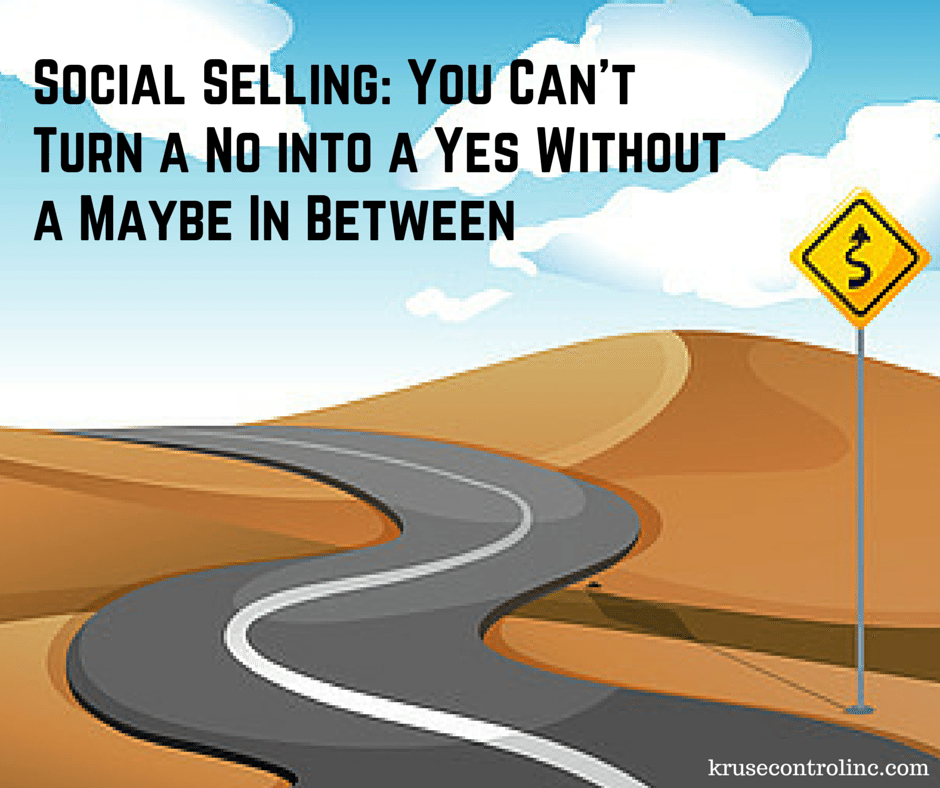 The path to the sale has many twists and turns. It’s not always easy to determine where and when you can provide the most value to your target customers along that road. Social Selling, as part of your overall sales process, helps identify where those twists and turns occur and where sales are in danger of going of the cliff.
“You can’t turn a no into a yes without a maybe in between.”
~Frank Underwood, President of the United States,
House of Cards
Like a lot of people (perhaps you, too), I’ve been watching House of Cards on Netflix. I’m riveted by the stories told and the strategies Frank Underwood comes up with to get what he wants. Even though he’s a dastardly and immoral character, you have to give him a star for his skill in coming out on top. Kevin Spacey plays him masterfully.
When I heard Frank utter the above quote, I was struck by how true it is, especially when it comes to commerce. In this world of consumer mistrust, the road to the sale often starts with “no.” That “no” may just be because they’ve never heard of you before and know nothing about what it’s like to do business with you.
The “no” may also be due to a poor customer experience they’ve had or that they’ve heard about via social media.
Reviving or repairing a brand’s image in the eyes of the consumer takes skill and effort. Getting from a no to a yes can seem like a long journey. The “maybe” in between is where Social Selling thrives.
Where Social Selling succeeds is in the support of the consumer purchase journey: in between the no and the yes.
By delivering quality content that can influence opinions, you and your sales team become the influence agents – the likable experts.
One of the greatest advantages with Social Selling is your ability to leverage content marketing to reach the right customer, with the right message, at the right time. Quality content gets you from no to yes:
- Information: Things that feed their knowledge.
- Inspirational: Things that fuel their fire.
- Entertaining: Things that make them smile.
Expert Social Selling content can take a target customer who knows nothing about you or your business and put you on their radar. Social Selling engagement chaperons the lead and converts them to a sale.
But what if you’re already on their radar and they’ve heard negative things or had a poor experience? Here’s where it gets perhaps more difficult but can also be very rewarding.
Thankfully, with Social Selling strategies and tactics embedded in your process, and salespeople who have solid relationships with customers, these situations occur less and less. However, they still happen.
One of the most gratifying events is to take a customer from loathing you to loving you.
“There’s no better way to overpower a trickle of doubt than with a flood of naked truth.” ~Frank Underwood
Never underestimate the power of redemption. Thoughtful transparency CAN win a customer back. Use a little Frank Underwood-style finesse:
- Be humble
- Admit the error
- Authentically explain how it happened
- Ask for another chance to deliver the experience they expected…and beyond
Social Selling brings you closer to yes. It fills in the gaps of how customers perceive your business. It can transform you from an afterthought into a major player. Salespeople develop lasting trust and enjoy the advantage over competitors. Isn’t it time you to straighten the road for your customers?

The post Social Selling: You Can’t Turn a No into a Yes Without a Maybe In Between appeared first on Kruse Control Inc.
 “If you don’t like what’s being said about you, change the conversation.” ~Don Draper
Successful offline and online reputation management is difficult. Many businesses struggle with the what, the why and the how to manage their reputation. The goal is to capture your happy, loyal customers’ opinions but to get there, many moving parts must align.
I notice things.
Perhaps it’s my love of satire or the fact that Jon Stewart is my idol, but I notice things that correlate. Things that maybe don’t add up; things that make you go “Hmm.” It generally happens when I see two seemingly innocuous anecdotes or narratives that when put together, create doubt in a consumers’ mind. As a brand reputation consultant, I’m drawn to those situations where a company says one thing and their actions contradict it.
Very often, there’s a disconnect between companies’ top management levels and the people on the front lines.
For instance, I noticed that an executive “CMO” of a publicly traded automotive group is keynoting an exclusive dealer conference. She’s going to share her company’s insights on:
- What experience they believe customers want
- Why they believe customer experience innovation is a differentiator
- What operational challenges they faced and how they were overcome
I’m sure many attendees will want to hear her success story. There will be many accolades and high-fives for this person’s expertise and why not? Her company claims to be a customer experience innovator.
Here’s the Disconnect
Curiously though, a deeper look at their actual results (at the dealership level) tells a different story and this is where my habit to “notice things” came into play the other day. I periodically check the online ratings of a dealership that I managed a few years ago. I do this because this dealerships’ online reputation is awful and the real life experience at the dealership is not. It hurts my heart to witness this, especially because when we were all working together, we were #1 in customer satisfaction, sales and service.
This dealership is one of the company’s flagships stores and they happen to have a lot of very happy, loyal customers who sing their praises. Although you’d never know it by the looks of their online ratings.
Where exactly is the evidence of this company’s expertise (that will be conveyed at a conference) when it comes to their flagship stores’ online reputation?
There’s a disconnect somewhere and they need to find it quickly. They need to change the conversation.
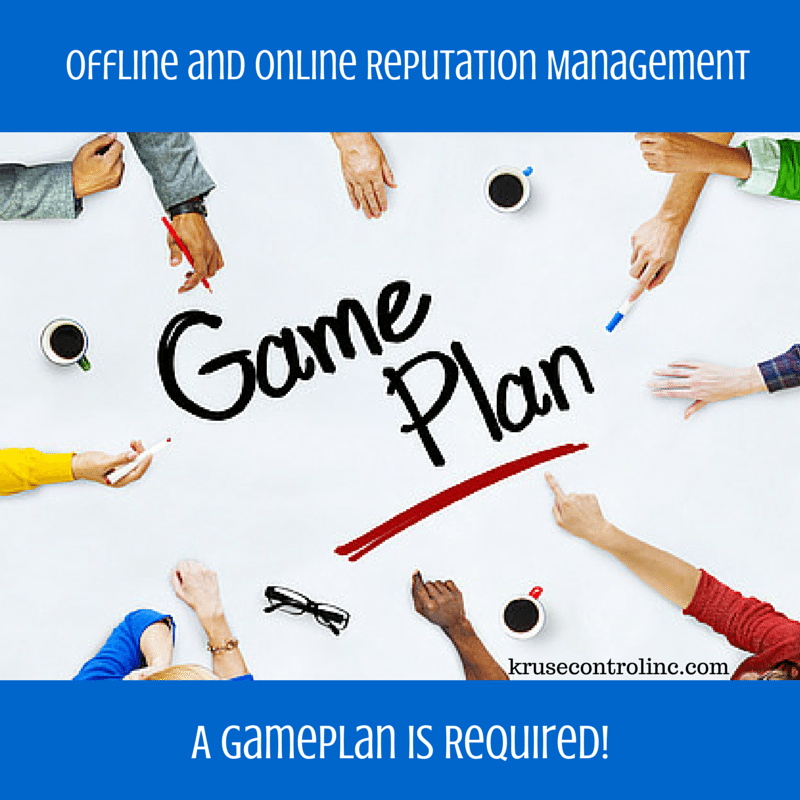
Online reputation management requires a savvy gameplan.
The gameplan must be championed from the top and executed down to the last employee who turns off the lights at closing time. It’s imperative to introduce operational systems, an action plan (strategies) and tactics to ensure your online reviews mirror your customers’ offline experience.
When leader of a company makes claims about their stellar successes publicly, the evidence should be undeniable. In this case, there may be lots of plausible answers for why certain facts state otherwise. But, the fact is the fact and when 96% of consumers turn to online reviews during the purchase journey, those facts need to be positive.
I have a few friends left at that dealership and I truly care about their online reputation. It’s been going on for quite a while now, at least 2 years, and I hope someday soon the CMO sees the irony that I noticed and takes action to improve things.
Why let this happen to you?
Take action now:
- Leverage every software tool you have
- Designate leaders in your organization to monitor what’s being said
- Develop and implement an online reputation management action plan
- Motivate every employee to make online reputation the #1 priority
Because if online reputation management is not a priority, sooner or later your going to lose business to the guy down the street or across town. It’s only a few clicks away to lose business to your competitor. Get your gameplan happening now. There’s no reason to lose the game when you have so many good plays left!
The post Offline and Online Reputation Management: a Gameplan is Required! appeared first on Kruse Control Inc.