S&P Global Ratings recently offered more analysis as to how it examines subprime auto loan asset-backed securities (ABS) issuers in light of what the firm described as an increasingly noticeable trend.
The firm explained that certain U.S. subprime auto loan asset-backed securities (ABS) issuers are reporting more losses later in their transactions' lives than in the past. Because this development is likely due to the longer contract terms and the softer and gentler collection approaches, such as higher extension rates, S&P Global Ratings indicated that analyzing cumulative net losses in the traditional manner (by months outstanding) can sometimes provide an incomplete picture.
In a report published by S&P Global Ratings, titled “Using Pool Factors to Analyze U.S. Subprime Auto Loan ABS Credit Losses,” senior director Amy Martin noted that analyzing loss performance relative to pool factor (the amount of original principal balance remaining in a transaction) affords additional insight into performance, because it captures collateral and collection variations across issuers and over time.
“Issuers’ pools amortize at different rates, given their disparate lending terms and collection practices. We take this phenomenon into account in our rating approach,” Martin said.
“Slower amortization of a pool doesn't in and of itself pose a risk to the transaction as long as losses are within expectations and credit enhancement is adequate to cover tail-end losses,” she continued.
“In our opinion, monitoring losses by pool factor provides a better barometer of performance across issuers (than by month outstanding) because it takes into account the varying rates at which their pools amortize,” Martin went on to say.
“Such analysis can also prove useful when examining performance for an issuer over time, given that the terms of its auto loans or its tolerance for delinquencies and extensions may have changed,” she added.
S&P Global Ratings pointed out this report does not constitute a rating action.
Finance companies that use the defi SOLUTIONS platform now have additional tools to combat fraud.
PointPredictive, a leading provider of machine learning fraud and misrepresentation solutions, announced on Wednesday that its Auto Fraud Manager 2.0 and DealerTrace 2.0 solutions are immediately available for production use by all defi SOLUTIONS customers.
“PointPredictive is one of our newest and most innovative AI technology partners. We’re excited to offer our lenders seamless access to these forward-thinking fraud and misrepresentation solutions through the defi LOS platform,” said Stephanie Alsbrooks, chief executive officer of defi SOLUTIONS. “This is yet another great example of the power of community.”
PointPredictive offers a suite of artificial intelligence (AI) predictive scoring solutions that can identify the presence of material misrepresentation and fraud within auto financing applications and dealer processes. The company insisted this predictive technology has been shown to streamline real-time auto financing decisions, while reducing finance company losses by 50 percent or more in fraud and first and early payment defaults due to material misrepresentation.
The defi SOLUTIONS platform of services can offer finance companies the flexibility and freedom to leverage leading-edge technologies to optimize decisioning efforts.
Officials added defi SOLUTIONS’ auto finance customers have been invited to participate in a limited-time, no-risk, production pilot of these two PointPredictive solutions.
“This initial offering through our partnership with defi SOLUTIONS allows us to deliver a real-time, actionable fraud and misrepresentation score for each auto loan application from nearly 100 auto lenders processing through defi SOLUTIONS — the fastest growing auto origination platform in the U.S.,” PointPredictive chief executive officer Tim Grace said.
“Our research indicates that fraud and misrepresentation in the auto lending industry is a $6 billion annual problem,” Grace continued. “We are excited to be able to help all defi SOLUTIONS customers make a substantial dent in their portion of that number.”
Grace went on to reiterate that defi SOLUTIONS customers will have real-time access to Auto Fraud Manager 2.0 and DealerTrace 2.0, that can increase fraud detection by leveraging enhanced predictive algorithms that evaluate the entire loan application, as well as recent activity from dealers. This strategy can enable finance companies to screen for, and detect, all types of fraud, including identity, employment, income, collateral and dealer risk.
In numerous customer evaluations, PointPredictive insisted that Auto Fraud Manager consistently identified more than 50 percent of fraud, first payment defaults and misrepresentation-related early payment defaults within the riskiest 7 to 10 percent of all applications, when rank-ordered by the Auto Fraud Manager score.
For further information on receiving Auto Fraud Manager through defi LOS, contact PointPredictive at [email protected] or Patty Jefferson at [email protected].
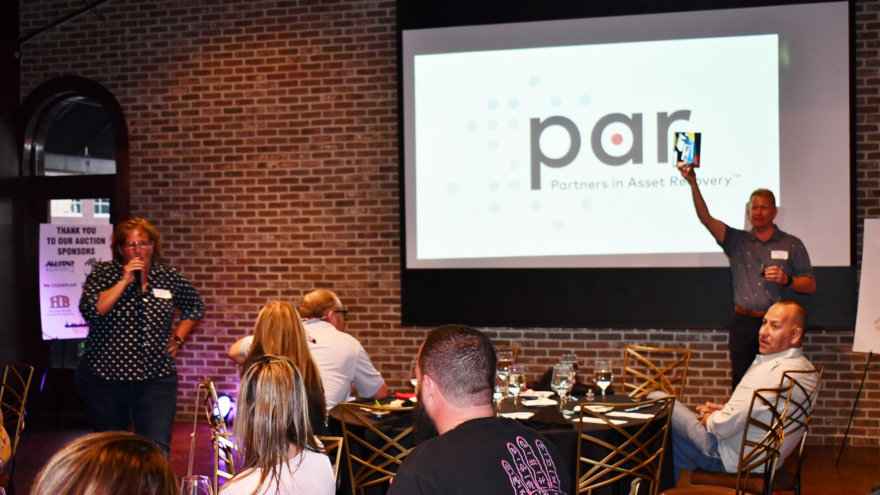
PAR North America recently held an event to honor 15 of the best repossession operations in the country and generated funds to help agents who sustain negative consequences that sometimes come with the job.
The business unit of KAR Auction Services handed out accolades for Agent of the Year, Resolution and Compliance Champion and various regional awards. The awards ceremony included an auction benefiting the Recovery Agents Fund (RABF).
PAR North America — a leading U.S. provider of vehicle transition services with coast-to-coast solutions for recovery management, skip tracing, remarketing and title services — honored Final Notice Recovery of Maryland as Agent of the Year for its high vehicle recovery rates and consistent dedication to providing excellent customer service.
Zane Investigations of Nevada was honored as the 2018 Resolution and Compliance Champion for its commitment to resolving customer issues promptly resulting in fewer customer complaints while meeting all compliance requirements and reporting on a weekly basis.
PAR North America and its recovery agent partners raised $40,000 for the fund. RABF provides financial help to families impacted by the dangers of the repossession industry and the unfortunate circumstances that may prevent those in the industry from being able to plan for unexpected events that can arise and devastate a family.
Other honorees included:
Regional Choice Awards
— Coastline Recovery Services of California
— Alpha Recovery of Arizona
— West Texas Auto Recovery of Texas
— Seize of Illinois
— Specialized Towing of Florida
— Associates Asset Recovery of North Carolina
— International Recovery Systems of Pennsylvania
Impound Agent of the Year
— H & S Recovery of Georgia
Resolution Champion
— Allstar Recovery of Mississippi
LPR Agent of the Year
— Hide and Seek Recovery of Texas
Rookie of the Year
— Skagit Towing and Recovery of Washington
Sidekick Salute
— AGR Recovery Specialists of Florida
— Relentless Recovery of Ohio
Over the past year, the handling of personal property and redemption fees has become one of the hottest compliance topics in the industry. It is on the radar screen of virtually every auto finance company in the country, as well as the regulators. Most of this interest is sparked by Consumer Financial Protection Bureau concerns over disparate treatment of customers and inconsistencies in what customers are charged.
This issue has resulted in significant changes by most lenders as to how these fees are handled. Most lenders have shifted their approach to one of the emerging five models:
• Fees charged are up to agent and collected by agent
• Fees charged are up to agent and billed to lender
• Lender sets allowable charges and are collected by agent
• Lender sets allowable charges and are billed to lender
• All in one pricing
The remainder of this article will examine the key issues surrounding each model and aim to give you additional data points to gain a better understanding of the individual approaches. Let’s look at the five models in a little more detail:
Fees Set by Agent/Collected by Agent
Most major lenders have moved away from this approach primarily because lenders have little control or visibility on what is actually being charged. Consumers face the same dilemma and can be taken advantage of by agents. It’s no surprise that the lending community is migrating away from this model.
Fees Set by Agent/Billed to Lender
Although some states do regulate and specify repossession related fees, this approach still leaves the lender exposed to wide variations in fees charged. This structure does provide more visibility but there are inconsistencies on what is charged to different customers and by different agents.
Lender Sets Allowable Charges/Collected by Agent
When it comes to personal property and redemption fees, this is one of the better models as it reduces disparate treatment and ensures reasonableness. The lender sets allowable charges which establishes a guideline for the agent. While a more favorable approach, the lender continues to lack visibility since there’s no guarantee that an agent will comply.
Lender Sets Allowable Charges / Billed to Lender
When lenders set allowable charges and it’s also billed to the lender, there is both visibility and accountability. More and more lenders are migrating to this approach.
All in One Pricing
All in One pricing is a single flat fee set by the lender that covers the cost of the repossession, any personal property or redemption-related fees, and other ancillary services that might occur. This model is extremely straight forward and very easy for lenders to administer. It’s a one size fits all approach; however, therein lies the challenge. Only a percentage of repossessions involve personal property, redemption and storage. This makes it difficult to come up with an appropriate price that would make sense for every repossession.
Our Recommendation
Each model does offer some advantages and disadvantages. However, based on an assessment of interests of the various stakeholders as well as both the administrative and regulatory issues, ALS Resolvion has been recommending the following framework to our clients:
• Allowable fees established by the lender and billed to the lender
• Personal Property Fee: Maximum of $50 unless state law provides specific guidelines in which case state law would apply.
• Vehicle Redemption: Storage of $20 per day for the first five days of storage and$35 per day thereafter. Redemption/Administrative fees – Maximum of $75. Total Maximum redemption related fees (admin fees + storage) equals $150.
We feel that this framework strikes the right balance between a fee schedule that is reasonable for the agent, the need to be fair to the consumer and the need for a process that the lender can defend from a compliance standpoint.
Mike Levison is the chief executive officer of ALS Resolvion. More details about the company can be found at www.alsresolvion.com.
Another way for repossession agencies to find the personnel they need recently launched.
The American Recovery Association (ARA), in partnership with TalentValue, recently rolled out an improved ARA Job Board at repojobs.us. It’s part of the association’s ongoing member recruitment strategy with TalentValue.
Through the job board, ARA members can post current job openings. The association intends for this new job board to connect ARA to fresh talent within the repossession industry, while also providing an indispensable resource for job hunters within the community.
The site makes job application quick and easy for candidates, and it streamlines the reviewal process for employers.
“The launch of the ARA Job Board will form an important critical link to helping ARA members find great people,” said Doug Duncan, president of TalentValue. “As this job board grows, it will have greater and greater impact on the industry as a whole, because the health of ARA’s member companies will become stronger and more profitable.”
Job seekers can narrow their search criteria, including:
1. Job title
2. Company name
3. Keyword
4. City, state and ZIP code
Agency members can get started with the recruiting process by following these steps:
1. Register your own career web page.
2. Post your own positions.
3. Use OnePost search engine optimized job postings.
4. Use TalentValue's Applicant Tracking System to vet your candidates.
5. Use the JobFit Assessment to avoid hiring mistakes.
6. Further vet your candidates with ARA's Compliance Background Checking Services.
7. Reach out to a TalentValue Recruiting Expert to get started.
It all can be starting by going to repojobs.us.
For more information about ARA, its partnerships, and its member benefits, visit repo.org.
GWC Warranty acknowledged that perhaps the most difficult obstacle to overcome in the dealership F&I office is getting customers to trust that the products store personnel are offering will be worth the added cost.
The provider of used-vehicle service contracts sold through dealers insisted in a recent blog post that establishing trust is the first step in building the foundation for long-term F&I success.
“But how do you go about gaining the trust of someone whose money you’re looking to spend on additional products like a vehicle service contract? Just like most things in life, honesty is the best policy in the F&I office,” GWC Warranty said.
“Being upfront about monthly costs, coverage limitations and the company backing your products will help customers feel the confidence they need to feel in order to make a service contract purchase,” the company continued.
GWC Warranty went on to dissect transparency even further, delving deeper in four specific areas.
Payment transparency
For the vast majority of customers — especially within the subprime credit spectrum — GWC Warranty pointed out that many dealerships and finance companies are negotiating on monthly payment and potential buyers on board with how the cost of a service contract impacts what hits their bank accounts each month.
At a glance, the company conceded the added cost can be staggering, especially in a world where some research shows 78 percent of people are living check to check.
“But breaking it down by daily cost could help overcome this hurdle,” GWC Warranty suggested, giving an example.
The daily cost of $300 payment is roughly $10 a day. If you add $50 per month for a service contract, that daily cost is just over $11 a day.
“This nominal daily increase compared to the cost of major repairs can help customers see the value in added vehicle protection,” GWC Warranty said.
Coverage transparency
GWC Warranty reiterated that not all coverage levels were created equally.
“It’s important to impart this on your customers,” the company said. “If you’ve mastered your menu selling strategy, working backwards from the highest level of coverage achieves this goal for you.
“Focusing on what customers miss out on and using this technique in tandem with highlighting small daily cost differences, it’s easy to spell out value that will help your customer see that you have their long-term financial interests in mind,” the company went on to say.
Provider reputation
GWC Warranty cautioned dealers that some customers may object to a service contract due to the industry’s reputation.
“But working with a reputable partner has its benefits — most notably your ability to showcase that reputation to customers,” the company said.
“When you can show customers that the product you’re selling is backed by a company with decades of experience and billions in claims paid, peace of mind will come easily — and quickly,” the company added.
Showcase past results
If the dealership has a customer who still does not trust the F&I process, GWC Warranty stressed that even the most difficult vehicle buyers can’t deny real-life results.
The company recommended that finance managers keep close a file of past work orders or a claims paid report and show that difficult buyer all the money VSCs have saved past customers.
“No customer can refute the value of a VSC after seeing exactly what it’s done for people in their shoes,” GWC Warranty said.
Figures that include six digits and a comma typically catch the attention of dealership management.
EFG Companies recently calculated that the average EFG trainee generates an additional $204,605 per year in F&I income through a 22-percent performance increase. To help sustain this performance increase, EFG Companies announced the launch of EFG Learning Opps Through Virtual Engagement (LOVE), a dynamic digital portal designed to boost F&I Producer knowledge, reinforces training learnings, and reduces the cost of a poor hiring decision for a dealership.
EFG Companies acknowledged that many dealer principals and general managers complain that their past experience in sending F&I producers to training only impacts per-month results in the short term. In addition, when training is not reinforced in the dealership, improvements are quickly negated by diminishing returns.
EFG Companies conducted a six-month analysis of the true impact of its industry-leading, behavior-based F&I training combined with its in-store engagement model. The company compiled a series of metrics, both pre- and post-training, with both the trainees and their dealership management.
EFG trainee performance showed:
• EFG’s guided-discovery training represented $204,605.00 in additional F&I income per producer per year, based on 80 turns per producer per month.
• Average trainee F&I performance increased 22 percent.
• PRU increased from $967 to $1,180 on average.
“It’s clear that using multi-sensory learning methods with interactive tools better enables F&I managers to effectively deliver measurable results to a dealership’s bottom line,” said John Pappanastos, president and chief executive officer of EFG Companies. “That’s why we developed EFG LOVE for our F&I class graduates.
“This analysis proved that our proprietary behavior-based approach to F&I producer development can generate more than $1.13 million in average F&I revenue per producer per year,” Pappanastos continued. With an average training cost of $2,000 per producer, the dealer sees a 100-times return on the initial investment in the first year.”
In addition to fortifying the lessons learned from EFG’s in-classroom training, EFG LOVE can equip dealers with information and best practices on how to both sell to, and employ, the soon-to-be largest generation in the workforce with the most buying power — millennials.
EFG Companies pointed out that numerous industry studies have shown that retail automotive faces a recruiting and staffing crisis. The 2017 National Automobile Dealers Association Workforce Study reported that retail automotive suffered from a 43 percent turnover rate, an 88 percent attrition rate among female new hires, and a below average rate of millennial new hires when compared to other industries.
And 65 percent of dealers state that recruiting and hiring is their No. 1 challenge — greater than customer acquisition or generating revenue.
In EFG’s more than 40-year history, the company has placed hundreds of top performers at automotive dealerships across the country. This has resulted in the deliberate build-out of a core-competency sourcing model to identify the core qualities of Top Performers.
EFG LOVE pairs this top performer profile with industry statistics and trends to better enable dealers to develop high-performing teams.
“EFG LOVE helps shorten the onboarding time for new hires, keeps employees motivated and accelerates the knowledge growth needed for a successful career,” said Steve Roennau, vice president of training and compliance with EFG Companies. “We created the content to enable the user to self-select actionable lessons in multiple digital formats.
“The more a producer can easily select materials that help them overcome their daily challenges, the more they will display the successful behaviors that they learned in our training,” Roennau went on to say.
EFG closed by mentioning turnover and failure to recruit high-performing professionals directly impacts a dealership’s bottom line. For example, a single poor hiring decision in F&I can easily result in up to $75,000 in lost profit due to onboarding costs and lost production, according to its analysis.
To see one of the many training videos featured on EFG LOVE, visit this website.
Dealership and finance company managers have another free education option thanks to online availability.
This week, Compli, a provider of automated HR and compliance program solutions, introduced CMS University. This four-course series of free masterclass-level online seminars focuses on how to build a best-practice compliance management system (CMS).
While the series is ideal for finance companies, Compli insisted the content is applicable to additional regulated businesses, including automotive dealerships.
CMS University evolved out of recurring conversations Compli had with business executives who knew they needed a CMS but didn’t know how to set one up or even what one looked like.
“Nobody likes to read a 1,500-page textbook. But that’s about how much material regulators expect you to know about building a compliance management system,” said Brian Larson, consumer finance director at Compli. “That’s when the light bulb went off, and we decided to jump in and make it easier for companies to implement a CMS by sharing our vast industry knowledge for free.”
Each of the four videos in the online seminar series are an hour or less in length and cover executive oversight, compliance program structure, consumer complaint response and internal audit preparation. Courses include easy-to-follow video lectures led by attorneys and industry veterans, instructional readings and the ultimate Prep for the “Test” Guide.
Larson emphasized the materials support companies' efforts to build a sound CMS that can better withstand regulatory scrutiny.
“Our program is not just for setting up a CMS. It also helps companies with an established CMS to easily audit their program to discover where they need to focus their resources,” Larson said.
Compli acknowledged that CMS University is not a degree-granting institution offering accredited courses. However, Compli explained that what it does offer is highly specialized insider compliance knowledge and expertise that anyone who handles compliance at their company can benefit from.
In addition to its online masterclass, Compli helps promote compliance education with free articles, webinars and other downloadable resources. To access those materials, visit Compli’s resource library.
To enroll in CMS University for free, go to this website.
Automotive Personnel founder and chief executive officer Don Jasensky offered a strategy so finance companies and other employers can handle one of the most challenging portions of the hiring process — the potentially large chasm between the salary offered and the compensation expectations of the top candidate.
Jasensky began by emphasizing to management that there should be no surprises when you offer a pay plan to a candidate.
For most candidates there is a direct relation to their comfort level with the variable proportion of the pay plan to the amount of base salary they need,” said Jasensky, who established his human resources firm in 1989. “If a candidate isn't certain how much they are likely to make with the variable portion, they will want more in salary.
“Over the years, we have seen companies get irritated with a candidate, thinking that they are offering a terrific pay plan where the candidate can make a significant jump in total income because of the generous bonus or commission plan,” he continued. “However — and this in very important — if the candidate does not understand the bonus plan, they may be mentally plugging in the wrong numbers and seeing the pay plan much differently.”
To rectify the situation, Jasensky, a longtime board member of the National Automotive Finance Association, offered what he insisted is a simple solution.
When making the offer, Jasensky stressed that management must explain the pay plan, then show what this pay plan would yield based on the previous 12 months. He said this process will pinpoint an exact number.
Then, Jasensky recommended that hiring officers explain that, “We are not bringing you on to keep things at status quo. We want to see a 15-percent increase in sales.”
Candidates could review a pay plan based on:
• Modest increase of 10 percent
• Hitting target of 15 percent
• Outperforms the target and hits a 20-percent increase
Jasensky closed with this takeaway.
“The better the candidate understands the variable portion the more likely he will accept your offer, so take the time to explain it,” said Jasensky who can be reached at (216) 226-8190 or [email protected].
Equifax auto finance leader Lou Loquasto pictures an industry landscape where finance companies rank dealerships based on risk and potential profitability, just like they do consumers as applications arrive in the underwriting department.
By extrapolating the knowledge gleaned through static pool analysis, Loquasto explained how dealerships and finance companies still can capture potential business in the subprime space as the current cycle backs off the growth pattern seen for several years.
The latest data Equifax shared with SubPrime Auto Finance News showed 1.37 million retail installment contracts were originated through March to consumers with a VantageScore 3.0 credit score below 620; deals generally considered to be subprime accounts. The figure represented a 7.3-percent decrease year-over-year.
“Does that mean every dealership subprime is down 5 to 10 percent? Without looking at the data and knowing what we know about the business, probably not,” Loquasto shared during a recent phone conversation. “That would be pretty remarkable if you look at 30,000 dealerships, and they’re all down 5 to 10 percent.
“We see dealers that are up in subprime and some that are down 25 percent,” he continued.
So how are some stores moving on an upward trajectory in subprime? Loquasto explained that finance companies need analytics platforms to determine which dealers are a better fit for their book of business and provide the right amount of risk for their appetite. Equifax recently analyzed TradeSight metrics evaluating a series of dealers with a focus on subprime accounts in the 560 to 580 credit range.
The chart below shows two dealerships with side-by-side comparisons that look at a handful of credit performance criteria, such as delinquency rates, average APR and length of months on the book.
According to the data below, dealer A shows a higher propensity for customers with 30-plus and 60-plus delinquencies, as well as charge offs. However, dealer A also represents clientele with higher APR rates. Based on this data from platforms such as TradeSight, Loquasto pointed out that finance companies can best analyze which contracts and dealers make up the best opportunity for their book of business based on a number of credit performance and risk assessment data.
“The difference in profitability of those two scenarios is dramatic,” he said.
| Item |
Dealer A |
Dealer B |
| Charge-off and Repo at Month 14 |
3.80% |
3.60% |
| Charge-off and Repo at Month 22 |
12.00% |
5.20% |
| 30 Days Delinquent at Month 18 |
36% |
11% |
| 60-Plus Days Delinquent at Month 18 |
18% |
8.20% |
| Average APR |
12.70% |
9.50% |
“Some dealerships where the performance is worse than you would expect and worse compared to their peers, some of those dealerships are down a lot in subprime. You say that makes sense. Lenders spotted something with that dealership, and so they’re pulling back and tightening up,” Loquasto said.
“But we see dealerships that are down in subprime, but the performance in their static pool is much better than other dealerships within the same credit band,” he continued. “We would look for lenders to review data, identify dealers like that and be a little more aggressive with that dealership. They might say, ‘This might be a deal I would normally turn down, but this dealer’s performance is so good that we’re going to give them the benefit of the doubt.’”
Loquasto acknowledged that sometimes dealerships have a negative reputation when it comes to subprime originations so finance companies simply tighten up underwriting across the board when they feel a market shift. He suggested that finance companies take a deeper analysis before just cutting.
“Our industry is so sophisticated right now, especially in subprime, that if a lender was looking at 1,000 loan applicants, they would scrutinize those 1,000 loan applicants with sophisticated scores and data with people who have great experience choosing good borrowers from bad borrowers, and they’ll be able to rank order the least riskiest to the most riskiest, and they do an awesome job,” Loquasto said.
“But they don’t do that with dealers so well,” he continued. “They don’t look at these 1,000 dealers and do a sophisticated analysis using all of the available data and sophisticated scorecards not only for the business they book, but the business their competitors book. And then have a sophistical ranked order list at the dealer level.
“That’s something we’ve been advocating for a long time,” Loquasto went on to say. “As a long as I’ve been in the business, more than 20 years, there are pools of dealers that help you with market share, which is fine. But what we’re advocating is dealer pools to rank order risk at the dealership level.”
Not just in subprime, Equifax data also showed a general slowdown in auto financing.
Again through March, Equifax said 5.82 million auto loans, totaling $130.6 billion, were originated, representing a 2.0-percent decrease in accounts and a 0.1-percent decline in balances year-over-year from this time last year.
Through March, Equifax found that 23.5 percent of auto loans were issued to consumers with a subprime credit score, and they accounted for 18.5 percent of origination balances.
Equifax went on to mention the average origination amount for all contracts came in at $22,693, a 3.5-percent rise. The average subprime contact amount stood at $18,033, according to Equifax, which added that figure marked a 2.7-percent lift year-over-year.
“Where we are in the cycle, there isn’t as much profitability out there for lenders. That’s why we’re talking about strategies like this so they can squeeze out every bit of profitability they can,” Loquasto said.
“Three, four, five years ago when profitability was high, maybe lenders weren’t as diligent about squeezing out every dollar of profit. But now they are,” he continued. “If we’re in the seventh inning of this cycle and lenders can get into the good habit of doing a better job rank ordering dealer risk then as soon as the cycle turns like we know it will and we get back into growth, they’ll have built in these good habits.
“Just like every customer has to be looked at differently and the industry does a great job of that, every dealer can’t be looked at the same,” Loquasto went on to say.