Experts from Comerica Bank, Cox Automotive and TransUnion all relayed this week that a myriad of circumstances is eroding consumer sentiment of individuals who might be currently in your auto portfolio or who might be added soon.
While TransUnion reported more than half of Americans (55%) remain optimistic about their financial future even as inflation and fears of a recession weigh on their finances, the credit bureau’s newly released Consumer Pulse study from Q2 2022 found that optimism levels dropped from 59% the previous quarter and 64% at the end of 2021 largely due to an array of challenges.
The TransUnion study found that inflation is the greatest worry for Americans — by a wide margin — with 63% of respondents ranking it as their top or second greatest concern. A recession (30%) and rising housing and rental costs (25%) followed.
The results from the May 12-19 survey of 2,739 adults found that concerns differed based on generation.
Experts said stock market volatility is a much greater concern to Baby Boomers compared to all other generations, whereas Gen Z had an outsized concern about jobs.
The study also indicated that the youngest generations were most positive about their financial future with 70% of millennials and 66% of Gen Z being optimistic about their household finances in the next 12 months compared to just 39% of Baby Boomers.
“It’s clear that Americans are facing many tests, whether it’s inflation, high housing and rental costs, rising interest rates or fears of a recession, but there’s also strong evidence that consumers are weathering this excess of challenges,” said Charlie Wise, senior vice president and head of global research at TransUnion.
“The majority of consumers are still optimistic. Jobs are plentiful and many consumers have seen material increases in their income over the past year, particularly those in lower income tiers. This has helped consumer credit performance remain steady — all reasons for optimism,” Wise continued in a news release.
Meanwhile, Cox Automotive chief economist Jonathan Smoke recapped more confidence erosion in a blog post uploaded on Monday.
In his analysis, “Smoke on Cars,” the Cox expert recapped that according to the Conference Board, consumer confidence declined 2.0% in May. The decline left confidence down 11.3% year-over-year.
“The underlying measures of present situation and future expectations both declined. Plans to purchase a vehicle in the next six months declined but was slightly higher than a year ago. Plans to purchase a home also declined and was higher year-over-year,” Smoke wrote.
“The Morning Consult daily index also declined in May, as it was down 4.4% for the month. The daily index from Morning Consult was at its lowest level so far for the pandemic on May 30, as inflation, declining equity markets and increasing cases of COVID driven by omicron variants weighed on consumer attitudes,” he continued. “The daily index declined through the first three days of June as surging gas prices increased to new nominal records.”
Furthermore, Comerica Bank chief economist Bill Adams elaborated further about the ingredients burdening consumers that TransUnion and Cox Automotive discussed.
“The expansion is slowing amid headwinds from Russia-Ukraine, surging energy and food prices, the end of crisis-era stimulus programs, tighter monetary policy, and Chinese lockdowns. But the U.S. is not currently in a recession, and the first quarter’s negative GDP looks like a red herring,” Adams said in his latest U.S. Economic Outlook.
“U.S. payrolls averaged a monthly increase of nearly half a million in the first five months of 2022, the unemployment rate is a solid notch lower than at the end of 2021, and industrial production is growing solidly. However, industries that surged during the pandemic like retail, e-commerce, and housing are retrenching as consumer spending shifts from goods back to services,” Adams continued.
“Inflation likely has peaked in year-over-year terms but will stay well above the Fed’s target through the end of 2022 as Russia-Ukraine keeps food and energy prices elevated. Prices of durable goods including used cars and trucks have started to edge back down, and wage growth is slowing,” he went on to say. “Retailers are starting to discount consumer goods again after a big increase in inventories since the fall of 2021. But there is no relief in sight for food, gasoline, diesel, and other energy prices as the Russia-Ukraine conflict grinds on.”
With prices set to stay high, TransUnion’s study showed the possibility of individuals being able to handle them — at least for the time being.
TransUnion said its study found that income appears strong with 81% of respondents reporting their income stayed the same or increased in the past three months; 90% expect the same in the coming year. More people reported starting a new job or a business than losing a job or quitting in the last three months. This is in line with May’s 3.6% unemployment rate from the U.S. Bureau of Labor Statistics.
Despite the many positives in today’s consumer credit market, TransUnion acknowledged nearly all Americans (95%) reported being concerned about inflation, with 38% extremely concerned. This is up 11 percentage points from the first time this question was asked in Q3 2021.
TransUnion mentioned that about two-thirds (64%) of all Americans expect to change spending in the next three months because of inflation. Of those, 52% say they’ll cut discretionary spending such as dining out, travel and entertainment. Approximately 41% say they’ll cut spending on retail shopping and 40% on making large purchases.
Overall, TransUnion noted that 33% of Americans plan to apply for new credit or refinancing in the next 12 months, a 5-percentage point drop from Q1 2022. Millennials (56%) and Gen Z (46%) plan on being most active in the credit markets with Gen X (32%) and Baby Boomers (10%) lagging, according to the credit bureau.
Of those who plan to apply for new or refinance existing credit within the next year, TransUnion said 32% say they’ll apply for a new home loan, an increase of four percentage points from Q1 2022. Millennials lead all generations at 40%.
“We are living through an unconventional period wherein consumers are facing more financial challenges than they have in at least a decade. Yet the job market is strong and most people are using the credit they have in a responsible manner,” said Margaret Poe, head of consumer credit education at TransUnion.
“This also is a time when consumers should remain diligent about their credit and put into practice healthy habits such as making on-time payments and keeping credit utilization at 30% or less,” Poe went on to say.
A variety of insights and trends from Data United LDS, the Conference Board, Fitch Ratings and Cox Automotive combined to offer quite a potential picture of the consumer who already has a contract in your portfolio or who might be getting set to take delivery at your dealership.
Let’s start with the upbeat data from Cox Automotive that focused on one of the most important pieces in being able to secure credit for a vehicle and maintain monthly payments: an improving employment scene.
Chief economist Jonathan Smoke noted this week that as of April 9, 1.42 million people were on traditional unemployment benefits, which was 346,000 lower than the claims level before the pandemic began. The Cox Automotive expert pointed out that the broadest measure of continuing claims was 1.62 million, according to the latest data from the week ending April 2.
“The total number of people receiving some form of benefit is 481,000 lower than the 2.1 million level before the pandemic began,” he continued in his Smoke on Cars blog. “Initial claims declined by 2,000 last week to 184,000 from an upwardly revised 186,000 the prior week. Weekly initial claims were 13,000 lower than they were leading up to the pandemic in 2020 and are at levels that have not been lower in more than 52 years.”
While that particular employment trend hasn’t been seen since the start of the 1970s, information from the Conference Board showed that some consumers still are facing a thicket of financial concerns.
The Conference Board Consumer Confidence Index decreased slightly in April, after an increase in March. The Index now stands at 107.3, which is down from 107.6 in March.
The Present Situation Index — based on consumers’ assessment of current business and labor market conditions — fell to 152.6 from 153.8 in March.
However, the Expectations Index — based on consumers’ short-term outlook for income, business, and labor market conditions — ticked up to 77.2 from 76.7.
“Consumer confidence fell slightly in April, after a modest increase in March,” said Lynn Franco, senior director of economic indicators at the Conference Board. “The Present Situation Index declined, but remains quite high, suggesting the economy continued to expand in early Q2. Expectations, while still weak, did not deteriorate further amid high prices, especially at the gas pump, and the war in Ukraine. Vacation intentions cooled but intentions to buy big-ticket items like automobiles and many appliances rose somewhat.
“Still, purchasing intentions are down overall from recent levels as interest rates have begun rising,” Franco continued in a news release. “Meanwhile, concerns about inflation retreated from an all-time high in March but remained elevated. Looking ahead, inflation and the war in Ukraine will continue to pose downside risks to confidence and may further curb consumer spending this year.”
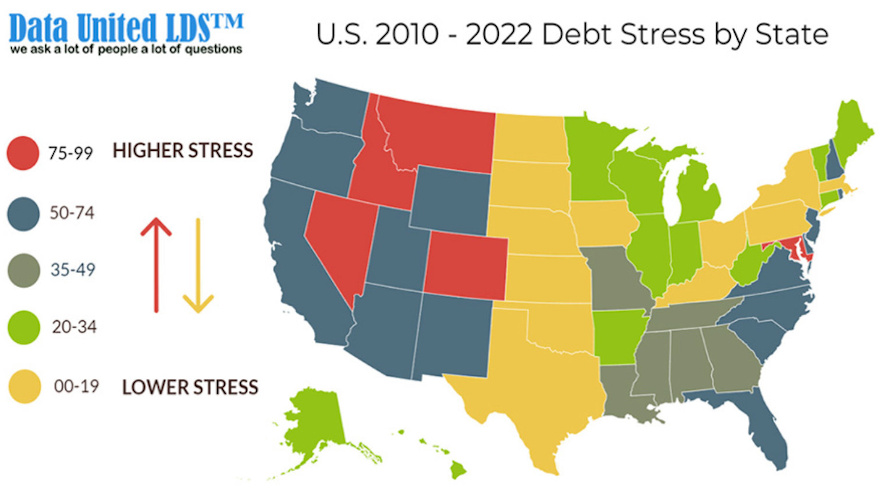
And speaking of spending, a 12-year project by Data United LDS uncovered several key findings through a consumer debt survey orchestrated between 2010 and 2022
Data United LDS discovered 21% of Americans have given up hope of ever becoming debt free in their lifetime.
Data United LDS also indicated 27% of respondents said they don’t know if they will ever be debt free, while 62% of respondents said they had no financial education from parents and/or school.
The firm went on to mention that highest debt stress was reported in Colorado, Nevada, Idaho, Montana and Maryland.
“I wanted to take a deep dive in to understanding how personal debt affects people psychologically. I want to know more than just what their numbers are (credit score, monthly income, age, total debt). I want to shed light on their plight because I went through personal bankruptcy myself. It was terrifying and soul crushing, said Catherine Dean who is the project lead at Data United LDS.
The survey insights from Data United LDS coinciding with Fitch Ratings reporting that total U.S. consumer debt reached a record $15.58 trillion at the close of 2021, primarily due to the rise in mortgages, auto financing and credit card debt.
“U.S. consumers have been resilient throughout the pandemic, but they will face new financial stresses as inflationary pressures grow. High inflation will compound the strain on low-income households without savings, as well as those that have not fully recovered from pandemic-related financial stresses,” Fitch Ratings said in a report titled, Most Borrowers in U.S. Securitizations Are Well-Positioned for Increasing Macro Risks.
“Fitch Ratings expects the Federal Reserve to substantially raise the federal funds rate in 2022 to combat inflation. Interest rate hikes will have a cooling effect on consumer spending and housing demand, slowing economic and home price growth,” the firm continued.
“Rising rates will increase debt burdens for new borrowers and those with variable-rate obligations, potentially affecting repayment of other loans. Higher rates will also increase loan refinancing challenges for borrowers with lower credit quality,” Fitch Ratings went on to say.
In separate public appearances this week, two members of the Federal Reserve Board gave similar, upbeat assessments about the economy and the prospects for steady performance next year.
However, one of the prominent measurements of consumer sentiment showed that individuals who might be purchasing vehicles among other spending activities isn’t quite as robust.
First on Monday, Federal Reserve chair Jerome Powell shared his economic assessment during the annual meeting of the Greater Providence Chamber of Commerce in Providence, R.I.
“We have heard two messages loud and clear,” Powell began. “First, as this expansion continues into its 11th year — the longest in U.S. history — economic conditions are generally good. Second, the benefits of the long expansion are only now reaching many communities, and there is plenty of room to build on the impressive gains achieved so far.
“These themes show through in many ways in official statistics,” he continued. “For example, more than a decade of steady advances has pushed the jobless rate near a 50-year low, where it has remained for well over a year. But the wealth of middle-income families — savings, home equity and other assets — has only recently surpassed levels seen before the Great Recession, and the wealth of people with lower incomes, while growing, has yet to fully recover.
“Fortunately, the outlook for further progress is good: Forecasters are generally predicting continued growth, a strong job market and inflation near 2%,” Powell went on to say.
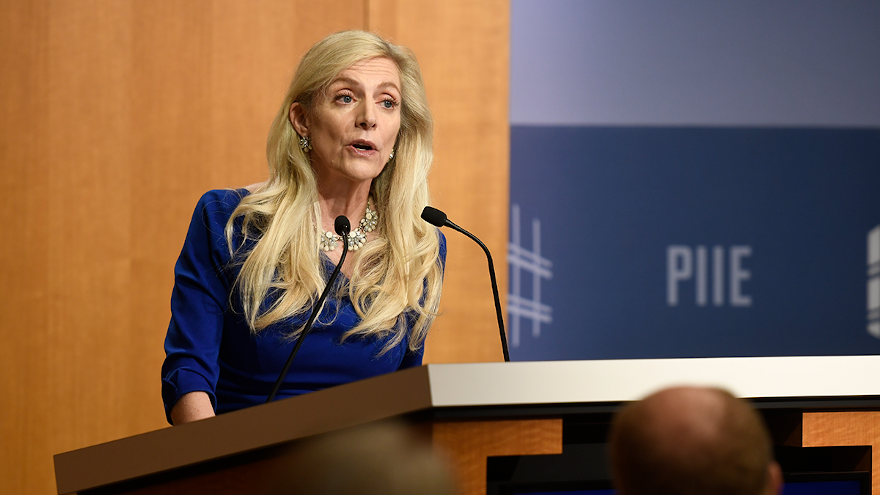
Then the next day, Fed governor Lael Brainard made a presentation in New York during the 2019 William F. Butler Award ceremonies hosted by the New York Association for Business Economics.
“There are good reasons to expect the economy to grow at a pace modestly above potential over the next year or so, supported by strong consumers and a healthy job market, despite persistent uncertainty about trade conflict and disappointing foreign growth,” Brainard said. “Recent data provide some reassurance that consumer spending continues to expand at a healthy pace despite some slowing in retail sales. Consumer sentiment remains solid, and the employment picture is positive. Housing seems to have turned a corner and is poised for growth following several weak quarters.
“Business investment remains downbeat, restrained by weak growth abroad and trade conflict,” she acknowledged. “But there is little sign so far that the softness in trade, manufacturing, and business investment is affecting consumer spending, and the effect on services has been limited.
“Employment remains strong. The employment-to-population ratio for prime-age adults has moved up to its pre-recession peak, and the three-month moving average of the unemployment rate is near a 50-year low,” Brainard went on to say. “Monthly job gains remain above the pace needed to absorb new entrants into the labor force despite some slowing since last year. And initial claims for unemployment insurance — a useful real-time indicator historically — remain very low despite some modest increases.
With respect specifically to the consumer sentiment that Brainard mentioned, perhaps it’s not quite as healthy as the Fed policymaker noted.
According to a news release on the same day as Brainard’s public appearance, the Conference Board Consumer Confidence Index decreased in November, following a slight decline in October. The index now stands at 125.5, down from 126.1 in October.
Officials noted the Present Situation Index — based on consumers’ assessment of current business and labor market conditions — decreased from 173.5 to 166.9. They added the Expectations Index — based on consumers’ short-term outlook for income, business and labor market conditions – increased from 94.5 in October to 97.9 in November.
“Consumer confidence declined for a fourth consecutive month, driven by a softening in consumers’ assessment of current business and employment conditions,” said Lynn Franco, senior director of economic indicators at the Conference Board. “The decline in the Present Situation Index suggests that economic growth in the final quarter of 2019 will remain weak. However, consumers’ short-term expectations improved modestly, and growth in early 2020 is likely to remain at around 2%.
“Overall, confidence levels are still high and should support solid spending during this holiday season,” Franco added.
The monthly Consumer Confidence Survey, based on a probability-design random sample, is conducted for the Conference Board by Nielsen, a leading global provider of information and analytics around what consumers buy and watch. The cutoff date for the preliminary results was Nov. 15.