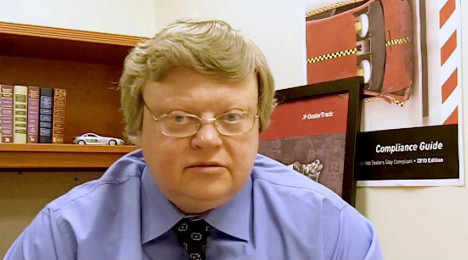
While dealership management emphasized this week’s settlement with the New York attorney general “acknowledges no admission of wrongdoing or liability,” Dealertrack Technologies' Randy Henrick shared his unsavory assessment of the “payment packing” possibly orchestrated by a trio of Honda stores as well as what the enforcement actions and multi-million dollar penalties could mean for dealerships in the Big Apple and beyond.
General manager Brian Benstock released a message later obtained by SubPrime Auto Finance News stating that “Paragon Honda, Paragon Acura and White Plains Honda announced they have reached a settlement with the New York attorney general’s office related primarily to their long-discontinued sales of third-party credit services offered by Credit Forget It (CFI). These services were broadly available to consumers directly from CFI, through automobile dealers and other providers.
“The settlement with the attorney general acknowledges no admission of wrongdoing or liability by the settling dealerships,” Benstock continued.
To recap, New York attorney general Eric Schneiderman explained the agreement, which returns more than $13.5 million in restitution to consumers, concludes an investigation into these dealerships for the alleged sale of finance office products to 15,000 consumers — items that in some cases added more than $2,000 in “hidden costs and fees” onto the sale or lease price of a single vehicle.
“Paragon dealerships stopped offering CFI credit services to customers in early 2014,” Benstock said in his statement. “We appreciate the attorney general’s office bringing the matter to our attention and working with us to create a positive outcome for our customers. We thank our employees and our customers for their ongoing support. It is because of your trust in us that we are able to serve this market as we do.”
That trust, however, could be severely damaged by this settlement. SubPrime Auto Finance News reached out to Henrick, who is associate general counsel for Dealertrack. Henrick regularly offers instructional webinars and has been a presenter at the National Automobile Dealers Association Convention discussing the advertising pitfalls and other behaviors in the finance office that draw the ire of state and federal regulators.
“Credit repair services are always a big target for regulators. Under federal law, you cannot charge a customer for a credit repair service until you’ve actually performed the service and repaired their credit. So you start with an unpopular product. This looks like they were essentially payment packed into the price of the vehicle or otherwise misrepresented to consumers,” Henrick said.
“This was bad conduct. This wasn’t something anybody could defend as legitimate or unintentional or a mistake,” he continued. “Dealers know payment packing is unlawful. They know credit repair services are dubious at best, although they are very profitable to resellers. I think having to put all of the money into a fund, as well as pay the $325,000 in penalties, that’s a pretty significant penalty even if the fund is only used to allow consumers to purchase additional services from the dealerships.”
What Henrick referenced was that the agreement requires Paragon to pay $6 million into a restitution fund administered by a third-party administer to be distributed to Paragon consumers with CFI contracts and to provide each of the about 15,000 consumers with a $500 “settlement card” that can be applied to one or more of the following from Paragon:
— The purchase or lease of any new or used vehicle
— Certain services or maintenance, such as oil changes, tire rotations, tire repairs, and wheel alignments
— Certain accessories, such as mats and replacement windshield wipers.
“Paragon Honda and Paragon Acura are New York's premiere Honda/Acura dealerships. We are family owned and operated since 1929. Our mission is to make every customer a customer for life by consistently providing world class service at our new and used car dealerships,” Benstock said.
“Paragon has a friendly and helpful sales staff and highly-skilled mechanics. We employ people from 24 different countries who speak 22 different languages. We have won multiple automotive industry awards including the American Honda Presidents Award, Council of Excellence Award for Finance, and Certified Dealer of the Year Award,” he went on to say.
Despite that treasure trove of accolades and a diverse staff, Henrick isn’t upbeat about the prospect of those 15,000 customers returning to a Paragon store.
“They’re depositing the money, but I don’t see anything here about them getting it back any of those unused funds. I would doubt that a lot of the consumers who were subject to this behavior are going to want to deal with those dealerships. It’s terrible publicity. It’s costly. It’s flat out unlawful. I’m surprised in this day and age you would see conduct like this on such a mass scale,” Henrick said.
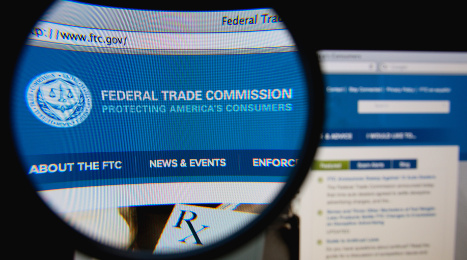
“This is not the (Federal Trade Commission) coming in and declaring something unlawful, something that previously was mainstream, as they’ve been doing with advertising,” he continued. “This is just bad conduct and known to be such. I’m not surprised by the harshness of the penalties given the magnitude of what the sales were.
“I suspect the majority if not all of it was payment packing,” Henrick added.
Impact in New York and Beyond
In recent months, Henrick has ramped up his educational and outreach efforts, especially in light of actions involving not only the FTC in what it dubbed Operation Ruse but also matters associated with the Department of Justice and franchised stores.
“I think there’s a number of dealers who see these things as a cost of doing business. Historically fines and penalties against auto dealers haven’t been of this magnitude such that it could be a cost of doing business,” Henrick said.
“These are not all dealers or most dealers. These are a few dealers that view these kinds of things as a cost of doing business,” he continued. “And even if they get caught, they were having to pay very little in relation to the profits, but Schneiderman here levied a very heavy penalty and that’s what the FTC has been doing as well.”
Henrick recollected how the FTC recently penalized a dealer who pushed buyers into a program where they made biweekly payments, pitched on the promotion of saving money. Regulators found the program didn’t save customers any money, rather it actually cost them more, which prompted them to say it was “a deceptive trade practice,” according to Henrick. He said the store eventually had to pay the FTC a fine approaching $200,000.
“You’re beginning to see large numbers and I believe part of that is regulators’ enforcement philosophy that this is no longer just a cost of doing business, that you’re going to straighten up and do things right or they’re going to pay a heavy penalty that’s not going to make it economically attractive. I think that’s the message here,” Henrick said.
Henrick also has anecdotally heard about the FTC currently “hammering our consent decrees for deceptive advertising” with multiple dealerships out West. Earlier this year, Operation Ruse led to millions in penalties against dealerships.
The furor of the FTC as well as the Consumer Financial Protection Bureau potentially is fueling enforcement officials such as Schneiderman as well as New York City Department of Consumer Affairs Commissioner Julie Menin, who were both quoted in this week’s settlement announcement. Henrick resides in New York so has a closer vantage point of both officials.
“Julie Menin is a very aggressive prosecutor. She’s been on a mission against auto dealers,” said Henrick, referencing a program Menin’s department announced back in April. It’s a new initiative to create what she called a “safer” loan product for qualified secondhand auto borrowers and to help them “avoid financial ruin by predatory loans.”
When asked about New York’s attorney general, Henrick said, “Schneiderman is showing himself to be one, as well. He’s been very active in the securities markets and certain other areas. This is a major foray into consumer protection and the dollars are large. I think the message he’s sending is clear: If New York auto dealers violate the law, particularly if they violate it in ways that are indefensible, they’re going to pay a hefty price and it’s not going to be just a cost of doing business.”
Henrick cautions dealers who might be far from New York about taking the approach that what happened in the Empire State won’t occur elsewhere. He suspects that other attorneys general will be discussing Schneiderman’s actions when they gather multiple times per year for their association events.
Henrick also mentioned plaintiff’s associations also might be examining this settlement to see if any class action suits can be brought.
“You’ve got a lot of aggressive attorneys general. Many states have unfair and deceptive acts and practices laws that give consumers the right to sue and rights to bring private attorneys general actions. I think Schneiderman doing something like this is going to be looked at very carefully,” Henrick said.
“Many dealers will say, ‘I don’t have to worry about all that because I have an arbitration clause in my contract,’” he continued. “But I think unfair and deceptive acts and practices claims can be separated from contract claims and they’re essentially statutory and tort actions. They’re not necessarily covered by the arbitrary class action waiver clauses. This puts it out there.”
Henrick left SubPrime Auto Finance News with one last point about this settlement and what the future implications could be.
“It’s an extreme case, but it’s not an extreme case because there are a small number of dealers, but in absolute numbers they’re not necessarily that small,” he said. “It’s not like the old days where the fines were $1,000 or $10,000. But we’re talking here at $325,000 penalty and a $13.5 million in restitution, albeit some of which will be spent on services at the dealership. But to the extent that the money is not all used up I think it’s going to be forwarded to the state. This is a multi-million loss for these dealerships even under the best of circumstances.
“This is the FTC’s and to a certain extend the CFPB’s approach in assessing penalties,” Henrick went on to say. “They’ve ratcheted up the numbers substantially from where they were just a few years ago. That causes people to sit up and take notice. Hopefully, it will indicate that the cost of compliance or the practice of compliance can put a dealer in a much better financial place than schemes like this do.”
The National Independent Automobile Dealers Association and Dealertrack Technologies recently joined forces to give dealers an opportunity to get their F&I department questions answered without paying a retainer or being charged billable hours.
Dealertrack associate general counsel Randy Henrick worked with NIADA to create an online outlet for dealers to submit questions about adverse action notices, Red Flags, the Consumer Financial Protection Bureau as well as the Federal Trade Commission or any other matters related to F&I compliance
“Have an F&I compliance question or need an update on new rules and regulations which may impact your dealership? You're not alone,” officials said.
“Randy will get back to you personally with a reply at no charge to you or your dealership,” they continued. “There's no catch, no fine print. We simply want to share our industry expertise with the dealer community.”
Dealers can submit their questions at this website.
The Federal Trade Commission referenced back to a practice this week that regularly upsets the agency, especially in the dealership arena when it comes to vehicle pricing and financing possibilities. It’s the concept of the bait and switch.
When asked about what concerns the FTC most about what unscrupulous dealers might be doing, Jessica Rich indicated what the regulator is most commonly seeing is what she called “bait-and-switch tactics where the advertisement says one thing, but it’s not the price that’s offered once you get to the dealer.
“It may be a special rate or discount but in the fine print are major qualifications that’s only available to people whose birthday is on a Tuesday — that’s a joke — but a very specific group of people,” said Rich, who is director of the FTC’s Bureau of Consumer Protection.
Rich, along with Joyce White Vance, United States Attorney for the Northern District of Alabama, spent nearly an hour on a teleconference after the FTC and 32 law enforcement partners announced the results of what they dubbed “Operation Ruse Control,” a nationwide and cross-border crackdown aimed at what they contend is to protect consumers when purchasing or leasing a vehicle.
Along with the bait-and-switch mention, Rich described the problems the FTC has with advertising disclaimers in fine print along with what she described as “deceptive” add-ons such as warranties that either aren’t fully explained or are integrated into the vehicle price, a practice known as payment packing.
“The deceptive ads with fine print disclaimers, or actually no disclaimers at all sometimes, are really unfortunately quite common,” Rich said. “That’s not to say there aren’t many, many honest dealers in this industry. But there are a lot of deceptive ads out there, and we’re going to keep bringing cases when we see them.”
And in regard to the problems with add-on products, Rich stated, “We have heard that this goes on a lot, and we will be looking for cases in this area. These two cases are the first but they won’t be the last.”
Furthermore, Rich mentioned how the FTC has found several examples of where advertisements or contracts are written in two different languages, resulting in difficulties for certain demographics such as Hispanics where their English proficiency might be limited.
“We at the FTC are very much on the lookout for scams that exploit people’s cultural differences or prey on particular groups. We have a number of initiatives in that area as well,” she said.
Could Finance Companies Be Victims, Too?
After Rich rattled off what dealer misdeeds are aggravating the FTC most nowadays, White Vance chimed in as well, delving into an area impacting finance companies.
First, White Vance acknowledged the parties involved in the settlements aren’t “indicative of what this industry is about because we’ve all had good experiences, and these stories about bad experiences come from consumers who were dealing with highly unethical salespeople. The practices I find to be most troubling are dealerships who inflate a buyer’s income so they can buy a car they can’t afford. Dealers should perhaps encourage strong purchasers who can qualify for loans to be the on-paper purchaser of the car rather than the one the purchaser cannot afford.
“This practice of adding non-existent vehicle accessories, saying you’ve got a moon roof and a high-end stereo on a vehicle that’s just the basic package in order to boost the loan amount,” Vance White continued. “These are practices that the dealers use to enhance their own bottom line without caring at all for the future financial stability of their customers and their family. If you want to talk about offensive, that’s it for me.”
In light of that assessment, White Vance recognized that finance companies could be victims in cases of fraud just like consumers, but “it’s often a fact-specific determination based on what happened in that particular case.”
She added, “Banks certainly need to be checking carefully, but in reality what we’ve seen is they don’t have the opportunity to check every single loan. Sometimes they do become victims.”
However, if finance companies have what White Vance described as “a cozy relationship with the dealer,” who might be producing questionable applications, the institution could end up being culpable of charges, too. But again the U.S. attorney from Alabama emphasized that any charges that might be levied are dependent upon the facts of the specific case.
Agency Collaboration
The FTC and the Consumer Financial Protection Bureau recently reauthorized their ongoing memorandum of understanding. The regulators explained the memorandum outlines the working relationship between the two agencies under the terms of the Consumer Financial Protection Act, and is designed to coordinate efforts to protect consumers and avoid duplication of federal law enforcement and regulatory efforts.
While this week’s enforcement actions didn’t include the CFPB, Rich insisted that federal regulators are collaborating with each other along with state and local authorities, resulting in enforcement actions like what the FTC shared this week.
“It’s a sign that this is a very important message we’re trying to get across both to businesses and to consumers that this type of deception will not be tolerated. It is illegal and there are ramifications. Enforcers at all levels are watching,” Rich said.
“We do find that working with our partners, people like Joyce in Alabama, and many others, does enable us to have greater impact,” she continued. “By working together we can bring more attention to the issue. Here we brought over 250 action across the country and even in Canada. We think it’s very good to work together. We have more of an impact. We’re trying to get a very strong message across.”
The Federal Trade Commission continues to ramp up its enforcement actions in the automotive space with its second significant collection of settlements in about 14 months.
On Thursday, the FTC and 32 law enforcement partners announced the results of what they dubbed “Operation Ruse Control,” a nationwide and cross-border crackdown aimed at what they contend is an effort to protect consumers when purchasing or leasing a vehicle.
The latest developments include 252 enforcement actions. The six new FTC cases also include more than $2.6 million in monetary judgments.
Officials indicated there were 187 enforcement actions in the United States since the agency’s last sweep along with 65 actions in Canada focused in Ontario and British Columbia. Enforcement efforts by the FTC, United States Attorney’s Office in the Northern District of Alabama and other partners at the federal, state and local level in the U.S. and Canada include both civil and criminal charges of deceptive advertising, automotive loan application fraud, odometer fraud, deceptive add-on fees, and deceptive marketing of car title loans.
“For most people, buying a car is one of the largest purchases they’ll make,” said Jessica Rich, director of the FTC’s Bureau of Consumer Protection.
“Car ads must be truthful, loan terms must be clear, and dealer practices must be honest. That’s why our partners are working together to crack down on deceptive marketing about car sales, leasing and financing,” Rich continued.
Joyce White Vance, United States Attorney for the Northern District of Alabama added, “Growing fraud and other deceptive practices in auto sales and financing are important issues affecting consumers when they are buying a vehicle.
“My office has worked closely with the FTC on this issue, and has prosecuted criminal cases at a Birmingham dealership,” White Vance went on to say. “The Mortgage, Loan Fraud and Discrimination Working Group of the Attorney General’s Financial Fraud Enforcement Task Force also is working with other law enforcement agencies to determine what we can do now to prevent fraud during the auto lending process.”
Cases Involving Vehicle Purchase Add-Ons
For the first time since receiving expanded authority over dealers under the Dodd-Frank Act, the FTC has taken two auto enforcement actions involving add-ons, which is the practice of a dealer or other third party adding to the vehicle sales, lease, or finance agreement charges for other products or services.
Officials indicated t few examples include extended warranties, payment programs, guaranteed automobile protection (commonly called GAP or GAP insurance), credit life insurance, road service, theft protection and undercoating.
Here are the details of two significant settlements the FTC announced:
—National Payment Network (NPN): The FTC charged that NPN, headquartered in San Mateo, Calif., allegedly violated the FTC Act by deceptively pitching consumers an auto payment program — both online and through a network of authorized dealers — that it claimed would save consumers money. The agency said NPN failed to disclose that the significant fees it charged for the service often cancelled out any actual savings. The fees to enroll in NPN’s program averaged $775 on a standard five-year auto loan.
—Matt Blatt and Glassboro Imports: In a related case, the FTC alleged that Matt Blatt dealerships, with multiple locations in New Jersey, violated the FTC Act by failing to disclose or adequately disclose the fees associated with NPN’s add-on service and that many consumers would not save money overall due to the program’s significant fees. The agency indicated Matt Blatt dealerships received a commission for each of the more than 1,000 consumers they enrolled.
Officials said NPN and Matt Blatt dealerships have agreed to settle the FTC charges, and under proposed consent orders are prohibited from misrepresenting that a payment program will save consumers money, unless the amount of savings is greater than the total amount of fees and costs charged in connection with the program. They also are prohibited from misrepresenting that the payment programs or their associated fees will improve, repair or otherwise affect a consumer’s credit record.
NPN will refund more than $1.5 million to consumers, and waive another $949,000 in fees to current customers during the fee waiver period. Matt Blatt dealerships also will pay $184,000 to the FTC as part of the settlement.
The commission votes to issue the two administrative complaints and to accept the proposed consent orders were 5-0.
Cases Involving Deceptive Advertising
The FTC reported three dealers — Cory Fairbanks Mazda of Longwood, Fla., Jim Burke Nissan of Birmingham, Ala., and Ross Nissan of El Monte, Calif. — have agreed to settle charges that they ran deceptive ads that violated the FTC Act, and also violated the Truth in Lending Act (TILA) and/or Consumer Leasing Act (CLA).
According to the FTC complaints, ads touted sales, lease or financing options that seemed attractive but were cancelled out by fine-print disclaimers. In other instances, the disclaimers did not disclose relevant terms, such as required down payments.
Officials explained the proposed settlements in these actions prohibit the defendants from misrepresenting the purchase cost or any other material fact about the price, sale, financing or leasing of a vehicle. Jim Burke Nissan and Cory Fairbanks Mazda are also prohibited from representing that a discount, rebate, bonus, incentive or price is available unless it is available to all consumers or all qualifications and restrictions are clearly and conspicuously disclosed.
The FTC added the proposed orders also address the TILA and CLA violations by requiring the dealerships to clearly and conspicuously disclose terms required by these rules.
The commission votes to issue the three administrative complaints and accept the proposed consent orders were 5-0.
“The FTC thanks the Consumer Protection Division of the Florida Office of the Attorney General in the Cory Fairbanks Mazda matter and the Los Angeles County Department of Consumer and Business Affairs in the Ross Nissan matter for their collaborative efforts and support,” officials said. “The FTC also would like to thank the South Carolina Department of Consumer Affairs for their contributions to this initiative.”
Auto Loan Modification Case
At the FTC’s request, the U.S. District Court for the Southern District of Florida temporarily halted the practices of Regency Financial Services of Lake Worth, Fla., and its chief executive officer Ivan Levy, who allegedly charged consumers upfront fees to negotiate an auto loan modification on their behalf, but then often provided nothing in return.
The court also froze defendants’ assets, and last month entered a Stipulated Preliminary Injunction Order. The FTC’s lawsuit filed on Jan. 26 is ongoing, and the commission is seeking a permanent injunction to stop defendants’ deceptive practices and to return ill-gotten gains to consumers.
According to the FTC’s complaint, defendants violated the FTC Act and Telemarketing Sales Rule by misrepresenting that they would obtain auto loan modifications for consumers and provide full refunds if they failed to do so.
The commission vote authorizing staff to file the complaint was 5-0.
“The FTC thanks the Florida Office of Financial Regulation for their support in this case,” officials said.
This operation follows the FTC’s sweep against 10 dealers announced last January, and “is part of the agency’s ongoing effort to protect consumers purchasing and financing a new vehicle,” the FTC said.
In what could be a wake-up call for dealerships and F&I managers when explaining how warranties work according to federal mandates, BMW of North America agreed to settle Federal Trade Commission charges this week that its Mini division violated the Magnuson-Moss Warranty Act by telling consumers that BMW would void their warranty unless they used Mini parts and Mini dealers to perform maintenance and repair work.
In an administrative complaint, the FTC alleged that BMW, through its Mini division, violated a provision in the Warranty Act that prohibits companies from requiring that consumers — in order to maintain their warranties — use specific brands of parts or specified service centers (unless the part or service is provided to the consumer without charge).
“It’s against the law for a dealer to refuse to honor a warranty just because someone else did maintenance or repairs on the car,” said Jessica Rich, director of the FTC’s Bureau of Consumer Protection. “As a result of this order, BMW will change its practices and give MINI owners information about their rights.”
The proposed order settling the FTC’s complaint prohibits BMW from violating the Warranty Act and the FTC Act in connection with any MINI division good or service.
The settlement also has two other requirements, including:
— Barring BMW, in connection with the sale of any MINI Division good or service, from representing that, to ensure a vehicle’s safe operation or maintain its value, owners must have routine maintenance performed only by MINI dealers or MINI centers, unless the representation is true and BMW can substantiate it with reliable scientific evidence
— Requiring BMW to provide affected MINI owners with information about their right to use third-party parts and service without voiding warranty coverage, unless BMW provides such parts or services for free.
The commission vote to accept the consent agreement package containing the proposed consent order for public comment was 5-0.
In material the agency released in conjunction with the settlement, the FTC reiterated that it's illegal for a dealer to deny warranty coverage simply because a vehicle owner had routine maintenance or repairs performed by someone else. Routine maintenance often includes oil changes, tire rotations, belt replacement, fluid checks and flushes, new brake pads and inspections.
The FTC defined a warranty as “a promise, often made by a manufacturer, to stand behind its product or to fix certain defects or malfunctions over a period of time. The warranty pays for any covered repairs or part replacements during the warranty period.”
Agency officials maintained that an independent mechanic, a retail chain shop, or even the vehicle owner can do routine maintenance and repairs on a vehicle. The Magnuson-Moss Warranty Act, which is enforced by the FTC, makes it illegal for manufacturers or dealers to claim that a warranty is void or to deny coverage under a warranty simply because someone other than the dealer did the work.
“That said, there may be certain situations where a repair may not be covered,” FTC officials said. “For example, if you or your mechanic replaced a belt improperly and your engine is damaged as a result, your manufacturer or dealer may deny responsibility for fixing the engine under the warranty.”
However, according to the FTC, the manufacturer or dealer must be able to demonstrate that it was the improper belt replacement — rather than some other defect — that caused the damage.
“The warranty would still be in effect for other parts of the vehicle,” the FTC added.
Finance companies and trade associations might not always agree with the mandates from the Federal Trade Commission and Consumer Financial Protection Bureau, but the two regulatory agencies announced they plan to continue to work in tandem.
This week, the FTC and CFPB reauthorized their ongoing memorandum of understanding. The regulators explained the memorandum outlines the working relationship between the two agencies under the terms of the Consumer Financial Protection Act, and is designed to coordinate efforts to protect consumers and avoid duplication of federal law enforcement and regulatory efforts.
The memorandum was reauthorized for a three-year term. The FTC vote approving the reauthorization was 5-0.
Coinciding with this reauthorization, the CFPB released its latest supervision report highlighting legal violations uncovered by the bureau’s examiners.
The bureau found deceptive student loan debt collection practices, unfair and deceptive overdraft practices, mortgage origination violations, fair lending violations, and mishandled disputes by consumer reporting agencies.
The report also showed that CFPB supervisory resolutions resulted in remediation of $19.4 million to more than 92,000 consumers.
“We are sharing our latest supervisory highlights report with the public so that industry can see trends, examine their own practices, and be proactive to make needed changes before consumers are hurt,” CFPB director Richard Cordray said.
“The CFPB will continue to monitor both bank and nonbank markets to ensure deception is rooted out, deficiencies are corrected, remediation is given to consumers, and violations are stopped in their tracks.”
The complete report is available here.
As a part of the last SubPrime News Update of the year before the Cherokee Media Group team breaks for the holidays, the publication wanted to share a rundown of the top 10 stories that generated the most reader interest in 2014.
Not surprisingly the majority of these leading stories had a connection to a significant regulatory development with agencies such as the Consumer Financial Protection Bureau, the Federal Trade Commission and the Department of Justice.
1. SubPrime Auto Finance Executive of the Year Winner Named
CARY, N.C. — SubPrime Auto Finance News has revealed the recipient of this year’s SubPrime Auto Finance Executive of the Year award, an honor sponsored by Black Book Lender Solutions.
The accolade is going to Ian Anderson, president of Westlake Financial Services, which reached $2 billion in total receivables earlier this year.
Sparked by the some of the best months in company history this summer, Westlake’s portfolio now has that total receivables figure connected to more than 270,000 customer accounts.
2. Credit Acceptance Subpoenaed by Justice Department
SOUTHFIELD, Mich. — Another day, another finance company acknowledges it has received a subpoena from the U.S. Department of Justice.
Credit Acceptance Corp. posted a filing with the Securities and Exchange Commission stating the company that specializes in subprime auto financing received a civil investigative subpoena from the Justice Department pursuant to the Financial Institutions Reform, Recovery, and Enforcement Act of 1989.
The subpoena is directing Credit Acceptance to produce certain documents relating to subprime automotive finance and related securitization activities.
3. CPS to Pay $5.5M to Settle FTC Charges
WASHINGTON, D.C., and IRVINE, Calif. — The Federal Trade Commission said that Consumer Portfolio Services will pay more than $5.5 million to settle charges that the subprime auto finance company used “illegal tactics” to service and collect consumers’ loans, including collecting money consumers did not owe, harassing consumers and third parties, and disclosing debts to friends, family and employers.
According to regulators, CPS agreed to refund or adjust 128,000 consumers’ accounts constituting more than $3.5 million and forebear collections on an additional 35,000 accounts to settle charges the company violated the FTC Act.
The FTC also indicated CPS will pay another $2 million in civil penalties to settle FTC charges that the company violated the Fair Debt Collection Practices Act (FDCPA) and the Fair Credit Reporting Act (FCRA)’s Furnisher Rule.
4. CFPB Allegations Against American Honda Finance
TORRANCE, Calif. — First, the Consumer Financial Protection Bureau and the U.S. Department of Justice delivered notices to Toyota Motor Credit Corp., alleging discriminatory practices regarding vehicle financing.
Now, American Honda Finance revealed it also received the same allegations from these federal regulators.
In documents filed with the Securities and Exchange Commission, officials from the CFPB and DOJ sent a letter to Honda’s captive finance company saying they have authorized enforcement actions alleging discrimination in automobile loan pricing to certain borrowers by dealers and alleging the loan pricing disparities were caused by AHFC’s business practices related to dealers.
5. Pelican Auto Finance’s Plan to be a Top Subprime Player
CHADDS FORD, Pa. — Pelican Auto Finance is using what executives describe as a “crawl-walk-run approach” to growth in the deep subprime auto financing world. And they want to start running to the point where the company’s portfolio ranks among the top five institutions nationwide, blending together a business strategy of being an indirect lender for franchised and independent dealers to tap as well as a purchaser of paper from buy-here, pay-here operators.
“Right now we have significant capitalization behind us,” Pelican chief executive officer Troy Cavallaro told SubPrime Auto Finance News.
“I think a year from now we’re going to be well positioned to be one of the top four lenders in the deep subprime space,” Cavallaro continued. “I understand that Westlake’s portfolio is well over a $1 billion and Credit Acceptance’s portfolio is well over $1 billion. We don’t expect to get there in the next 12, 18 or 24 months. But we think we can position ourselves to be the No. 4 or No. 5 deep subprime lender in the nation. That’s our goal is to get there.”
6. Dodd-Frank Power Triggers Action Against NY Lender
NEW YORK —The Dodd-Frank Act provided the foundation for more regulation of auto financing by federal regulators. Now a state-level agency is leveraging Dodd-Frank to seek orders against a New York-based subprime lender.
Benjamin Lawsky, who is New York’s Superintendent of Financial Services, obtained a temporary restraining order in federal court against Condor Capital Corp., a subprime auto lender headquartered on Long Island, and its owner, Stephen Baron.
Lawsky explained a DFS investigation uncovered that allegedly Condor has engaged in a longstanding scheme to steal millions of dollars from its customers — among other unfair, abusive, and deceptive practices.
7. Investment Firm to Merge Flagship Credit Acceptance & CarFinance Capital
CHADDS FORD, Pa., and NEW YORK — The investment firm that oversees two subprime auto finance companies — Flagship Credit Acceptance and CarFinance Capital — announced that it is merging the two operations together.
Officials from the alternative asset management unit of Perella Weinberg Partners explained the combined company now will total assets in excess of $2 billion.
“Since forming Flagship and CarFinance, we have been pleased with the performance and strong execution of both companies,” said David Schiff, partner at Perella Weinberg Partners and portfolio manager of the asset based value strategy. “Together, the two companies will create a top-tier independent auto finance company with enhanced scale, lower cost of capital, superior cost controls and more efficient access to the capital markets.”
8. Report: 6 Finance Companies Subpoenaed in NY
NEW YORK — Regulatory investigations of auto finance companies are piling up as now reportedly the New York Department of Financial Services is joining the fray.
An online report citing an anonymous source indicated New York state’s financial services regulator subpoenaed the captive arms of Ford, Honda, Nissan and Volkswagen as well as Santander and TD Bank.
A person familiar with the matter told Reuters the developments are part of a probe of possible consumer abuses in subprime auto lending.
9. Department of Justice Subpoenas GM Financial
FORT WORTH, Texas — As the company completed a property purchase to house more personnel, General Motors Financial said in a regulatory filing that the company has been subpoenaed by the U.S. Department of Justice.
According to the paperwork posted with the Securities and Exchange Commission, Justice Department officials served GM Financial with a subpoena on July 28.
Company officials said the subpoena directs them to produce certain documents relating to their and their subsidiaries’ and affiliates’ origination and securitization of subprime auto loan contracts since 2007 in connection with an investigation by the U.S. Department of Justice in contemplation of a civil proceeding for potential violations of Financial Institutions Reform, Recovery, and Enforcement Act of 1989.
10. Latest House Bill Aims at Curbing CFPB’s Authority
WASHINGTON, D.C. — During the same week the Consumer Financial Protection Bureau “strongly urged” companies to make credit scores more readily available, a bill passed through the U.S. House aimed at limiting the authority of the bureau, which the measure’s author called, “a dangerously powerful and dangerously unaccountable agency.”
As currently constructed, Rep. Sean Duffy, a Wisconsin Republican who authored H.R. 3193 — known as the Consumer Financial Freedom and Washington Accountability Act — indicated the bill would accomplish four objectives.
SubPrime Auto Finance News gratefully thanks all subscribers, advertisers and industry partners for their support, interest, readership and feedback throughout the year.
Regular updates on industry trends, analysis and more will return on Jan. 2.
In the meantime, happy holidays and best wishes for a great 2015.
Best regards,
Nick Zulovich
Editor, SubPrime Auto Finance News
The Federal Trade Commission penalized a pair of dealership groups for violations of a previous consent order regarding advertising the cost of buying or leasing a vehicle.
Part of the consent orders established in March 2012 indicated FTC officials could inspect any advertising material distributed by Billion Auto — a chain of 20 family-owned dealerships in Iowa, Montana and South Dakota, and a family-controlled advertising company, Nichols Media — as well as Ramey Motors and three affiliated dealerships in Virginia and West Virginia.
Last week, the agency announced that Billion Auto and Ramey Motors violated of those FTC administrative orders, which prohibit the dealerships from “deceptively” marketing elements to making a vehicle purchase such as down payments and annual percentage rates.
FTC officials said Billion Auto and Nichols Media have agreed to settle charges that they violated a 2012 FTC administrative order. That order prohibits Billion Auto, and any companies in active participation with it, from misrepresenting material costs and terms of vehicle finance and lease offers and requires specific disclosures, mandated by the Truth in Lending Act (TILA) and Regulation Z, and the Consumer Leasing Act (CLA) and Regulation M.
The Billion Auto defendants agreed to pay $360,000 in civil penalties to settle the FTC’s charges.
According to the complaint against Billion and Nichols, the dealerships and advertising company violated the 2012 FTC administrative order by frequently focusing on only a few attractive terms in their ads while hiding others in fine print, through distracting visuals, or with rapid-fire audio delivery.
“For example, some dealership ads promoted low monthly payments or attractive annual percentage rates and finance periods, while concealing other material items, such as low payments were for leases, not sales,” FTC officials said. “Major limits existed on who could qualify for discounts, and offers often included significant added costs.”
In a separate action seeking civil penalties, the FTC charged Ramey Motors with violating a similar 2012 FTC administrative order.
Among other things, the FTC contends Ramey Motors’ ads allegedly misrepresented the costs of financing or leasing a vehicle by concealing important terms of the offer, such as a requirement to make a substantial down payment.
The complaint also charges Ramey Motors with failing to make credit disclosures clearly and conspicuously, as required by the TILA. The FTC also alleges that the dealer group failed to retain and produce appropriate records to the commission to substantiate its offers.
Ramey Motors and its affiliates are subject to $16,000 in civil penalties for each alleged violation of the FTC administrative order.
The FTC vote to refer the Billion complaint and proposed stipulated order to the Department of Justice for filing was 5-0. The Justice Department filed the complaint and proposed stipulated order on behalf of the FTC in the U.S. District Court for the Northern District of Iowa last Thursday.
The FTC vote to authorize filing the complaint against Ramey Motors was 5-0. It was filed in the U.S. District Court for the Southern District of West Virginia last Thursday.
“If auto dealers make advertising claims in headlines, they can’t take them away in fine print,” said Jessica Rich, director of the FTC’s Bureau of Consumer Protection. “These actions show there is a financial cost for violating FTC orders.”
Consent Order Background
Back in March 2012, Billion Auto and Ramey Motors and three other dealerships agreed to FTC settlement orders that require them to stop running ads in which they promise to pay off a consumer's trade-in no matter what the consumer owes on the vehicle.
The consent order associated with both Billion Auto and Ramey Motors indicated an “advertisement” shall mean a commercial message in any medium that directly or indirectly promotes a consumer transaction.
The FTC insisted that those ads contain “clearly and conspicuously” elements, with five associated mandates:
— In a print advertisement, the disclosure shall be in a type size, location, and in print that contrasts with the background against which it appears, sufficient for an ordinary consumer to notice, read, and comprehend it.
— In an electronic medium, an audio disclosure shall be delivered in a volume and cadence sufficient for an ordinary consumer to hear and comprehend it. A video disclosure shall be of a size and shade and appear on the screen for a duration and in a location sufficient for an ordinary consumer to read and comprehend it.
— In a television or video advertisement, an audio disclosure shall be delivered in a volume and cadence sufficient for an ordinary consumer to hear and comprehend it. A video disclosure shall be of a size and shade, and appear on the screen for a duration, and in a location, sufficient for an ordinary consumer to read and comprehend it.
— In a radio advertisement, the disclosure shall be delivered in a volume and cadence sufficient for an ordinary consumer to hear and comprehend it.
— In all advertisements, the disclosure shall be in understandable language and syntax. Nothing contrary to, inconsistent with, or in mitigation of the disclosure shall be used in any advertisement or promotion.
Furthermore, the consent order mandated the stores stop two other practices regarding trades, including:
— Misrepresent that when a consumer trades in a used vehicle in order to purchase another vehicle, the dealer will pay any remaining loan balance on the trade-in vehicle such that the consumer will have no remaining obligation for any amount of that loan.
— Misrepresent any material fact regarding the cost and terms of financing or leasing any newly purchased vehicle.
Hudson Cook is keeping a watchful eye on a pair of developments regarding debt collections and the regulatory impact on finance companies.
The firm indicated the Consumer Financial Protection Bureau and the Federal Trade Commission filed several enforcement actions relating to debt collection and the notice of proposed rulemaking on debt collection practices is expected shortly. In light of those developments, Hudson Cook is hosting a free webinar to explain what the potential impact could be.
The Hudson Cook partners set to be a part of the hour-long webinar that’s scheduled for 1 p.m. ET on Dec. 15 are:
— Lucy Morris, recent deputy enforcement director in the division of supervision, enforcement, and fair lending at the Consumer Financial Protection Bureau
— Joel Winston, former associate director of the FTC’s division of financial practices
— Barbara Sinsley, who is considered one of the nation’s leading attorneys on debt sales and collection practices.
The panel will be moderated by Gary Becker, former chief executive officer and general counsel of DCM Services who now is a Hudson Cook partner
“Those attending the webinar will learn about the recent enforcement actions and projected rulemaking related to debt collection,” Hudson Cook said. “The panel of experts will provide insight into enforcement actions and their implications for the debt collection industry.”
Finance company managers and debt collection staff members can register for the free webinar here.
The National Automotive Finance Association in cooperation with Hudson Cook is gathering together four of the most knowledgeable experts in auto finance industry compliance for a free webinar.
The session titled, “Auto Finance: Federal Supervision and Enforcement,” is set for noon EST on Oct. 14. The webinar is scheduled to include the following Hudson Cook partners:
— Lucy Morris, recent deputy enforcement director in the Division of Supervision, Enforcement, and Fair Lending at the Consumer Financial Protection Bureau
— Joel Winston, former associate director of the Federal Trade Commission’s Division of Financial Practices
— Rick Hackett, former CFPB assistant director in the Office of Installment and Liquidity Lending Markets
— Michael Benoit, senior partner in Hudson Cook’s Automotive Finance Group and a member of the firm's regulatory enforcement team
Morris recently joined Hudson Cook after three years with the CFPB where she was responsible for overseeing investigations and litigation relating to consumer financial products and services. Prior to her time at the CFPB, Morris was an assistant director and senior attorney in the Division of Financial Practices at the Federal Trade Commission.
Winston's responsibilities at the FTC focused on the oversight of civil enforcement actions and investigations, including litigation and leading settlement negotiations.
Hackett's responsibilities at the CFPB included leading and managing a team responsible for advising the bureau on auto financing market information and policy issues.
“The Consumer Financial Protection Bureau's new larger participant rule for auto finance will subject larger auto finance companies to supervision by the CFPB,” NAF Association executive director Jack Tracey said. Those attending the webinar will learn about the new rule and what auto finance companies can expect to experience in a supervisory exam.
“The webinar will also cover the CFPB's enforcement activities and how its enforcement authority complements its new supervisory authority,” Tracey continued. “The panel of experts will provide insight into the exam process and discuss recent enforcement actions and their implications for the auto financing industry.”
Finance company executives, dealership F&I managers and other interested individuals can register for the free webinar here.