
JD Power 2026 U.S. Tech Experience Index reinforces consumer desire for ‘simpler’ vehicles
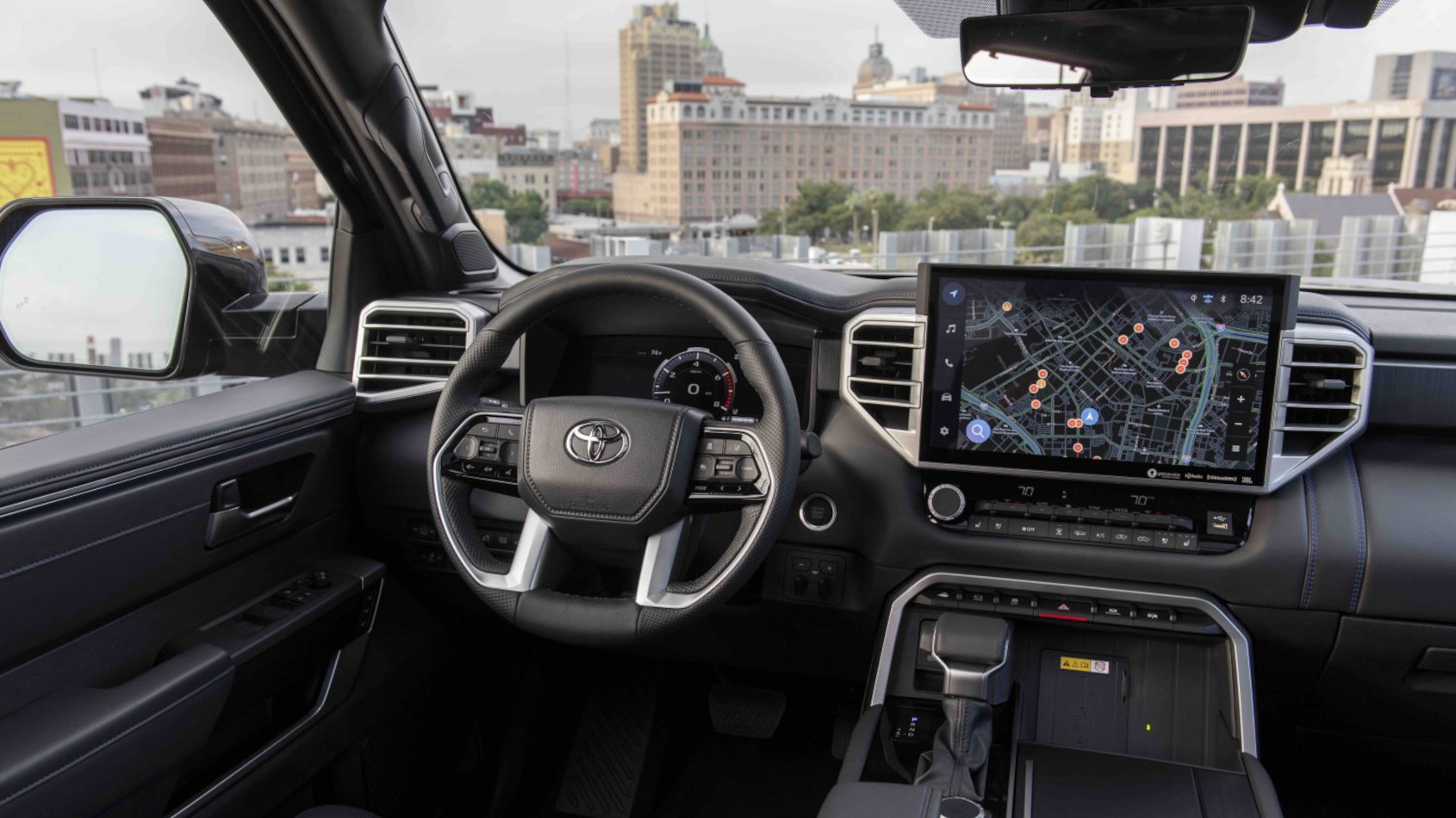
The Toyota Tundra was one of the specific models highlighted in the JD Power 2026 U.S. Tech Experience Index (TXI) Study. Image courtesy of Toyota.
By subscribing, you agree to receive communications from Auto Remarketing and our partners in accordance with our Privacy Policy. We may share your information with select partners and sponsors who may contact you about their products and services. You may unsubscribe at any time.
Carfax recently highlighted how “less complex vehicles” topped its reliability rankings.
Findings from the JD Power 2026 U.S. Tech Experience Index (TXI) Study released on Thursday reinforced why those vehicles would be viewed so favorably.
Amid growing complaints about screen overload in today’s vehicles, JD Power’s research found that owners are most satisfied with the technology that they barely notice
Researchers said smart technologies quietly simplify tasks like starting the vehicle and managing cabin comfort, reducing friction instead of adding complexity behind the wheel.
JD Power explained that features like smart ignition, which automatically starts and turns off the vehicle based on driver actions, and smart climate control, which uses artificial intelligence to adjust the cabin environment for maximum comfort and efficiency, deliver high satisfaction with few problems, while more complex features like hands-free driving systems and passenger screens often add friction instead of value.
“The technology customers value most is often the technology they barely notice because it simply works,” said Doron Hikry, director of customer success at JD Power. “Smart ignition and smart climate control make everyday driving easier without demanding the driver’s attention, while more automation and additional screens don’t necessarily translate into a better experience.
Subscribe to Auto Remarketing to stay informed and stay ahead.
By subscribing, you agree to receive communications from Auto Remarketing and our partners in accordance with our Privacy Policy. We may share your information with select partners and sponsors who may contact you about their products and services. You may unsubscribe at any time.
“For automakers, the opportunity is to prioritize technology that makes driving simpler, not more complicated. The features that solve real problems without adding effort or stress for the driver are the ones resonating most with customers,” Hikry continued in a news release.
The 2026 U.S. Tech Experience Index (TXI) is based on responses from 68,084 owners of new 2026 model-year vehicles who were surveyed after 90 days of ownership. It was fielded from June of last year through May of this year based on vehicles registered from March of last year through February of this year.
The execution measurement examines how much owners like the new technologies and how many problems they experience while using them. The TXI dataset allows automakers to immediately identify the specific technologies their customers consider to be must-have, nice to have or not necessary at all.
Other key findings from the 2026 index included:
Inconspicuous smart tech delivers the strongest payoff
JD Power indicated smart technologies that operate seamlessly in the background are earning high satisfaction among owners while also generating relatively few problems.
For example, smart ignition ranks highest in overall satisfaction and has one of the lowest problem counts (2.4 problems per 100 owners). Similarly, smart climate control and smart driver preferences account for high levels of customer satisfaction and desirability, and low overall problem counts.
More automation doesn’t automatically improve the experience
In the United States, SAE Level 2 (L2) driver assistance systems, which require drivers to keep their hands on the wheel and eyes on the road, outperform more technologically advanced SAE Level 2+ (L2+) hands-free systems on execution and overall experience scores, despite L2+ systems offering more functionality.
While L2+ systems have a slightly lower problem count than L2 systems (13.8 versus 14.3 PP100, respectively), they do not deliver a better overall experience, according to JD Power.
Researchers determined this finding suggests that simply adding hands-free capability does not necessarily translate into greater customer satisfaction.
“The results indicate that owners may currently be more comfortable with systems that clearly assist the driver rather than those that introduce a greater degree of automation,” Hikry said.
Passenger screens offer little appeal to owners
Passenger screens are more common and actively used in premium vehicles, yet they rank among the most problematic technologies in the index (21.3 PP100).
Researchers discovered 35% of owners industrywide who have a passenger screen say they have never tried to use it, while just 6% say they use it every time they drive.
Some vehicles equipped with passenger screens also had higher rates of infotainment system problems in the JD Power 2026 U.S. Initial Quality Study (IQS).
Brand & model accolades
The index also highlighted which brands and models have the best technology, according to the consumers involved in the project.
Cadillac ranked highest overall and highest among premium brands for innovation, with a score of 641 (on a 1,000-point scale). Genesis (559) came in second and BMW (524) landed in third.
Hyundai ranked highest among mass market brands for innovation for a seventh consecutive year, with a score of 524. GMC (470) and Kia (470) tied for second.
The U.S. Tech Experience Index (TXI) also analyzed 40 automotive technologies, which were divided into five categories:
—Comfort and convenience
—Connected vehicle
—Driver assist
—Electric vehicle
—Smart vehicle
JD Power said the smart vehicle category is not award-eligible this year.
The Cadillac Escalade was the premium model receiving the comfort and convenience award for its camera rear-view mirror technology. Toyota Tundra was the mass market model receiving the comfort and convenience award, also for camera rear-view mirror technology.
BMW X6 was the premium model receiving the connected vehicle award for phone-based digital key. Hyundai Palisade was the mass market model receiving the connected vehicle award, also for phone-based digital key.
Genesis GV70 received the award for driver assist in the premium segment for its blind spot camera. Hyundai Palisade received the award for driver assist in the mass market segment, also for blind spot camera.
BMW iX received the award for electric vehicle in the premium segment for one pedal driving. Hyundai IONIQ 9 took the award for electric vehicle in the mass market segment for its EV charging scheduler.