In January, Walser Automotive Group, in partnership with PICO Venture Partners, announced the launch of a cloud-based predictive finance management system fueled by artificial intelligence that’s designed to cut the delivery process down from an average of three hours to 30 minutes.
On Thursday, that company — FUSE Autotech — announced the completion of its $10 million Series A round of financing, led by Target Global. Participation also included PICO Venture Partners, former Auto1 chief operating officer Christopher Muhr and Escavel Capital.
FUSE Autotech said through a news release that this new round of funding will be used to expand its product and R&D teams.
“We are excited to complete this round together with leading auto industry software experts whose significant experience adds enormous value as we scale our company,” FUSE Autotech chief executive officer Colton Ray said. “The investment will allow us to expedite development and focus on expansion.”
FUSE Autotech currently serves more than 100 dealerships in the United States through various FUSE SaaS products. The company is processing nearly $1 billion worth of vehicle transactions per year.
“We are excited to add FUSE Autotech to our mobility fund as we continue to partner with entrepreneurs to transform the automotive industry,” Target Global general partner and vice chairman Shmuel Chafets said in the news release.
“We began this journey with Auto1, which has grown into Europe’s largest wholesale platform for used cars. Today, FUSE’s innovative solutions are reinventing the financing segment of the industry and bringing tremendous added value for dealerships on a path that is set up for rapid growth,” Chafets continued.
Also involved with the company is Elie Wurtman, managing partner of PICO Venture Partners and co-founder of Vroom.
“The automotive industry experience is rapidly evolving on all fronts and one of the biggest opportunities is reinventing the finance process into a fully automated omnichannel experience,” Wurtman said.
“I am excited to work together with Andrew, Shmuel and Chris and to bring our expertise in both the auto industry and scaling software companies to lead FUSE on a quick pathway from launch to scale,” she went on to say.
Car IQ is looking to make payments easier for fleet managers to track and drivers of fleet vehicles to make when they’re behind the wheel.
The company that developed a payment solution specifically for fleet vehicles, on Wednesday announced it has raised $15 million in Series B funding.
Car IQ said through a news release that the round was led by Forté Ventures. Other new investors Ally Ventures, BlackBerry Limited, State Farm Ventures and TELUS Ventures joined existing investors Alpana Ventures, Avanta Ventures, Citi Ventures, Quest Venture Partners and Scrum Ventures.
Car IQ explained its contactless payment network can allow connected cars and trucks to pay merchants and service providers without a credit card. With Car IQ, vehicles can pay for a wide variety of services including fueling, tolling, parking, and more without needing to add extra hardware to the vehicle.
Car IQ’s patent-pending “Know Your Machine” technology is accepted by payment networks and is the foundation for the first machine payment network that uniquely authenticates vehicles, enabling direct vehicle-initiated transactions and payments.
Car IQ is targeting the approximately $650 billion spent annually on vehicle services using credit cards, debit cards, and ACH, where people must perform and manage the transaction.
“Existing payment methods are costly, difficult to reconcile and prone to fraud. Customers cannot authenticate the actual vehicle, the service needs of the vehicle, or validate that the vehicle received a billed-for service. This creates security risks for the fleet operator, merchant, and payment network,” Car IQ said in its news release.
The company highlighted transactions on Car IQ’s payment network have security elements built into the payment stream and are supported by patent-pending technology that enables banks and merchants to authorize vehicle purchases of all types of services autonomously.
The vehicle’s ability to pay for and validate transactions is based on a unique machine identity verification process called “Know Your Machine” that can eliminate the need for human use of credit cards to process the billions spent each year on fleet vehicle services.
“Our solution introduces the next generation of contactless payments, taking the logical step of connecting machines directly to banks and service providers and eliminating legacy processes that are difficult to manage or result in fraud,” Car IQ chief executive officer Sterling Pratz said.
“We believe machine banking is the future, where not just vehicles but any IoT device will be able to connect and pay autonomously — and it’s our technology that will make it possible,” Pratz continued.
Forté Ventures partner Louis Rajczi commented about why the firm decided to support Car IQ.
“Car IQ is already working with a number of the largest merchants, payment providers, OEMs and fleet owners. Our investment will allow them to significantly broaden these relationships, expand into new markets, and add features that will significantly enhance the value of the offering,” Rajczi said.
“We believe that machine payments will become increasingly important, and will expand well beyond the initial focus on vehicles,” he went on to say.
In less than a year, car-ownership app Jerry forged an investment path to value the company at $450 million.
The latest stop on the journey happened on Tuesday when Jerry announced the completion of a $75 million Series C funding round led by Goodwater Capital.
The company highlighted the latest financing was completed just seven months after Jerry’s $28 million Series B round, bringing total funding to $132 million.
Jerry explained that it looks to save customers time and money on car expenses. The company first launched its artificial-intelligence- and machine-learning-optimized car insurance compare-and-buy service in 2019 and today serves more than 1 million customers as a licensed insurance broker in all 50 states.
Jerry said in a news release that this new funding round fuels the launch of the app’s marketplaces in vehicle financing, repair, warranties, parking, maintenance and additional money-saving services.
“We’re helping our customers find savings on car expenses because we believe driving can be kept affordable and accessible,” Jerry co-founder and chief executive officer Art Agrawal said in the news release.
“This $75 million investment accelerates the development and refinement of additional automotive compare-and-buy marketplaces,” Agrawal continued.
Jerry said it can save customers an average of $800 per year on auto insurance policies that are comparable to their existing policy. As the company develops new marketplaces for vehicle expenses and services, the company said the opportunity to further reduce the total cost of vehicle ownership for individuals and families increases.
“Access to reliable and affordable transportation is critical to economic empowerment,” said Rafi Syed, Jerry board member and general partner at Bow Capital, a firm that invests in technology that advances society and betters our world.
“Jerry is helping car owners make the most of every dollar they earn,” Syed continued. “While we see Jerry as an excellent technology investment showcasing the power of data in financial services, it’s also a high performing investment in terms of the financial inclusion it supports.”
Chi-Hua Chien is a partner at Goodwater Capital and described the path Jerry has taken so far.
“Unlike lead-generation-based car insurance comparison sites, Jerry’s recurring revenue model positions the company for predictable revenue and scalable growth that’s not based on an ever-increasing marketing spend,” Chien said. “The company’s super app approach to saving customers time and money on all car expenses also extends the potential customer base across auto-related categories.
“Our re-investment in Jerry reflects our confidence in the company’s business model, growth rate, addressable market, and AI- and ML-based technology that continues to increase gross margins,” Chien continued.
Highland Capital Partners, a venture growth investment firm, brings to Jerry expertise in building successful direct-to-consumer, tech-enabled businesses. Park West Asset Management invests in public and private companies, primarily in technology, consumer and healthcare.
Jerry is headquartered in Palo Alto, Calif., operates offices in Toronto and Lockport, N.Y., and employs remote staff.
“Our oversubscribed Series C round is indicative of consumer demand for frictionless auto services marketplaces,” Agrawal said. “As we reviewed our investor options, we chose to deepen our relationship with Goodwater Capital, Bow Capital and Kamerra, and to add two new investors, Highland Capital Partners and Park West Asset Management.”
Sometimes, one of the most challenging parts of vehicles changing ownership is completing the title work.
Champ Titles is trying to smooth that process and now has more financial resources to do so.
On Wednesday, the technology company that looking to modify the way that vehicle titles are created, managed and transferred in the United States, has closed an $8.5 million Series A investment.
According to a news release, the round was led by EOS Venture Partners and W. R. Berkley Corporation, and it brings the company’s combined funding to more than $17.5 million.
Champ Titles was launched in 2018 and can reduce the amount of time it takes to create, manage, or transfer a vehicle title to just one day.
The company highlighted the money raised will be used to accelerate the distribution of its technology across multiple vehicle title ecosystem verticals and a broader geographic footprint.
“What we are doing here saves not only weeks in processing time but money for everyone,” Champ Titles chief executive officer Shane Bigelow said. “The world is rapidly digitizing, and Champ’s end-to-end vehicle titling solutions are being adopted at a high rate because we significantly reduce the time and effort required to create, manage or transfer the vehicle title. This funding will allow us to roll out Champ Titles faster to more users across the entire U.S.”
“Coming on the heels of the recent announcement of our strategic partnership with Copart, Inc., we are honored to receive investments from such accomplished institutional and strategic investors — W. R. Berkley Corporation, Ally Ventures, Guidewire Software, Inc., and State Auto Insurance as well as great venture firms in EOS Venture Partners, Westerly Ventures, Sadie Ventures, A100x Ventures, and XBTO Humla Ventures,” Bigelow continued. “Their support of our efforts means a great deal to our team, our customers, and to our future.”
Champ Titles solutions are designed for insurance carriers, automotive retailers, finance companies, state governments and others. Products Champ Titles currently has in production include:
— Digital total loss, which can allow insurance carriers to more quickly acquire and dispose of vehicles in instances of total loss by digitizing the process from owner engagement to title application submission, reducing cycle times significantly
— DMV SaaS, which can give state agencies the ability to modernize their title and registration systems, providing significant benefits to all users of these upgraded systems
Mike Nannizzi, a director at W. R. Berkley with responsibility for fintech investments, said, “Transferring title after a total loss is a slow process that involves many parties. Digitization allows the whole chain of participants in a title transfer to cooperate in a secure and efficient manner, and drive better outcomes for everyone involved. Having earned the support of such a strong group of strategic partners — many of which participate in that same chain — we believe Champ’s team and technology are best positioned to execute on this very significant opportunity.”
Jonathan Kalman, a founding partner of EOS Venture Partners and another of the lead investors in the latest round of funding, added: “We are delighted to support Champ Titles. Champ securely digitizes what is currently a complex paper-based process and in doing so they help everyone who is involved in the selling of a vehicle. They are in the right place, at the right time, fulfilling a country-wide need to digitize the transfer of auto titles.”
To learn more about the Champ Titles platform, visit www.champtitles.com or send a message to [email protected].
Startup Carputty wants to “rewrite industry rules” when it comes to auto financing.
The firm now has more than $7 million in funding to get that process in motion.
On Friday, Carputty announced it has raised $7.2 million in a seed round led by Kickstart Fund, which contributed $3 million. The funding round also includes a significant investment from others providers, including Kinetic Ventures, University Growth Fund, Aries Capital Partners and Atlanta-based entrepreneur John Dancu.
“Our mission is a big one: to lift the veil from car financing and provide real-time flexible lines of auto credit in just minutes,” said Carputty co-founder and chief executive officer Patrick Bayliss, an experienced multi-dealership owner. “We’re thrilled about this opportunity to improve the entire cycle of auto finance and provide the consumer with the last auto loan they should ever need.”
Carputty said it will use the funds to enhance its “unique, hassle-free” products.
“Carputty is positioned to rewrite industry rules,” said Carputty co-founder and chief product officer Joshua Tatum, whose decades of experience in consumer lending and technology prompted him to launch the Atlanta-based automobile financing company.
“This available capital enables us to quickly scale while delivering easy-to-use lines of credit and proprietary valuation tools, that allow our clients to treat their cars as the true assets that they are,” Tatum continued.
Carputty currently has two solutions, including:
— Flexline, which can allow consumers to have one or more vehicles on a single platform, all while having interest rates determined by their unique profile versus what a dealer determines with markup.
— V3 Valuation, which can provide predictive analytics to help consumers obtain the best values for their vehicles, saving money by pinpointing the best time to add or remove a vehicle from their Flexline, using past, present and future values to their benefit.
“Carputty is putting the consumer and their household first when it comes to financing new and used auto purchases — all combined with ease of use, quick decisioning, low rates and the ability to place multiple cars in one line of credit,” Dancu said in the news release.
Kickstart Fund Partner Dalton Wright added, “We believe in the vision of Patrick and Joshua to take financing to the next level by transferring control back to the consumer.
“Studies show the top concerns for car financing are uncertainty around the fairness of the loan and a long, difficult-to-understand process. Carputty is focused on delivering a fully digital solution to these concerns in a market that is in dire need of transformation,” Wright went on to say.
Bain & Co. pointed out that companies have typically prioritized the speed at which they implement digital transformations across their organizations to combat digital disruption.
However, Bain experts said these promising digital transformation initiatives often lose momentum and fail to produce the broad impact needed to compete in today’s world.
Through Bain’s annual survey of 1,200 international business leaders, the firm found a growing realization among leadership teams that speed alone is not enough to capture the full value of digital transformation for an organization.
Rather, Bain discovered that companies are now learning to prioritize scaling their best digital services to create lasting impact across their operations. Experts noted that this typically requires retooling an organization’s technological architecture and integrating digital fluency into its business functions.
“Despite launching promising digital transformation initiatives, incumbent companies continue to face old problems such as a cultural divide between IT and business operations,” said James Anderson, a partner at Bain & Co. and leader of its digital delivery practice.
“Companies must start analyzing the needs of their business and begin creatively executing on solutions that promote digital transformation across their entire operating model,” Anderson continued in a news release.
By analyzing companies’ most effective efforts, Bain identifies four key patterns of digital transformation that allow companies to both compete and rebuild in the digital landscape. They include:
1. Laying down the digital foundations
Bain said this component often involves companies that are under pressure to develop new digital capabilities and are essentially starting from scratch.
“The threat is clear and evolving steadily but has yet to produce a burning platform for change. Many industrial companies find themselves in this situation,” Bain said.
2. Integrating a fragmented digital landscape
Bain explained companies that fall into this next pattern suffer from digital fragmentation.
“They have no shortage of digital projects bubbling up across the company, but they lack the ability to prioritize the most promising initiatives and scale them across the organization,” experts said.
3. Digital transformation front to back.
Bain indicated the third pattern also confronts the legacy conundrum in the core business, but the problem, in this case, is different. Rather than a fragmented IT architecture, Bain noted that these companies have years of accumulated systems that were built on top of each other as the business evolved.
“The resulting tangle of tech infrastructure ends up being inefficient and inflexible, slowing down the company’s reaction time,” experts said.
4. Launching a new digital attacker.
Sometimes the magnitude and pace of disruption in an industry require more change than an incumbent company can support, according to Bain. Experts said a company’s size, complexity or resistance to change might prevent it from moving fast enough to remain competitive.
“Increasingly, the answer is to launch an entirely new business to attack opportunities that the core business cannot,” experts said. “A digital attacker is both an offensive and a defensive bet. On offense, it allows companies to enter a new market with a tailored, lightweight solution that is free of legacy baggage.
“On defense, it gives the company a fresh value proposition to attract new customers within its existing market — for instance, aiming at millennials, students and young professionals to build the customer base of the future,” they went on to say.
Laura Polasek, a director within Bain’s digital delivery practice, added these observations.
“There is a tendency for organizations to launch small digital initiatives that ultimately fail to move the needle,” Polasek said in the news release. “Successful digital transformation depends on a balancing act — namely, the ability to scale meaningful change without disrupting the core.”
More details about Bain’s findings can be found via this website.
One of the reasons why Cherokee Media Group expanded Used Car Week to include the National Auto Venture & Investors Conference (NAVIcon) is a development like what surfaced on Monday involving a past Emerging 8 honoree.
Lightico — whose next-generation digital completion platform is used by major companies in the insurance, automotive, telecom and financial industries to help millions of their customers eliminate roadblocks to deal completion — announced an additional $15 million follow-on Series B funding round led by Capital One Ventures.
According to a news release, this development brings the total round for Lightico to $27 million.
Joining the round is Poalim Capital Markets as well as previous Lightico investors lool Ventures, Oxx, Spinach Angels, Crescendo Venture Partners and Mangrove Capital Partners.
The fintech firm said Capital One Venture’s financial investment in Lightico — its second in less than a year — comes after scaling Lightico’s digital solution to fully digitize its own customer-facing interactions.
Lightico highlighted the funds will support the rollout of its Digital Completion Cloud, which can increase speed and conversion rate of customer-facing interactions.
The company explained the remote-first, consumer-focused platform is designed to replace siloed journeys that are slow and out of tune with consumer expectations of a seamless “Amazon” experience for everything.
Furthermore, Lightico noted the customer-centric focus of the platform can provide a superior experience to legacy B2B eSign solutions that were made for a PC-first, contract-focused experience.
“Capital One seeks to consistently provide the best possible digital experience to its customers, and Lightico has been a valuable partner in keeping Capital One Auto Finance at the forefront of our industry,” said Steve Braskamp, senior vice president in Capital One’s auto finance division.
Lightico went on to explain its Digital Completion Cloud can allow companies to gather eSignatures, collect documents, perform ID&V, accept payment and more in an app-free, secure manner through a simple collaboration window opened on the browser of the customer’s smartphone.
These processes can happen effortlessly while an agent is on the phone so that typically high-friction interactions such as insurance onboarding or auto loans are completed quickly and easily without the need for email, printer, fax or in-branch visits.
“Traditional eSign and eContracting solutions weren’t built for the millions of B2C, consumer-focused interactions that happen every day,” Capital One Ventures partner Adam Boutin said in the news release. “Today, companies need to offer start-to-finish journeys that match consumer expectations, allowing them to complete everything from auto loans to insurance claims with just a few clicks on their phone.
“Our investment in Lightico is a result of the demonstrated value of the company’s platform, the rapidly accelerating adoption of Lightico’s Digital Completion Cloud, and its enormous market potential,” Boutin continued.
Along with Capital One, Lightico’s client roster includes MetLife and GlaxoSmithKline. Its solution also integrates into businesses via an open API or through relationships with business systems such as Salesforce and Nice InContact.
“The growth we’ve seen over the past 18 months has been incredible and the value of enabling consumer-facing businesses complete their journeys digitally and quickly has been proven time and again in terms of real ROI,” Lightico chief executive officer and co-founder Zviki Ben Ishay said.
“We’re excited that Capital One continues to be part of our vision of creating effortless, efficient and digitally complete customer journeys will become a reality,” Ben Ishay went on to say.
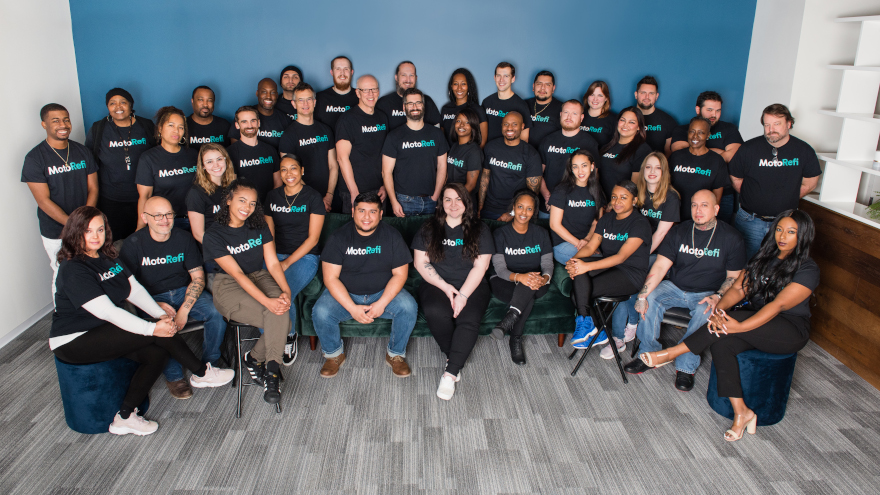
Previous Emerging 8 honoree MotoRefi continues to collect investor funding to accelerate growth and achieve other major milestones.
The auto fintech startup recently announced a $45 million Series B funding round led by Goldman Sachs Asset Management’s Growth Equity team.
MotoRefi works directly with credit unions and other finance companies to enable consumers to quickly and seamlessly refinance their installment contract, saving them an average of $100 a month on their monthly payments.
With the new injection of funds, the company said in a news release that plans to continue its strong growth trajectory by investing in its platform and continuing to expand the team.
Goldman Sachs led the round, joined by new investor IA Capital and return investors Moderne Ventures, Accomplice, Link Ventures, Motley Fool Ventures, and CMFG Ventures.
“We’re impressed with MotoRefi’s rapid growth and innovative approach to this massive opportunity in auto fintech. MotoRefi is building a revolutionary business that helps consumers save money on what has become a major expense in their lives, and we couldn’t be more excited to join the team,” said Jade Mandel, vice president on the growth equity team within Goldman Sachs Asset Management.
Mandel also will become the third woman to join MotoRefi’s Board.
The fundraise reflects steady momentum for the platform, which has included:
— 7 times revenue growth from Q1 2020 to Q1 2021
— 5 times volume growth from Q1 2020 to Q1 2021
— 2.5 times team growth from Q1 2020 to Q1 2021
“In 2020, we proved we are the go-to platform for auto refinance. In 2021, we’re scaling that offering to make auto refinance accessible to everyone- helping more people save money on their car payments,” MotoRefi chief executive officer Kevin Bennett said. “Goldman Sachs is the best in the business when it comes to financial services, and we’re thrilled to partner with Jade Mandel and the Goldman Sachs team on our next phase of growth.”
The news also comes after a series of major company milestones. During the first quarter, the company announced senior hires along with a new headquarters and launched a new technology ecosystem for other financial companies, including a partnership with SoFi.
This $45 million round is a large increase from MotoRefi’s most recent fundraising, a $10 million Series A-1 round in January. With this Series B investment, the company has now raised more than $60 million since its inception in 2016.
TransUnion is trying to show the industry just how focused on information security and consumer privacy the company really is.
The company said its latest example of commitment to build and invest in technology to help businesses and consumers transact in an increasingly digital marketplace arrived recently with a preferred equity investment and strategic cooperation agreement with Spring Labs, an advanced cryptography and blockchain based financial technology firm transforming the exchange of sensitive data.
According to a news release, the companies are collaborating to increase access to Spring Labs’ data exchange network and products, while enabling TransUnion to expand protection of sensitive consumer data and promote transformative technology in its business.
“Spring Labs built a state-of-the-art technology protocol that cryptographically transforms and anonymizes data to unlock new data and products,” said Steve Chaouki, president of U.S. markets at TransUnion, who is joining the Spring Labs board of directors.
“The ability to securely exchange information without revealing the underlying data and identity of network participants creates opportunities for our customers and the consumers they serve through sharing of historically siloed data,” Chaouki continued in the news release
TransUnion highlighted that Spring Labs is “revolutionizing” the way consumer financial data is stored and shared among financial services institutions with a network foundation known as the Spring Protocol.
This privacy-preserving information exchange can return control and value to data owners, unlocking new data sources and enabling competitively sensitive parties to collaborate for the common good.
Spring Labs’ advanced cryptography can allow strict control of information visibility, and its permissioned blockchain can provide a time-stamped, immutable record and audit trail. The company explained this approach can offer a “rare” combination of transparency and privacy, uniquely suited to data exchanges in instances where participants may be concerned about sharing with competitors.
For example, finance companies and lenders can exchange information to identify fraud or verify identities without disclosing underlying data.
“We are thrilled to announce TransUnion’s investment and related cooperation agreement. With tens of thousands of customers, TransUnion is the ideal partner for Spring Labs as a respected global information and insights company that shares our commitment to stewarding sensitive data. We see multiple avenues for collaboration, including the extension of our products, services and network to TransUnion’s customers,” said Adam Jiwan, co-founder of Spring Labs.
“Additionally, by joining our board, Steve will help drive continued growth for Spring Labs through his deep understanding of the business, data and analytics needs of financial services and other industries,” Jiwan added.
At the core of this relationship, TransUnion will help expand existing Spring Labs’ networks to new organizations, as well as develop new networks based on customer needs and interests.
“Our core promise is to make trust possible between businesses and consumers,” said Marko Ivanov, senior vice president at TransUnion and Spring Labs partnership lead. “Spring Labs resolves the challenge of information sharing among competitors without inhibiting competition while providing regulatory transparency and protecting consumer privacy.
“In addition, the flexibility and ease of integration of the Spring Protocol will enable rapid design and deployment of new networks in numerous industries across multiple use cases including credit risk, fraud and marketing. We are excited about the possibilities,” Ivanov went on to say.
Spring Labs recently demonstrated the potential of its technology by deploying a network for data sharing among Property Assessed Clean Energy (PACE) financing providers, launched in the fourth quarter.
Network participants estimate it could save up to $10 million in fraud or 1% of total industry loan transactions.
Separate reports from Bain & Co. and S&P Global Market Intelligence detailed how much the COVID-19 pandemic propelled the adoption of digital tools in banking and financing, cultivating a fertile field for more advancements and investments this year and beyond.
Beginning with the consumer-facing perspective, Bain pointed out that customers have turned to digital channels for all kinds of transactions, including the financing and purchasing of vehicles as well as other banking products.
Experts said that as bank branch visits have dropped, change has led to an increase in the hidden defection of consumers, who are now increasingly buying products from banks and providers other than their primary bank.
Now, depending on the country surveyed, between 25% and 51% of all banking product purchases are going to banks that aren’t the surveyed customers’ primary bank. These are among the findings included in Bain’s latest report, As Digital Banking Takes Off, Hidden Defection of Consumers is Rampant.
Over the past few years, Bain said banks have focused on improving their digital services due to increased consumer demand. Improvements to banks’ mobile apps and websites have paid unexpected dividends for customers during the COVID-19 pandemic, according to the report.
While deposits and core current (checking) accounts generally remain at customers’ primary banks, Bain discovered are losing customers on high-margin products such as loans, credit cards and investments.
“We surveyed more than 56,000 consumers in 11 countries and found that while respondents most frequently cited affordability of a competing offer as their reason for purchasing products from another bank, they also cited better digital tools, a simpler purchasing process and convenience as key reasons,” said Katrina Cuthell, a partner with Bain & Company in Sydney and a co-author of the report.
“These numbers were higher among younger customers, who put an even greater emphasis on digital tools, convenience, branding and security,” Cuthell continued in a news release
If current trends hold, Bain projected that hidden defection will likely intensify in many countries due to the spread of regulations, which will make consumer data portable and thus encourage competition.
The U.K. — which has one of the most competitive banking markets in the world — has the highest defection rate of the 11 countries surveyed. As consumer-friendly, “open-banking” types of regulation take hold in more countries, competition in those markets could intensify. as well, according to Bain’s findings.
“We saw that while some respondents actively search for product options, others respond to ads, with 29 percent of those who defected receiving a direct offer from a competing bank. Of the latter group, 78% said they would be willing to buy from their primary bank if it made a compelling or equivalent offer,” said Gerard du Toit, a Boston-based partner with Bain & Company and the leader of the firm’s global customer experience practice.
“In order to halt the current defection of customers, banks will need to remove the friction that exists in their marketing so consumers won’t feel compelled to shop around, and excel in the basics of opening accounts, so prospective buyers don’t drop off,” du Toit went on to say.
Fintech investment ripe for growth
Now let’s look at the investment angle.
Last year’s favorable market conditions for companies in the U.S. fintech sector are likely to continue throughout 2021, according to S&P Global Market Intelligence’s annual Fintech Market Report.
The new report indicated that the fintech sector not only weathered the storm of the COVID-19 pandemic in 2020, but many subsectors benefited from it, due to the increased use of digital channels by consumers.
Published by S&P Global Market Intelligence’s Financial Institutions Group (FIG) Research team, this report put a spotlight on the current state of digital distribution and fintech.
The report found that changes in consumer behavior driven by the COVID-19 pandemic led to favorable conditions for the fintech sector. These conditions included surges in demand for digital insurance brokers, mobile banking and more.
Coupled with an ample supply of venture capital and the potential for more IPOs and mergers, analysts said the positive trajectory for the sector is expected to remain.
“By now, the fintech sector is probably on everyone’s radar, but the extent to which customers continue to use digital channels after the pandemic passes remains to be seen,” said Thomas Mason, senior research analyst for FIG at S&P Global Market Intelligence.
“At the very least, the pandemic has put a spotlight on both the strengths and weaknesses of digital distribution, offering a stress test of the scalability and fault tolerance of these systems,” Mason continued. “We expect increased digital adoption and the one-stop-shop model to be key themes in 2021, as well as robust IPO and M&A activity in the space.”
Other key highlights from the report included:
— Digital investing: Analysts determined the economic impact of COVID-19 provided a clear windfall to online brokers as U.S. retail investors that already had accounts traded much more heavily, and first-time investors jumped into the action. Charles Schwab, E*TRADE and TD Ameritrade together boosted new accounts in 2020 by 316% in the first quarter and 197% in the second quarter.
— Digital lending: S&P Global Market Intelligence noted the pandemic has been the most significant shock to the non-bank digital lending industry in the past 10 years. Origination volume in the first three quarters of 2020 declined 36% year-over-year across a core group of companies focused on personal lending, small and medium-sized enterprises lending, and student lending.
— Insurtech: Analysts pointed out the insurtech space has been largely unfazed by the pandemic, with many startups still able to grow rapidly, secure venture capital and go public. The creation of insurtech companies that both sell and underwrite policies (also known as full stack) accelerated in 2020, with five property and casualty companies either forming a carrier or announcing the acquisition of one, up from three in 2019 and one in 2018.
—Mobile banking: The latest research found that customers have increasingly turned to their mobile bank apps for basic banking services since the outbreak of COVID-19, forcing institutions to rapidly adjust digital strategies to fill gaps in their offerings. S&P Global Market Intelligence’s 2020 U.S. mobile banking survey found that nearly 58% of respondents indicated that they visited branches less frequently after the COVID-19 outbreak began in the U.S. Overall, 44% of respondents to the survey indicated that they leaned on their mobile banking apps more frequently as a result of the pandemic.
— Mobile payments: The report also mentioned the COVID-19 pandemic has boosted mobile payment adoption in the U.S. and led to record growth among multiple nonbank payment providers. Square’s Cash App saw funds stored in-app grow from $945 million to $1.3 billion in the month of April. PayPal saw net new active accounts nearly double from 3.9 million to 7.4 million in the same month. Both businesses experienced significant growth in users and transaction activity in the months following the initiation of the pandemic.