One automaker accounted for almost half of 2025’s recalled vehicles, report finds
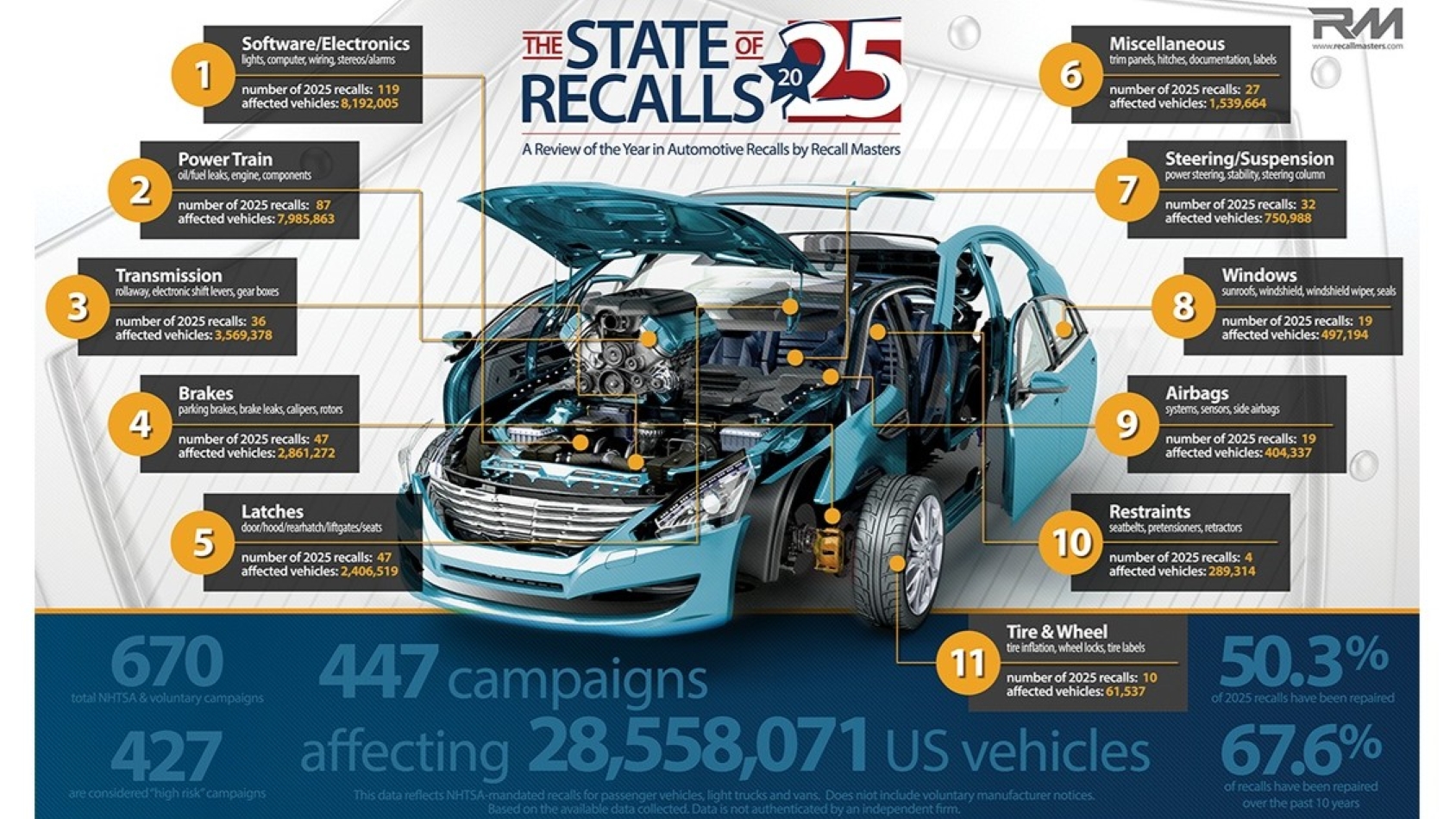
Image courtesy of Recall Masters.
By subscribing, you agree to receive communications from Auto Remarketing and our partners in accordance with our Privacy Policy. We may share your information with select partners and sponsors who may contact you about their products and services. You may unsubscribe at any time.
More than 28 million vehicles were recalled in 2025.
Almost half of them were from one automaker.
The ninth annual State of Recalls report from Recall Masters showed the number of recalls and vehicles affected by them last year was up slightly from 2024, in large part because of a staggering 12.9 million Fords recalled — 45% of the industry’s total — in 146 recall campaigns.
For comparison, the manufacturer with the second-highest vehicle total for the year was Toyota with just over 3.2 million, and no other OEM issued more than 41 campaigns.
Recall Masters, a provider of automotive recall management and retention systems, called 2025 a “disastrous” year for Ford, which dealt with large-scale campaigns affecting tens or hundreds of thousands of vehicles encompassing multiple issues with software, electrical systems, powertrain and safety components.
The report, based on data from the National Highway Traffic Safety Administration, noted Ford had already broken the record for most recalls in a single year by the end of June.
Subscribe to Auto Remarketing to stay informed and stay ahead.
By subscribing, you agree to receive communications from Auto Remarketing and our partners in accordance with our Privacy Policy. We may share your information with select partners and sponsors who may contact you about their products and services. You may unsubscribe at any time.
Overall, the report identified 447 NHTSA-mandated recall campaigns industrywide, as well as 223 voluntary manufacturer recall notices, with software and electronics defects as the major culprits as vehicle technology continues to shift in that direction.
In all, almost 8.2 million vehicles were recalled in 119 campaigns as a result of what Recall Masters termed a “consistent pattern of recalls tied to defects” involving rearview cameras, driver assistance systems, instrument clusters and more.
“The automotive industry’s transformation into a software-defined ecosystem is no longer theoretical,” the report said. “It is here and now, and fully reflected in recall data.”
While software recalls can be remedied by over-the-air updates, the report warned that is not a be-all and end-all.
“While OTA updates offer a powerful remedy pathway, they also introduce new risks: incomplete updates, version conflicts and cybersecurity vulnerabilities can all create secondary recall scenarios,” it said.
Dealerships can be affected as well, according to the report, which noted those potential problems with the updates can require work in the store, creating “a hybrid service model where technicians must possess both mechanical expertise and software diagnostic capabilities.”
Just behind software/electronics are powertrain defects, which rose to some 8 million vehicles affected by recalls involving drivetrain component failures — a “notable shift” that signals “a growing area of concern,” the report said. Those systems often require specialized diagnostics and repair procedures, which means vehicle owners can expect longer repair times and a greater dependence on parts availability.
The good news in the report is a record-high recall completion rate for recalls in their first year. The data showed many 2025 campaigns with repair rates of more than 90%, an improvement over historical averages that have often lagged well below 70% in the first year. Recall Masters said those numbers illustrate a “trend in greater awareness from consumers and impressive vigilance from dealership service departments.”
In all, 50.3% of all recalled vehicles announced in 2025 were repaired by February 2026.
In addition, the longstanding Takata airbag recall seems to at last be fading away. The report found 19 campaigns for the airbags, affecting about 404,000 vehicles, suggesting “a meaningful decline compared to the peak years of the Takata crisis, which once impacted tens of millions of vehicles globally.”
“After nearly two decades of persistent challenges, 2025 may mark a turning point in airbag-related recalls,” the report said. “The 2025 data indicates the industry may finally be moving beyond this prolonged remediation phase. Most high-risk inflators have now been identified, replaced or removed from the vehicle population.”
The report also said increased regulatory scrutiny and testing standards make it far less likely for another such large-scale failure to arise.
The full State of Recalls report and executive summary can be downloaded here.