Annual Urban Science survey shows dealerships are overwhelmingly the top choice for car purchases
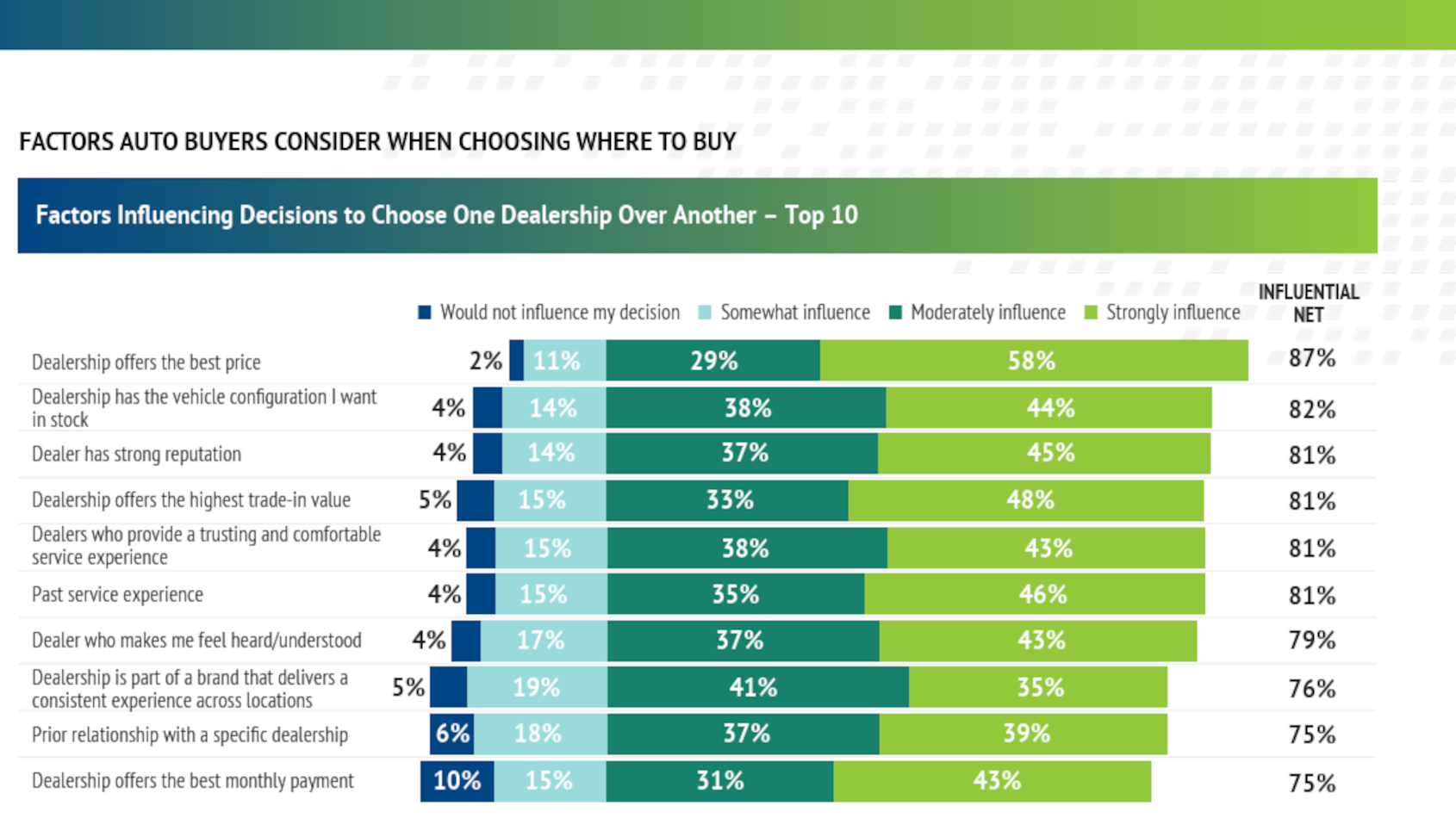
Chart courtesy of Urban Science.
By subscribing, you agree to receive communications from Auto Remarketing and our partners in accordance with our Privacy Policy. We may share your information with select partners and sponsors who may contact you about their products and services. You may unsubscribe at any time.
While findings showed the journey of a vehicle rolling over the curb at your dealership is becoming increasingly fragmented and digital, a top discovery from the sixth annual automotive research study by Urban Science in collaboration with The Harris Poll should make store managers excited.
Urban Science found that nine in 10 U.S. car buyers said a traditional dealership is their top choice for purchasing a vehicle. But researchers also learned that fully online experiences are not out of the question.
In fact, 66% of car buyers indicated they would consider purchasing directly from a traditional dealership’s website.
Among other top survey results released on Wednesday, they included:
—Dealer confidence remains high, with 74% believing they play an essential role in the new-car buying journey and 63% strongly agreeing the traditional car dealership is optimized for the future. Car buyers, on the other hand, are less convinced, but their sentiment grew more positive year-over-year.
—Economic pressures are notably shifting how consumers shop. Nearly one-third (31%) of consumers prioritize price and value over brand loyalty. As a result, 44% of car buyers spend more time researching before contacting a dealer, and 25% are more likely to buy entirely online than they were a year ago.
Subscribe to Auto Remarketing to stay informed and stay ahead.
By subscribing, you agree to receive communications from Auto Remarketing and our partners in accordance with our Privacy Policy. We may share your information with select partners and sponsors who may contact you about their products and services. You may unsubscribe at any time.
—When choosing which dealership to purchase from, potential buyers consider many factors. Still, price and vehicle availability win out, with 59% saying they would drive further to get a better vehicle price.
In comparison, almost half (45%) of U.S. auto buyers say they would be less willing to travel far for service as for a new-vehicle purchase.
—Federal policy changes have impacted electric-vehicle readiness among car buyers.
Urban Science indicated 36% of respondents said they are now less likely to purchase an EV and nearly half (47%) said they will never be ready to accept an EV. This hesitancy is contributing to a split in powertrain preferences among auto buyers and dealers, with a majority (60%) of the latter excited about EVs.
—While EV readiness declined among car buyers, longstanding barriers to purchase continued to decline.
Range anxiety was down 4% year-over-year and worries about charging time and high MSRP were down 4% and 3%, respectively. Auto buyers are increasingly turning to hybrids, and 31% think automakers should prioritize them until challenges with EVs are fully addressed.
Conducted in January, the latest Urban Science Harris Poll survey gathered data from adults aged 18 and older who currently own or lease or plan to purchase or lease a new or used vehicle in the next 12 months, including 3,012 adults from the United States, 1,001 from Germany and 1,001 from the United Kingdom.
In addition to the car-buying public survey, data was also collected from 252 franchised dealers across the United States with the title of sales manager, general manager or principal/VP/owner.
“While affordability-related worries have begun to ease over the past year, capturing service and sales revenue across the automotive retail landscape remains challenging. Auto buyers are more willing to cross-shop across brands, dealers and marketplaces, extending the buying journey over one to three months,” said Amy Bowering, who is global marketing director at Urban Science. “In response to these shifts, dealers are making significant investments in digital media, bringing more data to their disposal than ever before.
“Often delayed, this data leaves automotive firms without the real-time insights they need to sync offline sales with digital spend, accurately validate ROI and optimize future campaigns,” Bowering continued in a news release. “The key to navigating this complexity lies in leveraging the power of daily sales data to sell more cars, drive efficiency and increase profitability across service and sales operations.”
Complete survey results can be found via this website.