AI’s potential on display at NADA Show as it expands into more areas of dealership operations
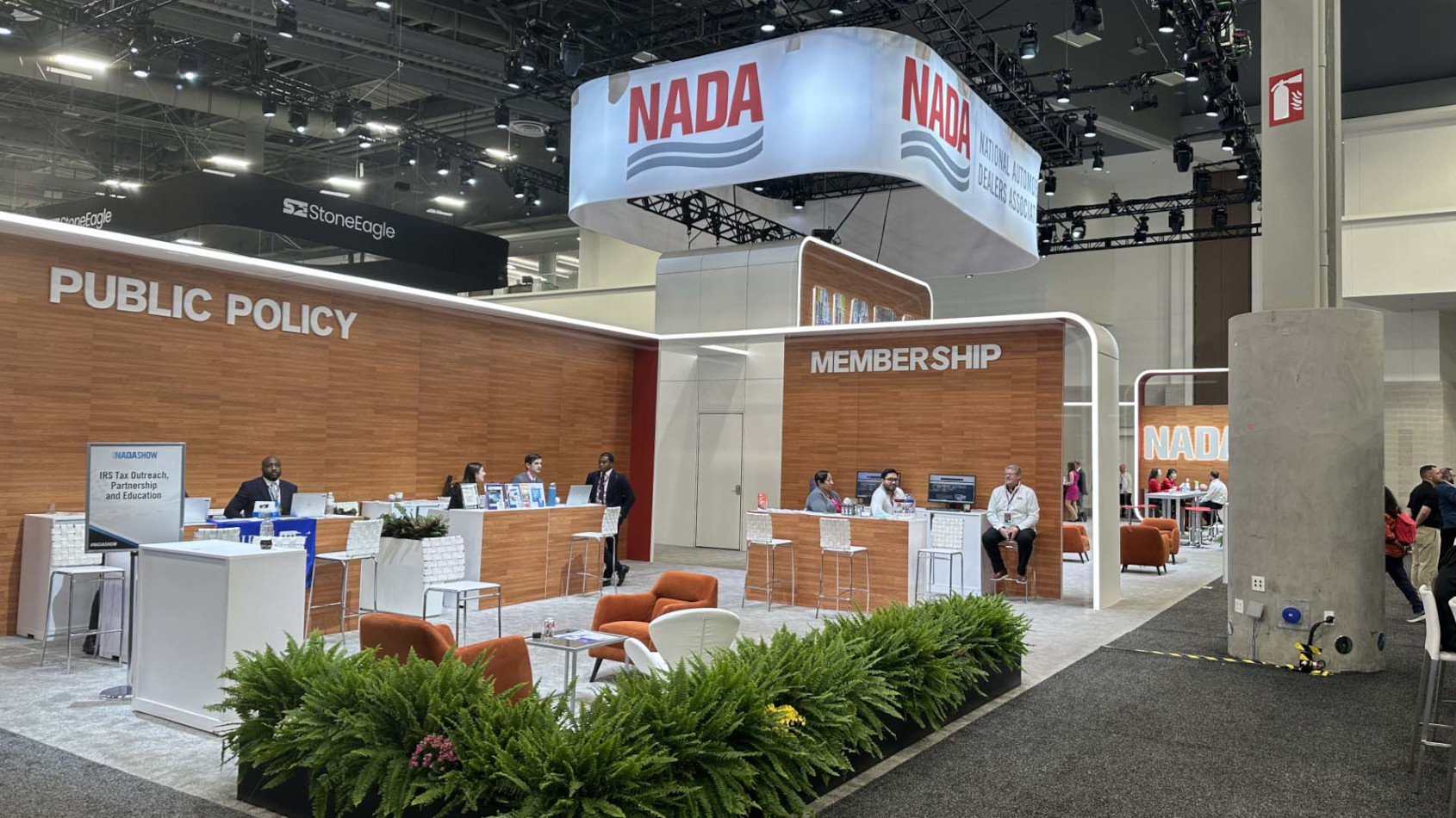
A National Automobile Dealers Association booth at NADA Show 2026 earlier this year. Photo by Joe Overby.
By subscribing, you agree to receive communications from Auto Remarketing and our partners in accordance with our Privacy Policy. We may share your information with select partners and sponsors who may contact you about their products and services. You may unsubscribe at any time.
LAS VEGAS –
Artificial intelligence was everywhere at NADA Show 2026 earlier this year, and one thing quickly became apparent: while AI may have been used primarily as a communication tool, its use cases have quickly expanded to other parts of dealership operations.
From speeding up reconditioning to dynamic pricing for used vehicles, AI is quickly becoming a crucial tool for dealers.
“Today, the major impact of AI is around sales,” Euwart Anderson, EVP and GM, dealerships at Vehlo, a company with a stable of sales and service software solutions, told Auto Remarketing during the show. “Our focus going forward is centered around fixed operations.”
The State of AI in Automotive Retail Q12026 report by DMS provider Reynolds and Reynolds found that 57% of dealership personnel reported using AI “in some capacity as part of their job function.”
Of those dealership personnel, fixed ops personnel had the second highest AI usage rate, at 57%. Only executives and dealer principals ranked higher at 70%.
Vehlo has added an AI element to its Rapid Recon software, which tracks reconditioning steps. “It accelerates the assessment process,” Anderson said. “It now takes hours instead of days.”
Subscribe to Auto Remarketing to stay informed and stay ahead.
By subscribing, you agree to receive communications from Auto Remarketing and our partners in accordance with our Privacy Policy. We may share your information with select partners and sponsors who may contact you about their products and services. You may unsubscribe at any time.
The AI function automates and recommends reconditioning steps and has reduced the time to line from up to 25 days to six or seven days, he said.
Selling more tires
Dealers lose a lot of tire sales to independents. TraXtion aims to use AI to help dealers get some of that business back.
It’s AI-powered optic diagnostic system takes 130 photos of a vehicle’s tires as it enters a dealership’s service lane then evaluates and rates the tires as green (good health) yellow (caution) or red (replacement needed).
“The minute they drive over our system, (the car owner) gets an entire health report,” TraXtion CEO Brad Kokesh told Auto Remarketing at the show.
That prepares the customer for a conversation with the service advisor about tires, even if it is just preparing them to make a purchase in the future, he said.
If a tire purchase is imminent, TraXtion offers three options based on price through its integration with Dealer Tire, which distributes tires to dealerships.
“We want to lead them to a sale and lead them to be more informed about what tires they should have on that car,” Kokesh said.
Better used descriptions and preserving margins
Reynolds and Reynolds has been “head’s down working on (AI tools) for a while,” Greg Uland, vice president of marketing, told Auto Remarketing at the company’s booth.
AutoVision AI, for example, is Reynolds’ inventory management tool. In the used-vehicle space, it learns what media and words in vehicle descriptions are most effective at engaging customers, said Chris Walsh, Reynolds’ president and acting CEO.
In 2024, Reynolds introduced Spark AI, a unified data layer for all its AI tools.
At NADA, it introduced Rey, an AI agent powered by Spark AI. Rey’s core function is automating high volume, low risk tasks, Walsh said.
In its next phase, Rey will provide support, such when a service advisor needs help with a repair order. He or she can ask Rey for help connecting with the tech center or access to help screens.
Rey can also be leveraged “to provide operational support recommendations such as stocking used vehicles,” he said.
For example, Rey can run a report showing used inventory that is more than 45 days old and selling for less than a certain amount. “You don’t have to do anything,” Walsh said. “Rey does it for (you).”
Taking the emotion out of used-car pricing
Online automotive marketplace CarGurus was also an early AI adopter, CarGurus vice president of product Ben Kasdon told Auto Remarketing in the CarGurus booth at NADA. But AI has “evolved a ton” since it was used to compare prices to market value, he said.
Its latest AI-powered product, PriceVantage, is a used-vehicle pricing tool that was built “with an AI-first mentality,” Kasdon said.
It aims to help dealers proactively manage the price of used inventory on their lots, he said, by analyzing how much consumer demand waxes and wanes, how long the car has been on the lot, and other data.
“We have learned consumer demand signals are a strong indicator of where the market is going to move,” he said.
PriceVantage considers more factors than a human could and identifies where a price adjustment can command as much margin as possible versus time sitting on the lot, Kasdon said.
It can be run nightly, he said, and “you can see how does your price increase or decrease your chance of selling the car?”
Vehicle page views can go up as much as 200% after PriceVantage recommends a price decrease, Kasdon said.
It takes the emotion out of pricing, he said. “The data is clear.”
A shoulder performance manager
AI loves data, the more the better, and Urban Science has “a lot of great industry data,” Tom Kondrat, global lead, advanced analytics at Urban Science, told Auto Remarketing at NADA.
It uses AI to aggregate that data and make recommendations, he said. For example, Urban Science is well known for defection data, letting a dealer know what brand a lost lead bought instead.
Now, Urban Science uses AI to look at additional data and pick out trends and insights to determine why that person defected, Kondrat said.
Urban Science also has access to close to 99% of all Certified Pre-Owned retail transactions, he said, and is building AI to analyze and summarize trends in that space, as well.
Dealer are “just dipping their toe in the water” of AI possibilities, Patrick Janes, AVP of vAuto inventory solutions, part of Cox Automotive, said in an interview just before NADA.
“You think this is a revolution, but when you hear people say this is just beginning, it makes sense,” he said.
In used-car sales, Janes figures AI will continue to improve dealers’ ability to price their used inventory.
Last year, Cox partnered with UVeye, which used AI to scan vehicles and subjectively assess reconditioning needs and costs.
“This is the piece dealers often miss,” he said, and they underestimate the recon cost by $800 on average.
UVeye data has been integrated into vAuto’s appraisal process, and several dozen dealers are testing it, Janes said.
At NADA, Cox Auto launched its next-gen Virtual Assistant which uses vAuto and UVeye data and its VinSolutions Customer Relationship Management system to help dealers more quickly acquire used inventory.
“Dealers are going to have a performance manager on their shoulder,” Janes said.