
CarGurus faces NYC lawsuit over listings called ‘great deals’
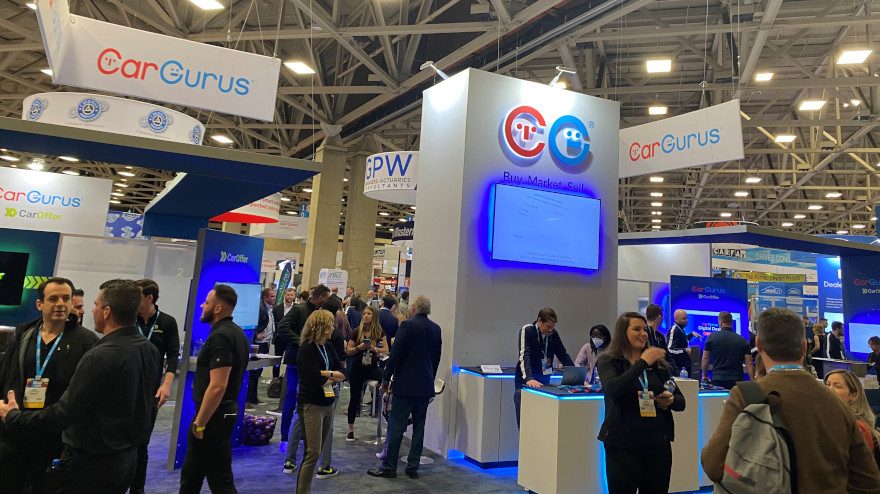
CarGurus booth at NADA Show 2023. Photo by Joe Overby.
By subscribing, you agree to receive communications from Auto Remarketing and our partners in accordance with our Privacy Policy. We may share your information with select partners and sponsors who may contact you about their products and services. You may unsubscribe at any time.
Online vehicle listings that include terms such as “good deal” or “great deal” are the crux of a regulatory enforcement lawsuit filed against CarGurus on Thursday.
And the lawsuit surfaced about two weeks after CarGurus rolled out the latest addition to its dealer platform — VINMax — that extended its consumer demand data and artificial intelligence-powered predictive capability into marketing for the first time.
The New York City Department of Consumer and Worker Protection (DCWP) charged CarGurus with deceiving customers by advertising falsely reduced prices as “Good Deals” or “Great Deals.”
According to a DCWP news release, CarGurus is “hiding hundreds or thousands of dollars in additional fees, down payments, and trade-in requirements. The company uses its misleading price ratings system, as well as an AI chatbot, to dupe people into believing that they are receiving a bargain on a car.”
Officials said CarGurus violated the New York City Consumer Protection Law more than 2,000 times over the course of their investigation.
The lawsuit, filed in New York State Supreme Court, seeks to permanently stop CarGurus from “deceiving” New Yorkers and impose civil penalties.
Subscribe to Auto Remarketing to stay informed and stay ahead.
By subscribing, you agree to receive communications from Auto Remarketing and our partners in accordance with our Privacy Policy. We may share your information with select partners and sponsors who may contact you about their products and services. You may unsubscribe at any time.
Auto Remarketing contacted CarGurus on Friday about the lawsuit, and the company shared a statement from CEO Jason Trevisan, who said:
“We are deeply disappointed that the New York City Department of Consumer and Worker Protection (DCWP) is bringing claims against CarGurus. We’re also surprised they’re taking this step given our history of leading the market in information transparency, our open collaboration with them, and our repeated efforts to engage productively with them.
“Their claims don’t reflect the facts: Since our founding in 2006, CarGurus has pioneered used car price transparency for consumers through tools and features that have since become industry standards. Over the last 20 years, we’ve continued to raise the bar as the leading provider of automotive information, driving others to follow our example.
“Trust and transparency have been core to the CarGurus mission. We’ve led the industry with tools that give shoppers more confidence when making one of the biggest financial decisions of their lives — a responsibility we take seriously.”
Just before the end of June, CarGurus announced a significant dealer policy change that started July 14 in response to vehicle advertising and pricing demands by the Federal Trade Commission.
Site officials previously said used inventory on its platform without disclosed fees will be categorized as “No Rating” and will move lower in search results.
CarGurus then said on July 29 that more than 90% of used inventory from subscribing dealers now includes disclosed fees “with most getting on board well before the deadline.”
However, DCWP said that it found CarGurus failed to take adequate steps to enforce its own guidelines, leading to increased consumer confusion.
According to an example detailed in the news release, a CarGurus listing on the web in June detailed a 2018 Honda offered for sale by Elite Mitsubishi as $2,212 below market value, and thus a “Great Deal.”
“However, at the bottom of the listing was an additional disclaimer section that revealed an itemized list of mandatory hidden fees. The actual price for this listing was therefore much higher, and meant that consumers would end up paying $1,473 above market value,” DCWP said.
In the statement, Trevisan defended CarGurus’ tools, saying:
“We were the first to introduce Deal Ratings that objectively evaluate a vehicle’s list price relative to similar cars in a region across a full spectrum of ratings, ranging from Great Deal to overpriced.
“We provide these deal ratings from an unbiased point of view, rather than using it as a marketing tactic. Because of that, we continue to be the only car shopping site to identify listings as overpriced.
“We maintain the highest standards for Great Deal ratings. CarGurus awards our top deal ratings to a smaller share of used inventory than competitors.
“We were the first to show a listing’s price change history and days on the market. Both give consumers useful information as they search for the right car and connect with dealers.
“We encourage shoppers to rate their dealer experiences and limit reviews to those who can verify they interacted with the dealer, giving consumers an extra layer of transparency when deciding where to buy.
“We provide vehicle history reports which give shoppers a clearer picture of a vehicle’s past, including reported accidents, prior damage, and title status.
“These are just some examples of our legacy of transparency as a marketplace, and they show a clear through line of efforts to provide the most data-rich and transparent consumer shopping experience. Beyond our history, we’re always looking to the future as we recognize that maintaining our position as a market leader is never done.”
And DCWP doesn’t appear to be only targeting CarGurus.
In the past five years, DCWP said it has investigated more than 106 used-car dealerships and secured $1.79 million in consumer restitution.
Officials added a recent analysis of more than 40,000 online listings found that the listed price for a car was marked up on average by about $1,100 in mandatory fees.
And DCWP seems particularly perturbed about what it called “a misleading rating system that lists cars as ‘Great Deal’ or ‘Good Deal.’”
Officials added that consumers encounter “further deception” when they use an AI chatbot available on CarGurus’ website, which also generates lists of “deals,” as the company “profits by giving fake assurances to customers, providing misleading ratings, and supporting these searchable comparison listings.”
Samuel Levine is the DCWP commissioner.
“New Yorkers should be able to trust that a ‘Great Deal’ is actually a great deal. Our lawsuit seeks to stop bait-and-switch pricing, eliminate hidden fees, and ensure customers aren’t getting fleeced when making one of the biggest purchases of their lives,” Levine said about the lawsuit, which can be viewed here.
Trevisan pointed out that CarGurus has continued to invest in and prioritize new tools, technologies, and guidelines to continue providing transparency as regulations, pricing practices, and consumer expectations change. He said recent examples of this strategy include:
—Required dealer fee disclosure: We were the first car shopping site to require that dealers disclose any mandatory dealer fees (not including governmental fees) on used car listings to keep their Deal Ratings. Listings without fee information get a “No Rating” price analysis and are ranked lower in search results.
—Clearer pricing on site: The site added “Price includes fees” and “No additional dealer fees” badges and filters to help shoppers easily identify these listings. Listings without fee information are clearly labeled as “Fees not disclosed,” so shoppers can see and compare all available options.
—Adapting to new risks: Because pricing practices evolve and no system can identify every issue immediately, we are continuously enhancing our tools, processes, and policies as new patterns emerge. This includes ongoing investment in our Trust and Safety team, who use a combination of AI tools and human review to identify potential issues and take action when listings don’t meet our standards (including removing deal ratings, pricing, and even removing dealers from our platform for non-compliance).
—Proactive industry collaboration: We’ve been working with automotive industry associations, dealer technology partners, and federal and state agencies to encourage transparency improvements and share ideas for how to best move the industry forward. As we built our fee-disclosure updates, we worked closely with regulators to better understand their focus on price transparency. We’ve proactively shared best practices with dealer listing-feed providers.
“This reflects the many ways we’re continuing our mission to provide consumers the most trustworthy experience in car shopping, a goal that’s consistent with the DCWP’s mission of safeguarding consumers from unfair, deceptive, and predatory practices. We have shared information with them about our practices; we’ve continued to enhance our policies and enforcement tools; and we will continue to fulfill our mission of being the most trusted and transparent automotive marketplace,” Trevisan said.
“The allegations in the complaint ignore our decades-long track record of setting the standard for transparency in car buying and selling. They also overlook clear evidence of the value consumers find in our features. Shoppers have made CarGurus the most-visited car shopping site in the U.S., and they choose to spend more than double the total time on our site than on our closest competitor’s,” he continued.
“We reject the DCWP’s claims and will defend the company vigorously,” Trevisan added.
CarGurus faces this lawsuit after enhancing VINMax, which can handle targeting and promotion decisions automatically based on CarGurus’ real-time supply and demand data.
VINMax expands CarGurus’ growing dealer solutions across inventory, marketing, lead conversion, and data. Built on the same data and intelligence architecture as PriceVantage and Shopper Signals, VINMax is the first CarGurus product to bring automated, predictive intelligence to marketing.
Using CarGurus’ proprietary marketplace data, VINMax can identify VINs that would benefit most from extra exposure and can promote them automatically on CarGurus and through off-site channels.
CarGurus highlighted that vehicles with strong demand get maximized to capture full value at peak interest, while VINMax catches underperforming inventory early, using consumer demand signals to boost high-potential VINs before they age.
An analysis of VINMax-boosted listings on CarGurus shows the impact, including:
—Vehicles sold nine days faster than comparable non-boosted listings, a 23% improvement in turn time
—Listings also generated 34% more daily leads than comparable non-boosted listings
“VINMax is one of CarGurus’ fastest-growing product launches, a signal of the value it provides dealers in maintaining healthy inventory and strong margins,” said Ben Kasdon, vice president of dealer product management at CarGurus. “Using live market data, it determines where extra visibility can make the biggest difference so dealers can act earlier on VINs at risk of aging while making the most of demand for their strongest inventory.
“Our solutions complement each other to give dealers a more intelligent toolkit across their workflow,” Kasdon added in a news release. “PriceVantage identifies when a price change can maximize margin on a high-demand vehicle or improve performance on slow-moving inventory.
“When a vehicle is priced right, VINMax determines where more visibility can help drive a sale. Shopper Signals then flags the shoppers most likely to buy. Together, they help dealers act earlier and more decisively to protect and grow margin,” Kasdon went on to say.
To learn more about VINMax, visit dealers.cargurus.com/vinmax.