It is late summer 1995 in New York City — one year before its Yankees reignited their baseball dynasty and won their first of four World Series in five years, one year after its Rangers reached hockey’s mountaintop and its Knicks got oh-so-close in basketball.
And meeting in the singles finals of the U.S Open tennis tournament in the city that summer are, arguably, some of the generation’s greatest stars: Pete Sampras beating Andre Agassi in the men’s final, Steffi Graf defeating Monica Seles in the women’s.
What, you might ask, does that have to do with remarketing?
Not a whole lot, other than this:
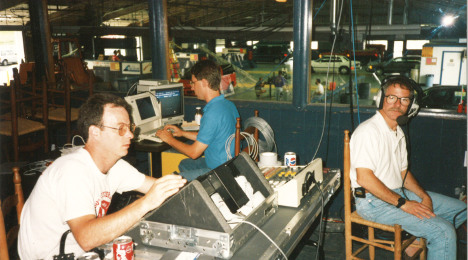
Some of the satellite trucks at that 1995 tennis tournament in Queens would end up, weeks later and some 200-plus miles to the northwest, playing a pivotal role in what is described by at least one account as being the first car ever sold via simulcast.
Executive meeting sparks interest
ServNet has shared an account of the events that happened Oct. 12, 1995 at State Line Auto Auction in Waverly, N.Y.
A few months before that sale, the group’s report says, ServNet’s then-executive director Harry Beyer introduced Campus Group Companies chief executive officer Steve Campus to the auction group.
Campus had technologies that he felt auctions could use; for instance, there was a device that let conference attendees vote electronically, and then those votes could be tabulated.
A large pharmaceutical company was a client of the Campus Group and wanted physicians to be able to use the technology in real time. In essence, doctors at seperate confernces could all vote their opinions at the same time. The Campus Group utilized satellite technology to accomplish this.
Campus thought this might be useful for the auction business, as well, so he presented this to the ServNet group.
Jeff Barber, the owner of State Line Auto Auction, decided to give it a shot, as long as there was interest in the product.
With State Line having been a GM Sponsored Auction since 1989, Barber and Beyer approached then-GM Remarketing director Ford Sims, who gave them the greenlight to use this satellite technology at one of their sales.
Plan moves forward
Some serendipity in all of this: there were already satellite dishes available at GM dealerships, who would be the folks actually bidding at the sale. These stores used them for their parts departments, the story goes.
With this in play, the auction’s sales and marketing team sought out permission to use this existing equipment for remote bidding.
This foundation of the idea bubbled into a project: GM could hold a closed auction, and allow dealers who weren’t present in the actual lanes in Waverly to bid on cars remotely at the same time the sale was happening.
The report explains the technology involved in the project worked like this: Live video was streamed via satellite and audio was streamed through a phone bridge in Kansas. No Internet was involved.
And the satellite trucks transmitting that video signal? Those were the ones that had come from the aforementioned U.S. Open.
Results of sale & legacy
State Line included 400 vehicles at its sale that day, all of which sold. There were 125 bidders who were in the lanes at Waverly, with 15 bidders who chose to test out this new remote bidding from their respective dealerships.
Thirteen of those 15 ended up buying at least one car remotely, and they combined to purchase 45. The first was sold to Farnsworth Chevrolet of Canandaigua, N.Y., which ended up purchasing eight remotely that day. Bob Johnson Chevrolet purchased 12.
So how has the industry been impacted some 20 years later?
Consider this: last year, 17.9 percent of auction sales were Internet-based, according to the 2014 NAAA Annual Review.
Simulcast alone had a 13.8-percent share.
And for the record, Sampras and Graf happened to win a few more Grand Slam titles in the years since.
The Knicks, well, their time is coming.
When Patsy Staub drove by Manheim Pennsylvania auction 28 years ago, she wasn’t sure exactly what went on all day at the mammoth facility that stretches for acres upon acres of Lancaster County.
“And then I saw a job advertisement, and I thought, ‘Oh, I’ll go in and check it out,’” Staub said. “If anybody had told me I would spend my career here, I would have thought, ‘You’re crazy. I know nothing about cars; I’m not a big car nut or anything like that.’”
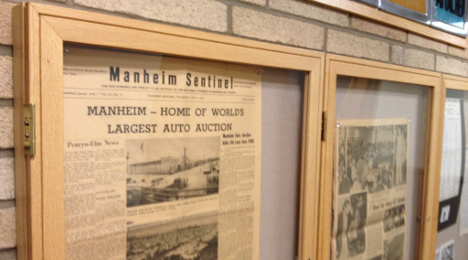
But that’s exactly what happened — and it has been an exciting time these past few decades, said Staub, who is a manager in the commercial accounts department. The auction celebrated its 70th anniversary last week, and Auto Remarketing made the trip to southeastern Pennsylvania to get an inside look at what is said to be the largest auto auction in the world.
“It has grown and changed,” Staub said. “And even though you’re doing somewhat the same process every week, there’s always something different.
“There’s always something new to learn, especially over that time period," she added, referring to her now 28-year tenure at the auction.
Additional opportunities in wholesale
The kind of change that has swept through the auction business and particularly these last few years, certainly brings with it challenges — but also opportunities.
That appears to be the case at Manheim Pennsylvania.
Take, for example, some of the areas of this auction (or any auction, for that matter) that go beyond the buying and selling of cars, like its reconditioning facility or post-sale inspection center.
In fact, the auction was expecting to do between 1,500 and 1,800 post-sale inspections during its anniversary week.
Areas like this can bring additional business opportunities for the auction beyond the actual sale, which could be even more important down the road as the Internet continues to change how cars are bought and sold in the physical environment.
Manheim Pennsylvania general manager Julie Picard said that with dealers backing off, to some degree, from the reconditioning aspect of the business and focusing more on the sales side, the auction has a chance to boost its business through avenues like its paint-and-body shop and detail shop.
“We’ve had some larger dealerships contact us and want us to start doing the reconditioning work in order to make them front-line ready,” Picard said, noting that staffing needs would have to be a big focus to be able to potentially expand the number of shifts in the paint/body shop and the detail shop.
“So, there’s a lot of opportunity there, there really is, to be a 24-7 (resource) for our dealers in any way, shape or form that they need,” she added.
On sale days, those dealers travel from places as far away as Seattle or Dallas, California or Montana. Or right at home in the Keystone State.
“There just isn’t one state, I don’t think, where we don’t sell to, every week,” Picard said.
Long-tenured wholesaler
One of the folks from whom those dealers might be buying is Bob Adcock, the chief executive officer of Adcock Bros. Inc., a wholesaler located less than a half-mile from the auction.
Adcock, who has been coming to Manheim Pennsylvania for 43 years, started out just selling a handful or so cars a week at the auction, only to grow and grow over time.
Today, the company goes beyond just wholesaling, and handles things like auto transport and reconditioning, just to name a few of its additional specialties. According to the company, Adcock Bros. buys and sells between 500 and 700 cars each week.
“It’s not easy, the finding and buying. It takes a lot of effort, and you’ve got to be there,” Adcock said of being a wholesaler. “You’ve got to be consistent with your dealers.
“And they start relying upon you,” he added. “And that’s our benefit … we help them, same as they’re helping us. We’ve got the check right there for them … and that business is behind them now, and then they can go to the next case.”
The exercise seemed simple enough. Or so I thought.
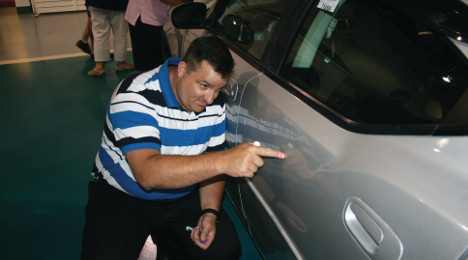
Fill out a condition report on one of the vehicles sitting in the auction arena just outside the classroom at ADESA Charlotte.
While the actual attendees of NAAA's Auction Standards Training class went right to work, knowing exactly where to go as they furiously filled in boxes on the condition report checklist, I had no clue where to start.
And I certainly didn't get very far. Point is, the condition report was far more in-depth than I imagined (a good thing, by the way).
As I came to realize, it was also far more important.
The same goes for entire two-day experience covering the various intricacies of damage analysis and automotive structures
I was there as an observer (and as a very amateurish photographer). The two-day event — led by Matt Arias, the co-chair of NAAA's Auction Standards Committee — went into great detail covering such topics as condition reports, flood/hail damage, disclosures, safety, the material making up a vehicle, restraint systems, types of vehicle structures, how to spot prior repair, collision dynamics and so much more.
Day 1 of the class focused on non-structural elements, and Day 2 dealt with structural damage.
And while the following nugget comes from the structural damage overview for Day 2 specifically, it's a great reminder as to why the information Arias shared is so important: “Early detection will mitigate costly buying and selling misrepresentation, lost customer confidence, time, arbitration-related issues and overall vehicle value loss.”
More information about the next training opportunity can be found on the NAAA website.
With their values down 10.5 percent, entry-level cars have shown the most depreciation of any segment since the beginning of May, according to Black Book. And last week, that downhill movement only continued.
So, given how the supply of off-lease and rental cars is ramping up at auctions — which could potentially drive these prices down further — these soft entry-level car prices are worth monitoring, Black Book says.
Entry-level car values were off 0.93 percent ($61) last week, the company noted, meaning this segment was the biggest decliner among the 24 that Black Book tracks.
“The entry-level car segment continues to drop lower even after experiencing the most depreciation in the last four months,” Anil Goyal, vice president of automotive valuation and analytics, said in Black Book’s latest Used Car Market Insights report.
“It will be interesting to see trends on late-model vehicles as more off-lease and rental cars are beginning to show up at auctions,” he added.
For instance, take this comment Black Book personnel gathered from a Texas man in the lanes last week: “More and more rental cars are showing up in this area. We should see what impact this has over the next few weeks.”
The National Auto Auction Association Convention is just weeks away, and Auto Remarketing is celebrating the annual event and the auction industry with our yearly NAAA Convention issue.
One of the special sections in that magazine (our Sept. 15 edition) is the annual “Auction Life” photo spread, where we invite NAAA-member auctions to submit photos of daily auction life from the past year.
If you and your auction(s) would like to participate, please have photo submissions emailed to Auto Remarketing editor Joe Overby no later than 5 p.m. (EST) on Sept. 4.
If you are sending large or multiple pictures, a zip file or a photo-sharing site might work better.
These photos can run the gamut: We want to see everything from the daily business operations and sales days to the life and fun that occurs at your auction (for example: cookouts, special events, holiday parties, team-building activities, etc.)
They will need to be in high-resolution, JPG format.
Please send captions, if they are available, as well. And while we strongly encourage these photo submissions, we won’t be able to print every photo. However, as a bonus, we will also be running some photos in our digital version of the magazine as an Online Extra.
If you need ideas on what kind of photos to send, last year’s photo spreads can be found here:
http://digital.autoremarketing.com/publication/?i=224921&p=46
Thank you, and see you in Orlando for the convention!
After nearly 8-percent year-over-year growth in the second quarter, auction volume through the first half of 2015 stands 7.3 percent ahead of the levels reached in the opening six months of 2014.
That’s according to AuctionNet data cited by the NAAA’s latest Auction Industry Report.
The report, compiled by NAAA economist Ira Silver, indicates that auction volume climbed 6.9 percent in the first quarter of this year, which was followed by 7.8-percent growth in Q2. (In all of 2014, auction volume climbed 4.9 percent, according to the report).
In the second quarter of 2015, specifically, commercial consignment was up 11.2 percent. Meanwhile, dealership consignment climbed 5.0 percent.
Year-to-date, commercial volume has jumped 10.3 percent, with dealer volume up 4.8 percent.
“The relative strength in commercial consignment is related to the high growth in new sales in past years,” Silver said in the report. “Dealer consignment is increasing at a lower rate than commercial consignment due to its dependence on current new-vehicle retail sales, which are growing at a slower rate than they were in the early stages of the recovery.
“This pattern of relatively strong commercial consignment is likely to continue for at least the next year,” he continued.
Turning to vehicle types, Silver added: “Passenger car auction volume growth continued to outpace light truck volume performance, a trend that began last year.”
Specifically, passenger car volume was up 8.3 percent in Q2, with the year-to-date gain at 8.8 percent. Light truck volume was up 7.3 percent in the quarter and 5.7 percent year-to-date.
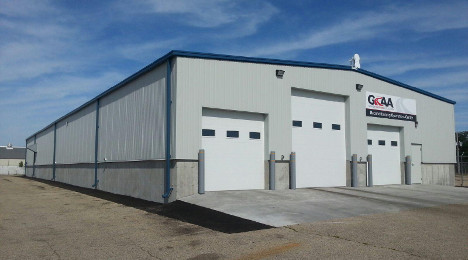
The Greater Rockford Auto Auction has recently opened a 10,000-square-foot reconditioning operations center, otherwise known as “The ROC.”
The new facilities includes three assembly line detail lanes, a full mechanical repair shop and a post-reconditioning photography area.
The auction said The ROC enables it to boost efficiency and capacity in a big way.
“We are excited for the opening of ‘The ROC.’ The facility allows for increased efficiency and capacity and was built with the future in mind. We are mindful of the upcoming volumes of off lease vehicles and are ready to handle them,” said GRAA general manager Chad Anderson.
“The new operations center allows us to better serve our customers and it allows us to move on to our next project of reconfiguring and freshening up our sale lanes,” he added.
And the auction has already started its next project to enhance its facilities: redesigning the auction lanes.
“Our strategic plan is to continuously improve our level of service to our customers and our new reconditioning facility is a step in that direction,” said Anderson.
The largest wholesale auto auction in the world will celebrate its 70th birthday on Wednesday.
Manheim Pennsylvania opened its doors with single lane in 1945 — today, it has 33 lanes as well as digital access, selling over 450,000 vehicles per year.
The auction’s “Manheim through the Years” event will be hosted on Wednesday and Thursday, featuring decade-themed sales lanes dedicated to the business’ growth.
Thursday will end with a Highline sale for dealers in the morning, followed by a dealer appreciation event that evening.
“Our seven decades of success would not be possible without our employees, loyal customers and community support,” said Julie Picard, the auction’s vice president and general manager. “Recognizing this historical milestone allows us to look back at how it all started, as well as consider the exciting possibilities ahead.”
Picard also announced that the auction has selected St. Jude Children’s Research Hospital as the charity of choice for the 70th anniversary events. Brittany Clark, the regional development representative for the hospital, commented on the recognition.
“It’s an honor to be designated as the charity of choice for Manheim Pennsylvania’s 70th anniversary activities,” Clark said. “This auction is steeped in history and demonstrates a deep commitment to serving others, whether customers or charitable organizations such as St. Jude Children’s Research Hospital. We are proud to partner with Cox Automotive and Manheim Pennsylvania and helping them better understand St. Jude’s impact as the hospital continues to lead the way in how the world understands, treats and defeats childhood cancer and other life-threatening diseases.”
More information about the auction can be found here.
Insurance Auto Auctions announced Thursday the expansion of its branch in Austin, Texas.
The facility now encompasses 57 acres and offers what IAA says is an improved auction experience.
Relocated in 2012, the venue began with 37 acres with two covered run-and-drive lanes and 250 feet of covered motorcycle and high-value vehicle storage.
“Our expansion in Austin is exciting for several reasons,” said John Kett, IAA’s president and chief executive officer. “The growth of our state-of-the-art facility provides more storage area and further enhances our unparalleled auction experience by providing our loyal customers a greater inventory of vehicles from which to choose. It also gives IAA additional capacity to handle catastrophe (CAT) situations in the Austin area, helping the community more efficiently recover from disasters.”
The Austin site’s upgrades include enhances sustainability features, such as water reclamation technology for irritation, recycled concrete and reclaimed asphalt.
Looking toward the southeast, Louisiana’s 1st Choice Auto Auction (LAFCAA) likes to characterize its services as “lagniappe.” What is that, you may ask? According to the company, locals will recognize it as a Cajun French word that represents that little bit extra effort that is given to their customers every day.
Complimentary breakfast and lunch on every sale day, free snow cones, charitable efforts, and other extras offered by the auction are what they say makes their company embody the term.
On its calendar of upcoming events, LAFCAA will host its Tailgate Event on August 25 to celebrate the beginning of football season, featuring 1,000 vehicles, over $10,000 in tailgate-related prizes and a guest appearance by Hall of Fame quarterback Jim Kelly.
For more information, visit LAFCAA’s website here.
ADESA highlighted the newest features of its website on Monday, pointing toward making buying and selling more convenient for its customers as the primary reasons behind its updates.
As listed by the company, the changes include:
- Enhanced AutoBid feature. LiveBlock bidders can now add, edit, view and remove automated bids directly from ADESA.com through the addition of AutoBid buttons to the Run List Search Results, Vehicle Details and Watch List pages. And AutoBids can now be entered and changed any time until the vehicle is transacted.
- New LiveBlock Sale Schedule page. A nationwide listing of live auction events is now easily accessible from ADESA.com. Users can hover over “BUY” from the main navigation bar and select “LiveBlock Sale Schedule” to view the new page. Run Lists for individual sale events are accessible from the LiveBlock Sale Schedule page by clicking any number shown under the “Inventory” column.
- Search enhancements. The Search Results entries page will now display multiple promotions for vehicles that are eligible for more than one offer.
- ADESA Market Guide (AMG) subgrouping sort feature. Users now have the ability to sort subgroupings on the AMG Search Results page.
- Back support for sort and search criteria from AMG Search Results page. For users who click the back button on a Web browser or the “Back to AMG Search Criteria Page” link, the previous screen’s sort or search criteria will be retained, eliminating the need to reselect them. This is a user-requested enhancement.
- Registration process updates. A new online Remove User Form allows ADESA.com account holders to easily remove an authorized user.
Stephane St-Hilaire, ADESA’s chief executive officer and president, provided comment on the site’s enhancements.
“Our team focuses on identifying customer pain points and utilizes technology to address those issues,” he said. “We want to provide seamless solutions that make it easier to do business with us. All of the latest improvements to ADESA.com move us forward and deliver on these goals.”
For more information, check out the ADESA website.