Cox Automotive said it will be releasing a Digital Retailing solution on April 1 that will let car shoppers start and agree to terms of a deal with the retailer online, then transition to an in-store process to finalize the transaction and take delivery.
This will be done by partnering some of the services of Dealertrack and Dealer.com with online deal-making platform MakeMyDeal. All three are Cox Automotive companies.
MakeMyDeal will be integrated into Dealertrack’s credit application and its sales and F&I portal, Cox Auto said in Wednesday’s announcement.
This lets the customer safely and easily submit a credit application through the dealership’s website once he or she reaches an agreement with the dealer on the terms of the deal.
Then, dealership staff can work the deal via Dealertrack’s Sales and F&I portal, the Digital Retailing Showroom app, and with CRMs, Cox Auto said.
“Dealers will benefit by giving shoppers a more robust online to in-store experience, all while maintaining control of the deal and improving upon their workflow efficiencies,” said Mike Burgiss, vice president, Digital Retailing, Cox Automotive.
“Our vision is to enable the success of retailers in the evolution from digital marketing to digital deal-making, and onto the ultimate stage — the digital transaction,” he added.
Here’s where Dealer.com comes in. MakeMyDeal will be incorporated into the provider’s websites solution. That is one of a few upgrades Cox Automotive will reveal as part of its efforts to “make the website experience more engaging, secure and efficient.”
Users of eBay Motors will now have the inspection services of WeGoLook at their disposal, thanks to a partnership between the two companies.
Through WeGoLook, eBay Motors will be able to offer on-site inspections on any car, motorcycle, RV, powersport vehicle or boat in the U.S.
Rates will start at $69 per inspection, eBay Motors said in the news release posted to its site.
Buyers can also use WeGoLook to verity the online listings.
And as for folks selling on eBay Motors, the third-party services of WeGoLook can be a way for them to drive buyer confidence.
“When shopping for vehicles online, consumers want the same convenience and services they have become accustomed to receiving when buying clothing or electronics,” said Jay Hanson, eBay’s vice president of North America merchandising, hard goods. “With WeGoLook, we’re providing customers with an additional peace of mind when they buy on eBay.”
String Automotive unveiled enhancement to its Dealer Positioning System (DPS) that can help dealerships proactively execute on the marketing data recommendations the system can provide.
Named Strategy in a Box, String Automotive explained that the new feature takes the bedrock of crucial information that lies within the DPS and delivers precise marketing action items, model by model. The result is step-by-step instructions on how to target the right customers geographically, through the right channels, and with the most targeted message to lift sales.
The company also pointed out dealership management can give these action reports to their internal teams or agencies to execute on the marketing recommendations.
“Our String Automotive clients tell us over and over that they just want to sell more vehicles instead of getting caught up in data. We agreed, and that’s why in 2016 String Automotive’s latest services will crunch the numbers and generate your go to marketing plan, while giving you the exact people to target,” said Ken Kolodziej, String Automotive’s co-founder and chief executive officer.
Utilized by more than 250 dealer operations executives, String Automotive’s Dealer Positioning System can combines multiple sources of data from inside and outside the dealership to provide a rich, actionable plan to gain market share in each geographic area. By showing dealership personnel where they can lift market share, which channel will be most effective in doing that, and what message will resonate best with those target customers, String can help dealerships make the most of their marketing budgets.
“There is no doubt that String gives us an advantage over our competitors,” said Kevin Liles, general manager of Edwards Chevrolet in Birmingham, Ala. “Half of the battle is knowing where to focus our efforts, but Strategy in a Box arms us with so much more, the best medium(s), the best message and the perfect targets for ‘no waste’ advertising execution.”
To find out more about Strategy in a Box, go to www.stringautomotive.com. Dealers also can stop by booth No. 6645N at the National Automobile Dealers Association Conference and Expo in Las Vegas beginning on March 31.
Direct-to-consumer car-buying platform Roadster announced a new service known as Roadster Express that will allow shoppers to buy or lease a new vehicle completely online with the dealer.
Here’s how the process would work for new-car buyers:
- First, the shopper configures his or her vehicle online. He or she can see the entire deal, including fees and taxes, through the Web.
- Second, the shopper can submit a credit application online and schedule home delivery.
- If the shopper has a car to trade in, he or she can chose to have a network of dealers and professional buyers bid on the car.
- Complete transaction paperwork, which the company says can be finished in 10 minutes and from home.
“Nine out of 10 shoppers today dread the car buying process and want to outsource some part of the experience," Roadster chief executive officer Andy Moss said in a news release.
“Pair this with the growing acceptance of buying big-ticket items online and it's clear that the time is now to enhance the new-car buying experience in a big way,” Moss continued. “Roadster Express is the solution that finally brings 100-percent online car buying to market in the U.S.”
Moss added: “Roadster customers are looking for a great price. They also want the convenience of buying a car as simply as everything else they buy online.”
The company works with several dealerships for each brand. Roadster said in its news release it aims to give dealerships “a new and efficient sales channel, delivering closed sales as opposed to traditional leads, with no additional overhead required.”
The price of the car is still set by the dealership; Roadster just facilitates the deal, it said.
Right now the Express solution can be found only on Roadster.com, but the company said an e-commerce solution for dealer websites is in the works.
Roadster Express is currently available on 25 models in California. The company plans to expand to other states and offer different models in 2016.
Roadster also recently launched a trade-in program designed to give consumers an offer within 48 hours. When the new car is delivered, a check is brought to the buyer for the trade-in. The consumers signs documents for that car and gives the Roadster Delivery Specialist the keys.
On Monday, NCM Associates launched the latest software solution to be added the organization’s business intelligence division; a tool dubbed NCM LiveAudit.
The company said the NCM LiveAudit payables monitoring solution, developed by Intelligent Dealer, is a cloud‐based application that can work seamlessly with dealership management systems to provide a whole new way to control a dealership’s cash flow.
Using a complex algorithm to analyze current monthly spending against dealership averages based on NCM Benchmark data — or against self-defined goals — the LiveAudit system can track and monitor spending to ensure transparency, accuracy and a reduced risk of fraud and financial mismanagement.
“As we all know, profit margins in retail automotive are notoriously slim,” lntelligent Dealer chief executive officer Frank Sheets said. “Monitoring outgoing payments always has been important, but too difficult to do efficiently. We’re pleased to address that limitation with NCM LiveAudit.”
NCM Associates went on to mention the LiveAudit platform can collect historical data and learn more about operator’s business while improving how it analyzes dealership spending.
More than just a spreadsheet, the company insisted LiveAudit is a “robust” tool that also can notify dealers of upcoming contract renewals so they don’t unknowingly auto-renew for another year — or longer — with an unwanted vendor.
Additionally, LiveAudit can store associate pay plans to ensure compensation is aligned with dealership objectives.
“NCM is proud to partner with Intelligent Dealer to introduce another auto-industry game changer,” NCM Associates president and chief executive officer Paul Faletti Jr. said. “Between NCM axcessa, and now with LiveAudit, the quality of information available to dealers is unprecedented.
Faletti added that, “axcessa offers dealers an unbelievable level of visibility to critical dealership operational performance. And there’s never been an easier way to monitor dealership spending than NCM LiveAudit.
Through solutions like these, we’re happy to help our clients gain some peace of mind knowing exactly where their hard‐earned dollars are going,” he went on to say.
NCM will demonstrate the LiveAudit system and offer presale discounts at during the upcoming National Autombile Dealers Association Convention & Expo at booth No. 3013C.
To reserve a spot, register online at www.ncmassociates.com/signup.
Cox Automotive on Tuesday highlighted plans for the unification of Dealer.com’s advertising technology, and OEM and advertising partnerships, with Haystak’s customer service model in an effort to strengthen the benefits of its integrated software solutions.
Under the Dealer.com brand, Cox Automotive explained that its automotive retailing clients will have access to a combined advertising offering that sits within what the company described as the “richest data ecosystem in the industry.”
The company indicated Dealer.com will leverage Haystak’s award-winning customer service model to further strengthen the overall advertising solution. Cox Automotive added that existing Haystak clients will continue to experience the same exceptional service and support while benefiting from the best technology in advertising for automotive retailing.
Cox Automotive went on to mention that the current Haystak and Dealer.com products and service offerings will remain the same until the combined product is rolled out later this year.
“As stand-alone products, Dealer.com and Haystak are already the best there is in automotive retail advertising,” Cox Automotive chief operating officer Mark O’Neil said.
“Bringing them together makes the Dealer.com advertising solution simply untouchable in terms of technology, data and service,” O’Neil continued. “This combination provides an enormous competitive advantage for our clients. We are proud to continue to bring forth the best solutions possible as a result of the continual integration across the Cox Automotive platform.”
Auto/Mate Dealership Systems rolled out four new features for its dealership management system (DMS) accounting suite on Monday. The company said the updates are designed to streamline processes that typically involve “countless” hours of labor by accounting personnel.
The company lists the new features as:
— Inquiry screen data entry
— Automated inter-company accounts payable
— Automated inter-company general journal postings
— Cash receipt templates
“A common problem with DMS accounting suites is that the end user is required to navigate through many screens in order to access, enter and change information,” Auto/Mate president and chief executive officer Mike Esposito said. “Our updates make it possible for a user to access everything from a single menu, which greatly reduces the amount of time it takes to accomplish certain tasks.”
The company then went into detail about each of the new updates:
Inquiry screen data entry
Auto/Mate said the inquiry screen is an often-used feature in dealership accounting systems. Personnel use the inquiry screen to research and drill down into cash accounts, expenses and more, as well as to view schedule details and specific transactions.
Now users have the ability to make data adjustments right from the inquiry screen. No longer do they have to back out of the screen and perform a separate function to enter or change data.
Users can also do multi-general ledger inquires within one company or multiple ones as well as build accounting set-ups that allow the user to have predefined sets of accounts they look up regularly.
"The feedback from our customers who have tested this feature is that it's a huge time-saver and they absolutely love it,” Esposito said. “Now they can live and work within that one screen instead of having to navigate back and forth between different parts of the system.”
Automated inter-company accounts payable
This new feature can give users the ability to automatically post expenses across multiple companies or accounts, eliminating the need to manually divide and post individual expenses.
For example, Auto/Mate explained a dealer group with multiple locations might have each store pay a percentage of the monthly electric bill. Previously, accounting personnel would have to manually figure the percentage amount, then log into each company's account to enter the amount due in accounts payable.
“A staff member in an eight-store auto group told us that to reconcile all the inter-company accounts took her an average of two to three days every month,” Esposito said. “Once we set up the system to figure and post all these expenses automatically, her time spent reconciling inter-company accounts was reduced from three days to under two hours every month.”
Automated inter-company general journal postings
This new feature can allow inventory to be moved between companies without having to transfer the inventory manually.
For example, Auto/Mate proposed that if Store A wants to sell a vehicle in Store B’s inventory, previously Store B would have to first “sell” the vehicle to Store A. This process would require a salesperson to generate a deal and the accounting personnel to manually enter several transactions.
Now, this type of inventory transfer can be completed with a simple journal entry.
“It’s not uncommon for an auto group to have an 800-line journal entry to reconcile at the end of every month, which can take hours if not days to complete,” Esposito said. “Automating journal entries virtually eliminates the need to create dozens of manual transactions along with the need to reconcile them.”
Cash-receipt templates
For non-accounting personnel, Auto/Mate acknowledged that entering cash receipts into the accounting system can be challenging if they don't know how or where to post everything. This situation can create extra work for accounting personnel because they must double-check all cash receipts, spend time correcting errors and assign receipts to the correct accounts.
Auto/Mate now allows the accounting office to create user-defined cash receipt templates for each individual or role in the dealership.
For example, a salesperson typically receives payments for a pre-defined list of circumstances, such as a down payment for a vehicle. Accounting personnel can create a cash receipt template for a salesperson that gives them one or two options for how they can post that type of receipt into the system. Every staff member in the dealership can have their own specific template that defines where and how they can post receipts, virtually eliminating posting errors.
The updates also allow accounting personnel to automatically generate a deposit slip based on cash receipts just added to the system.
“On a Monday morning or after a holiday, this can save a significant amount of time compared with having to manually write all cash receipts onto a deposit slip before heading to the bank,” Auto/Mate said.
To see a demo of Auto/Mate's accounting suite, stop by booth No. 1853C at the 2016 NADA Convention & Expo in Las Vegas. Dealers can make an appointment at http://www.automate.com/nada
For more information on Auto/Mate's accounting suite, visit http://www.automate.com/DMS or call (518) 371-4331.
Black Book has signed a partnership deal with DRIVIN to be the exclusive vehicle valuation provider for the company’s proprietary inventory trading platform.
Also, under the partnership announced Monday, Black Book will power the vehicle valuation function of DRIVIN Insights. That tool, which is currently being piloted, allows dealers to take 100 million data points and turn them “into actionable stories for a dealer’s lot and local market, based on consumer shopping trends, local market supply/demand, optimal inventory levels, and unique dealer behavior.”
DRIVIN dealer partners can tap into the Insights tool without paying a subscription fee.
Other pieces of the partnership include the following: Black Book is integrating the DRIVIN Buy Confidence and negotiated inventory widgets into their Black Book Digital mobile application; Black Book and DRIVIN will collaborate on creating data-based insights and used-car trend reports to share with dealer partners.
“DRIVIN is disrupting the used-car industry by offering dealers a better way to source, acquire and receive the right, quality inventory for their lot,” said Black Book’s Jared Kalfus, senior vice president of sales. “We are excited by this long-term partnership and look forward to being their exclusive partner for valuation services, while offering our dealers access to DRIVIN’s pre-negotiated inventory and premier sourcing service via our Black Book Digital mobile app. DRIVIN helps dealers rethink their sourcing strategy and stock the right used cars for their lot based on consumer demand, local market analysis and profit margins.”
DRIVIN chief executive officer Kayne Grau said: “We are proud to join forces with Black Book, a leader in the automotive industry. Using their data and standardizing vehicle valuations across our suite of products, including Insights and Marketplace, will help us better serve the needs of our current and future dealer partners
“Additionally, we are excited to integrate our Buy Confidence and negotiated inventory widgets into the Black Book mobile app, expanding our reach and delivering real value to their dealer network with expanded nationwide access and efficient sourcing,” he said.
The U.S. Department of Transportation’s National Highway Traffic Safety Administration hosted a media conference call on Friday, outlining its current actions and future plans to prepare for the impending legislative needs of the United States in regards to future automated automobile technologies.
NHTSA’s communications director Gordon Trowbridge fielded many questions from journalists and industry analysts, including quite a few trying to get a better idea of when we can expect automated technologies, such as self-driving vehicles, to actually become a widespread reality. In short, Trowbridge made it clear that NHTSA’s role in the situation is to make sure it is prepared when such technologies do become widespread, not to decide when it actually happens.
The fact that the automotive and technology industries appear to be getting closer to making self-driving cars a reality in the next decade is evident, however, and NHTSA says it is taking several further actions to prepare.
One such action is to hold two separate public meetings in April to allow interested parties to come and provide feedback to NHTSA with their concerns and suggestions to help the federal body develop guidelines for the safe development of automated safety technologies.
The first will be held on April 8 in Washington, D.C.; the second will be held later in April at a yet-to-be-disclosed location in California, according to Trowbridge. He says that additional information for the California meeting, including the time, location and how the public can participate, will be released soon.
Trowbridge also said that NHTSA has engaged in a number of conversations with state legislations to get a dialogue rolling to keep the lines of communications open between state and federal governments on the topic of automated vehicle technologies. In terms of who will decide whether a vehicle’s automated technologies are safe, whether it be state or federal authorities, is still undefined.
In a release from NHTSA, Transportation Secretary Anthony Foxx commented on the organization’s goals in this situation.
“We are witnessing a revolution in auto technology that has the potential to save thousands of lives,” Foxx said. “In order to achieve that potential, we need to establish guidelines for manufacturers that clearly outline how we expect automated vehicles to function — not only safely, but more safely — on our roads.”
Establishing operational guidelines is just one of five of NHTSA’s initiatives that Foxx announced in January during the North American International Auto Show in Detroit. Here are the other four, as NHTSA listed in the release:
- President Obama’s budget proposal for a 10-year, $3.9 billion investment in advancing autonomous vehicle technology, including large deployment pilots in communities around the country.
- Working with states to develop model state policy.
- Using NHTSA’s existing authority to interpret current regulations, and offer limited exemptions from those regulations, in pursuit of advances that could increase safety.
- Determining what new regulatory tools and authorities might be required to meet NHTSA’s safety mission in an era of rapidly changing technology.
NHTSA also released its initial assessment of current Federal Motor Vehicle Safety Standards to identify the key challenges ahead between now and the full deployment of automated vehicles.
The report, prepared by the USDOT’s Volpe National Transportation Systems Center, basically found that there are very few existing federal regulatory hurdles for the deployment of automated vehicles that feature traditional designs and equipment that accommodate a human driver, for example those containing traditional controls like a steering wheel, gas and brake pedals, etc. According to Trowbridge, the biggest challenge will be in the area for new automated vehicles designs that don’t feature such traditional designs.
NHTSA Administrator Mark Rosekind commented on the findings of the report in a release from the administration earlier today.
“The Volpe Center report is a great first look at current standards, and it highlights the need for the actions Secretary Foxx outlined in January,” Rosekind said. “It also shows there are few current restrictions on some automated vehicle concepts, which highlights the need to establish clear expectations for their safe operation. At the same time, for other vehicle designs, the agency has more work to do to ensure the safety of new innovations, and we look forward to learning more from stakeholders as we start that work.”
The full report from The Volpe Center can be accessed here.
The future of making cars? Don't blink. It's here.
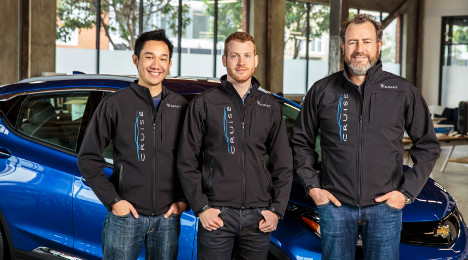
Two of the Big 3 made significant vehicle technology splashes on Friday, with Ford launching a Ford Smart Mobility subsidiary and General Motors purchasing Cruise Automation, a developer of autonomous vehicle technology.
GM recently rolled out an Autonomous Vehicle Development Team, of which San Francisco-based Cruise will be a part. The acquisition of Cruise, which officials said will stay in San Francisco, will likely close next quarter upon meeting customary closing conditions.
The automaker said the move helps it “further accelerate GM’s development of autonomous vehicle technology.”
Commenting in its news release, GM president Dan Ammann said: “Fully autonomous vehicles can bring our customers enormous benefits in terms of greater convenience, lower cost and improved safety for their daily mobility needs.”
Mark Reuss, the automaker’s executive vice president of Global Product Development, Purchasing and Supply Chain, said: “Cruise provides our company with a unique technology advantage that is unmatched in our industry. We intend to invest significantly to further grow the talent base and capabilities already established by the Cruise team.”
This move follows three related steps by General Motors in 2016. GM has partnered with Lyft, launched a personal mobility brand for car-sharing fleets called Maven and rolled out the aforementioned autonomous vehicle development division, the company said.
As for Cruise, it launched in 2013 and quickly started buidling and testing autonomous vehicle technology, GM said.
“GM's commitment to autonomous vehicles is inspiring, deliberate, and completely in line with our vision to make transportation safer and more accessible,” said Cruse Automomation co-founder Kyle Vogt. “We are excited to be partnering with GM and believe this is a ground-breaking and necessary step toward rapidly commercializing autonomous vehicle technology.”
Kelley Blue Book analyst Akshay Anand said in comments provided to the media by parent Cox Automotive that this move illustrates the emphasis GM — and its rivals, for that matter — are putting on autonomous driving.
“The Cruise acquisition shows that GM is serious about autonomous driving, as is almost every other auto manufacturer,” Anand said. “Like it or not, autonomous cars are coming, and coming fast.”
That’s something the industry would be wise to take to heart. Those who don’t adapt could get left out.
“The race to produce a fully autonomous car has accelerated to a breakneck pace. Every automaker is jockeying for position because of the massive opportunity this new technology represents,” said KBB senior analyst Karl Brauer, in the same commentary. “The opposite is also true — a car company that falls behind in this area could end up being the Nokia of the auto industry.”
This “jockeying for position” is particularly evident in the fact that just across town, Ford was making a related (albeit, different — its action was beyond automation) move in creating Ford Smart Mobility.
The subsidiary will operate in both Dearborn, Mich. and Palo Alto, Calif. It will focus on the automaker’s mobility services efforts.
In essence, Ford said the company is striving to be “both an auto and a mobility company.” The new subsidiary gives the automaker a dedicated division to focus solely on those endeavors, while the parent company takes care of the day-to-day business of building cars, says Autotrader senior analyst Michelle Krebs in comments also provided by Cox Automotive.
“In addition to tapping in to new revenue sources, Ford is establishing a framework for all work related to future mobility that allows the rest of the company to focus intently on the day-to-day core business of vehicle manufacturing,” Krebs said.
“Past efforts by Ford to transform to a mobility company failed because the company took its eye of its core business,” she added. “Yet, the work that goes on within the new mobility subsidiary can feed back into the core business when appropriate if Ford does this right.”
In its news release, Ford said the subsidiary will “compete like a startup company” and develop mobility services “on its own.” Ford Smart Mobility will work with start-ups and technology companies, as well, while also building upon the various related efforts already in the works at Ford.
“Working with Ford’s existing product development, research and advanced engineering, marketing and data analytics teams – which will remain unchanged – the subsidiary will develop commercially ready mobility services and invest in promising mobility-related ventures,” the company said in its release.
Ford Smart Mobility will tackle connectivity, mobility, autonomous vehicles, and the customer experience, as well as data and analytics.
Leading the subsidiary will be Jim Hackett, who is stepping down from his post on Ford’s board of directors to become Ford Smart Mobility chairman.
“Ford Smart Mobility and expanding into mobility services are significant growth opportunities,” said Ford president and chief executive officer Mark Fields. “Our plan is to quickly become part of the growing transportation services market, which already accounts for $5.4 trillion in annual revenue. Jim Hackett is the right visionary leader — with extensive experience in business development and design — to take us into the mobility services business in the future.”
Sharing additional insight in his comments provided by Cox Auto, Brauer said: “The challenge for Mark Fields and Ford will be to ensure autonomy from the core business while maintaining sufficient information. This potential to expand Ford Motor Company's understanding of this dynamic space is substantial.
“Mark says the new division will be separate but connected, with a specific governance between the core company and this subsidiary. Ideally the knowledge will stream both directions, with Ford benefiting as much or more from Ford Mobility LLC as it benefits from the mothership,” he added.