Operators now have a clear guide on how to avoid getting into trouble with the Federal Trade Commission.
Cindy Liebes, director of the FTC’s Southeast region, shared what she deemed to be the “seven deadly advertising sins” buy-here, pay-here dealers commit that place them in the center of her regulatory radar.
“No doubt, one of the FTC’s top priorities is protecting consumers in the auto marketplace. However, I’ve also heard from many honest dealers saying they can’t compete with the dealer down the street who doesn’t follow the rules,” Liebes said.
“Regulatory actions against unscrupulous dealers promote fair competition, which is good for any industry and protects the players trying to do the right thing,” she continued.
Liebes will discuss more about compliant advertising and auto financing on the second day of Innovate: The Independent Dealer Industry Conference, hosted by DealerSocket starting on Sunday in Fort Worth, Texas.
Liebes will outline lessons for dealers learned from Operation Ruse Control, an initiative she led where the FTC partnered with 32 other governmental agencies. The regulatory project resulted in 252 enforcement actions against dealers nationwide.
Ahead of her keynote, Liebes shared a list of seven deadly advertising sins, all of which draw suspicion from regulators.
“While I can’t speak about current non-public investigations, it’s important for dealers to know that the FTC is committed to bringing law enforcement actions in the auto industry,” Liebes said. “We don’t pay attention to the size of a dealer either. Big and small stores need to get their house in order.”
According to Liebes, dealers’ violations include:
1. Twisting the facts about add-ons
For example, the FTC recapped a California-based company deceptively claimed in online ads and through a network of authorized dealers that vehicle buyers who purchased its biweekly payment program would save money. Consumers weren’t told that the cost of the add-on often outstripped any savings. This case resulted in a $2.475 million settlement of refunds and fee waivers.
2. Lowballing your pitch
The FTC indicated several dealers recently “crossed the line” by using headlines to tout bargain prices while failing to adequately disclose the true cost of the deal. For example, one Florida dealership pitched “used cars as low as $99.”
But $99 was just the minimum bid for vehicles offered at a liquidation sale, and that didn’t include substantial mandatory fees. The ads also included photos of loaded cars without clearly explaining that some pictures featured — like spoilers and sunroofs — weren’t included in the price.
3. Luring customers with misleading “zero” promises
The regulator explained one California dealer’s deceptive use of zero promised “$0 initial payment, $0 down payment, $0 drive-off lease.” Another ad promised “$0 down, 0 percent APR financing, 0 payments and 0 problems.” But consumers had to pay much more up-front to lease or purchase the cars. And “0 percent APR?” The annual percentage rate for financing those vehicles for the advertised payment was way more than zero percent.
4. Hiding the strings attached to a deal
The FTC mentioned an Alabama dealership highlighted eye-catching prices without clearly explaining what the vehicle would really cost consumers. In some cases, ads featured prices that factored in special discounts or rebates that weren’t available to everyone. For example, some prices applied only to recent college graduates, a restriction not prominently disclosed.
5. Burying key disclaimers in fine print
The regulator pointed out the fine-print footnotes, unclear “disclaimers” that consumers must scroll down to see, or other buried information won’t live up to the FTC’s “clear and conspicuous” standard. Advertisers often ask how big a disclosure must be, but it’s more than a matter of font size. A clear and conspicuous disclosure is one sufficient for consumers to actually notice, read and understand.
6. Ignoring applicable credit laws
The FTC noted one common pothole is using certain “triggering terms” under the Consumer Leasing Act, Truth in Lending Act, Reg Z or Reg M without making required disclosures. For example, if operators advertise monthly lease payments, that kicks in a requirement under the Consumer Leasing Act that you disclose other facts about the transaction — like the total amount due at lease signing; whether a security deposit is required; and the number, amount and timing of scheduled payments.
7. Violating prior orders
The FTC may seek monetary civil penalties for violations of prior FTC administrative orders. For example, the FTC recently brought two actions alleging violations of administrative orders, which prohibited dealers from deceptively advertising the cost of buying or leasing a car. One action resulted in the dealer group paying a hefty civil penalty, and the other action is pending. These actions show that there can be a financial cost for violating FTC orders.
To get more detailed, real-world knowledge on BHPH compliance, operators can join Liebes and other legal experts at Innovate: The Independent Dealer Industry Conference. The show will feature more than 80 different classes — all more than one hour long — that dive deep into compliance, technology, collections, finance, accounting, operations and more.
“In total, attendees will access more than $10,000 in legal insight for the price of admission,” organizers said.
DealerSocket expects more than 600 attendees at this year’s conference, including major exhibitors and financial institutions that will showcase the latest dealership technology, best practices and industry solutions.
To view the full schedule or buy tickets, visit www.MyInnovate2015.com.
AutoStar Solutions isn’t trying to dampen the Christmas spirit buy-here, pay-here operators might have, but chief legal officer Steve Levine warned dealers of what he described as a potential “Grinch" — regulators such as the Consumer Financial Protection Bureau, the Federal Trade Commission and state attorneys general.
Keeping with the mood of the season Levine shared what he called 12 Days of Dealership Compliance, a rundown of steps BHPH operators can take to keep regulators satisfied.
“The government crosshairs on auto dealers is not going away. In fact, it’s only intensifying,” Levine said. “For dealers big and small, the threat is real, and so is the learning curve.
“This 12-step checklist will give dealers the starting points they need to keep the big government Grinch at bay,” he continued.
• DAY 1: Document the pertinent facts. Protect your dealership from the start, when facts are fresh on your mind and you don’t have to rely on memory. Keep detailed notes about the transaction, negotiation process and customer. They may come in handy later.
• DAY 2: Keep a centralized compliance manual. Type out all your processes, procedures and other compliance-related documentation, then compile them in a large three-ring binder. If a regulator comes to visit, this book should be one of the first things you show him or her. It’s a clear sign that you understand the importance of compliance, and you’ll get big points for effort.
• DAY 3: Get to know your regulators. If you develop a positive relationship with your assigned regulators, you may be surprised at the courtesies they pay you – such as a heads-up phone call when they receive a complaint.
• DAY 4: Hire a specialized attorney. Just because you share a long history with your current attorney doesn’t mean he or she is the right person for automotive regulatory issues. Are car dealers his or her specialty, or just one of the many types of clients in his or her practice? Regulatory compliance is a highly detailed, ever-changing area of the auto industry. As a result, some lawyers who don’t fully understand the car business have unknowingly implicated their clients. Is that a risk you want to take? If you decide to switch, consider an attorney who is an active member of the National Association of Dealer Counsel.
• DAY 5: Reframe your view of complaints. In reality, complaints can be a gift. They may feel annoying, but many of the people who come to you first will complain to a regulator or lawyer if the matter isn’t resolved. In fact, 90 percent of state Attorney General investigations originate from complaints. So consider them a golden opportunity to fix the problem and prevent a regulator from ever hearing about it.
• DAY 6: Audit your deal jackets before turning them over. If you receive an auditor letter asking for a certain number of deal jackets in various categories, by all means, ask your attorney to hand-pick the ones without compliance issues. And only turn over what’s legally required. Miscellaneous handwritten notes or other extraneous documents can implicate you and cause further action unnecessarily.
• DAY 7: Implement progressive discipline for rogue employees. Never, ever turn a blind eye to employees who break compliance rules. If you don’t discipline (and document it), regulatory agencies will hold you accountable for your employees’ mistakes.
• DAY 8: Proactively right your wrongs. This is not the time to shove problems under the rug and hope no one notices. The minute you find a compliance issue, if you can fix it monetarily, do so. Then keep records of any refunds, and tell the regulator if he or she comes knocking.
• DAY 9: Get your advertising house in order. Non-compliant ads and direct mail pieces give regulators a foot in your door, after which they may start poking around in other areas. It’s best to read up on advertising compliance and consult an auto dealer attorney to avoid further trouble.
• DAY 10: Pass on your knowledge. All the understanding in the world about compliance issues means nothing if your staff doesn’t share that knowledge. Regulators will investigate whether you train your team to comply, or set policies just for show.
• DAY 11: Assume your regulator has little to no experience with dealerships. State Attorneys General, for example, oversee so many industries that most of their lawyers possess only a basic understanding of the auto world. It’s your job to help them understand how things work, and why.
• DAY 12: Be as nice as humanly possible. Some dealers take a risky approach with regulators … confrontation. It simply doesn’t work. The government possesses all authority and leverage in this situation. But they are people too, so behaving as kindly as you can muster will go a long way.
Operators can gain an in-depth compliance education by joining Levine and some of the most-respected automotive compliance experts in the country at the next Innovate Conference, coming next fall. Dealers can sign up to get conference updates, ticket information, a list of speakers, the full breakout schedule and more at www.myinnovate2015.com.
Compliance technology provider SecureClose wrapped up AutoStar Solutions’ seventh annual Innovate conference on Wednesday with a list of 10 recommendations for how to significantly decrease risk from lawsuits and government actions pertaining to the F&I closing process.
Brent Chavez and Joe Perkins of SecureClose first cited the latest move by the Consumer Financial Protection Bureau to expand its supervision to large non-bank auto finance companies. Chavez said dealers and finance companies have experienced more expansion of government regulation in the last several years than at any other time in his career.
As a result, Chavez urged dealers to:
1. Record your sale closings.
2. Script your disclosures.
3. Document your training.
4. Establish clear processes and procedures.
5. Get an outside compliance review.
6. Appoint a compliance manager.
7. Develop a customer complaint procedure and log.
8. Manage your vendor compliance.
9. Automate processes for improved accuracy and consistency.
10. Implement a proactive review process to catch violations before it’s too late.
“As a car dealer myself for more than 20 years, I understand the pressures dealers face on a daily basis,” SecureClose founder Ace Christian said. “To be quite honest, the last five years have been the toughest for me due to changes in the market, increased competition, hard-to-find inventory and the biggest one — government regulation.”
Christian said the F&I office is one of the most heavily regulated areas of a dealership. With so many constantly changing checklists and disclosures — combined with the element of human error and fatigue at the end of a long day — Christian acknowledged violations are bound to happen.
Christian said dealers need a way to automate the closing process to ensure consistency, along with a reliable method to record closings and store them for easy access.
“Video recordings by themselves are not a complete solution,” he said. “I can’t tell you how many times I’ve seen dealers videotape closings that — when watched back later — clearly show violations. Not to mention the technical difficulties inherent with quality video coverage and storage.
“Training also doesn’t fix the fact that your F&I guy is a human being,” Christian said. “After a 12-hour day, he’s tired. He wants to go home. The customer wants to go home. So maybe he forgets a point or two. What’s the big deal? Well, when that forgetfulness comes back to bite you in a year after the customer has sued and that F&I guy no longer works for you, it is a huge deal.”
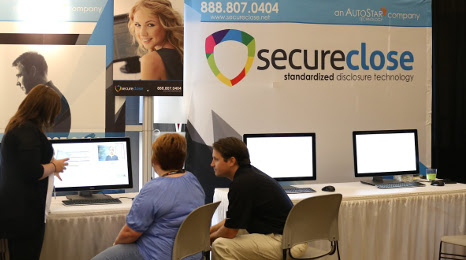
Christian demonstrated for attendees how SecureClose can help dealers ensure every closing is fully compliant by utilizing computer screens that verbally walk customers through each closing document. He explained all information used adheres to the latest national and state-specific regulations. Buyers can pause or rewind as many times as they wish to make sure they understand the contract terms — but no fast-forwarding or skipping any steps.
An electronic signature tablet captures signatures and places them in the appropriate spots in the document. A front-facing camera records audio and video of the entire process, including everything shown and done on the system screen.
Once the presentation is complete and all documents signed, audio and video of the customer plus the recording of the on-screen activity can be combined in a comprehensive ClosingRecord, which is stored on a secure online server for future retrieval. The dealer or customer can view this complete record at any time.
“SecureClose protects the customer and the dealer from being taken advantage of,” Christian said. “It’s the answer to most of the regulations coming out of Washington, D.C., right now. And it’s certainly a vital component of any dealership that wants to stop lawsuits before they start.”
Christian has used various versions of SecureClose at his dealership in Arizona for the past year.
“I received several attorney demand letters during that time. I just sent them the ClosingRecord for those deals, and I never heard from them again,” Christian said.
Steve Levine is chief legal officer for AutoStar Solutions, which acquired a 50-percent stake in SecureClose earlier this year. Levine is expecting finance companies will champion SecureClose to their dealers.
“It’s not just a buy-here, pay-here solution,” Levine said. “When retail dealers use this product, finance companies can have confidence their dealers conducted a fully compliant closing. That means no complaints from the consumer six months down the road, after the lender has already acquired the contract.”
SecureClose is available nationwide. Levine said the company is following an aggressive installation schedule to make SecureClose available to dealers of all sizes.
Collecting More During Payment Proccess
Elsewhere at the Innovate conference, Susan Perlmutter, chief revenue officer for Sigma Payment Solutions, shared with BHPH dealers several strategies for lowering the costs of payment acceptance.
“Once you combine a collector’s hourly pay, overhead and the cost of the credit card payment, you’re looking at more than $6 per payment,” Perlmutter said. “You can offset that amount by allowing a provider such as Sigma to pass a convenience fee to the consumer.
“The other option is self-service consumer payment channels,” she continued. “This empowers your customer to pay with no staff interaction. No human error, no vacation or sick days. You can accept payments 24 hours a day, seven days a week, 365 days a year. Your collectors can then focus their attention on delinquent customers.”
Sigma Payment Solutions’ automated options include pay-by-text, kiosks and Interactive Voice Response (IVR). Perlmutter pointed out each of these choices can help dealers bring costs down to 55 cents per payment — a savings of about $5.75.
Strategy for Small Dealers
David Brotherton, consultant and 20 Group leader at Leedom & Associates, led a class teaching smaller BHPH dealers and focused on ways they can “level the playing field” against larger competitors. Brotherton offered three tips:
1. Learn as much as you can about the customer. The more you know about your potential buyer, the greater your chance to get them sold. Once they visit your dealership and hear your program details, you have a tremendous advantage over the dealer down the street — so don’t waste the opportunity.
2. Measure activity levels before results, at least initially. Activity will ultimately yield results, so pay more attention to follow-ups, phone calls, emails and in-person visits. Get those numbers as high as you can, execute well, and results will follow.
3. Invest in a comprehensive Customer Relationship Management (CRM) system. Whether you sell 10 vehicles or 200 vehicles per month, you must use a CRM to legally and effectively communicate with your customer base. For example, using a fully compliant CRM with a texting feature will protect you from a devastating lawsuit settlement because you didn’t strictly adhere to the CAN-SPAM Act.
Full-length video of all the Innovate general sessions will be available soon on AutoStar Solutions’ YouTube channel.
Thanks to the power of the Internet and regulatory zeal for them, consumer complaints boast a shelf life that’s more on par with red wine than red roses. Disagree? Consider this story Terry O’Loughlin shared earlier this year.
O’Loughlin, now the director of compliance at Reynolds and Reynolds, spent 16 years with the Florida attorney general’s office. His first trial was against a dealer, who eventually ended up with a prison term of eight years. O’Loughlin specialized in automotive cases before leaving the Sunshine State’s top prosecutorial department in 2006.
Then two years ago, O’Loughlin received a notice from his former employer to return to the attorney general’s office because a large FedEx package arrived for him. Turns out, it was a consumer complaint stemming from an incident nearly a decade old. O’Loughlin handed the material back to the Florida attorney general since the complaint still fell in its jurisdiction, and officials pursued the matter.
“Consumers, they’ll finally figure out where to file a complaint,” O’Loughlin told dealers gathered in Las Vegas earlier this year at the Compliance Academy hosted by the National Alliance of Buy-Here, Pay-Here Dealers.
“They might not send it to the right place initially, but they will, and it may affect you,” he added.
During his presentation, O’Loughlin mentioned research that indicated consumer complaints associated with the automotive industry — including vehicle performance and service by dealerships and finance companies — have been ranked No. 1 in volume for 19 of the past 20 years. As a result, he insisted that government agencies — especially the Federal Trade Commission, the Consumer Financial Protection Bureau and attorneys general — are watching for complaints and making them the basis for regulatory enforcement actions.
“Right now, you are under the gun,” O’Loughlin said to a ballroom full of buy-here, pay-here dealers.
With that situation in mind, O’Loughlin joined a host of other legal experts and consultants who all have reiterated to BHPH operators of all sizes — handle complaints quickly and with the most prudent strategy possible before they snowball into more significant problems.
“If a consumer files a complaint in writing, consider it a ransom note,” O’Loughlin said. “It could be to you because if you don’t correct that problem, somehow it might become very expensive.”
How Complaints Fuel Activity
During his presentation, O’Loughlin highlighted the most popular path consumers are using to lodge complaints again dealers — regulatory agency websites. He pointed out the prominent position complaint gateways have on the sites hosted by the CFPB and the FTC.
O’Loughlin didn’t have the time to go state by state, but he showed how the attorneys general in New York and Florida have followed the same strategy established by their federal brethren in terms of how to set up their online portals to funnel consumer complaints their way.
“An attorney general can enforce almost any law he wants. The CFPB and FTC have much stricter mandates. It all depends on consumer complaints,” O’Loughlin said.
“What does the CFPB promise to do? They promise to mediate, but what they’re really doing is collecting data against car dealers,” he continued. “The FTC does it a little differently because they say the FTC cannot resolve individual complaints but have tips to your money back.
“So why is the Federal Trade Commission asking for complaints if they’re not going to help that consumer? Once again, they’re trying to establish a pattern and practice to file charges,” O’Loughlin went on to say.
At this point, O’Loughlin implored BHPH dealers to rectify complaints as best as possible before their customers turn to federal or state online outlets to share their unhappy details.
“How do they get to these agencies? You let them get there. If you stop them, the government won’t ever hear about them,” he said.
O’Loughlin pointed out that dealers have the right to see any complaints that are submitted to federal or state regulators. If one is in the database, he suggested dealers remedy the situation, if possible.
Through various record search methods, O’Loughlin also mentioned that other individuals are scouring complaint databases looking for juicy details. One he referenced was consumer-supporting media outlets.
Back in the fall of 2011, the Los Angeles Times generated plenty of buzz with a series of reports titled, “Wheels of Fortune,” sharing stories of buyers allegedly mistreated by BHPH dealers throughout California. The stories sparked a significant legislative rise by Golden State lawmakers who put together a series of new regulations that dealer associations fought hard to keep off the books. Gov. Jerry Brown eventually signed two of the three most significant bills into law.
In light of all of those developments, O’Loughlin believes the Los Angeles Times and California lawmakers “wouldn’t have been able to do it without those consumer complaints.”
And newspaper researchers and reporters along with legislative assistants aren’t the only one combing through these complain databases. O’Loughlin highlighted another interested party — one that might make BHPH operators cringe.
“There are thousands of attorneys all across the country that do nothing but sue car dealers, and they’re looking for opportunities here,” O’Loughlin said. “Where do they get them? They get them from complaints.”
Another Observer with Same Perspective
Automotive Compliance Consultants general counsel David Missimer gave a strong warning to dealers stemming from what might be considered a small problem or incident blossoming into a significant issue that attracts the attention of federal regulators.
Missimer described many dealers’ attitude toward government laws regulating their business as unfortunate and likely to cost them dearly.
Why could such a stance hurt dealers badly? Missimer pointed to how easily it has become for consumers to register complaints against dealerships.
“The compliance approach of some in our industry is that the Consumer Financial Protection Bureau, the Federal Trade Commission nor the Occupational Safety and Health Administration will take much interest in a single dealership, so why make compliance a priority?” Missimer said.
“This approach works well until someone is injured in a shop accident, a disgruntled employee decides to take on the title of whistleblower or a consumer takes their complaint to the government,” he continued.
Missimer reminded dealers that the government has made it very easy for consumers to register complaints against them.
“Have you logged onto the CFPB or FTC website lately? These agencies are begging people to contact them and complain about your business,” he said.
Presently, Missimer noted that CFPB posted complaints do not provide a consumer narrative, but the bureau is strongly considering changing that policy.
Given the CFPB’s eye on dealerships, Missimer believes that it likely won’t be long before consumer report narratives will also focus on dealerships as well.
Missimer said haphazard compliance is not an option in today’s business environment.
“Not a single reward is associated with noncompliance unless you consider the discount in attorney fees you get from your lawyer for frequent use,” he said.
“For those dealers,” Missimer continued, “their business risk-reward analysis should consider how much can it afford to pay for fines, lawyers, settlements and judgments — and still make a profit.”
Missimer reminded dealers the CFPB is not going away, and the FTC has taken more dealer compliance action in the past six months than it has in the last 10 years.
He also noted federal and state agencies now share consumer complaint information.
“To test your risk, type into Google ‘car dealer suit’,” Missimer said. “When I did this, I got more than 1.2 million results in 0.34 seconds, with the very first result being, ‘How to sue a used-vehicle dealer in small claims court.’”
Plans of Action
While adding a disclaimer that BHPH operators should also seek recommendations from their own attorneys, O’Loughlin harkened back to his prosecutorial days when giving suggestions on how dealers should handle complaints and maintain compliance in connection with vehicle sales.
“Just making an attempt at complying with the law or an attempt on how to follow what the government wants you to do helps you defend yourself. Just because you can’t get it exactly right doesn’t mean you shouldn’t start,” O’Loughlin said.
At one junction of his Florida attorney general’s office time, O’Loughlin prosecuted a pair of dealers simultaneously. One operator made a concerted effort to follow state and federal regulations. The other one ignored rules.
O’Loughlin paused and asked dealers, “Guess which one felt the full brunt of the attorney general’s office?”
Before an operator ends up in a legal entanglement, O’Loughlin recommended that operators establish a dedicated phone line and protocol handled by an upper-level experienced manager to handle complaints and monitor regulatory and other consumer-based websites for activity.
“Don’t get noticed, but if you do, make sure you’re ready with some kind of protocol because you have to have a response strategy,” O’Loughlin said. “You used to be under the radar, but not anymore.”
AutoStar Solutions chief legal officer Steve Levine gathered with three other bright auto industry regulatory experts to compile 10 separate strategies buy-here, pay-here dealers can implement to avoid actions from agencies such as the Consumer Financial Protection Bureau and Federal Trade Commission.
Joining Levine, a former dealer attorney, to make these recommendations were:
• Terry O’Loughlin, director of compliance at Reynolds & Reynolds, and a 16-year veteran of Florida’s Office of the Attorney General, where he investigated and prosecuted non-compliant dealers and finance companies
• Shaun Petersen, partner at MacMurray, Petersen & Schuster, compliance counsel to the National Independent Automobile Dealers Association and former attorney with Ohio’s Office of the Attorney General
• Eric Johnson, partner at Hudson Cook who also worked many years at his family’s dealership.
The group cautions dealers to stay off the radar of regulators first and foremost by solving consumer complaints quickly. However, in the event that a dealer catches the eye of the CFPB or FTC, these attorneys insisted BHPH dealers already must have a response strategy.
The expert panel recommends that dealers:
1. Get the right people in place. Establish a board with management oversight, and appoint a permanent compliance officer who reports to that board. Ensure vendors — repo agencies, advertising firms, etc. — are keeping a close eye on their own compliance. BHPH operators will be held responsible for their mistakes.
2. Develop a complaint management system. Make it easy to understand and accessible. Be sure to define what qualifies as a “complaint,” then establish a dedicated complaint phone line that can only be accessed by your general manager or compliance officer. Any written complaints should be automatically transferred to the general manager or compliance officer, as well; no other employees should be able to review them.
3. Audit yourself before the regulators do. Frequently examine how your compliance program is functioning and how it can be improved.
4. Documents are your major defense, so treat them accordingly. That means keeping detailed records and — most importantly — making sure your documents are in full compliance so they help you instead of hurt you. To avoid misunderstandings, use a Deal Summary form, which summarizes the entire transaction.
5. If you receive a complaint from a government agency, respond right away and promise to cooperate. This is not the time to act defensive. Simply request the written complaint (it is public record), along with any supporting documents. Study the deal jacket and records to determine whether the complaint is valid. If the matter is minor, offer a resolution without being asked. If it’s more serious, contact your attorney.
6. Train your staff on how to interact with auditors. Know ahead of time where you will locate them in your dealership, including what they will and will not have access to. For example, some dealers have been held accountable for conversations auditors overheard in the break room.
7. Hire a compliance “mystery shopper.” Get in touch with a compliance professional you trust, and ask them to go through every step of the vehicle buying process undercover. You may be surprised at what risks they expose.
8. Get a second opinion on consumer correspondence. Your letters and documents may look fine to you, but you must hire a compliance professional to review each piece of correspondence that consumers see. You may very well find violations you didn’t even know existed.
9. Follow the golden rule of complaints. It is far cheaper — and better for your reputation — to resolve a complaint before it escalates to a government agency or attorney. Even if you’re not at fault, the time and effort to respond to investigations or fight lawsuits would be better spent elsewhere.
10. Remember, you don’t know what you don’t know. If you’re truly committed to achieving 100 percent legal and regulatory compliance at your dealership, your final — and most crucial — step is to invest in high-quality compliance education.
Levine, O’Loughlin, Petersen and Johnson will lead the class, “The CFPB, FTC and State Regulators, Oh My — What Every Dealer Needs to Know,” during the seventh annual Innovate conference, hosted by AutoStar Solutions. Innovate, four-day event, will be on Sunday at the Gaylord Texan Resort & Convention Center in Grapevine, Texas.
“Dealers shouldn’t take chances when it comes to compliance issues. One day, your dealership can be running smoothly, and the next day, everything changes because the FTC just sent you a civil investigative demand letter,” Levine said.
“I may be biased, but AutoStar’s 2014 Innovate conference is the best place I know of for meaty, focused compliance learning,” he continued. “If I could personally gather all my dealer clients from when I was in private practice and get them to this conference, it would have saved them some huge legal bills.”
Attendees can choose from a wide variety of classes in 10 different tracks, including compliance and technology. The compliance track alone will host 10 back-to-back classes, plus an ask-the-lawyer panel and a Q&A with former CFPB assistant director Rick Hackett.
AutoStar expects more than 500 attendees at this year’s conference, in addition to major exhibitors and financial institutions that will showcase the latest dealership technology, best practices and industry solutions.
To register, visit http://innovate.autostarsolutions.com, where users can build and save their own customized event schedule. Those who would rather go mobile can tailor their schedules with the Guidebook app, available at http://guidebook.com/g/innovate2014.
Two buy-here, pay-here operators who say they have more than 80 years of experience ended up in serious trouble with the Federal Trade Commission.
Earlier this month, the FTC charged Arkansas dealer, Abernathy Motor Co., and its two principals, Wesley Abernathy and David Abernathy, with failing to display federally mandated buyer’s guide on used vehicles offered for sale.
Those guides are required by the FTC’s Used Car Rule.
Officials indicated each violation could result in a civil penalty of up to $16,000.
“Used-car dealers are required to post a buyer’s guide providing warranty and other important information on the cars they offer for sale. That’s the law,” said Jessica Rich, director of the FTC’s bureau of consumer protection. “Consumers have a right to receive this information up-front to help them make an informed buying decision.”
The FTC’s Used Car Rule, which took effect in 1985, specifically requires dealers to disclose whether the vehicle comes with a dealer’s warranty or is being sold “as is.”
If the vehicle is sold with a dealer’s warranty, the rule requires the buyer’s guide to list its basic terms and conditions, including the duration of coverage, the percentage of total repair costs to be paid by the dealer and the exact systems covered by the warranty.
Back in January, the FTC announced that its Southwest Region Office had warned 11 dealerships in Jonesboro, Ark., that their sales practices violated the Used Car Rule.
Officials said all but Abernathy Motor Co.Subsequently came into compliance.
Abernathy Motor Co. Has four BHPH locations in Arkansas: two in Blytheville, one in West Memphis and one in Jonesboro. The FTC’s complaint also names the company’s owners and an affiliated dealership, Ab’s Best Buys AMC as defendants.
According to the complaint, the FTC visited the Abernathy dealership in Jonesboro in November 2012, and found that none of the vehicles offered for sale displayed a buyer’s guide.
The agency said it informed the dealership of that fact, and sent the dealership a copy of the guide and the FTC publication, “A Dealer’s Guide to the Used Car Rule.”
Then last May, FTC officials said they revisited the Abernathy dealership and also visited Ab’s Best Buys. They found both dealerships were offering used vehicles for sale that did not display a buyer’s guide.
According to the store’s website, Abernathy Motors first incorporated in 1966 as a Dodge dealership in Jonesboro. Then 10 years later, Abernathy started to finance vehicles for customers who did not qualify for financing through Chrysler’s captive or a commercial bank.
By 1996, Abernathy sold the franchised store to focus solely on BHPH. The operation set up its own related finance company Instant Auto Corp., having since accumulated more than 1,800 accounts through annual gross sales of more than $15 million.
Abernathy highlighted an A-1 status with the Better Business Bureau.
The operation closed its website description by saying, “We are owner operated and our family friendly staff enjoys working with our customers to find a good payment plan for them. We set up deals so that the customer always wins.”