A founding member of the Automotive Intelligence Council is making a segment of its business available 24 hours a day, seven days a week.
On Monday, MBSi Corp., announced the broadening of its technical customer support hours to help clients that use its repossession assignment management software and vendor compliance solutions at all times of the day.
The company said the MBSi customer success team now will be available around the clock to help all customers.
MBSi explained that it launched additional support hours to provide coverage for potential issues as further commitment to the success of all clients which closely aligns with the company’s central theme: “Driven to Serve You Better.”
MBSi president Cort DeHart elaborated about the strategy in a news release.
“We understand the asset recovery industry operates outside of normal business hours and we took the necessary steps to be the first to market with around the clock support ensuring all of our clients — lenders, forwarders and agents – have the back-end support needed to successfully manage their business,” DeHart said.
“We need to be available when our clients need us. With 24/7 support, our customer success team will be available to deliver best-in-class support them,” he went on to say.
While the overall automotive industry might be relatively healthy, no doubt there are dealerships struggling with aged inventory, auctions stressed to keep commercial consignors satisfied and finance companies wringing their hands over compressed margins and wavering portfolio performances.
But if you would please indulge me for a couple of moments to convey what’s happening in what I contend is the most difficult segment for any individual or company to navigate in the automotive space — vehicle repossession.
Reputable repossession agencies want to complete the unenviable task of taking back vehicles when contract holders fail to stay current on payments.
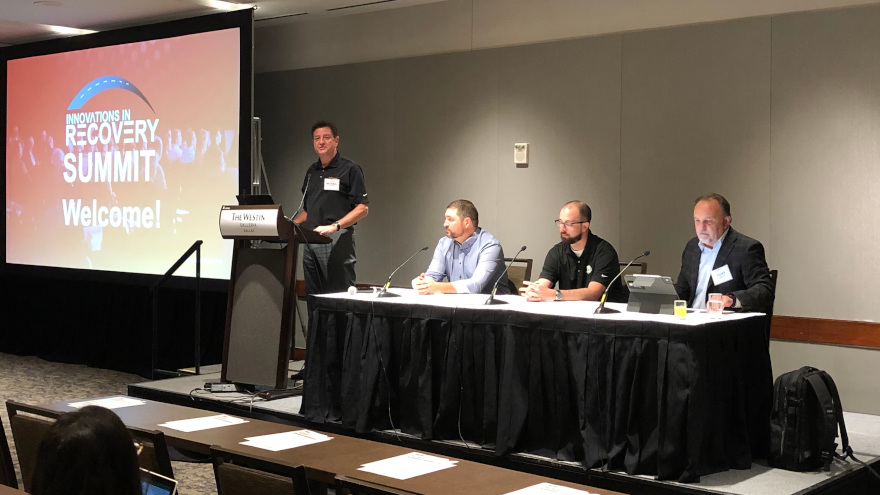
But as Les McCook of the American Recovery Association clearly laid out during the Innovations in Recovery Summit hosted by ALS Resolvion in late September, the dire straits repo agents now are encountering are unprecedented and could make the prospect of getting your collateral back all the more challenging.
“In the next 24 months, there will be significant changes in the industry,” McCook began during his time behind the lectern of this well-orchestrated event by ALS Resolvion. Competitors shared speaking time in front of attendees, who all arrived from organizations vying to remain successful.
For the next 10 minutes, McCook spelled out a host of challenges repossession agents now encounter. Now before you dust off the notion by thinking that’s what McCook should do as the executive director of an association, please consider some of the matters he mentioned.
McCook indicated repossession agents are down to just two possible providers for liability insurance — one of the most important and expensive parts of their operational functions. And McCook said one of those providers is seriously considering the notion of no longer covering repo agencies as the commercial insurance world is having its challenges, too.
“The commercial auto insurance segment is headed to its ninth straight year of underwriting losses. When you stop and think about that, that’s a devastating number. We cannot bring a new insurance company. We literally are hanging on to one by a thread right now because we have been creative and finding solutions,” McCook said.
“There’s a possibility that an insurance carrier will not even cover industry in California in the next year and half,” he added.
McCook noted there are 67 fewer licensed repo agents in California than there were just three years ago. In Florida, the number of licensed agents is down 23% during that span.
Be it in California, Florida or any location in between, what McCook discussed next gave me pause as to how truly challenging — and dangerous — repossessing vehicles can be. And I’m not referring to an irate contract holder storming out of a residence or workplace brandishing a weapon as an agent is trying to recover the collateral.
Before the ALS Resolvion event, McCook asked ARA members to send pictures of vehicle conditions and the personal property within these units from assignments completed in just the previous five days. McCook flashed a couple of pictures on the presentation screen. To say they were graphic is an understatement.
Spoiled food, illegal drug paraphernalia, soiled hygiene products and containers of elements likely from the entire periodic table were just some of visible material. And as McCook pointed out, repo agents are mandated by federal and state regulations either to store or appropriately dispose of that property. And oftentimes, agents must do it without much compensation, if any at all.
McCook asked attendees, “Do you know in California, you have to have a whole separate, fireproof container to hold toxic waste materials that are found in automobiles? And how many of you think there is toxic waste in these cars? Have you thought about that? Have you thought about what the liability could be?”
He added about the images he received from ARA members, “The things that I got back in just within five days were just unbelievable.”
“This is a cost burden that I don’t think being considered into a marketplace. And again, if you want to keep the viability of the business model that we’re in today, someone has to stop and pay attention to what’s happening on the other side of the fence, that what hardship are you putting on them, what burden you are putting on them that they cannot have a sustainable relationship with your company long term,” McCook went on to say.
No doubt, answers to these challenges require more than just throwing money at the problem. McCook probably said it best: “That’s why these meetings and discussions are going to be very important in the near term to have success and viability in the long run.”
Nick Zulovich is senior editor at Cherokee Media Group and can be reached at [email protected].
Finance companies that use Recovery Database Network (RDN) now have some additional assurance their repossessions are being completed according to state and federal regulations.
On Wednesday, the KAR Global business unit rolled out a seamless application interaction with the American Recovery Association (ARA) that is designed to provide RDN customers instant access to recovery agents’ compliance status.
Both RDN and ARA insisted this additional visibility into real-time information offers increased confidence when considering an agent for assignment.
“By working with the ARA, the industry’s leading voice for establishing universally accepted compliance standards, RDN customers gain peace of mind.” said Justin Zane, president of RDN and Clearplan.
“The new ARA Compliance System will provide all industry stakeholders a comprehensive, verified one-stop solution for compliance management that operates in real-time,” Zane continued in a news release. “This is a big step forward for our industry, and we believe it will deliver great value to all current and future customers.”
Any finance company or agent who assigns or accepts assignments through RDN can take advantage of the transparency offered by the new compliance status feature. To access the benefits of this new compliance tool, finance companies and agents can simply enroll in the ARA Compliance program.
When logging a new case in RDN, color codes under an additional “ARA” column indicate whether an agent is ARA Standards Compliant: red for non-compliant or incomplete, green for compliant, and yellow for pending status. Lenders can quickly filter agents based on current compliance status.
An “ARA Compliant Agent(s)” filter option is also available for agency management.
“ARA is uniquely positioned to lead and manage the oversight of these compliance initiatives for the benefit and mutual success of all stakeholders in the recovery space,” ARA president Dave Kennedy said.
“Together with RDN, we will strive to protect and serve the interests of lenders, forwarders and the repossession community while increasing the efficiency and effectiveness for how compliance is engaged and verified,” Kennedy went on to say.
For more than 10 years, RDN’s software-as-a-service technology has been designed to deliver improved recovery performance and increased operational efficiency while providing full security and transparency.
Similarly, Clearplan’s digital platform can provide recovery agents, drivers, forwarders and automotive lenders a centralized, mobile, cloud-based hub for repossession workflow and logistics management.
Together, Clearplan and RDN, both business units of KAR Global, can connect thousands of recovery agents and automotive finance companies to a streamlined vehicle recovery process — with reduced redundancies and increased actionable data. For more information, visit this website.
Members of ARA, the world’s largest association of recovery and remarketing professionals, specialize in locating and repossessing collateral on behalf of lending institutions such as banks, savings institutions, finance companies, credit unions, rental/leasing companies, and auto, truck and equipment dealers. The nonprofit organization’s members serve 27,000 national and international cities. All members are certified independent business operators. For more information, www.repo.org.
One of the most frustrating places where a finance company’s collateral can be during the repossession and recovery processes is the equivalent of “car jail.”
To help mitigate risk and reduce that frustration, skip-trace and repossession management firm ALS Resolvion recently released a new impound management service called Impound Pro.
The “end-to-end” service is designed to address the major pain points in the current process of handling vehicles that have been impounded. The firm explained these pain points can include operational inefficiencies, excessive expense, exposure to lien loss and issues remarketing the vehicle.
Impound Pro includes several service components such as VIN monitoring, impound yard negotiation, legal services support, value assessment support, speedy recovery, remarketing for total loss and end of life vehicles, and insurance claim services.
Most of these components are provided inhouse by ALS Resolvion, but certain services are delivered seamlessly through key partnerships the firm has developed.
The company highlighted the service is available on an “ala carte” basis, giving finance companies the ability to pick and choose certain components or utilize the service as an end-to-end solution.
“The impound management process is difficult for most lenders,” ALS Resolvion chief executive officer Michael Levison said in a news release. “There are multiple steps involved and typically several different service providers must be used.
“Impound Pro is designed to streamline the process and reduce the number of touch points in the process and, by doing so, improving efficiency and results,” Levison continued.
For more information about ALS Resolvion’s Impound Pro service, contact Jose Mendiola at [email protected] or call (954) 931-2848.
Justin Zane offered vivid imagery to finance company attendees during the opening session of ALS Resolvion’s Innovations in Recovery Summit last week on the topic of updates regarding agencies’ efforts to find vehicles that are out for repossession.
“Visualize a truck backing up to your door every day with 410,000 updates, dumping it and then driving away,” said Zane, who is the chief executive officer of Recovery Database Network (RDN) and Clearplan, each part of the KAR Global family of companies.
“Most agents are contingency now. They’re not going to get paid unless they secure the collateral, so the actions don’t stop,” Zane continued. “These agencies are still going to run all these accounts repetitively try to secure your collateral, but their updates that they’re sending back to you, you can’t consume them.”
MBSi Corp. president Cort DeHart participated on this panel, as well, chiming in on Zane’s descriptions.
“These are remnants from a bygone era,” DeHart said. “It’s one of those habits that are hard to break.”
Both Zane and DeHart explained that their technology companies not only are trying to change industry habits, but also streamline processes by leveraging technology. Especially since when it comes to charge-offs, repossessions and recoveries, time truly is money.
Zane described enhanced ways firms are getting updates to finance companies.
“Whether it’s through API, whether you’re logging into Cort’s system, whether you’re logging into mine, you’re consuming all this data. What we’re trying to do is we’re trying to ease the industry into the process. Instead of a text update, what you’ll be receiving is kind of a categorized set of updates,” Zane said.
“If it’s a simple, ‘Ran the address, no unit found,’ that’s going to be an update type. And the next phase of that is also going to be your kind of discounted, or your invalidated information, because a lot of a lot of agencies will tell you in an update that this address is no longer any good. But per your automated systems, you are still asking for an update on 123 Main Street, even though on the first day, that agency told you this address is no good. It’s vacant, and it was vacant three times I ran it for three other companies,” he continued.
“So what we want to do is categorize those into buckets, if you will, or update types. The only thing you’re going to be doing is actually filtering through either we found new information, or we need information. But the simple status updates, we think that those are a thing of the past,” Zane went on to say.
Along with a new way of presenting data, Zane also elaborated on what else might be on the horizon for the recovery industry,
“You’re going to see cleaner data,” he said. “We’re already introducing you to real-time connectivity at the agent at the agent level. You’re already getting connected much, much quicker to your assignments. Your assignments are getting filled faster. Agents aren’t coming back and updating their accounts at the end of the night anymore, because they have to be within a certain proximity of the address to perform an update. The information you guys are getting is already better. You may not realize because it still comes through the same conduit.
“Now our job is to make the information cleaner and more consumable,” Zane added. “The next two to three year, even though even though our space has been really, really slow to move with technology, technology forces more speed now on every industry, and I think you’re going to see a lot of advancements.”
DeHart also insisted the recovery industry must continue to adopt technology to improve itself. He pointed to significant reductions in wrongful repossessions since mobile technology can connect the finance company with the repossession agent almost instantly if the customer finds the funds to redeem their contact and become current.
“I will say that to the extent that we can use data to make decisions in real time, that are not monolithic across the board, across the whole portfolio, but the ability to consume the data, use it to drive workflow and processes downstream, that might be where we could get in the near future. And I think that’s a huge step forward,” DeHart said.
“The new platforms will be able to keep up with data changes and things that we don’t even know are out there yet because they’re architected with different plug-and-play options and new technologies that may be developed in a different industry,” he went on to say.
Experian determined the 60-day delinquency rate remained almost at the exact same reading year-over-year, with the second-quarter rate coming in at 0.65%. That’s just 1 basis point higher than what analysts spotted after Q2 2018.
Experian’s Q2 2019 State of the Automotive Finance Market report did show a bit of rise in accounts set to be charged off among finance companies. That’s the collection of providers that Experian sees often catering to subprime customers while operating without deposits like commercial banks and credit unions.
For those finance companies, analysts noticed their 60-day delinquencies rose to 1.40% in Q2, representing an 8 basis-point lift year-over-year.
As far as the areas where 60-day delinquencies are most prevalent, Experian pinpointing the Top 10 for the second quarter, mentioning many locations familiar to skip-tracers and repossession agents. Here is the latest rundown:
1. Mississippi: 1.19%
2. Maryland: 1.10%
3. Louisiana: 1.08%
4. Washington, D.C.: 1.08%
5. Georgia: 0.94%
6. South Carolina: 0.86%
7. Alabama: 0.82%
8. Arkansas: 0.82%
9. New Mexico: 0.77%
10. North Carolina: 0.75%
During this summer’s Automotive Intelligence Summit, masterQueue finalized a partnership with PassTime. On Thursday, the web-based Software-as-a-Service platform that can automate the skip-tracing process expanded its relationship with PAR North America, a business unit of KAR Auction Services.
According to a news release, PAR said it has enhanced its capabilities through the power of masterQueue — giving PAR a more efficient tool for skip-tracing.
“As they face higher recovery costs, our customers demand solutions that can provide efficiencies while increasing recovery rates,” PAR president Lisa Scott said. “Partnering with one of the most reliable, respected automation platforms in the industry gives our customers confidence, knowing they are getting the most precise skip tracing information that ultimately could lead to increased recovery rates.”
masterQueue can improve productivity and efficiency by combining the power of artificial intelligence and data with its seamless, streamlined collections and skip tracing information solution. Its platform is a single software solution uniquely designed to automate data collection, manage regulatory compliance and maintain data privacy.
“The skip-tracing process has its challenges, especially when lenders lose touch with their customers,” said Shannon Berry, skip services and project manager at PAR.
“Now, together with masterQueue, we have simplified the process with aggregated, up-to-date information in one easy-to-use solution. PAR customers will benefit from enhanced, informed reporting and potentially improved recovery rates,” Berry went on to say.
Representatives from both masterQueue and PAR will be participating in Repo Con, which is presented by Millennium Capital and Recovery. Repo Con is part of the industry-leading conference conducted during Used Car Week, which begins on Nov. 11 at the Red Rock Resort in Las Vegas.
Agenda details and Early Bird Registration discounts available through Oct. 1 can be found by going to www.usedcarweek.biz.
Collections agents, skip-tracers and other personnel associated with repossessions and recovery will have to wait a while longer for a federally operated database of reassigned phone numbers to become available.
Despite objections from a private sector company, an order released by the Federal Communications Commission last week said the regulator’s Consumer and Governmental Affairs Bureau (CGB) and the Wireline Competition Bureau (WCB) granted, in part, a request for an extension of time filed by the North American Numbering Council’s (NANC) Numbering Administration Oversight Working Group (NAOWG).
In December 2018, the FCC adopted rules that would establish a single, comprehensive database containing reassigned numbers information. The database will enable any caller to verify whether a number has been permanently disconnected before calling that number, “and it will help consumers avoid unwanted calls intended for others,” according to the FCC.
The FCC directed the NANC to present a technical requirements document (TRD) containing the NANC’s recommendations on certain technical aspects of database establishment, operation, and funding no later than June 13, Specifically, the FCC directed the NANC and its NAOWG to consider technical issues surrounding how the database administrator can collect fees from callers that use the database.
In a letter dated April 30, the NANC requested an extension of the deadline from June 14 of this year until April 13 of next year. On June 12, the bureaus granted the NANC an additional three months setting a new deadline of Sept. 13 to provide its reassigned numbers database recommendations to the FCC.
The FCC’s bureaus also required that the NANC provide a progress report by July 12 so that the commission could evaluate its progress toward the deadline.
Well, according to the latest FCC document, a letter dated July 11 said the NANC chair provided the FCC status report that indicated that the NAOWG was “making progress but that an additional extension would likely be needed to complete the NAOWG’s work.”
Then on Aug. 14, the NAOWG submitted a letter requesting an additional seven-month extension of the deadline to April 13, 2020 as mentioned in its earlier extension request.
“The NAOWG asserts that although it has continued to work diligently, additional time is necessary to complete its work on the database’s Technical Requirements Document and to make recommendations on the funding, pricing, and fee structure issues,” the latest FCC order said.
“In addition, the NAOWG claims that progress has been slow because of the complexity of the task, which has been made greater by a reluctance by vendors of similar databases to provide assistance out of fear of disqualification from bidding on the reassigned numbers database contract,” the document continued.
“In support of its request, the NAOWG argues that it has been diligently engaged in meeting the Commission’s deadline, conferencing for approximately four hours each week, and resolving details which, if left unresolved, would be deferred to another time,” the document also said.
The FCC explained what elements went into making its latest decision.
“In this instance, however, it is important that the commission receive a complete set of technical recommendations in order to establish an operational database efficiently,” officials said in the order. “At the same time, it is important that the Reassigned Numbers Database be launched as quickly as possible.
As a result, the FCC granted the NANC an additional four months, until Jan. 13, to complete its work on the Technical Requirements Document associated with the Reassigned Numbers Database and to present its recommendations to the commission.
“The additional time will ensure the development and consideration of a complete record on the complex technical aspects of the database’s establishment, operation and funding,” officials said. “The additional time is also necessary for the NAOWG’s, and in turn the NANC’s, development of fully informed recommendations and thus serves the public interest.
“To ensure that we can monitor the NANC’s progress and encourage timely completion, we condition the entirety of the extension on the NAOWG submitting an adequate work plan, including a detailed timeline by Sept. 30, showing how the NANC will complete its work by the specified dates,” they went on to say.
“We do not believe that a grant of the NAOWG’s requested seven months is warranted under the circumstances. In the NAOWG’s extension request, it notes that the NAOWG will likely complete the Technical Requirements Document by the end of year,” officials added. “We find, therefore, that the bureaus’ four-month extension allows sufficient time for the NAOWG to complete its work, seek agreement from the NANC, and present the Technical Requirements Document to the Commission by the Jan. 13 deadline we establish herein.
Meanwhile in the same order, the FCC also touched on a letter it received from Somos, Inc. that challenged the need for the NANC to receive any additional time to complete its work.
“Specifically, Somos argues, among other things, that the reassigned numbers database will not be difficult to set up, based on its experience with administration of toll-free numbers, and that the Commission could outsource the NAOWG’s remaining tasks to bidders,” FCC officials said. “We treat Somos’s filing as an opposition and note that it was untimely filed later than the 10-day deadline specified pursuant to … the commission’s rules.
“Even if we were to consider Somos’s opposition on the merits, however, we find it unpersuasive because we accept the NAOWG’s expert view that preparing the Technical Requirements Document poses significant complexities and that preparing a detailed TRD will benefit the procurement,” officials continued. “We believe that there are complexities to the Reassigned Numbers Database, as described in the NANC’s requests, that are different from a toll-free number database and that necessitate the NANC’s expertise and the additional time it seeks.
“Indeed, the NANC is the commission’s expert advisory body on these matters and we see nothing in Somos’ filing that would justify reversing the commission’s directive to consult the NANC on the relevant issues, or that persuades us that additional time is unnecessary,” officials went on to say. “Moreover, we are concerned that outsourcing the remaining tasks to bidders could negatively impact the procurement because doing so would require bidders to speculate on the matters the NANC has not addressed and make it extremely difficult for the commission to consistently compare bids.”
With the threat of security breaches haunting companies large and small, Recovery Database Network (RDN) is taking steps to ensure its systems connected with repossessions and recoveries are safe.
The division of KAR Auction Services announced it achieved the six components that go into Veracode Verified Team Status certification. Veracode Verified is a program that validates a company’s secure software development processes by testing for potential vulnerabilities and evaluating its software security.
The company explained this verification helps assure RDN customers across the repossession and disposition value chain of its commitment to securing their data.
“RDN is continuously making enhancements through data science and building on its digital suite of solutions,” RDN vice president Pradeep Mahdevu said in a news release. “Undergoing rigorous security testing, implementing strict development practices, and earning Veracode Verified certification ensures that our digital solutions meet a high standard of application security, reducing risk for our customers.”
Organizations like RDN that had their secure development practice validated, and their application accepted into the Team Tier, have demonstrated that the following security gates have been implemented into their software development practice:
• Assesses first-party code with static analysis
• Documents that the application does not allow Very High flaws in first-party code
• Provides developers with remediation guidance when new flaws are introduced
• Assesses open source components for security flaws
• Identifies a security champion within the development team to ensure secure coding practices are used across the development lifecycle.
• Provides training on secure coding best practices for the identified security champion.
“RDN is committed to delivering secure code to help organizations reduce the risk of a major security breach,” Veracode’s Asha May said. “Companies that invest in secure coding processes and follow our protocol for a mature application security program are able to deliver more confidence to customers who deploy their software.”
For more than 10 years, RDN highlighted that its software-as-a-service technology has helped finance companies with improved recovery performance and increased operational efficiency while providing full security and transparency.
Similarly, Clearplan’s digital platform provides recovery agents, drivers, forwarders and automotive lenders a centralized, mobile, cloud-based hub for repossession workflow and logistics management.
Together, Clearplan and RDN connect thousands of recovery agents and finance companies to a streamlined vehicle recovery process — with reduced redundancies and increased actionable data.
One of the most frequent guests on the Auto Remarketing Podcast is back for another episode.
DRN’s Jeremiah Wheeler recapped his TED-style presentation during this summer’s Auto Intel Summit along with looking ahead to Used Car Week, which begins on Nov. 11 in Las Vegas.
The full discussion can be found below.
Download and subscribe to the Auto Remarketing Podcast on iTunes or on Google Play.
You can also listen to the latest episode in the window below.
Catch the latest episodes on the Auto Remarketing Podcast homepage and on our Soundcloud page.