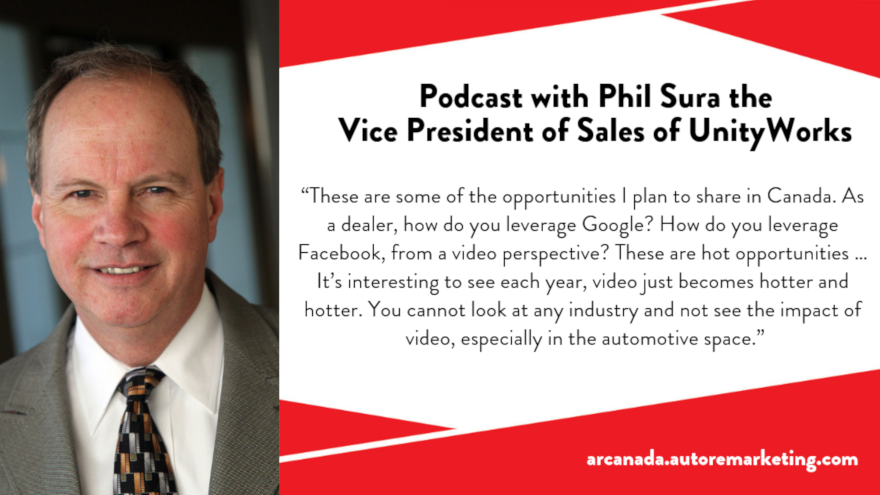
Phil Sura of UnityWorks is known as the foremost expert in integrating video on dealer websites.
Phil will share his expertise and guide dealers to higher levels of success during Dealer Training Tuesday as part of the Auto Remarketing Canada Conference next month in Toronto.
The conference runs from March 19-20 at the Westin Harbour Castle in Toronto.
Listen in to the podcast below as Phil and AR Canada Conference chair Bill Zadeits catch up during the recent NADA Show 2019 in San Francisco.
The full discussion can be found below.
Download and subscribe to the Auto Remarketing Podcast on iTunes or on Google Play.
You can also listen to the latest episode in the window below.
Catch the latest episodes on the Auto Remarketing Podcast homepage and on our Soundcloud page.
Please complete our audience survey; we appreciate your feedback.
As much as technology has enhanced the way Canadian dealers can find inventory that turns quickly while securing financing for their customers, personal relationships still matter, especially when it comes to store management and its F&I activities.
For the second consecutive year, dealers in Canada continue to stress the importance of the dealer-finance company relationship and are more satisfied with providers that not only understand their needs, but also consistently exceed their expectations. Those findings surfaced this week as a part of the J.D. Power 2018 Canadian Dealer Financing Satisfaction Study.
As the auto retail financing industry becomes more commoditized, the J.D. Power survey showed dealers cite “people relationships” and “ease of doing business” as the top two reasons for their selection of a financing provider. The importance of these two reasons are echoed both by captive and non-captive finance companies.
The survey revealed factors such as dealer compensation and competitive rates are also relevant in the provider selection decision, but are of secondary importance to customer service-related reasons.
“The marketplace in Canada continues to be strong, yet highly competitive, so relationships are what make the difference,” said Jim Houston, senior director of automotive finance at J.D. Power.
“Lenders can adjust their credit policy, interest rate or dealer compensation plans, but it’s how they interact with dealers and resolve issues when they arise that have the greatest effect on satisfaction,” Houston said. “When overall satisfaction increases, dealers are more willing and able to deepen the business relationship with lenders.”
The study, now in its 20th year, found that problem resolution and the speed with which an issue is rectified significantly affect dealer satisfaction levels. Moreover, it’s the credit department that bears the load and acts as the first port of call when things go sour.
Six in 10 dealers (60 percent) indicate that credit desk personnel are the first point of contact for any problems or concerns. Additionally, 76 percent of dealers said they were able to engage with credit staff when needed.
“While both captive and non-captive lenders’ credit departments perform well in making themselves available, lenders should not rest on their laurels,” Houston said. “Instead, they should maintain a sense of urgency when responding to dealers, as satisfaction levels plummet when the credit department is not readily available.
“Leveraging various communication channels and technology coupled with adequate credit department staffing are some measures in which lenders can demonstrate their commitment and differentiate themselves to increase satisfaction,” Houston went on to say.
Two other additional findings from the latest survey included:
• Finance company selection influenced by more than just relationships: Beyond the relationship influence, dealers have different views of satisfaction depending on the type of finance company with which they are doing business. Dealers who work with captives place higher importance on the provider’s customer loyalty rebates (27 percent) than those who work with non-captive finance companies (4 percent).
In contrast, dealers that choose to do business with non-captive finance companies place a greater importance on dealer compensation (13 percent), compared with those that choose to work with captives (4 percent).
• Sales performance requires improvement: In a highly competitive and fragmented market, J.D. Power learned that exceeding expectations becomes a paramount differentiator. The study found that dealers hold their finance company sales representatives to a higher set of standards, yet sales representatives exceed expectations less than half of the time.
Finance company rankings
Overall dealer satisfaction in the captive segment is 875 (on a 1,000-point scale), a 7-point increase from 2017. Overall satisfaction in the non-captive segment is 862, a 4-point decrease from 2017.
Mercedes-Benz Financial Services ranked highest in the captive segment with a score of 948. Ford Credit (903) ranked second, while Honda Financial Services (883) came in third. Toyota Financial Services (878) ranked fourth.
Among non-captive finance companies, TD Auto Finance ranked highest with a score of 884. Bank of Montreal (881) came in second, and RBC Royal Bank (868) placed third.
The 2018 Canadian Dealer Financing Satisfaction Study captured 4,861 finance provider evaluations across the two segments from new-vehicle dealerships in Canada. The study was fielded in February and March.
The Ontario Motor Vehicle Industry Council announced it recently launched a province-wide multi-media campaign to increase awareness of all-in price advertising.
OMVIC said it started the campaign following research the council conducted that showed some Ontario car dealers continue to add additional fees to their advertised prices — though it is illegal and disadvantages law abiding dealerships.
“Since 2010 car-buyers have had right to all-in price advertising”, OMVIC director of communications and education Terry O’Keefe said in a news release. “That means dealers must include all fees, except HST and licensing, in any advertised vehicle price.”
The council said when dealers don’t include all fees it is unfair to car-buyers and non-compliant dealers get an unfair edge over dealers who advertise prices which include all fees and charges.
“If consumers know they have a right to all-in price advertising, they are able to protect themselves should they encounter non-compliant advertising,” OMVIC said.
The Ontario-wide campaign has used television, radio, online, billboard/transit and social media advertising to inform car buyers about advertising pricing.
OMVIC’s awareness initiative includes a TV commercial directed at consumers that says, “Buying a car? The fun is back! Ontario made all-in price advertising the law for Ontario car dealers — no more hidden fees. All-in price advertising: it’s your right!”
The campaign’s 15-second TV commercial along with a 36-second radio message is currently available on Youtube.
Below are examples of fees or charges that dealers must include in an advertised price, according to OMVIC.
- Freight
- PDI-PDE (pre-delivery inspection/expense)
- Administration (Admin) fee(s)
- Government levies (air tax, etc.)
- Safety and e-test (unless the ad contains a mandated "Unfit Vehicle" or "As-Is Vehicle" statement)
For more information on all-in price advertising, visit OMVIC’s website.
A recognized thought leader in the world of brand leadership, innovation and social influence marketing, Sean Moffitt, managing director of Wikibrands, has been involved with digital marketing for the past 15 years. He co-authored the best-selling book Wikibrands with Mike Dover and helped turn it into a living, breathing customer engagement hub and consultancy.
The Trillium Automobile Dealers Association (TADA) — which also is one of the industry partners for both the Auto Remarketing Canada Conference and the accompanying event, Women & Automotive — is bringing Moffitt to Ontario. In a prelude to his appearance as keynote speaker during TADA’s Auto Dealers Innovation Series on March 22 and 23 in Ottawa and Toronto, the association asked Moffitt about how Wikibrands came about, how businesses can use it effectively as a marketing strategy and thoughts about speaking to an automotive dealer audience.
Here’s what he had to say:
TADA: Can you tell us a little about what Wikibrands actually means from a business perspective?
Sean Moffitt: The literal definition of Wikibrands is from Wiki (which in Hawaiian means quick or to hurry) and brands in what we refer to as the trademark owned by a company. It’s essentially a call to action to make sure that brands, companies and marketers become much more engaged with their customers.
TADA: What are some of the key fundamentals you feel businesses need to understand when it comes to effectively engaging with their customers in today's hyper connected world?
SM: I certainly think that the climate has changed in the last 15 years, certainly if you have worked within the marketing sphere. It has become awash in digital platforms and certainly with social media blowing up 10 years ago—you know that to be an effective marketer today you have to be a little bit more flexible in how you position your brands.
Recognizing cultural change is one thing, but the other side is that there really is a lot of sweat equity involved in terms of being able to do it right and effectively engage with your audience. It’s easy to invent concepts, but it takes a longer period of time, to develop a real conversation and level of engagement.
TADA: With so many different social media and connectivity platforms available, how can a business effectively decide which approach to take —for example is there a danger of trying to do too much and be in too many places at once?
SM: My belief is that as a company, you should, if you can, try to do one or two things really, really well. It can be far more effective than trying to plug all of your fingers in the dam at once. The other part of that question is that becoming too attached to a particular social platform is also a recipe for failure. Through analysis every five years, I’ve looked at the core audience of social media and what their top brands were. Pretty much at every five-year stage of this journey, the top five brands change quite rapidly. The danger of getting married to one social platform is that it can be here one year and gone the next. Experience shows that many social medial platforms are like nightclubs—they tend to have two or three-year cycles.
TADA: Can you share with us a couple of examples of successful Wiki marketing strategies and perhaps how and why they were so effective?
SM: When Mike and I originally wrote the book, we took a pragmatic view and said let’s go to 100 companies we think are doing a really good job and see what they have done. We interviewed across 20 different industries at companies that were different sizes—private, public, not for profit—it didn’t matter who they were—we just wanted to understand what they were doing. We came up with the 12 principles that helped establish the road map to being receptive Wikibrands.
One example that stands out is Dollar Shave Club. This was a venture that was created six years ago principally on the back of really good engagement, really authentic storytelling and mastery of video and video sharing platforms. They got the message out and it was very effective. They took this idea on paper and transformed into millions of dollars in sales. Last July; Dollar Shave Club was purchased by Unilever for $1 billion in cash.
TADA: What are some of the key messages you're looking to broadcast to an automotive retailing audience, since the car business is still a unique model in terms of the emotional and cost factors involved when purchasing a vehicle?
SM: The automotive dealer is probably more important now than they have ever been. In general, retailers have developed a heightened presence in the last 10 years because they own that part of the brand experience. From my perspective, there is a maturity level in the automotive space that is beyond other industries—so my objective is to reach out and to get to that next stage of engagement. Where that’s concerned I think it comes down to three different objectives.
Firstly, as an effective marketing organization at the dealership—what are the key things you need to be doing?
Secondly, how do you get there? My goal is to provide some pragmatic tips on ‘here’s how to do it’— not just in theory but real step-by-step processes you can take back to your office and actually apply.
Thirdly, because things are changes so quickly, I will probably share tidbits of what is going to be happening right around the corner, especially if you want to be the first person within your specific world to take it to the next level and be at the forefront of discussions on everybody’s lips 12 months from now.
TADA: How and what should businesses do to ensure that engagement and sales actually correlate—a lot of the time we've seen successful engagement strategies that have not been properly translated into actual sales?
SM: I would say there are three effective approaches to make it work: One is a bit controversial but always works — essentially the moment you realize a competitor across the street is gaining because of their digital engagement strategy, your CEOs and executives become very interested in it themselves. It’s probably not the best place to start from but it is a very human reaction.
Additionally there are two other, more organic approaches. I call what we’re in today the sixth evolution of digital or the ‘Impact Age.’ We’ve had about 15 years of maturing digital business driven growth and there are enough case studies and in-market success to demonstrate that people who have done this have really put themselves further ahead than people that don’t. I think people that are open to receiving this type of information will open themselves up to this world of digital whether they come from it or not.
The third piece is that the great thing about digital is that you can invent things as you go. Obviously people have great ideas — as much as I can tell you your competitor is doing it or that strategically there is a way for it to work, then it makes sense to do it. The other part is that we can dream and build something big. We can do it together and produce massive amounts of success if it’s done right. At the end of the day it should be part of any business decision. If great digital engagement works for a small cookie cutter company then there’s no reason why it can’t work for your dealership.
For more details about TADA’s upcoming Auto Dealers Innovation Series that will feature presentations from high profile industry leaders that are experts in innovation, go to this website.
Last year saw Canada’s average new-car loan term eclipse 72 months, with terms longer than six years making up roughly 60 percent of the car loan portfolios of the country’s largest financial institutions.
This is just one key finding in Financial Consumer Agency of Canada’s recently released Auto Finance: Market Trends report, which highlights the very real problems posed by the current trend in loan-term growth.
Just six years ago, 2010’s average new-car loan term was 65 months. But with dealership’s increased emphasis on monthly payments and customer’s willingness to extend terms to get more car for what is perceived as less money in the short term, problems are arising.
FCAC is currently focusing its oversight and educational efforts into the market of longer-term loans by keeping a close eye on financial institutions and doing its best to help inform consumers.
"Recent trends in extended-term car loans have raised several concerns,” said Lucie Tedesco, FCAC’s commissioner. “Consumers must carefully examine their needs and their financial situation to ensure they can repay their car loans without undue strain, and with a full appreciation of the total interest charges and value of the car throughout the loan period."
According to the report, most Canadians continue to buy new vehicles roughly every four years, despite having an average loan term of over six, and many end up rolling negative equity into their new loans, which are getting longer and longer. Now, 72-, 84- and 96-month finance terms are becoming more and more common, with some even reaching as far as 108 months, and each accompanied by increasingly poorer interest rates.
"Consumers and auto dealers tend to focus on the monthly loan payments required for a car purchase. Few take issues such as negative equity into account when choosing between different car loan terms,” said Brigitte Goulard, FCAC’s deputy commissioner. “This is one of the reasons why FCAC will work with stakeholders to make sure that consumers are getting enough information and know which questions to ask."
FCAC says that the percentage of consumers in a negative equity position while trading in their vehicles has risen by 50 percent over the past five years – from 20 percent in 2010 to 30 percent in 2015.
The agency also believes the longer-term loans are contributing to the inflation of new-vehicle prices, the transaction costs of which are rising more than twice as fast as average monthly payments.
"Shopping around and asking questions when looking at different financing arrangements when purchasing a vehicle should be just as important as researching the type of car you want,” said Jane Rooney, FCAC’s financial literacy leader. “That is why FCAC has put together information to help people through this important financial decision."
To check out FCAC’s full report, click here. If you’re interested in learning more about the threat of increasingly longer-term auto loans, consider signing up for our upcoming Auto Remarketing Canada Conference, which will feature a panel of industry experts to discuss that very topic.
TRADER Corporation recently announced that it will be hosting the second annual Industry Day as part of the Canadian International AutoShow in Toronto.
Taking place on February 12 and featuring activities tailored for OEMs, agencies and automotive dealers, TRADER will also present an automotive sales and marketing event titled, “Carology: The Science of Selling Cars.”
The event will be free for industry professionals only and will include complementary early access to the AutoShow floor.
The Carology event will focus on how Canadian consumers shop for cars today, including their influences, where and how they research, how many dealerships they visit and recommendations for the industry to better meet their shopping desires.
Carology will feature an expert panel, including the following industry veterans:
- Scott Monty – CEO & founder, Scott Monty Strategies
- Nick King – Director of business intelligence & market research, AutoTrader UK
- Ian MacDonald – Director of consumer marketing & experience, autoTRADER.ca
- Kevin Coombs – Director of marketing intelligence, TRADER Corporation
For more information or to register for the event, click here.
The Ontario Motor Vehicle Industry Council announced Friday that it has issued a 450-day incarceration sentence to a dealer for two counts of curbsiding.
According to OMVIC, the dealer, Mehran Amini, was acting as a dealer without registration, contrary to the Motor Vehicle Dealers Act, and will serve the longest sentence of its kind ever issued in Ontario.
“This is the longest sentence handed out in Ontario for illegal vehicle sales,” said Michael Rothe, OMVIC’s director of legal services. “And it sends an important and strong message to those who would prey on Ontario consumers.”
OMVIC says that it charged Amini after it discovered he had purchased 30 vehicles, predominantly late-model pickup trucks with high mileage, in Western Canada and brought them to Ontario and rolled back their odometers before selling them to unsuspecting buyers.
“This individual is responsible for a great deal of consumer harm,” said Larry Edgar, OMVIC’s acting director of investigations. “When the true history of the vehicles became known, the purchasers found themselves with trucks worth far less than they had paid and many faced unexpected expensive repairs (due to the high mileages), some of which had crippling financial implications for the buyers.”
In court, the evidence shown against Amini included his ads placed in online marketplaces, where he posed as a private seller and used multiple aliases on top of telling some of the buyers that he was a dealer.
These are not the first curbsiding convictions issued to Amini – he has been charged and convicted by OMVIC on two prior occasions for the same behavior. His first conviction resulted in a $393,000 fine for selling 42 vehicles with rolled-back odometers, which Amini appealed. He is scheduled to appear in court March 21 for sentencing.
At a recent speaking event at the Canadian Club in Toronto, GM Canada president and managing director Steve Carlisle stressed the importance of the changing automotive sector — think electric vehicles, autonomous cars, vehicle sharing, car connectivity and more.
Carlisle called on governments in Canada to “act quickly” to make sure they have a "purposeful role" in this evolving automotive landscape.
"No company, country or government owns this space, but we see that Canada has distinct advantages in mobile technology, engineering skills, applied research and a strong automotive history," said Carlisle. "As Canada prepares to invest billions in much needed urban transportation infrastructure, we need to understand how new automotive technologies and urban mobility approaches can increase infrastructure ROI, accelerate environmental benefits and anchor new high skilled Canadian jobs at the forefront of a new automotive innovation supply chain."
In an effort to make its mark in this arena, GM Canada also announced it is providing $1 million in support of the University of Waterloo’s Engineering Faculty to fund a research chair in advanced materials. The automaker will also be sponsoring engineering student Capstone design projects involving software development, which it says is key to GM Canada's work on "the connected car."
Dean of Engineering Dr. Pearl Sullivan said, "Waterloo Engineering has a longstanding partnership with GM Canada. Their support of our ‘Educating the Engineer of the Future’ campaign allows us to collaborate further to advance innovations in automotive lightweighting and connectivity."
Carlisle also said that GM Canada will create an “innovation research outpost” within Waterloo’s Communitech innovation research hub, focusing on urban mobility, car sharing and mobile apps.
"Communitech has developed a unique innovation ecosystem that allows enterprise companies and startups to collaborate and innovate together," said Communitech chief executive officer Iain Klugman. "General Motors Canada is a great addition to this ecosystem, as our startup and mid-sized companies will benefit from having access to a world class automotive company, while GM Canada will be exposed to new concepts, technologies and ways of thinking about opportunities in the automotive sector."
And this isn’t the automaker’s first foray into these research areas.
This past April, GM Canada announced it that has been awarded a new automotive research and development and innovation mandate at its Oshawa Engineering Center, which focused on fast emerging "connected car" and the development of new urban mobility solutions.
The company is currently working on hiring 100 new software engineers as part of the aforementioned mandate. The Engineering Center is currently working on the development of new “connected car” software, urban mobility solutions and innovation in the use of batteries, among other projects.
In the electric car market, GM already has three EVs for sale in Canada, including the country’s best-selling plug-in vehicle, the Chevrolet Volt.
And in 2016, it will launch the all-electric Chevrolet Bolt, which touts a 320-kilometer battery range.
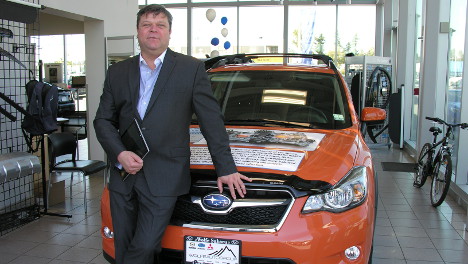
Matt Hale is the e-commerce specialist at Wolfe Langley Subaru, part of the Wolfe Auto Group in Surry, B.C. He may have only been in the business of selling cars for a little over two years, but he has certainly already made his mark.
In fact, after over 20 years in the hospitality industry, Hale jumped into car sales at the age of 39 and has been notching records ever since.
Take these stats into account. For 2014, Hale was:
- The No. 1 salesperson for Subaru in British Columbia
- The top salesperson for new units sold in Canada for the brand (308)
- No. 1 for the year in parts and accessory sales.
The new industry leader is certainly gaining renown, but let’s take a look at why Hale decided to jump into the car business in the first place.
Starting in the biz
Growing up, Hale was already a Subaru fan and actually wanted to go into the auto business at an early age, he said.
Instead, he found his place in hospitality. Interestingly, one of his best restaurant customers turned out to be Mike Hacquard, vice president and general manager of the Wolfe Auto Group.
“One night we were talking, and I didn’t know his history or who he was, but it turned out when we became better acquainted, he gave me a business card, and when I sold the restaurant, I decided to follow up and he gave me the opportunity to work for Wolf Subaru,” Hale shared.
Hale joined the dealership as a salesperson in 2013 and quickly moved up to the position of e-commerce specialist after about a year.
“I think the dealer saw the stats and the weekly reports that would go to the sales manager and dealer principal, and they would see the amount of leads and how many sales are generated from those leads, and I think that they saw that I was a fit for the Internet position based on those numbers,” Hale said.
The switch to auto sales, Hale noted, wasn’t as difficult as one might think, as he was already very familiar with customer service processes.
“I certainly was from a customer-service based industry before — for 20 or so years — and coming into this role, I definitely knew the process. And I could definitely provide customer service on the sales floor, but where I started to excel and where I firmly place my success in the industry —since I have only been at it for two years — was the use of DealerSocket, and the follow-up tools and everything it had to offer.”
The importance of a CRM in Internet sales
When he joined the dealership, the store had recently adopted the DealerSocket customer relationship management system, which Hale calls his “micromanager.”
“I have upwards of 250 clients rolling at any one time, coming in, or sold, or inquiring, and I can’t imagine doing it any other way than through this program,” Hale said.
When introduced to the DealerSocket program, Hale said that as a “tech guy,” he embraced the product and tried to get everything out of it he could.
Hale said the product, along with his dedication to his Internet customers, helps him stay up to speed.
“I have a smart watch that gives me all my leads and any emails, or when anyone clicks on a link that I send them, I get updated on my phone, on my watch, etc.,” said Hale. “I never miss anything that one of my customers is doing, when I have got them in that profile, whether they have been written up and in F&I or just coming in as an Internet lead.”
Switching from the sales floor to dealing primarily with Internet customers, Hale said, was an adjustment.
“I certainly had to learn how to deal with an Internet customer, because an Internet customer is very different from meeting a customer face-to-face. The demands I find with Internet customers are even higher,” he said.
Utilizing the CRM system, Hale says keeping in touch with customers throughout the deliberation process, the sale, and beyond, is key to retention and customer loyalty. The CRM system prompts Hale to send follow-up emails, promotions and more, which he says is key to Internet sales success.
“These Internet customers can easily get lost if they are not followed up with, and these generated tools, as well as the prompting tools that say follow up with this person, email this person, get back to them, however it comes up, provides what I call the momentum that keeps on bringing them along,” he explained.
And even if these communications don’t necessarily end up in a sale, he said it keeps Internet customers at the point where they know they haven’t been forgotten about.
“Even if you just keep reaching out and say, ‘Hey, you know too bad we couldn’t get you there this time and that unit sold, but now I’ve got you on my radar,’ and that communication can be set up so that every week or couple of weeks to just touch base,” he shared.
Hale said a good CRM system makes this easier because you can simply set your next “to-do” item, and when you get in the office in the morning, “there it is, in order of importance.”
“It’s (DealerSocket) just a system that makes it fool-proof as long as you are keeping up with your customer base. It actually is like a micromanager for a person just guiding you along,” he shared.
The Internet sales position is a highly sought after role in dealerships these days, especially if one is willing to invest in it.
“Your leads are mostly generated for you. Those Internet leads come in knowing what they want, and you have enough information to really get a picture of what they need, and you will know very quickly into it if they will turn into a sale,” Hale said.
And when using a quality CRM system, you aren’t just blindly sending out emails, but rather, you are prompted when a customer opens an email, or clicks on a link.
“There is a satisfaction in the process as well. You aren’t just wondering if you are going to get that person to get back to you or whether they have seen it or not. One of my best emails templates that I have is, ‘Hey, I’ve noticed you have seen my information, what would you like to do now?’ It just prompts them forward again, and I’ve only been asked once how I knew that they opened their email,” Hale said, laughingly.
Top focuses in e-commerce for dealerships
When asked what dealerships should be focusing on in e-commerce, Hale said it all comes down to timing.
Hale said he answers Internet requests within 60 minutes. And he doesn’t stop when he’s off the clock. In fact, Hale said some of his busiest hours responding to clients occur between 7 p.m. and 9 p.m.
“And I actually have gone to the point, with a customer I know is right there close to a sale, when I know they’ve opened their email, I will just give them a call within a minute or two,” he said.
Once you make that point of contact, and the shopper hears your voice, Hale said, “They go from being an Internet customer to being your customer.”
“That voice connection to the information that you sent out is another big thing, as well,” Hale said. “So I think timing more than anything else is important, and just knowing that customer has received the information and have it in front of them on the screen. I spend most of my days and nights watching and seeing how customers progress through the sales process.”
He also said that using mobile tools is key to success as an Internet specialist in dealerships they days.
“I always know what is going on, even though I might be with a different customer. And that is one of the toughest things. A lot of people will arrive on your doorstep without an appointment, and you know that they may be coming, but your only one person that can take care of one person at a time properly,” said Hale. “But if you are out on the lot or writing up a deal, and you see that you have got a customer that has opened the email on your smartwatch of smartphone, you know they are the first point of contact after you have finished up, and you go straight to that.”
Just over Hale’s short time in the industry so far, he is seeing a shift to a more digital, online car sales process.
“I certainly know the statistics of when people are looking on the Internet and starting their steps toward the purchase is increasing every year, especially in Canada,” Hale said.
This trend bodes well for dealerships, as Hale explained when an Internet customer comes through the door — if you have provided proper service over the Web — he or she is often ready to buy upon entering the showroom.
“I know that I have provided them with the information, with the emails back and forth, and they come in with a sense of confidence more than anything else, that they have been taken care of coming to the dealership through the Web,” said Hale. “And they are ready to buy, and that’s usually when they step foot in the door.”
Hale says the key to ensuring these Internet customers come in for a sale is making sure they feel well serviced on the Web, before even making it into the store.
“They can be on the other end and I don’t know them, and they don’t know me, but if they feel as if they are getting taken care of, it leads them to our store,” Hale added.
Hale also pointed out a rumor moving around the dealership was that Internet sales normally remained flat, but it didn’t take this e-commerce specialist long to prove that theory wrong.
“I out-grossed the guys on the floor through the Internet. I don’t manage the process through; I carry the process out through what I am being prompted to do,” Hale said, once again noting how a CRM system can help salespeople stay on top of their duties.
“Today (in early September), I came in and had 15 to 20 three-month follow-ups, phone calls or emails; so I’ve got my three-month template, I have a little bit of a personal blurb, and 99 percent of the time I have those people get back to me and say, ‘thank you.’ Sometimes, people feel as if they have driven away and been forgotten about, and this ensures that doesn’t happen,” said Hale.
And for Subaru — a brand known for its customer loyalty — retention and referrals are key.
“Referrals for the Subaru brand are huge, and that is the word-of-mouth for not just the product, but also being taken care of and being that guy that follows up with them. Again, I do a three-month, six-month and 18-month follow-up, and those follow-ups oft en lead to repeat sales and happy customers sharing their experience,” Hale concluded.
Editor''s Note: This profile was first published in Auto Remarketing Canada's Power 200 Issue. See here for more insight from top-selling dealerships and leading remarketing companies.
Perhaps dealers should be looking into rental car trends when deciding what units to stock on their new and used lots.
According to the new Canadian Automotive Survey from Enterprise Holdings, nearly six in 10 (59 percent) of their customers in Canada have considered purchasing a make and model of the car they drove as a rental, which shows a direct link between rental car experience and future vehicle purchases.
The number jumps even higher — to 72 percent — for those customers ages 25-34.
The survey of 1,501 Canadian Enterprise Holdings customers also showed that 69 percent of customers reported that a positive rental experience with renting a certain vehicle changed their perception of that car make of model.
"Car rental is one of the best ways to introduce consumers — and prospective buyers — to different manufacturers and new car models," said Paul Belfer, vice president of Canadian fleet acquisition for Enterprise Holdings. "Our manufacturing partners have long found our fleet as a great testing ground for new technology. Now, this survey shows Canadians view our vehicles in the same way, as an opportunity to drive a new make and model that may influence a future purchasing decision."
Interestingly, the company explained it seems as if in many cases, Canadians are using rental cars as an “extended test drive” of a vehicle before purchasing.
This point was brought up at the International Car Rental show this past spring by Enterprise Holdings' senior vice president of vehicle acquisition Susan Lombardo.
"Manufacturers have discovered that car rental — regardless of whether it's for an hour, a day, a week or longer — is a significant link in the automotive value chain," said Lombardo. "That means we can help automakers maintain and even grow market share. As a result, we continue to look for ways to collaborate and communicate with our manufacturing partners every day."
Trends do differ by market, though. Enterprise’s research shows consumer behavior in this respect differs greatly between Canadians and Americans.
According to the survey, almost half of Canadian customers rent cars mostly for personal use, compared to 37 percent of Americans, who are more likely to rent for business.
Further illustrating the more personal nature of the rental market in Canada, about one third of Canadian respondents said they believe their choice of a rental car make and model says a lot about them.
And one of the aspects of vehicles that might convince renters to purchase is new technology. According to the survey, 42 percent of survey responders say that rental cars are when they typically experience new auto technology, which can be a big draw to an eventual purchase.
In light of these results, it also may be interesting to track how new-vehicle segment purchases relate to vehicle trends in the rental market.
According to the survey, when selecting a rental car, Canadians are more likely to choose a compact car than American customers — 16 percent versus 10 percent.