You may be used to seeing these guys’ television commercials – TV spots full of humor and quirks – but you can expect to see them on the television in a different respect by the end of the month.
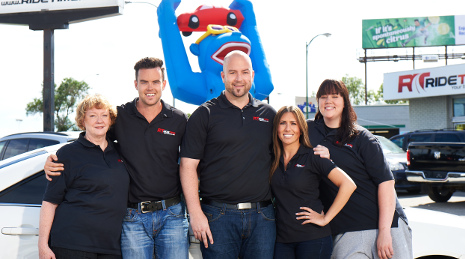
The brothers who run sales at Ride Time — Doug MacIver and Andrew MacIver — as well as all of the employees at the family-owned Winnipeg, Manitoba, used-car dealership, are set to debut in the first season of the new reality TV show, The Bargain Brothers.
The series is set to premier on the Business News Network (BNN) on Oct. 21 at 7 p.m. EST.
The series features the ups and downs and ins and outs of running a family-owned business, along with a peppering of best practices and insight into a successful used-car business.
Besides the self-proclaimed “Bargain Brothers”, the series features Doug MacIver’s wife, Meagen MacIver; sister, Alexandria MacIver; and mother, Evelyn MacIver; as well as the stores eclectic group of employees.
Doug MacIver explained to Auto Remarketing Canada the great thing about the show is it really appeals to a wide variety of viewers.
“If you are interested in cars, there are the ins and outs of how we have to go about buying cars and selling cars to customers and getting them ready. If you are into lighthearted comedy – I like to think my family is pretty funny – there are some pretty funny clips throughout each episode,” said MacIver. “If you are into family shows you will see the love and frustration siblings have amongst each other. I think it kind of appeals to everybody from the small business aspect right through to the comedy aspect.”
How Did It Happen?
You might be thinking, how did a car dealership make it onto a reality television show?
One word: family.
Doug MacIver explained to Auto Remarketing Canada his brother Andrew had been watching the Business News Network one day and noticed a couple of advertisements that stated the network wanted to speak to you if you owned a family business.
Intrigued, the brothers put together a brief email of some of their TV commercials and gave the network a brief rundown of their story.
“We weren’t expecting much,” said MacIver, “maybe a business analysis, or something.”
Ten days later the dealership got a phone call from a TV producer in Toronto who explained the network was looking to do a reality TV show on a family business.
After a Skype interview and a couple of days of waiting, the family was asking themselves, “What happens next?”
After the producer sent the Skype interview to the network, she told the dealership they might hear from the network sometime in the summer, or about three to four months later.
She was wrong.
Four hours after the network received the interview, Ride Time got a call.
“The network loved it and ended up buying the first season, which consists of six episodes,” MacIver said.
Interestingly, though a reality show at a car dealership might not be something you see on the TV every day, it wasn’t a new idea to Doug MacIver; it had come up many times with his late father Doug MacIver Sr.
“My dad was a typical car guy, a bit of a wild man – but a genius marketer. He had a couple of franchise stores, and we would always joke and said it would be so funny if we had a reality TV show. We heard that from a million people,” MacIver said.
MacIver said some colleagues showed friendly envy at the press the dealership was getting, but he says it’s not really about the store.
“I’ve got some friends in the automotive world, and some of them say, ‘Well, we are so jealous you got a show’, because they think we got the show because we have a car dealership, but that’s not how the show happened, it was a call for family business. We just happened to be in the car business,” he explained.
As for the working with your family, day in and day out, MacIver says it has its ups and downs, just like any business, but at the end of the day, there is a freedom that comes from working with people you know will still be there at the end of the day.
“Obviously, there are things you can say to your family members you couldn’t necessarily say to an employee, because the family member is going to forgive you and it will all be over,” he said.
“It’s been interesting since we have started this, I have heard a lot of times from people that family businesses are normally not successful. This is the only thing I have ever known, and we have been fortunate to be as successful as we have been. But I can see why people say that, because there are a lot of things you have to brush off and go to work with a smile on your face and get better every day,” MacIver continued.
Getting the ‘Natural’ Down
Many reality shows today are scripted and come off as fake or stilted. Doug MacIver said they wanted to try to avoid that, but of course, the family isn’t full of actors.
That said, when asked if it was hard to remain natural on camera, Doug MacIver said it came pretty easily.
“I played pro, or semi-professional hockey for nine years, so I was already comfortable on cameras. And when I came back home, my brother and I started shooting these TV commercials of ours for the store. We do some funny stuff. So the first couple it was a little tougher for him, but now he is a natural,” he said.
He explained the family was a bit hesitant at first because they didn’t want the show to come off as fake.
“And we didn’t want anything that was going to make us look bad quality wise, but what we have done here and in our show is true reality and a look into our lives,” MacIver said. “It is an adjustment, you are living your life, and there are four or five people behind the camera.”
“We shot over half the year last year pretty much. By the end, everyone was super natural, and it comes across great. We have all been blown away by the quality of the episodes,” he added.
Press & Plans For the Future
The MacIver brothers are big on marketing – and there’s nothing quite like a TV show to get people’s attention.
“The interesting thing was when we started this journey is a lot of people asked us if we were worried if they would make us look bad,” said MacIver.
That wasn’t a concern, since MacIver said his family believes the way of the future is through transparency and “doing things the right way.”
“Those are values that have made us successful. The only way someone could make us look bad is if we were doing bad things. So introducing cameras into our lives, it’s just our life, right? Through our TV commercials, our personality has already been part of our brand, and that helps customers come to us,” said MacIver.
But when the team at Ride Time agreed to take on the TV show, business wasn’t the main concern.
“It wasn’t so much that we were thinking of the business opportunities that came with the TV show, it is just another avenue through people can see who we are. I’m sure business will most likely come through this, but it’s mostly a great opportunity to that no one really gets,” MacIver said.
“My brother always says if no one watches the show, we are going to have six really great family videos,” he added.
In the promotional videos for the show, MacIver expressed a desire to become one of the biggest used-car dealerships in North America, following in his father’s footsteps, who once owned the largest Chrysler store in Canada by volume.
The family made the switch to used cars in the mid-2000’s.
“We started out pretty small, but we don’t really have any limitations set forth by the manufacturer, and that has been liberating to a degree – of course there are benefits of having franchised stores. We may get back into that one day, but we believe we have built a pretty strong brand with Ride Time,” said MacIver.
He says the time is ripe for used-car growth, as the industry has made it through the “new-car wave,” and used-car prices are beginning to soften at auction.
“We are going to be in a strong position now that we have ridden that wave and we have increased year-over-year, and we are in a position to forge ahead. The thought was that Ride Time could include franchised used-car dealerships, either privately held or through some owner/operator investments,” MacIver said. “So that is definitely the goal at some point in the near future, opening our first shop outside of Manitoba.”
Mercedes-Benz Canada is expanding its presence in the Greater Toronto area by appointing a new dealer.
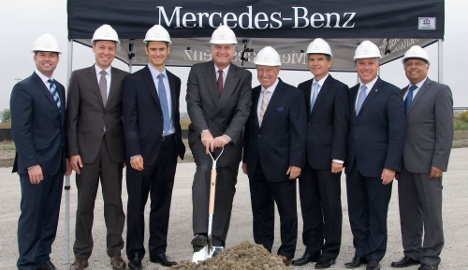
Company executives and the dealership’s new management recently turned over the first shovelful of soil of the future Brampton-based facility.
Mercedes-Benz Brampton will be run by Sam Eltes and Jonathan Eltes, dealer principles, as well as Gary Williams, the store’s general manager.
"Sam Eltes is a long-time trusted partner of Mercedes-Benz Canada and it is our pleasure to welcome him and his team to the Greater Toronto Area. They bring a great deal of experience and knowledge which will make the start up process smoother and more fluid for the benefit of their new customers," said Tim Reuss, president and chief executive officer of Mercedes-Benz Canada. "This new facility will also provide another convenient point of sales and service in the GTA to effectively serve the needs of existing and future customers in this important growing market."
During the groundbreaking ceremony, the group was also joined by Rob Girouard, general manager of Silver Star Mercedes-Benz, located in Montreal.
Mercedes-Benz Brampton will be the second Mercedes-Benz banner for the Silver Star organization.
Construction of the new facility began in August on a six-acre site located on the southeast corner of Mayfield Road at Highway 410.
And this will be a quick turnaround, as the facility is scheduled to be fully operational by May 2015.
The store is set to be 60,000 square-feet and will house the Mercedes-Benz, AMG and smart brands.
A service area that will feature 29 work bays will take up 30,000 square-feet.
AutoCanada continued to ramp up its expansion efforts with the announcement that is has obtained approval from General Motors Canada to invest in Edmonton dealership Lakewood Chevrolet.
The dealer group reported it will be purchasing a 75 percent non-voting equity interest in the shared of the dealership. The acquisition is expected to close Tuesday.
Pat Priestner, chairman and chief executive officer of AutoCanada said, "Lakewood Chevrolet is a really well known dealership in Edmonton and has an excellent management team, with whom we are pleased to continue to operate the dealership on a go forward basis.”
The dealership was founded by Pat Healey, and is currently operated by Healthy and Kerry Russell.
Russell will continue to operate the dealership as general manager and will retain an interest in the store.
Priestner will be names dealer operator, personally holding a 15-percent equity interest voting control of the dealership.
AutoCanada is also purchasing the dealership land a facility, which is approximately 37,000 square feet and situated on a seven-acre parcel of land.
The dealership facility includes a nine new-vehicle showroom and a four used-vehicle showroom, 24 service bays and eight body shop bays.
This announcement comes right after AutoCanada opened Kia Edmonton North, a new dealership location in Edmonton, as well.
This is AutoCanada’s first Kia store, a previously announced open-point dealership that was awarded to the dealer group.
Priestner said, "We are very pleased to open KIA Edmonton North, our first KIA dealership, and we look forward to building upon our relationship with this important and growing brand by providing an excellent customer experience in a key retail automotive market in Canada."
The company announced earlier this month the addition of Tower Chrysler in Calgary.
Priestner was thankful to the Rewucki family, who founded Tower Chrysler over 40 years ago, for allowing AutoCanada to absorb the dealer into its group while maintaining Tower Chrysler’s reputation in the thriving area.
“Calgary is absolutely one of the best cities in Canada for automotive retail,” Priestner said, “and we hope to continue to expand upon our current eight-dealership platform in this city.”
And expand it has. AutoCanada has opened or acquired over 12 dealerships so far this year, a trend that Priestner believes will continue.
The momentum on the acquisition front continues to develop for Canada’s largest publicly traded dealer group.
AutoCanada just announced across-the-board financial growth in its second-quarter conference call last week, and it has already added to the mountain of acquisitions made in the first half of the year with this week’s addition of Tower Chrysler in Calgary.
Pat Priestner, the group’s chairman and chief executive officer, was thankful to the Rewucki family, who founded Tower Chrysler over forty years ago, for allowing AutoCanada to absorb the dealer into its group while maintaining Tower Chrysler’s reputation in the thriving area.
“Calgary is absolutely one of the best cities in Canada for automotive retail,” Priestner said, “and we hope to continue to expand upon our current eight-dealership platform in this city.”
And expand it has. AutoCanada has opened or acquired 12 dealerships so far this year, a trend that Priestner believes will continue.
“I think for the pipeline over the next two to three years, I really feel strongly, we know a lot of dealers in the country, and there are a lot of good dealers and good people, and I think more and more are looking at selling, including dealer groups,” Priestner said.
Even though the group has been focusing a lot on growth, the company’s CEO wanted to emphasize that they’re putting the value of quality before quantity.
“When you do potentially 15 acquisitions in a year, instead of two, four or six, or whatever, it probably takes us a few months longer to get the processes,” Priestner said. “And one of the things that we really look at at AutoCanada is it’s a retail business, and we think culture is a really big part of our business. And we’ve got so many great dealers with us and our head office people. We’ve got virtually no turnovers. We’re a little bit slower to hire; we don’t just run out and hire a lot of people.”
It’s that exact focus on company culture and taking the time to make sure things are done correctly that makes Tom Orysiuk, AutoCanada’s president, confident with their business decisions focusing on expansion.
“Virtually every acquisition I’m really, really happy with,” Orysiuk said. “I’m not overly fussed with any integration issues. I’d always like to see things go faster, and I try to temper my expectations a little bit better, but we’re making really good progress and processes put into place.”
And in the position where dealerships can be purchased in the $150,000 to $200,000 range, Priestner loves the opportunity to make short-term financial risks for the potential reward of long-term prosperity.
“I would trade those extra costs, if we can ever have quarters where we can do this many acquisitions, I’d be thrilled to have those costs in a short-term period like we had this one,” Priestner said.
When asked about the impact OEM recalls have had on the group’s business, which are pushing many to the limit in the U.S., the company’s president answered with a slight chuckle.
“From my viewpoint, it’s kind of funny, there seems to be a difference between the Canadian and the U.S. market,” Orysiuk said. “In the Canadian market there’s very little emphasis by the consumers on the recalls. Frankly, we haven’t seen a lot of activity. When there’s a problem, we deal with it. We work with our all our OEM problems and deal with them and make the customer happy and then move along. It really hasn’t impacted our business.”
For more information on the leading dealer groups in Canada, check out the most recent digital edition of Auto Remarketing Canada Digital Magazine.
AutoCanada announced its second-quarter results late last week, showcasing a same-store used-vehicle retail revenue increase of 9.9 percent. The group also made their largest acquisition to date by acquiring the Hyatt Group of Dealerships in Calgary while also adding their first BMW and Mini dealerships by securing BMW Canbec and Mini Mont Royal.
AutoCanada was featured recently in Auto Remarketing Canada Digital Magazine's Leading Dealer Group issue.
Pat Priestner, the chairman and chief executive officers of AutoCanada, noted the importance of growing the group’s dealer base.
“Our experience over the past 18 months has made it clear to us that dealership succession has become a key issue in the Canadian automotive retail market, and, as a result, the company increased its acquisition guidance in June of 2014,” Priestner said. “As the deal pipeline remains strong, management maintains this guidance and is confident that, in addition to acquisitions completed to date, it shall add an additional 8 to 10 dealerships by May 31, 2015.”
Same store wholesale of used vehicles in the second quarter increased 41.5 percent year-over-year, jumping from 17,584 units in 2013 to 24,875 this year. Combined with the 9.9 percent jump in retail sales, AutoCanada’s total same store Q2 used sales grew by 17.6% compared to last year.
Same store gross profit from used vehicle wholesale also increased by 33.6 percent in Q2 year-over-year despite 5.9 percent drop in same store gross profit for used vehicle retail sales.
The company overall generated $12.8 million in net earnings, or $0.588 per share, compared to $0.532 in Q2 of 2013. Existing and new dealership gross profit increased 20.4 percent, jumping from $64.9 million in 2013 to $78 million this year.
To get a bit more insight into what makes a Groupe Park Avenue dealership tick, Auto Remarketing Canada chatted with David Webber, vice president and general manager of Park Avenue Audi in Brossard, Quebec. This interview was part of the Auto Remarketing Canada Digital Magazine Leading Dealer Group Issue, which is set to be released soon.
Webber says the Montreal-area dealership touts an impressive reputation based on the Audi nameplate as well as the Groupe Park Avenue title.
Webber talks on staff training, showrooms, digital marketing and more.
ARC: Give me a little history of the dealership. Can you tell us a bit about your location and demographics?
David Webber: We have been an Audi dealer since 1990. We are in the suburbs of Montreal, and we are on the south side of that river — the South Shore of Montreal, and there are about 750,000 people there.
Mostly French-speaking; we are in a nice neighborhood — we draw a lot from the island of Montreal but drive a lot of sales from our specific market, which is the South Shore.
ARC: Give me an overview of your customer service strategy. Are there any specific areas you all try to focus on?
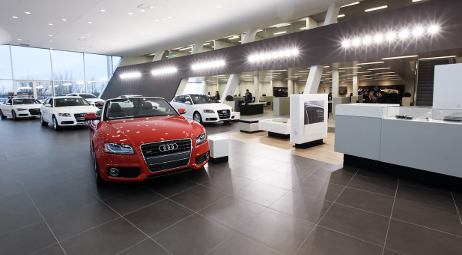
DW: We built this big Audi terminal that opened at the end of 2011, and the building is very impressive and potentially imposing to our customers. One thing that the departments try to collectively do is make the customer feel comfortable. From the minute they walk in, the receptionists ask to take their coat and try to make them feel at home and not overwhelmed by the high-end luxury car facility.
We focus very much on the tools that Audi give us, such as its CSI program.
ARC: Can you provide an overview of your digital marketing strategy? Has social media, website optimization, SEO/SEM, and more, helped push sales and improve customer relationships?
DW: We focus heavily on SEM and SEO, and we have a Web development team in-house. They are constantly looking to post on Facebook, not just about cars, but also about interesting things that are going on at the dealership. It gets people’s attention. Our Web strategy is at the heart of our communications standards.
We have launched a new website in all of the Groupe Park Avenue dealerships that is focused on getting customers to make contact with us. We make it easy for them to find our inventories, and we make it easy for them to make appointments. We are adding blogs to our website, and work on retargeting and search engine optimization. We still do traditional marketing, because I feel we still need to those traditional ad campaigns, but much of those serve to drive traffic to our website.
ARC: Tell me a bit about your staff training strategy and how this is crucial to dealership success.
DW: Audi has a very extensive Audi certification program through which every year each employee has to go through sales training and brand training. And then Normand Hebert, the president and CEO of Groupe Park Avenue, does an orientation session practically on a quarterly basis with new hires, so they really get a feel for the DNA of the company.
Another area we are fortunate in this respect is Audi is a really strong brand right now, and we do attract accomplished successful salespeople with a strong reputation in the industry more often than not, so in-house training is very tailored to the new hires.
We do pretty good follow-up with our employees and put them on a track for expectations. We evaluate six weeks down the road after hire, and so on. I meet weekly with my sales managers, and we go over the status of reps and new hires.
ARC: Tell me a bit about the connection to the Groupe Park Avenue dealer group and the benefits of being part of the dealership group.
DW: Reputation, above all. It’s good for attracting employees, and it’s good for attracting customers. Naturally, when you have a group with centralized accounting and expenses, you get economies of scale that help us operate more efficiently. At the end of the day, this leads to added value for our customers.
Going back to our employees, we actually have a retirement plan, which is not often heard of in Canadian dealerships. Another thing that adds values is our business development center that calls all our customers, and this really helps us fill our service centers, especially in periods when it isn’t as busy. There are a lot of upsides.
ARC: On average, how many pre-owned vehicles does your dealership sell per month? What are some of the tools you use to ensure used-sales success?
DW: We do about 30 used cars a month retail, and 20 to 25 wholesale. We are noticing with being more efficient we are increasing grosses over 2013 so far in 2014, and that’s because we use a lot of new tools.
We use just about every used car tool available — vAuto and online dealer-to-dealer auctions like TradeRev, that help us get inventory and get rid of inventory on a timely basis, as well. vAuto really helps us analyze the purchases and state of the inventory.
Since we have been using these tools, we turn our inventory much more frequently. I think our turn rate right now is 13 to 14 turns a year, which means very few cars over 30 days in stock, so we really try to stay on top of it. When you turn your inventory, you are generally making more money with a smaller investment. We don’t need to keep $1 million worth of inventory, we can keep much less and turn it more frequently and make more gross profit on less of an investment. That is really starting to pay off.
ARC: Used inventory has been tight lately. Where do you find is the best outlet to secure quality, pre-owned inventory? Have you all used any alternative sourcing methods?
One of the tools that we use is Auto Alert, which helps you choose cars in your vehicle fleet, either in service, sales, or leasing, and get a feel for when they are ripe to be traded in. Then, we offer customers to get a new vehicle, and we get our hands on their trade-ins.
We mine our service customers, for sure, as well. The service experience is crucial, because the service experience is what drives that customer loyalty. So we focus on CSI, and we focus on our customer handling in the workshop. We have a drive-through with two full time greeters that direct the customers and do whatever it takes to improve the customer service experience.
DW: Do you sell CPO vehicles? Please tell us a little bit about this program and how you convey the value of certified vehicles to your customers.
Yes, we do sell CPO. Audi Certified Pre-Owned is very comprehensive; it’s a 300-point inspection. It’s expensive, usually, and it adds quite a bit to our reconditioning costs since it is very strict. However, it gives customers peace-of-mind, and attached to the CPO program is a preferred interest rate that goes along with the warranty to soften the blow on the price for shoppers.
ARC: How do you convey the value of Audi certification to your customers?
There is a whole presentation kit available from the manufacturer that we use when showing our CPO cars. If we have any cars that we don’t certify, due to mileage being too high, or maybe a car that is traded in that is off-make and maybe doesn’t qualify for the CPO program, we explain the difference. It’s actually a pretty easy way to ensure customers are confident in a vehicle.
If a car can be certified, we certify it. We don’t up-sell the certification — if we have faith in the certification process, we let people know right up front. Usually they stop looking at non-certified Audis once we do that presentation.
Groupe Park Avenue announced this week it has decided to follow the industry trend and conduct business on Saturdays. The family owned dealer group, who is included in the upcoming Auto Remarketing Canada Digital Magazine’s Leading Dealer Groups in Canada issue, will begin offering its Saturday services on September 6.
Norman Hebert, Groupe Park Avenue’s president and chief executive officer, announced the news to his personnel last week and showed regret when facing the reality of needing to be open on the weekend.
“To respect our sales team, we never favoured the option to be open on weekends,” Hébert said in his announcement, “but now that the trend has grown amongst the competition, we have no other choice but to jump into the mix in order to protect our market share.”
Despite having to work Saturdays, the dealer group has augmented the employees’ work schedule, still allowing the group of 650 to have two days off per week and limiting Saturday hours to 10 a.m. – 4 p.m., while closing at 6 p.m. on Fridays.
In the upcoming issue of Auto Remarketing Canada Digital Magazine — set to be released this coming Tuesday — we showcase some of the country’s oldest, biggest and most influential dealer groups.
One of these leaders in the industry is Groupe Park Avenue, who touts 18 franchises in Montreal and Vancouver.
But they aren’t done expanding yet.
In fact, Normand Hebert, president and chief executive officer of the dealer group, told Auto Remarketing Canada the company is preparing for “its next phase of growth.”
Since the family-owned business opened its first store in 1959 — a General Motors dealership on Park Avenue in downtown Montreal — the dealer group has evolved into a group of import franchises that sell over 13,000 used and new cars per year.
Hebert explained though the company has had a few acquisitions over the past few years, most of their growth has been through open-point deals.
“The next phase of our growth is through acquisitions, and we hope to grow by five to eight stores in the next five years, generally in the Quebec marketplace,” Hebert said.
As the company has grown in size in Montreal and diversified its import product portfolio, Herbert shared the dealer group’s centralized location wasn’t an accident.
“Having many stores in one location allows our customers to grow with us as their automotive needs change and evolve,” he said.
The company is preparing for its next phase of growth, and Hebert said, “We already have an infrastructure in place for shared services for our new stores, be it HR, IT, Web and some marketing — so we are ready for this next step.”
When asked whether or not the dealer group would consider adding new brands to its lineup, Hebert said it was a definite possibility, though they want to grow their current franchise store count, as well.
“There are some gaps in our product portfolio, so there are opportunities if they come our way, and we would like to fill in those gaps,” Hebert said. “But, obviously we would like to add to the brands we already have, as well.”
Sales Soar Above Market Average
And it seems the dealer group is well positioned for growth, as Herbert pointed out they are well-above market averages when it comes to sales.
“We are very excited about our year in a market that is down about 4 percent in Quebec. Our retail sales at the end of May were up 12 percent, and in June, our showroom rides have been up over 40 percent. We will see how that shakes out in terms of delivery,” Herbert said. “We will probably finish the month of July with retail sales north of 15 percent in a market that’s down 4 percent. We are very pleased with our performance.”
While new-car sales are up close to 15 percent compared to 2013 rates, used sales for the dealer group are soaring, as well.
When Auto Remarketing Canada chatted with company management in late June, Groupe Park Avenue expected to close out the month with used sales up by 10 percent.
Editor’s Note: See the upcoming Leader Dealer Groups of Canada issue of Auto Remarketing Canada Digital Magazine. The issue is set to be released this Friday and will offer insight, best practices and more from the nation’s top dealers.
Ens Lexus has moved to a larger location in Saskatoon Auto Mall — and is also working toward becoming the first Saskatchewan dealership to achieve Leadership in Energy and Environmental Design (LEED) recognition for its new facility.
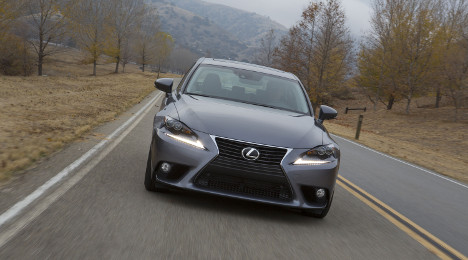
The dealership traded out its old 5,000-square-foot location for a new $8-million, 22,000-square-foot facility.
“For the past 24 years, Ens Lexus has played a very important role for Lexus in Canada,” said Cyril Dimitris, director, Lexus Canada. “The dealership’s contribution will now become even greater with the team moving into this spectacular new facility.”
And the dealership paid careful attention to energy efficiency while constructing the new facility. Ens Lexus is currently pursuing Silver Certification in the Leadership in Energy and Environmental Design Green Building rating system.
If granted the certification, Ens Lexus will become the first dealership in Saskatchewan to achieve an official LEED Green Building title “based on its energy-efficient design and extensive use of recycled materials,” according to Lexus Canada.
“We are extremely proud to open this exciting new building, which will not only be recognized for its environmental sustainability, but also set the standard in putting the customer first with its open and inviting design,” said Joshua Ens, dealer principal. “With this expansion, Lexus guests can anticipate an exceptional experience every time they visit us.”
The dealership staff is also ramping up service for customers. The new store will feature a Lexus limousine service as well as a seasonal tire storage service.
Saturday hours have been extended, as well.
Pfaff Automotive Partners is bringing a new brand to Canada.
The dealer group announced today it is the exclusive Canadian importer and dealer of the Italian sport brand Pagani.
The exotic brand, Pagani Automobili S.p.A., got its start in 1992 by Argentinian, Horacio Pagani and is based in Italy.
"We are proud to bring this exotic automotive brand to Canada, with its reputation for leadership in technology and design," said Christopher Pfaff, president and chief executive officer of Pfaff Automotive Partners. "Aligning the Pfaff brand to Pagani is an absolute honour and we are excited to introduce their latest supercar, the Huayra, to the Canadian market."
Pfaff explained in partnering with the exotic car brand, the dealer group is looking to satisfy what they see as the growing supercar market in Canada.
Pfaff will serve Pagani clients from its dealership in Woodbridge, Pfaff Porsche.
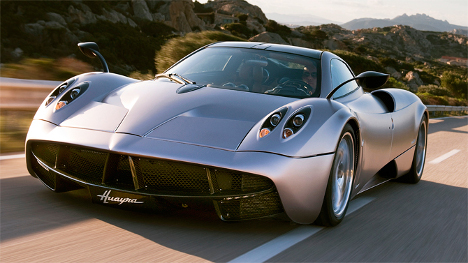
Each Pagani vehicle are completely custom made. The company’s flagship model the Huayra is made of more than 4,000 components and touts a Mercedes-AMG M158 V12 twin-Turbo engine.
The Huayra was launched as a complete redesign of Pagani’s first model, the Zonda, which took seven years for the company to complete.
"To create (the pieces) and put them together requires creativity, patience and passion that I share with a fantastic young team and with the most competent partners in all sectors," said Horacio Pagani, founder of Pagani. "The team was able to work on many projects at the same time, driving on different tracks that occasionally came to meet by sharing engineering concepts, materials, safety and scientific or design studies."